
Little Rock Look Back: First Hall High Graduation in 1958

Another historic high school graduation took place on May 28, 1958.  It was the first graduation ceremony for Little Rock Hall High School.

The school opened in September 1957 as Little Rock’s newest high school, located in “west” Little Rock.  (It is sometimes listed as the second Little Rock high school, ignoring the fact that Horace Mann high school existed.)

The first graduating class was smaller than future classes would be.  Because they had attended Central High School for their sophomore and junior years, many seniors who were zoned for Hall High chose to attend Central for their senior year.

Instead of processing in to Elgar’s “Pomp and Circumstance,” the Hall High seniors entered to Rimsky-Korsakov’s “Procession of the Nobles.”  The music for ceremony also included “The Star Spangled Banner,” Scarmolin’s “My Creed” and Handel’s “Sarabande and Bouree.”
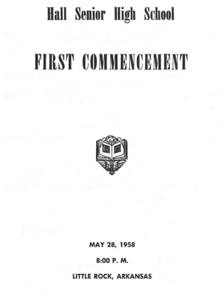
Principal Terrell E. Powell (who would be tapped as superintendent of the district in a few months) presided over the ceremonies.  Superintendent Virgil Blossom (whose daughter had graduated from Central High the day before) spoke briefly to introduce the School Board members.  One of them, R. A. Lile, presented the students with their diplomas.

There were 109 seniors listed in the graduation program, seven were honor graduates.  The senior class officers were: Redding Stevenson, president; Amanda Jeanne “Toppy” Cameron, vice president; and Karl E. Stahlkopf, secretary. Porter Briggs was the first student body president. Linda Overstreet was student body vice president and Linda Neathery was 12th grade representative on the student council.

The Senior speakers were:  Anita Kluglose (“Toward a Pathless Wood”), Karl Stahlkopf (“Toward the Mysterious Stars”), Linda Neathery (“Toward Majestic Mountains”) and Thomas York (“Toward Unlimited Horizons”).  Other students participating were Redding Stevenson presenting the senior gift, Mary Ellen Lenggenhager giving the invocation, and Michael Ebert giving the benediction.
Little Rock Look Back: Ernest Green graduation from LR Central High

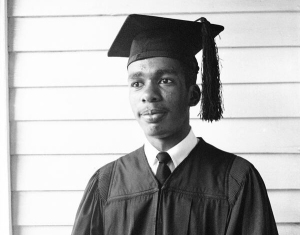
Last week, the Class of 2018 graduated from Little Rock Central High School.  Perhaps the most famous graduation ceremony in the long-storied history of Little Rock Central High took place on May 27, 1958.  It was on that date that Ernest Green became the first African American to graduate from the formerly all-white school.

Among those in the audience to witness this historic event was an up and coming minister named Dr. Martin Luther King, Jr.  A friend of L. C. and Daisy Bates, he attended the 1958 Central High School graduation to witness Green receiving a diploma. Each senior only received eight tickets to the ceremony at Quigley Stadium.   Dr. King was in the state to address the Arkansas AM&N (now UAPB) graduation.  Because he was going to be nearby, Dr. King wanted to witness the history.  Green did not know that Dr. King was in the stands until after the conclusion of the ceremony.  Later that evening, Dr. King gave Green a graduation present of $15.

Ernest Green, Dr. King and Daisy Bates share a relaxed moment — which was probably rare for the three in 1958

Because of fears about the event becoming a media circus, the Little Rock School District limited the press on the field to one Democrat and one Gazette photographer. Other press were limited to the press box normally filled with sportswriters covering the gridiron exploits of the champion Tigers.  There were photos taken of Green prior to the ceremony as well as during the ceremony.

During the graduation rehearsal, there had been concerns that some students or other people might try to disrupt the practice.  But it went off without a hitch.  Likewise, the ceremony itself went smoothly.  Local press reported that some members of the class briefly chatted with Green during the ceremony.  That the event took place without incident was a relief on many levels to City leaders.  Also in the class of 1958 were a son of Little Rock Mayor Woodrow Mann and a daughter of LRSD Superintendent Virgil Blossom.

Little Rock Look Back: 27 students attempt to integrate LR schools in 1956

Arkansas Democrat photo by staff photographer Mr. Bisgood.

On Monday, January 23, 1956, twenty-seven African American students attempted to integrate four Little Rock schools.  By the end of the day, all four school principals had refused entry and some of the students had met with LRSD Superintendent Virgil Blossom.

Eight girls who were students at Horace Mann High School arrived at Central High at 9:30 am accompanied by Daisy Bates and Frank W. Smith both of the NAACP.  One male student attempted to integrate Little Rock Technical High School.  Four students arrived at Forest Heights Junior High (accompanied by three adults) and fourteen students attempted to integrate Forest Park Elementary (accompanied by four adults).  Neither the Arkansas Gazette nor the Arkansas Democrat broke down the age or gender of the junior high and elementary students.

Though all were referred to meet with Mr. Blossom, only the young women from Horace Mann visited with him.  After the conversation both he and Mrs. Bates declared the conversation had been friendly.   Mr. Blossom, in denying the request, noted that the Little Rock School District had a plan for integration. To allow them to integrate immediately would have been going against the plan.  The integration plan was connected to the completion of the new high school.  If it were ready to open in the fall of 1957, then integration at the high schools would start then.  The newspapers noted that there was no timeline for when it would extend down to the junior high and elementary levels.

That evening, Rev. J. C. Crenchaw, the president of the Little Rock NAACP, issued a statement.  In it he expressed frustration that the LRSD was vague on its timeline for integration.  He noted that the students lived near the schools which they tried to integrate and were therefore forced to travel several extra miles each day to attend school.  He also commented that the young man who attempted to enroll at Tech was not afforded the training available there at his current school.

The Arkansas Democrat ran a photo of the meeting with Mr. Blossom.  It identified the seven students who were pictured.  No mention was made as to whether the eighth student was present but not photographed, or if she did not attend the meeting.  As was the practice at the time, the addresses of the students were listed by their names.  Based on those addresses, the students lived between 0.4 and 0.9 miles from Central High School and were between 2.1 and 3.2 miles away from Horace Mann High School.  Of the seven students in the photo, two were seniors, three were juniors, and three were sophomores.  None of the students named became part of the Little Rock Nine who did integrate Central High twenty-one months later.

On January 24, the Gazette editorial writer opined they were glad for the amicable nature of the conversations. They hoped it did not affect the good race relations in Little Rock.  The writer concluded by saying they did not want it to incite extremists (but did not specify if they viewed the extremists as being for or against integration.)

Little Rock Look Back: Ernest Green graduates from Little Rock Central High

Perhaps the most famous graduation ceremony in the long-storied history of Little Rock Central High took place on May 27, 1958.  It was on that date that Ernest Green became the first African American to graduate from the formerly all-white school.

Among those in the audience to witness this historic event was an up and coming minister named Dr. Martin Luther King, Jr.  A friend of L. C. and Daisy Bates, he attended the 1958 Central High School graduation to witness Green receiving a diploma. Each senior only received eight tickets to the ceremony at Quigley Stadium.   Dr. King was in the state to address the Arkansas AM&N (now UAPB) graduation.  Because he was going to be nearby, Dr. King wanted to witness the history.  Green did not know that Dr. King was in the stands until after the conclusion of the ceremony.  Later that evening, Dr. King gave Green a graduation present of $15.

Because of fears about the event becoming a media circus, the Little Rock School District limited the press on the field to one Democrat and one Gazette photographer. Other press were limited to the press box normally filled with sportswriters covering the gridiron exploits of the champion Tigers.  There were photos taken of Green prior to the ceremony as well as during the ceremony.

During the graduation rehearsal, there had been concerns that some students or other people might try to disrupt the practice.  But it went off without a hitch.  Likewise, the ceremony itself went smoothly.  Local press reported that some members of the class briefly chatted with Green during the ceremony.  That the event took place without incident was a relief on many levels to City leaders.  Also in the class of 1958 were a son of Little Rock Mayor Woodrow Mann and a daughter of LRSD Superintendent Virgil Blossom.

Black History Month Spotlight – Mt Zion Baptist Church

Mount Zion Baptist Church, Little Rock, AR.JPGThe new Arkansas Civil Rights History Audio Tour was launched in November 2015. Produced by the City of Little Rock and the University of Arkansas at Little Rock allows the many places and stories of the City’s Civil Rights history to come to life an interactive tour.  This month, during Black History Month, the Culture Vulture looks at some of the stops on this tour which focus on African American history.

Mt. Zion Baptist Church was organized in 1877 and is one of the earliest black congregations in Little Rock. The church was rebuilt in its current location in 1927 under the leadership of Rev. Fred T. Guy. From the late 1800s to the present, local church leaders, their congregants, grassroots groups, civic organizations, fraternal societies, and black business owners fought for equal rights.

A warrior in the community and tireless human rights advocate, Rev. Fred T. Guy, Mr. Zion’s pastor, challenged Superintendent of Schools Virgil Blossom and the Little Rock School Board to desegregate schools in 1957. “Next to the law of God, the Constitution of the United States means the most to me. When you start to tinker with the Constitution, it becomes awfully important to us,” said Rev. Guy.

The app, funded by a generous grant from the Arkansas Humanities Council, was a collaboration among UALR’s Institute on Race and Ethnicity, the City of Little Rock, the Mayor’s Tourism Commission, and KUAR, UALR’s public radio station, with assistance from the Little Rock Convention and Visitors Bureau