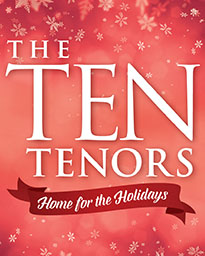
RobinsoNovember: The Ten Tenors in concert tonight

ten-tenors-rcmhTonight is the first vocal event at the new Robinson Center.  And what better way to test the new acoustics than the vocal stylings of ten tenors?

Home for the Holidays is a magical experience for the whole family that will dazzle, delight and captivate audiences. Join Australia’s rockstars of the opera as they amaze and enthrall with their unique selection of traditional and contemporary seasonal favorites. With soaring versions of Joy to the World, Sleigh Ride, White Christmas, Amazing Grace, Winter Wonderland, Feliz Navidad and many more, Home for the Holidays is the perfect way to celebrate the spirit of the season.

The TEN Tenors are undoubtedly one of Australia’s most successful touring entertainment groups of all time, with more than 90 million people worldwide witnessing their unmistakable charm, camaraderie and vocal power.  Following 17 years of sell-out performances across the globe, including more than 2000 of their own headline concerts, THE TEN TENORS have cemented their place as one of the world’s most loved classically based contemporary music groups.

Tickets are available at Celebrity Attractions’ website.

RobinsoNovember: James Rice and Jim Rice

J Rice 1920On June 7, 1920, the Little Rock City Council finally authorized the demolition of Little Rock’s 1906 temporary auditorium.  The structure had originally been built as a skating rink which, when chairs were added, could be used for public meetings.  Since the mid 1910’s, the City Council had discussed tearing it down over safety concerns.  But since Little Rock had no other structure as a substitute, the Council kept delaying the decision.
In 1920, though there was not alternative space available, the Council decided that the structure had to come down.  So City Engineer James H. Rice was authorized to have the building removed.

JimRice RobinsonToday, Rice’s grandson, also known as Jim Rice is the COO of the Little Rock Convention & Visitors Bureau.  In that capacity he oversaw the renovation of Little Rock’s 1940 municipal auditorium – Robinson Center Music Hall.

While his grandfather was efficient at demolishing a worn out building that was beyond repair, Jim deftly helped make sure that the existing city auditorium was refitted and restructured so that it would no longer be worn out.

RobinsoNovember: Ben Piazza

benpiazza book coverAnother of the spaces in Robinson Center is named in memory of actor-director-playwright-author Ben Piazza.  He was born on July 30, 1933, in Little Rock, and graduated from Little Rock High School in 1951 as valedictorian. He also had starred in the senior play that year (The Man Who Came to Dinner) and edited the literary magazine.
After graduating from Princeton, he moved to New York City to become an actor.  He made his Broadway debut in 1958 in Winesburg, Ohio.  In April 1959, he starred in Kataki and received a Theatre World Award for his performance.

As the 1960s dawned, Piazza joined a small cadre of actors who had achieved status on Broadway who then also returned to acting Off Broadway.  Colleen Dewhurst, George C. Scott, and James Earl Jones were others in this select group who helped establish Off Broadway as an entity in itself, instead of being just a farm team for Broadway.

In February 1963, he took over the role of Nick in the original run of Who’s Afraid of Virginia Woolf? on Broadway.  During the run of this show, Piazza’s novel The Exact and Very Strange Truth was published.  It is a fictionalized account of his growing up in Little Rock during the 1930s and 1940s.  The book is filled with references to Centennial Elementary, Westside Junior High, Central High School, Immanuel Baptist Church and various stores and shops in Little Rock during that era.

In August of 1967, his play The Sunday Agreement premiered at LaMaMa.  This was Piazza’s first playwright output to be professionally staged.  In March 1969, a double bill of his one-acts: Lime Green/Khaki Blue opened at the Provincetown Playhouse.  It

Throughout the 1960s and early 1970s, Piazza toured in many plays nationally and internationally. He also appeared in major regional theatres as an actor and a director.  As the 1970s progressed, he turned his focus to television and movies.

Piazza’s film debut had been in a 1959 Canadian film called The Dangerous Age. That same year, his Hollywood film debut came opposite Gary Cooper in The Hanging Tree.  Throughout the 1950s and 1960s, he appeared in a number of TV shows including Studio One, Kraft Theatre, Zane Grey Theatre, The Naked City and Dick Powell Theatre.

In the 1970s and 1980s, his appearances included I Never Promised You a Rose Garden, The Bad News Bears, The Blues Brothers, and Mask.  On TV, he appeared in Dallas, Dynasty, Saint Elsewhere, Barnaby Miller, Moonlighting and Family Ties. 

Piazza’s final big screen appearance was in the 1991 film Guilty by Suspicion.  He played studio head Darryl Zanuck in this Robert DeNiro-Annette Bening tale of Hollywood during the Red scare.

Ben Piazza died on September 7, 1991.

1969 Turkey Day Football in LR: Hogs, Tigers, Warriors, Rockets, and Bearcats

The Hogs stop Texas Tech at War Memorial Stadium

The Hogs stop Texas Tech at War Memorial Stadium


Thanksgiving 1969 marked not only the Culture Vulture’s first foray into the holiday, it saw three high schools and the University of Arkansas all playing football games in Central Arkansas.  November 27 was a day for football in the Rock!  It appears this was the only time this feat happened.

It was a cool and misty day which seems to have made balls slippery and grass fields sloppy. But the precipitation seemed to be more an annoyance than a barrier for the players and fans.  

The Arkansas Razorbacks, ranked number 2 in the nation, played host to the Texas Tech Red Raiders at War Memorial Stadium.  The two teams played before a crowd of 35,287.  This was the smallest crowd in LR that season, likely due to it being Thanksgiving and the presence of the Central/Hall football game the same day.  It would have been hard to fit in two football games, Thanksgiving meals, and a possible church service all within one day.  

The Hogs were 16 point favorites for the game with a 1:50 kickoff.  It was broadcast on ABC, and fans were encouraged to wear red to show up well on the color telecast.  

The Hogs beat the Red Raiders by a score of 33 to 0 in their penultimate regular season game.  Turnovers were the key with the Hogs recovering a fumble and intercepting five passes.  (The final Hogs regular season game was the shootout against Texas in Fayetteville on December 6.)

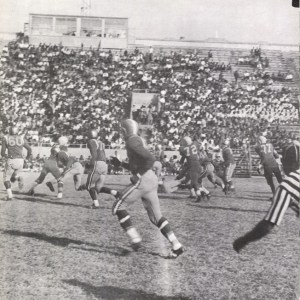
Little Rock Catholic took on NLRHS north of the river with a 10am kick off. The Rockets, under head coach George Loss, were 9-2 heading into the game. The Wildcats (coached by Ken Stephens) were 5-4 and had won four in a row. At the end of the game, NLR was triumphant by a score of 21 to 12.  

Later that day, Jones High hosted Horace Mann at the same stadium. This game, with a 2pm kickoff, would be the final game between Jones and Mann. Jones was being closed at the end of the year.  
The teams had met earlier in the season with Mann triumphing 13 to 8. Mann had a record of 2-8, playing in the larger AAAA classification. Jones, with a record of 4-6, played in the AA classification. It is notable that by 1969 the teams were in Arkansas Activities Association classifications and playing integrated schools.  

Jones scored an upset victory over the Bearcats by a score of 19-8. 

Quigley Stadium was less than three miles from War Memorial Stadium. With a 10am kickoff before a sold out crowd, people who had wanted to go to both the Hogs game and Hall/Central game also had the option of listening to the high school gridiron competition on KARK radio. 
Prior to the game, Hall had captured the AAAA State Championship. CW Keopple was the Warriors’ coach, while Gene Hall was the Tigers’ mentor.  The damp field and high stakes of the game turned it into a defensive slugfest.  Hall had 2 fumbles while Central fumbled four times.  

At the end of the fourth quarter the scoreboard showed a 0 to 0 tie. And that one went into the record books.  Hall’s season record was 9-0-1, while Central’s was 6-2-2.  It was the best season record Hall had amassed in its 13 years of football. 

Four football games within a few miles of each other were a peek into Little Rock life: 

  • The Hogs were riding the crest of their 1960s football superiority in the Southwest Conference.  
  • The final Thanksgiving football game in Arkansas between two segregated public schools. 
  • Continued alternating dominance by Hall and Central in the state’s largest school sports classification.  Soon, Parkview would be added to the mix. Throughout the 1970s, all three Little Rock public high schools would rotate winning state championships. 

Turkey Day Football – Central vs. Hall from 1958 to 1982

hall-central-1966For many years Little Rock dominated the state in football. First as Little Rock High School, then as Little Rock Central, the City’s oldest high school won over 20 state championships from the 1910s through the 1950s. With the emergence of Little Rock Hall, the 1960s were dominated by the City’s newer high school.  Together these schools led the state in football for over 60 years.

While the 1970s and 1980s saw less consistency in the quality of gridiron prowess at Little Rock’s two oldest public high schools, it did not matter.  A Hall vs. Central Turkey Day football game was often like a football season unto to itself.  The previous weeks of the football season did not matter – all that mattered was the Warriors against the Tigers.

The games were always played at Quigley Stadium, which was at the time the home stadium for all three of the Little Rock School District’s high schools (the third high school Parkview opened in 1968).  Each year Central and Hall would alternate which was the “Home” team.

The week leading to the game would feature skits and pep rallies at both high schools.  Pranks, rumors of pranks, and threats of retribution would abound between the schools.  Cars wrapped in orange and white would circle the Central campus one day, while black and gold cars would encircle Hall’s campus another day.

On game day there would be special performances at the stadium by the drill teams, cheerleaders and bands of both schools.  The Tiger and Warrior mascots would taunt each other.  Friendships between students at the rival schools were put on hold.  It was all about the tradition and THE GAME.  Church services, family dinners and any other activities were scheduled around the festivities at Quigley.

Hall High opened its doors and started playing football in 1957. As a new school with a largely younger student body, it only played smaller schools that initial season.  The first Hall vs. Central game was set for Thanksgiving 1958.

During the 1958-1959 school year, Little Rock’s high schools were closed for the ill-conceived, ill-advised reason to keep them from being integrated schools.  Though classes were not in session, football teams practiced and played.  The Arkansas Gazette noted that most of those games that season drew only 1,000 spectators, which was down from the usual 5,000 to 8,000 a game.

With the future of Little Rock’s high schools in doubt, there was some hand wringing about whether the 1958 game would be not only the first meeting between Hall and Central, but perhaps also the last.  In only its second year of playing, Hall was undefeated and poised to win the state championship heading into the Thanksgiving game.  Central surprised the Warriors by winning 7-0 before a crowd of 5,000, which cost Hall the undefeated season and the championship (El Dorado became state champs).  This game set the tone for the high stakes of the rest of the series.

The next year classes were back in session at Hall and Central. The future of the series was not in doubt. Hall achieved its first win with a 16-13 victory over the Tigers. Hall also captured a state championship with the win.

Over the years, the Thanksgiving Day game would deliver state championships to Central in 1960, 1975, 1978, 1980 and 1981.  Hall walked away on Thanksgiving Day with championships in 1964, 1966, 1969, 1977, and 1979.  On several other occasions, Central or Hall kept the other team from winning a championship.

Three times the teams fought to ties: 1962, 1963 and 1969. (The latter two games ended in 0-0 ties.)  The 1980 game was notable for being played in snow at Quigley Stadium. While the Thanksgiving Day games at Quigley (and its predecessor Kavanaugh Field) had often been played in the rain, snow was a new experience for the day.

With the changes of state athletic conference classification, the 1982 game was announced as the final Thanksgiving Day game between Hall and Central. The top two classifications were being combined which would necessitate conferences and playoffs to determine the state champion. This would mean that Hall and Central would need to meet before Thanksgiving.  Going into the game Hall led the series with 13 wins to Central’s 8 wins.

The 1982 edition lived up to the hype.  This was the 25th edition of the Hall and Central rivalry. While there was no doubt that Hall would end up with the most wins, Central wanted to make sure that they ended it in the way they started it in 1958 – with a win.

Central boasted a 4-1 record. Pine Bluff and LR Parkview were both 4-1-1. Hall was 3-0-2. As long as Central or Hall won outright, the winner would be state champ. A tie (and there had been three previous ones) would result in a four-way tie for first place.  Hall’s coach C. W. Keopple had led the team since 1964 and amassed a 10-6-1 record against Central.  The Tigers were mentored by Bernie Cox who was 4-3 against the Warriors since taking over in 1975.

Nearly 9,000 fans packed Quigley Stadium for a cold but dry day. As the buzzer sounded after four quarters, the Hall High Warriors were jubilant. They had won the game 14-3 after putting together a nearly flawless offensive effort. The win moved them into first place with a 4-0-2 record. Central, which had sat atop the conference most of the season, ended up in fourth place with a 4-2 record.  The defeat also ended the Tiger’s hopes for a third consecutive championship.  This game, like so many before it, provided high drama and excitement as it confounded some pundits yet also lived up to billing.

And with that, the series concluded.  In the end, Hall had fourteen wins while Central had eight.  There were also three hard-fought ties.  Central achieved four shutouts of Hall, while the Warriors blanked the Tigers three times.  In the twenty-five games, Central scored 228 points, and Hall scored 297 points.

From 1983 until 2005, Hall and Central continued to play each other in football. This time, they played for the ceremonial bell in what became known as “The Battle for the Bell.”  Today, the bell is proudly displayed at Quigley Stadium.  After 2005, Hall moved into a lower classification than Central. This put them on separate tracts facing different sets of teams.


Central Hall Central Hall
1958 7 0 1971 7 28
1959 13 16 1972 7 10
1960 20 0 1973 7 3
1961 6 9 1974 25 24
1962 14 14 1975 26 6
1963 0 0 1976 10 11
1964 0 8 1977 8 18
1965 7 20 1978 17 14
1966 3 7 1979 0 17
1967 0 28 1980 7 0
1968 14 17 1981 15 0
1969 0 0 1982 3 14
1970 14 35


Turkey Day Football – Dunbar & later Mann take on Jones High

Mann High School takes on Jones High in 1962

Mann High School takes on Jones High in 1962

From the 1930s to the early 1960s, Thanksgiving Day high school football in Arkansas was the time for big rivals to meet.  In addition to Little Rock playing NLR (later morphing into Central playing Hall), many a Thanksgiving Day schedule involved seeing Jonesboro face off against Paragould or El Dorado play Camden. Fayetteville vs. Springdale, Morrilton vs. Conway, Newport vs. Batesville, and DeQueen vs. Texarkana were all longtime traditions.

In these days, football classifications were much more fluid.  It would not be until the 1960s that the Arkansas Activities Association would permanently institute state playoffs in football.  This led to the demise of Thanksgiving Day games throughout the state.  Either the schools were not in the same classification and/or they were in a classification that had playoffs starting in mid-November.  Gone were the days when a regular football season extended from September to Thanksgiving.

The two exceptions to this were the largest classification of schools and the segregated African American schools.  The largest class, which eventually became known as the AAAAA (it had previously been the Big 6, 8, 9–whatever number of schools were in it), had few enough members that they were all in one conference.  A conference championship was tantamount to a state championship.

The African American schools were ignored in athletics as they were in other areas.  While the schools fielded teams and played each other, they did not have playoffs or Arkansas Activities Association recognized championships.  Up through the late 1950s, a mention of their games in the Arkansas Gazette or Arkansas Democrat was rare.

For several years, Little Rock’s Dunbar High School Bearcats took on the Scipio Jones Dragons of North Little Rock on Thanksgiving Day.  Due to the lack of coverage in newspapers, there are few records of these games.  Unfortunately the yearbooks of neither school shed any light. Due to limited budgets which led to thinner yearbooks, the football team usually got one page that was devoted to showing the players and left no room for details about their exploits on the gridiron.

In the 1955-1956 school year, Little Rock opened a new high school for African American students – Horace Mann High School. The Bearcat mascot of Dunbar (now a junior high) became the new Horace Mann mascot.  Mann carried on the tradition of playing Jones on Thanksgiving.

Many seasons the African American LR-NLR football game was the second meeting of the two teams.  They usually played against each other in September and then again on Thanksgiving.  This second game seems to have been as much about ensuring that their students, fans, and alumni had the chance to have a Thanksgiving Day game – just as most white schools throughout the state had.

Due to the lack of African American high schools fielding football teams in Arkansas, often the LR and NLR schools would also play out-of-state teams.  While it was not unusual for Little Rock’s white high school to play teams from other states, this was because of prestige, not necessity.  The same luxury was not afforded African American schools.  In 1963, for instance, Horace Mann played teams from Oklahoma, Tennessee, Louisiana and Texas.  Their in-state rivals that year were segregated schools in North Little Rock, El Dorado, Pine Bluff (two schools), Camden, Hope, Hot Springs and Texarkana. Horace Mann’s travel schedule was much more extensive than either Central or Hall had on a weekly basis.

From 1956 through 1965, Mann and Jones met at Wildcat Stadium. After that season, the Thanksgiving game would alternate between Wildcat and Quigley.  Since the Central v. Hall and NLR v. Catholic matchups were in the morning, the Mann v. Jones games were afternoon affairs.

As the Little Rock School District was gradually integrating its high schools in the 1960s, the Mann vs. Jones game continued.   (Both school districts seemed to be more focused on the “deliberate” part of the Supreme Court directive than on the “speed” aspect.)   With the demise of Jones High in the spring of 1970, the Mann vs. Jones series ended.

Because of the lack of records of the Dunbar games, here is the breakdown only of the Mann games.  In the fourteen Mann vs. Jones games, Horace Mann won ten of the outings, while Jones captured four.  The Bearcats shut out the Dragons twice, while NLR only once blanked LR.  Horace Mann scored 332 points over the fourteen Thanksgiving games to Scipio Jones’s 126 points.


Horace Mann Scipio Jones
1956 14 0
1957 27 13
1958 0 13
1959 40 7
1960 45 0
1961 31 6
1962 31 18
1963 14 20
1964 27 6
1965 51 9
1966 20 7
1967 13 14
1968 19 13
1969 8 19


RobinsoNovember: Art Porter Jr.

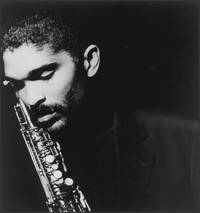
bhm art jr.Like his father, Art Porter Jr. is recognized with a space named in his memory in the new Robinson Center.  Today marks the 20th anniversary of his tragic death.

Arthur Lee (Art) Porter Jr. was born in Little Rock on August 3, 1961. Porter began his music career under the tutelage of his father, legendary jazz musician, Arthur Porter, Sr. who surrounded him with everything musical. He performed proficiently on drums, saxophone and piano. He was classically trained but his performances ranged across jazz, rhythm and blues, funk, and ballads.

During high school, under the supervision of Sterling Ingram, private teacher and band director at Parkview High School, Art Jr. was selected to be a member of the Arkansas All-State Band for three consecutive years.  At age 16, he was awarded the “Most Talented Young Jazz Artist in America” by the National Association for Jazz Education.

During Porter’s youth, his playing while underage in venues where liquor was sold proved controversial. Bill Clinton, then attorney general, established a framework for the legislature that would allow minors to work in such venues with parental supervision. Act 321 known as The “Art Porter Bill” became Arkansas law.

Porter graduated from Northeastern University in Chicago, Illinois, in 1986 with a BA degree in music education and performance.

Art burst on the music scene with his debut album, Pocket City (1992), followed by Straight to the Point (1993). In 1994, his third album, Undercover, placed Porter solidly on the “wave” radio charts with R&B artists as well as “cool jazz” artists. During this same year, he performed at Carnegie Hall for the Polygram Anniversary Celebration. His final album, Lay Your Hands on Me (1996), contained the radio favorite “Lake Shore Drive.”

Porter traveled the world with performances but no matter where his music would carry him, he always returned to his beloved hometown of Little Rock. He conducted workshops for music students at his alma maters, Dunbar Magnet Junior High School and Parkview Arts and Science Magnet School. Porter died on November 23, 1996, in a boating accident in Thailand. He had just completed a performance at the Thailand International Golden Jubilee Jazz Festival commemorating the fiftieth anniversary of King Bhumibol Adulyadej’s reign.  In 2013, he was posthumously inducted into the Arkansas Black Hall of Fame.