Black History Month – Dave Chappelle at Robinson Center

davechappelleOn June 13, 2012, comedian Dave Chappelle appeared at Robinson Center as he was just starting to emerge from a several year self-imposed hiatus.  The night before the Little Rock stint, he had appeared in Memphis.

Lindsey Millar wrote a review of Chappelle’s show which is available here (and has been referenced elsewhere as others scratched their heads from his appearances at other places).  A YouTube video shows Chappelle reacting to the crowd at Robinson calling the Hogs.  He was amused/confused.

Born in Washington DC to two academics, he was raised in Maryland.  He graduated from Washington’s Duke Ellington School of the Arts, where he studied theatre.  He then moved to New York City to pursue a career as a comedian.  He also started acting in movies and toured as an opening act for Aretha Franklin.  As his profile rose, he started making appearances in TV shows and movies in addition to performing stand up.

In 2003, he launched the “Chappelle’s Show” on Comedy Central.  After two successful seasons, he walked off the set during planning for a third season, which cost him a $50 million contract.

From 2006 to 2013, he made a few appearances in stand-up shows and gave a few interviews.  But most of the time he kept a low profile.  Since 2013, he has slowly started making more appearances. In 2014, he appeared on TV programs to promote a Radio City Music Hall appearance.  He also acted in the 2015 film Chi-Raq.  In November 2016, he hosted “Saturday Night Live.”


Comedies, Dramas and Musicals mark the 2017-18 season at Arkansas Rep

ark repA Southern story that is a favorite, a modern take on a classic comedy, a new musical based on a timeless Christmas tale, a contemporary drama of familial relationships, a joyous romp of a musical, a darkly comic tale of manners (without the manners), and a biting look at the madness of the holidays compose the 42nd season of the Arkansas Rep!

Under the leadership of new Producing Artistic Director John Miller-Stephany, the Arkansas Repertory Theatre, the state’s largest nonprofit professional theatre, announced its 2017-18 Season.

Beginning in August, the new season exemplifies The Rep’s mission of producing diverse work of the highest artistic standards for its Arkansas audience.

The Heart is a Lonely Hunter
Aug. 23 – Sept. 10, 2017; Opening Night on Friday, Aug. 25, 2017
By Rebecca Gilman | Based on the novel by Carson McCullers
Directed by John Miller-Stephany

Based on Carson McCullers’ celebrated debut novel, this haunting Southern drama tells the story of a handful of misfits in a 1930s Georgia mill town. Deaf-mute John Singer becomes confidant and confessor to four of the town’s most colorful eccentrics, forever changing their lives by his sympathetic and gentle presence. Rebecca Gilman’s poignant adaptation for the stage captures all of the loss and longing of the original novel and combines it with a graceful theatricality.


The School for Lies
Oct. 11 – 29, 2017; Opening Night on Friday, Oct. 13, 2017
By David Ives | Adapted from The Misanthrope by Molière

Based upon Molière’s classic 17th Century comedy, The Misanthrope, The School for Lies feels surprisingly relevant as it exposes the hypocrisies of polite high society with a sharp wit and even sharper observations about human nature. Comic master David Ives (All in the Timing, Venus in Fur, Is He Dead?) adapts this wicked farce for contemporary audiences, contrasting the high-brow characters with low-brow humor and employing present-day language that breathes fresh air into this rollicking satire.


The Gift of the Magi
Nov. 29 – Dec. 24, 2017; Opening Night on Friday, Dec. 1, 2017
A new musical by Jeffrey Hatcher, Maggie-Kate Coleman and Andrew Cooke
Directed by John Miller-Stephany

The Arkansas Repertory Theatre is proud to present the world premiere of a new chamber musical based upon O. Henry’s beloved holiday story. Unwrap a new tradition in this tender tale of love and sacrifice, told with fresh intimacy on The Rep stage. Acclaimed playwright Jeffrey Hatcher (Compleat Female Stage Beauty, Tuesdays with Morrie, Three Viewings) is joined by composer Andrew Cooke and 2017 Jonathan Larson Grant recipient Maggie-Kate Coleman (lyricist).


The Call
Jan. 24 – Feb. 11, 2018; Opening Night on Friday, Jan. 26, 2018
By Tanya Barfield

Annie and Peter are a childless couple in their late 30s who have decided to adopt a baby from Africa. But when they receive some surprising news about their potential bundle of joy, anxiety and doubt threaten to tear their world apart. Middle-class cultural sensibilities and global divisions come crashing in on their comfortable existence as they are forced to confront their own preconceived notions about what makes a family a family. As they reach out to friends and neighbors for advice, Annie and Peter become mired in indecision and second thoughts.


Mamma Mia!
March 14 – April 8, 2018; Opening Night on Friday, March 16, 2018
Music and lyrics by Benny Andersson and Bjorn Ulvaeus
Some songs with Stif Anderson | Additional material by Martin Koch
Book by Catherine Johnson
Directed by John Miller-Stephany

Young bride-to-be Sophie desperately wants her father to walk her down the aisle. But there’s a catch – she’s not sure which of her mother’s old flames is “the one.” So, she invites all three, hoping she’ll learn the truth, which unleashes an out-of-control flood of memories – and irresistible pop music – into all of their lives.


God of Carnage
June 6 – 24, 2018; Opening Night on Friday, June 8, 2018
By Yasmina Reza | Translated by Christopher Hampton
Directed by Cliff Fannin Baker

A simple playground scuffle between their young sons thrusts two sets of affluent parents into an uproarious maelstrom of epic proportions. As they meet to provide a positive example of conflict resolution, what begins as a civil conversation over cocktails and canapés soon devolves into a juvenile war of words and unexpected ferocity.   Winner of three Tony Awards, including Best Play, God of Carnage is a contemporary comedy of manners – minus the manners. From the fertile imagination of playwright Yasmina Reza (Art) comes this hilarious and terrifying descent into the heart of darkness – a searingly dark comedy for uncertain times.


PRODUCTION AT THE BLACK BOX THEATRE, The Rep Annex, 518 Main Street
New this Season, The Rep will run concurrent productions throughout the Christmas holiday. With the productions running on different stages and at staggered curtain times, patrons are encouraged to see both productions back-to-back.


The Santaland Diaries
Dec. 6 – 24, 2017; Opening Night on Friday, Dec. 8, 2017
By David Sedaris

Crumpet is just your average department store Christmas Elf. He’s your average, every day, chain-smoking, martini-swilling, foul-mouthed, Santa-denying department store Christmas Elf. What starts out as a mundane seasonal job to pay the bills becomes a darkly absurd quest through the grey and slush-filled streets of New York City at Christmastime. If the holidays make you feel more like Scrooge than Cratchit, more Grinch than Cindy Lou Who, more Abominable Snow Monster than Rudolph, then The Santaland Diaries is the perfect show for you!


Season Subscriptions are on sale now and start at $132, making subscribing to The Rep the most economical way to see all of the productions included in the 2017-18 Season.


For more information on Season Subscriptions, call The Rep’s Box Office at (501) 378-0405, Monday – Friday, 9 a.m. – 5 p.m., or visit http://www.TheRep.org.


Black History Month – Maya Angelou and Robinson Center

1414mayaOn February 23, 1998, Maya Angelou appeared with the Arkansas Symphony Orchestra in a concert at Robinson Center.  The evening featured Dr. Angelou narrating Joseph Schwantner’s tribute to Dr. Martin Luther King Jr., “New Morning for the World.”

Dr. Angelou, a former resident of Stamps, Arkansas, was not a stranger to Little Rock. She had appeared before at Wildwood Park and would later appear at the Clinton Presidential Center.

A former Poet Laureate of the United States and Tony nominated actor, she won a Grammy Award for her reading of “On the Pulse of the Morning” which had been written for the first inauguration of Bill Clinton as President of the United States.

A poet, author, educator, dancer, singer, actor, and activist, she wrote seven autobiographies. The most notable was arguably I Know Why the Caged Bird Sings.  Born in St. Louis, she spent part of her childhood in Arkansas before moving to California.  She led a peripatetic life both geographically and career-wise ending as a professor at Wake Forest and residing in North Carolina.  It was there that she died in May 2014.

Little Rock Look Back: US Supreme Court decision in BATES V. LITTLE ROCK

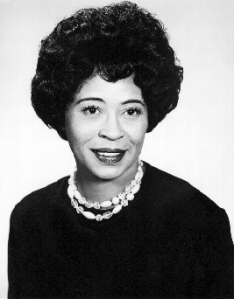
bates daisyOn February 23, 1960, the U. S. Supreme Court handed down a decision in the case of Daisy BATES et al., Petitioners, v. CITY OF LITTLE ROCK et al.  This case had been argued before the Court in November 1959.

Daisy Bates of Little Rock and Birdie Williams of North Little Rock were the petitioners.  Each had been convicted of violating an identical ordinance of an Arkansas municipality by refusing a demand to furnish city officials with a list of the names of the members of a local branch of the National Association for the Advancement of Colored People. The question for decision was whether these convictions can stand under the Due Process Clause of the Fourteenth Amendment to the United States Constitution.

The Little Rock ordinance (10,638) was passed on October 14, 1957. It charged that certain non-profits were actually functioning as businesses and using non-profit status to skirt the law. Therefore it required the non-profits to disclose their members and sources of dues.  North Little Rock passed an identical ordinance.

(Mayor Woodrow Mann was not present at the meeting of the LR Council when the ordinance was passed. But he signed all of the resolutions and ordinances approved that night.  Ordinance 10,638 was the only legislation that night which had also been signed by Acting Mayor Franklin Loy.  Mayor Mann crossed through Loy’s name and signed his own.)

Mrs. Bates and Mrs. Williams as keepers of the records for their respective chapters of the NAACP refused to comply with the law.  While they provided most of the information requested, they contended they did not have to provide the membership rosters and dues paid.

After refusing upon further demand to submit the names of the members of her organization, each was tried, convicted, and fined for a violation of the ordinance of her respective municipality. At the Bates trial evidence was offered to show that many former members of the local organization had declined to renew their membership because of the existence of the ordinance in question. Similar evidence was received in the Williams trial, as well as evidence that those who had been publicly identified in the community as members of the National Association for the Advancement of Colored People had been subjected to harassment and threats of bodily harm.

Each woman was convicted in the court of Pulaski Circuit Court, First Division, William J. KirbyJudge. They were fined $25 a person.  On appeal the cases were consolidated in the Supreme Court of Arkansas in 1958. The convictions were upheld by five justices with George Rose Smith and J. Seaborn Holt dissenting.

Mrs. Bates and Mrs. Williams then appealed to the U. S. Supreme Court.  The pair’s legal team included Robert L. Carter and George Howard, Jr. (who would later become a federal judge).  Little Rock City Attorney Joseph Kemp argued the case for the City.  The arguments before the U. S. Supreme Court were heard on November 18, 1959.

The SCOTUS decision was written by Associate Justice Potter Stewart.  He was joined by Chief Justice Earl Warren and Associate Justices Felix Frankfurter, Tom C. Clark, John M. Harlan II, William J. Brennan and Charles E. Whittaker.  Justices Hugo Black and William O. Douglas wrote a concurring opinion.

The U. S. Supreme Court reversed the lower courts.

In sum, there is a complete failure in this record to show (1) that the organizations were engaged in any occupation for which a license would be required, even if the occupation were conducted for a profit; (2) that the cities have ever asserted a claim against the organizations for payment of an occupation license tax; (3) that the organizations have ever asserted exemption from a tax imposed by the municipalities, either because of their alleged nonprofit character or for any other reason.

We conclude that the municipalities have failed to demonstrate a controlling justification for the deterrence of free association which compulsory disclosure of the membership lists would cause. The petitioners cannot be punished for refusing to produce information which the municipalities could not constitutionally require. The judgments cannot stand.

In their concurring opinion, Justices Black and Douglas wrote that they felt the facts not only violated freedom of speech and assembly from the First Amendment, but also aspects of the Fourteenth Amendment. They wrote that the freedom of assembly (including freedom of association) was a principle to be applied “to all people under our Constitution irrespective of their race, color, politics, or religion. That is, for us, the essence of the present opinion of the Court.”

Neither the Gazette or Democrat carried any reaction from City leaders. There was a City Board meeting the evening of the decision. If it was mentioned, the minutes from the meeting do not reflect it.

Arkansas Attorney General Bruce Bennett, on the other hand, was very vocal in his outrage. The city laws were known as Bennett Laws because they had been drafted by him as ways to intimidate African Americans and others he viewed as agitators.

In 1960 Bennett was challenging Governor Orval Faubus for the Democratic gubernatorial nomination.  In reaction to the to the Supreme Court he vowed that, if elected Governor, he would “de-integrate” (a term he proudly took credit for coining) the state.

For his part, and not to be outdone by the AG, Faubus fretted that the Court’s decision meant that Communists would be able to give money to the NAACP.

Black History Month – Andre Watts at Robinson Center

andre-wattsClassical pianist Andre Watts has performed at Robinson Center with the Arkansas Symphony Orchestra.

In 1963, 16 year old Andre Watts won a piano competition to play in the New York Philharmonic’s Young People’s Concert at Lincoln Center, conducted by Leonard Bernstein.  Within weeks of the contest the renowned conductor tapped Watts to substitute for the eminent but ailing pianist Glenn Gould, for a regular performance with the New York Philharmonic Orchestra. The performance was televised nationally, with Watts playing Liszt’s E-flat Concerto, and his career was launched.

Born in Germany to an American soldier and a Hungarian mother, he grew up on military bases.  At age 8, his family moved to Philadelphia. Following his 1963 performance, he won a Grammy in 1964 (at age 17) for Best New Classical Artist.

Since the 1960s, he has maintained a busy concert schedule. Along the way, he played for President Nixon’s first inaugural concert, graduated from college, been featured on PBS Live from Lincoln Center, toured Japan and Europe and the US.  At age 26, he received an honorary doctorate from Yale.  In 2004, he was appointed to the music faculty at the University of Indiana.  At age 70, he still performs concerts.  In 2011, he received the National Medal of the Arts.

Black History Month – Natalie Cole at Robinson Center

natalie-coleOn April 3, 2005, Natalie Cole performed at Robinson Center with the Arkansas Symphony Orchestra.  She also performed a retro-duet with her late-father, Nat King Cole.  As noted previously on this blog, he had graced the Robinson stage himself in the 1940s and 1950s.  Helaine Freeman from the Arkansas Democrat-Gazette noted that “Cole took her listeners through music genres that included a bit of jazz, a dash of blues and a fistful of R&B/pop.”

Cole was born in 1950 the daughter of the crooner and of singer Maria Hawkins Cole.  At age 6 she sang on her father’s Christmas album and started performing publicly at age 11.  After attending private schools, she attended both the University of Massachusetts and University of Southern California.  After college, she was signed with Capitol Records, her father’s label.  Her first album was released in 1975, which garnered her a Grammy Award for Female R&B Vocal Performance.

Throughout the 1970s, she had a series of successful albums. She became the first female singer to have two platinum albums in one year.  In the 1980s, her recording career slowed down, but by the late part of the decade, she had a resurgence.

In 1991, she recorded the album Unforgettable…with Love in which she sang songs her father had made famous.  The best known track was the title song, “Unforgettable” in which she dueted with him.  It won Album of the Year, Record of the Year, and Traditional Pop Vocal Performance of the Year at the Grammy Awards.

In the 2000s, she continued to sing and record switching between R&B and jazz genres.  She also started performing with symphony orchestras.

She cancelled several concerts in December 2015 and died on December 31, 2015.

Polk Stanley Wilcox joins Studio Gang Architects in planning for reimagined Arkansas Arts Center

arkartsThe Arkansas Arts Center announced the selection of Polk Stanley Wilcox Architects as associate architect for its upcoming building project. Polk Stanley Wilcox will work in partnership with Studio Gang Architects on a reimagined Arkansas Arts Center. Studio Gang was selected as design architect for the expansion and renovation in December.

Polk Stanley Wilcox Architects is a programming, architectural, planning and interior design firm with offices in Little Rock and Fayetteville. The firm has experience working with clients in a variety of industries, including healthcare, nonprofit, cultural, education, corporate and worship. Polk Stanley Wilcox also focuses on sustainability and creating buildings that operate on minimal energy usage.

“We are thrilled to partner with the Arkansas Arts Center and Studio Gang on this transformative project,” Polk Stanley Wilcox Principal David Porter said. “AAC has cast an exciting vision to rethink not only how the Center upgrades the interior and exterior spaces, but how the AAC connects to and enriches the broad arts and cultural tapestry of Little Rock. Studio Gang is a uniquely talented firm to lead the design effort. PSW is honored to bring our extensive experience from years of important projects in downtown Little Rock to come alongside them and the AAC to help create this next critical milestone for the city, state and region.”

Polk Stanley Wilcox has previously worked on a number of local projects, including the William J. Clinton Presidential Library, Heifer International Headquarters, the Arkansas Studies Institute and the recently opened Robinson Center expansion and renovation.

“We look forward to working with the team at Polk Stanley Wilcox,” said Studio Gang Founding Principal Jeanne Gang. “We hope to build on their strong history of collaborations in the area and believe that their knowledge of Little Rock will be a huge asset as we expand the impact of the Arkansas Arts Center in Little Rock, and in the region.”

Polk Stanley Wilcox Architects was selected from among three finalists to work in partnership with Studio Gang. Ten local firms responded to the RFQ issued last month. Allison and Partners and Cromwell Architects were also finalists.

The three finalist firms presented to the selection committee on February 16. The selection committee for the associate architect included AAC Executive Director Todd Herman, three representatives from Studio Gang, and international museum consultant Deborah Frieden, and AAC Board member Sara Hendricks Batcheller.

“Each of the finalists are strong, well-respected firms,” Arts Center Executive Director Todd Herman said. “Ultimately, Polk, Stanley, Wilcox was the best complement to Studio Gang in terms of experience and strengths. Their work at Robinson auditorium – similar in both scope and complexity – will be an asset as we move through the project. We are very pleased to have PSW on board for this important project that will create wonderful new spaces for the people of Little Rock and Arkansas to enjoy the arts. Having our architectural team in place is a major milestone. We are very excited to move the project forward.”