Black History Month – Daisy Bates and Robinson Center

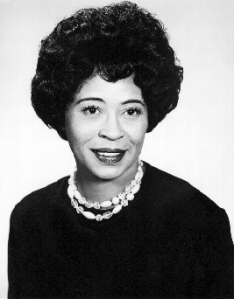
bates daisyToday is the Daisy Bates Holiday in the State of Arkansas.  So it is an appropriate day to pay tribute to Mrs. Bates, who played a leading role in the Little Rock Integration Crisis of 1957.

Daisy Lee Gatson Bates and her husband were important figures in the African American community in the capital city of Little Rock.  Realizing her intense involvement and dedication to education and school integration, Daisy was the chosen agent after nine black students were selected to attend and integrate a Little Rock High School.  Bates guided and advised the nine students, known as the Little Rock Nine, when they enrolled in 1957 at Little Rock Central High School. President Clinton presented the Little Rock Nine with the Congressional Gold Medal and spoke at the 40th anniversary of the desegregation while he was in office.

When Mrs. Bates died, a memorial service was held at Robinson Center on April 27, 2000.  Among the speakers were President Bill Clinton, Secretary of Transportation Rodney Slater, and Rev. Rufus K. Young, pastor of the Bethel AME Church.  Others in attendance included Lt. Gov. Winthrop Paul Rockefeller, Mayor Jim Dailey, Presidential diarist Janis Kearney, former senator and governor David Pryor, and five members of the Little Rock Nine:  Carlotta Walls Lanier, Ernest Green, Minnijean Brown Trickey, Jefferson Thomas, and Elizabeth Eckford.

It was during his remarks at the service that President Clinton announced he had asked that Bates’ south-central Little Rock home be designated as a national historic landmark.

Little Rock Look Back: The first Elvis performance in Little Rock

Photo by Wayne Cranford

Photo by Wayne Cranford

Sixty-two years ago today, on February 20, 1955, Elvis Presley made his first appearance on stage in Little Rock. He performed at Joseph Taylor Robinson Memorial Auditorium.

He was billed as “an added attraction” to a Grand Ole Opry Show headlined by the Duke of Paducah.  Others on the bill included Mother Maybelle and the Carter Sisters, Jimmie Rodgers Snow, Charlie Stewart, the Singing Hardens, Sammy Barnhart, Bob Neal, Uncle Dudley and Smilin’ Mac Cyclone. (It is interesting to note that at least some of the advance tickets billed it as The Elvis Presley Show, though the newspaper ads billed the Duke of Paducah as the headliner.)

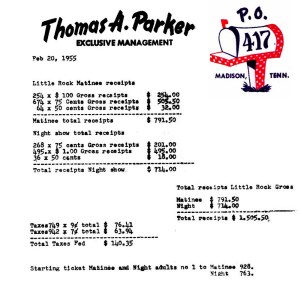
eap receits 05-little.rock_.feb_.55This concert was part of a weeklong tour of Arkansas and Louisiana.  There were two shows that day – one at 3p.m. and the other at 8:15p.m.  Tickets on the day of the concert were $1.00 for adults and fifty cents for children.  Advanced tickets had sold for 75 cents at Walgreens.
The night before, Elvis played the Louisiana Hayride in Shreveport.  Following his Little Rock appearance (for which he and his band were paid $350 instead of their usual $200), they played in Camden, Hope, and Pine Bluff.

It is believed that Elvis’ parents attended this concert in Little Rock. Gladys Presley was a big fan of the Duke of Paducah. Elvis apparently also wanted his parents to meet with Colonel Tom Parker, who would become inexorably linked with Elvis’ career.

Black History Month – Wiley Branton and Robinson Auditorium

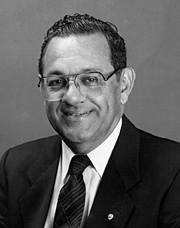
brantonMost of the people who are being featured this month have played at Robinson Center.  But today’s entry, Wiley A. Branton, Sr. worked to integrate Robinson Center.

In 1962, he filed a suit on behalf of several African American residents of Little Rock to integrate the City’s public facilities including Robinson Auditorium.  (The City Board and the Auditorium Commission were named in the lawsuit.)  In 1963, the decision came down and the facilities had to integrate.

This lawsuit was just one of many in which Branton paved the way for equal opportunities for all.  He helped desegregate the University of Arkansas School of Law and later filed suit against the Little Rock School Board in a case that went to the U.S. Supreme Court as Cooper v. Aaron.

A native of Pine Bluff, he graduated from what is now UAPB. After first being refused admission, he later became the fifth African American to attend the UA Law School and the third to graduate.  From 1953 to 1962, he had a law practice in Pine Bluff.  Between 1962 and 1965, Branton worked with representatives of the major African-American civil rights organizations to register almost 700,000 new black voters in eleven Southern states. Following that, he became executive director of the President’s Council on Equal Opportunity and help coordinate implementation of the Civil Rights Act of 1964. He spent 1965 to 1967 at the Justice Department, before becoming executive director of the United Planning Organization (UPO).  After working with a couple of other organizations, he returned to private practice in 1971.  In December 1977 it was announced that Branton would be the new dean of Howard University School of Law. After five years, he joined the law firm of Sidley and Austin in its Washington DC office.

Branton died of a heart attack in December 1988.  Eleven hundred mourners gathered at a memorial service at the Washington National Cathedral in Washington, D.C. Among those present was Supreme Court Justice Thurgood Marshall. The eulogy was delivered by Vernon E. Jordan, Jr..  Then-Gov. Bill Clinton spoke at the Pine Bluff memorial service for Branton.

Black History Month – Gladys Knight at Robinson Center

gladys-knight-14On February 18, 1995, Gladys Knight rocked the rafters of Robinson Center.  She returns to Robinson on April 3, 2017.

Georgia-born, Knight began performing gospel music at age four. After winning a national talent competition, she and some relatives formed a singing group called “The Pips.” Later it became known as Gladys Knight and the Pips.  The group debuted their first album in 1960, when Knight was just sixteen. W

ith Knight singing lead and The Pips providing lush harmonies and graceful choreography, the group went on to achieve icon status, having recorded some of the most memorable songs of the 1960s, 1970s and 1980s. Top 20 hits, like “Every Beat of My Heart,” “Letter Full of Tears,” “I Heard it Through the Grapevine” and “If I Were Your Woman,” “Neither One of Us (Wants to be the First to Say Goodbye),” “I’ve Got to Use My Imagination,” “Best Thing to Ever Happen to Me” and the #1 smash “Midnight Train to Georgia” established Gladys Knight and The Pips as the premiere pop/R&B vocal ensemble in the world.

In 1995, Knight earned her star on the Hollywood Walk of Fame, and the next year, Gladys Knight & The Pips were inducted into the Rock ‘N’ Roll Hall of Fame.  Knight published an autobiography, “Between Each Line of Pain and Glory” (a line taken from her million selling recording “Best Thing That Ever Happened to Me”), in 1997, and the next year, she and The Pips were presented with the Lifetime Achievement Award from the Rhythm & Blues Hall of Fame. In 2004, Knight received the “Lifetime Achievement Award” at the annual BET Awards ceremony. All told, Knight has recorded more than 38 albums over the years.

Black History Month – The National Black Political Convention at Robinson Center in 1974

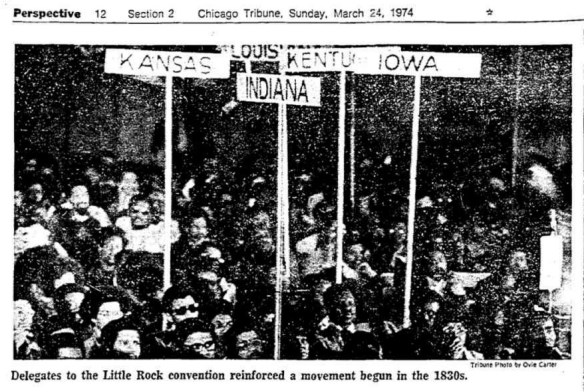
Chicago Tribune photo

Chicago Tribune photo

In March 1974, Little Rock hosted the second National Black Political Convention at the Joseph T. Robinson Auditorium and Camelot Hotel (now a Doubletree Hotel). The first convention was held in Gary, Indiana, in 1972, and garnered much publicity, producing a National Black Political Agenda that included demands for the election of a proportionate number of black representatives to Congress, community control of schools, and national health insurance.

There were approximately 1,700 delegates from 31 states at the Convention.

The Little Rock convention was co-convened by Congressman Charles Diggs of Detroit, Michigan; Mayor Richard Hatcher of Gary, Indiana; and poet Amiri Baraka. Plenary speakers included Atlanta Mayor Maynard Jackson and comedian and activist Dick Gregory. Jesse Jackson was also in town for the convention. The convention featured a testimonial and tribute to local civil rights leader Daisy Bates at Central High School.

The 1972 convention had called for African Americans to form their own party separate from the Democrats and Republicans.  Two years later, few elected leaders came to Little Rock.  As leaders of established political parties started to embrace African Americans, many seemed to find it more advantageous to participate within the party framework.

Some of the delegates to Little Rock expressed frustration.  They were not there, they told the press, to listen to speeches.  They were there to take actions.  Over 200 resolutions were submitted, which were difficult for the body to consider.

It was ironic that Daisy Bates was honored. While many in the convention were espousing the Black Separatist movement, Mrs. Bates spent her career focused on integration.  A series of articles in the Chicago Tribune discussed the challenges of the conventions many different viewpoints.  Another challenge the convention faced was financial.  The organizers refused to accept funds from white-owned companies or foundations. And there simply were not many African American owned funding sources which existed, let alone were interested in funding it.

Nonetheless, the Convention left its mark on attendees.  And it did showcase that Little Rock had made progress since 1957.

Black History Month – Duke Ellington refuses to play segregated Robinson Auditorium

Newspaper ad for the concert that was not to be

Newspaper ad for the concert that was not to be

Seventy-seven years ago today, Robinson Memorial Auditorium officially opened.  Today’s Black History Month feature is on an event that did NOT take place at Robinson.

In August 1961, it was announced that Duke Ellington would perform in concert at Robinson Center.  He had previously played there in the 1940s and early 1950s.  His concert was set to be at 8:30 pm on Tuesday, September 5.

Due to the changes of times, the NAACP had a relatively new rule that they would boycott performers who played at segregated venues.  When it became apparent that Robinson would remain segregated (African Americans restricted to the balcony), the NAACP announced they would boycott any future Ellington performances if he went ahead and played Robinson.

The music promoters in Little Rock (who were white) petitioned the Robinson Auditorium Commission asking them to desegregate Robinson – even if for only that concert.  The Commission refused to do so.  Though the auditorium was finding it harder to book acts into a segregated house, they felt that if it were integrated, fewer tickets would be sold.

Ellington cancelled the concert.

Robinson remained segregated until a 1963 judge’s decision which integrated all public City of Little Rock facilities (except for swimming pools).

Little Rock Look Back: Opening of Joseph Taylor Robinson Memorial Auditorium

Robinson Auditorium

Robinson Auditorium

On February 16, 1940, after three years of planning and construction including several delays due to lack of funding, the Joseph Taylor Robinson Memorial Auditorium officially opened. It was a cold, rainy night, but those in attendance did not care.

Searchlights painting arcs in the sky greeted attendees. They were borrowed from the Arkansas National Guard. Newspaper accounts noted that only a few of the men who attended were in tuxedos, most were simply in suits. The work to get the building opened had been so harried, that it was discovered there was not an Arkansas Flag to fly in front of the building. Mayor Satterfield found one at the last minute courtesy of the Arkansas Department of the Spanish War Veterans.

The weather delayed arrivals, so the program started fifteen minutes late. Following a performance of Sibelius’ Finlandia by the fledgling Arkansas State Symphony Orchestra, Mayor J. V. Satterfield, Ewilda Robinson (the Senator’s widow), Emily Miller (the Senator’s sister-in-law and a member of the Auditorium Commission) and D. Hodson Lewis of the Chamber of Commerce participated in a brief ribbon cutting ceremony. Mrs Robinson cut the ribbon on her second attempt (once again proving that nothing connected with getting the building open was easy).

The ceremony was originally set to be outside of the building but was moved indoors due to the inclement weather. The ribbon cutting took place on the stage with the ribbon stretched out in front of the curtain. The opening remarks were broadcast on radio station KGHI.

Mr. Lewis, Mrs. Miller and Mayor Satterfield look on as Mrs. Robinson cuts the ribbon

Mr. Lewis, Mrs. Miller and Mayor Satterfield look on as Mrs. Robinson cuts the ribbon

Though he had previously discussed how he had voted against the auditorium in 1937 before entering public life, the mayor’s remarks that evening were appropriately gracious, statesmanlike and a testament to the effort he had invested to get it open upon becoming mayor. “We hope you have a very pleasant evening and hope further that it will be the first in a long series which you will enjoy in this, your auditorium.”

Tickets for the event, advertised as being tax exempt, were at four different pricing levels: $2.50, $2.00, $1.50 and $1.00.

The estimated attendance was 1700. Following the ribbon cutting, the main performance took place. The headliner for the grand opening was the San Francisco Opera Ballet accompanied by the new Arkansas State Symphony Orchestra (not related to the current Arkansas Symphony Orchestra). The featured soloist with the ballet was Zoe Dell Lantis who was billed as “The Most Photographed Miss at the San Francisco World’s Fair.”

At the same time that the gala was going on upstairs in the music hall, a high school basketball double-header was taking place in the downstairs convention hall. North Little Rock lost to Beebe in the first game, while the Little Rock High School Tigers upset Pine Bluff in the marquee game.