
Little Rock Look Back: J. N. Heiskell

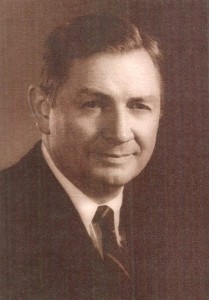
At the age of 87, J. N. Heiskell in 1960.

John Netherland (J. N.) Heiskell served as editor of the Arkansas Gazette for more than seventy years.  He was usually called “Mr. Heiskell” by all, but a very few confidantes felt confident to call him “Ned.”

Mr. Heiskell is the person most responsible for Robinson Center Music Hall being located at the corner of Markham and Broadway.  As Chair of the Planning Commission and editor of the Arkansas Gazette he had twin bully pulpits to promote this location when those on the City Council (who actually had the final say) were looking at other locations.  He felt the location would help create a cluster of public buildings with its proximity to the county courthouse and to City Hall.  Mr. Heiskell finally succeeded in winning over the mayor and aldermen to his viewpoint.

He was born on November 2, 1872, in Rogersville, Tennessee, to Carrick White Heiskell and Eliza Ayre Netherland Heiskell. He entered the University of Tennessee at Knoxville before his eighteenth birthday and graduated in three years at the head of his class on June 7, 1893.

His early journalism career included jobs with newspapers in Knoxville and Memphis and with the Associated Press in Chicago and Louisville. On June 17, 1902, Heiskell’s family bought controlling interest in the Arkansas Gazette. Heiskell became the editor, and his brother, Fred, became managing editor.

Governor George Donaghey appointed Heiskell to succeed Jeff Davis in the United States Senate after Davis’s death in office. Heiskell served from January 6, 1913, until January 29, 1913, when a successor was chosen by the Arkansas General Assembly.  His tenure is the shortest in the U. S. Senate history.  His first speech on the Senate floor was his farewell.  He was also only the second US Senator to live to be 100.

On June 28, 1910, Heiskell married Wilhelmina Mann, daughter of the nationally prominent architect, George R. Mann. The couple had four children: Elizabeth, Louise, John N. Jr., and Carrick.

In 1907, he joined a successful effort to build the city’s first public library. He served on the library board from that year until his death and was issued the first library card.  He also served on the City’s Planning Commission for decades.  In 1912, he was instrumental in bringing John Nolen to Little Rock to devise a park plan.

In the paper and in his own personal opinions, he crusaded on a variety of progressive causes.  Perhaps the most famous was the Gazette’s stance in the 1957 Central High desegregation crisis.  It was for this effort that the paper received two Pulitzer Prizes.

Although Heiskell stopped going to the office at age ninety-nine, he continued to take an active interest in the newspaper. He began by having a copy of the newspaper delivered to his home by messenger as soon as it came off the press each night. Eventually, he switched to having his secretary call him daily at his home and read the entire newspaper to him. He operated on the premise that “anyone who runs a newspaper needs to know what’s in it, even to the classified ads.”

A few weeks after turning 100, Heiskell died of congestive heart failure brought on by arteriosclerosis on December 28, 1972. He is buried in Little Rock’s Mount Holly Cemetery.  Interestingly, he is buried in the same cemetery as two of his most notable adversaries: Governor Jeff Davis, and segregationist Congressman Dale Alford.

Mr. Heiskell donated his vast papers to UALR. They are part of the Arkansas Studies Institute collection. These papers give insight into not only his career as a journalist, but also his political and civic affairs.  Thankfully he saved much of his paperwork. Without it, much insight into Little Rock in the 20th Century would be lost.

Little Rock Look Back: Founding of what is now Rose Law Firm

Rose Law FoundersOn November 1, 1820, Robert Crittenden and Chester Ashley signed an agreement to form a “Partnership in the Practice of Law.”  This document is the genesis for what is now known as the Rose Law Firm, the oldest law firm west of the Mississippi River.
Crittenden and Ashley were both political leaders.  At the age of 22, Crittenden was appointed Lieutenant Governor of Arkansas Territory by President James Monroe.  Ashley would serve as a U.S. Senator from Arkansas from 1844 to 1848.  His son William E. Ashley was the first Little Rock mayor to be born in Little Rock.

Both Crittenden and Ashley have counties in Arkansas named in their memory.  In addition both Chester and Ashley streets in Little Rock are named for the latter.

In 1832, Crittenden and Ashley dissolved their partnership, though each continued practicing law.  George Watkins joined Mr. Ashley in 1837.  By 1865, U.M. Rose joined partnership. The name Rose has been in the firm’s name ever since.

Little Rock Look Back: More Tricks than Treats on Halloween Streets

A recent romp through an ARKANSAS GAZETTE gave insight into Halloween in Little Rock in the middle of the 20th Century.

Apparently by late afternoon on Halloween 1950, downtown Little Rock was filled with kids and teens in costumes. Much of the focus seemed to be on tricks as many of these revelers were utilizing water guns to soak people, throwing enough talcum powder to create an aroma downtown, shooting off firecrackers, and soaping store windows. Several industrious store owners had coated there windows with glycerine so that soap would not mark them.

The mayhem was enough to cause even more problems to traffic at rush hour. Police officers were helpless as they were directing traffic.  One city bus filled with passengers was attacked by a phalanx of waterguns, until the windows were all closed.

GAZETTE writer noted that two teen boys were dressed rather convincingly as girls. One was described as “rather pretty.” It was not until the teen let out an expletive (which the paper reported as “g— d—–”) that the reporter was certain it was a male.

Not everyone was focused on tricks.  Merchants in the Heights neighborhood created a block party with a carnival. It was deemed to be so successful that it would become an annual event.

Little Rock Look Back: Little Rock High School Auditorium Dedicated

On October 31, 1927, a recital took place in the auditorium of the new Little Rock High School which served as a dedication ceremony for the new high school auditorium.  The school had been serving students for several weeks by the time the recital took place.  The first day of school was Wednesday, September 14, 1927.
The star of the recital was Mary Lewis, a Little Rock High School graduate (from the previous location on Scott Street) who had made her Metropolitan Opera debut and become a toast of New York City.

The evening started with remarks from former Arkansas Governor Charles Brough, who had made a name for himself as an advocate for education before, during and after his stint in the statehouse.  He was followed by Miss Lewis, who sang over a dozen arias and musical selections.  For her first encore, Miss Lewis sang “Dixie.”  Her second encore was supposed to be “Home Sweet Home.”  After several attempts to sing it, she was so overcome that she had to abandon the effort.

For more on the opening event, read Jay Jennings’ excellent book Carry the Rock: Race, Football, and the Soul of an American City.

The 1927 schoolbuilding replaced one built in 1905 at 14th and Scott Streets (with an auditorium completed a few years later at 14th and Cumberland).  This new building was located in the western edges of Little Rock on what had been city parkland.  The former West End Park was now site to Little Rock High School.  The adjoining Kavanaugh Field was a baseball field on which Earl Quigley’s football Tigers also played their games.

Architects John Parks Almand, Lawson L. Delony, George R. Mann, Eugene John Stern, and George H. Wittenberg (virtually all of Little Rock’s full-time working architects at the time) designed the $1.5 million structure, which the New York Times dubbed the most expensive school ever built in the United States at that time.

Featuring a combination of Collegiate Gothic and Art Deco architecture, Central High spans two city blocks, comprising over 150,000 square feet of floor space, upon its completion. Requiring 36 million pounds of concrete and 370 tons of steel, the finished product consisted of 100 classrooms (accommodating over 1,800 students), a fireproof 2,000-seat auditorium, a gymnasium, and a greenhouse.

The six-story structure (counting the bell tower and basement) features a middle section containing the auditorium with four classroom wings (two per side) flanking a reflection pool in the foreground of the building. Faced with brick, the building’s highlights include pilasters and colonnades of cut stone, double-hung window frames with twelve lights per sash, and a main entry terrace supported by a colonnade of five masonry arches rising above Corinthian columns of stone.


Little Rock Look Back: A governmental structure for Little Rock

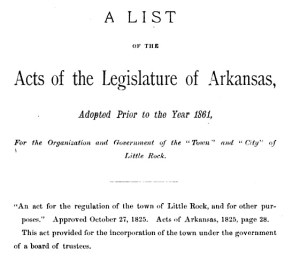
The first permanent settlement of Little Rock started in 1820. But by 1825, it was little more than a loosely defined group of structures. One hundred and ninety-two years ago today, on October 27, 1825,Territorial Governor George Izard signed legislation which started establishing a framework for Little Rock to function as a city.
It established that Little Rock citizens could elect a board of trustees to decide matters. Those trustees would choose one of their own to be a presiding officer. Though Little Rock would not be officially incorporated until 1831, this was the first step towards incorporation. The first trustees, elected for 1826, were Robert Crittenden, Joseph Henderson, Nicholas Peay, Bernard Smith and Isaac Watkins. Smith was chosen to be the presiding officer.

Crittenden had been largely responsible for the relocation of the capitol to Little Rock, where he owned a lot of land. He was a major political force in Arkansas politics during the territorial days. Watkins was a nephew of a signer of the Declaration of Independence. He had established the first tavern in Little Rock in 1821 and later he first mill in 1826. He was murdered in 1827 and the perpetrator was never captured.

Peay bought the tavern from Watkins in 1826 and continued in the tavern and hotel business the rest of his life. He later served on the Little Rock City Council and was acting mayor. His son Gordon Neill Peay served as Mayor of Little Rock. The Peay family also co-founded Worthen Bank and Christ Episcopal Church. Members of several branches of Mr. Peay’s descendants including the Worthen and Hurst families remain active in Little Rock affairs.

Little Rock Look Back: Mayor Pratt C. Remmel

One hundred and two years ago today, on October 26, 1915, future Little Rock Mayor Pratt Cates Remmel was born.  He was one of five children of Augustus Caleb and Ellen Lucy Remmel.  His father died when he was five, leaving his mother to raise six children (Gertie, Harmon – also known as Buck, Pratt, Gus, Rollie, and Carrie) by herself.  After graduating from high school in 1933, he received a bachelor’s degree in economics from the University of Virginia in 1937.  During World War II, he held the rank of Lieutenant in the US Navy.

The Remmel family had long been involved in politics.  A great-uncle had been the GOP nominee for governor and senator as well as serving on the GOP national committee.  Remmel’s father had been the state GOP chair and his mother was the Arkansas Republican national committeewoman for nearly three decades.  In 1938, shortly after returning from college, Remmel ran for the Little Rock City Council but did not win.  In 1940, he became chairman of the Pulaski County Republican Executive Committee. For the next several decades, he held various leadership posts in the GOP at the county, state and national level.

Remmel made his second bid for public office in 1951 when he challenged incumbent LR Mayor Sam Wassell, who was seeking a third term.  Wassell shared the often held belief at the time that the GOP could not win any races in Arkansas because of the aftereffects of Reconstruction.  Remmel ran a vigorous campaign and won by a 2-to-1 margin becoming Little Rock’s first Republican mayor since Reconstruction.  In 1953, he sought a second two year term and was re-elected.  Though he had worked to build the GOP in Arkansas, he did not emphasize party affiliation in this campaign. He stressed he had been “fair to all and partial to none.”  This campaign included a rally which was aired live on six LR radio stations at the same time, a first for Arkansas. He won by over 3,000 votes this time over alderman Aubrey Kerr.

Remmel had been mentioned as a potential candidate for US Senate or Congress in 1954.  Instead, he ran for governor and was defeated by Orval Faubus in his first race for the office.  Remmel did receive more votes for governor than any GOP candidate had since reconstruction.  He is credited with laying the groundwork for the future successful campaigns of Winthrop Rockefeller.

A month before the election in 1955, Remmel announced he would seek a 3rd term as Mayor.  While later admitting he should have stuck with the customary two terms, he also said he ran to give voters an alternative to the Democratic nominee Woodrow Mann.  Mann, like Remmel, was in the insurance business; Remmel considered Mann to have a questionable reputation.  Several statewide Democratic leaders campaigned for Mann, who beat Remmel by 1,128 votes, one of Little Rock’s closest mayoral elections.

As Mayor, Remmel served in leadership positions with the US Conference of Mayors and the Arkansas Municipal League.  It was during his tenure as mayor that the land which is now Rebsamen Golf Course was given to the City.

After he left office, Remmel returned to business interests and staying active in civic affairs.   He was an active leader of First United Methodist Church and Gideons International.  He was a Mason, a Shriner, a member of the American Legion, and the American Red Cross.   Remmel served on the Arkansas River Basin Commission and chairman of the Arkansas Waterways Commission.  In 1996, he was posthumously inducted into the Arkansas River Hall of Fame.

Married for many years to Catherine Couch, the couple had three children, Pratt Jr., Cathie and Rebecca.  Lake Catherine in Arkansas is named for his wife. Remmel Park and Pratt Remmel Road in Little Rock are named for Mayor Remmel.

Mayor Remmel died on May 14, 1991.  He and Catherine (who died in 2006) are buried in Oakland Cemetery.

Little Rock Look Back: Taft in Town

One hundred and eight years ago today (October 24, 1909), William Howard Taft became the third sitting president to visit Little Rock. His visit is the shortest presidential visit to the city, to date. 

 In this day of touchdowns at airports by politicians on the political stump, it is interesting to note that the shortest visit was made on a train. It was a true “whistle stop” visit.
Taft’s train arrived at Union Station (then a new building, it burned in 1920 and was replaced by the one standing there today) in Little Rock to a crowd of 15,000. President Taft stepped from the train, made brief remarks in a hoarse voice that few heard, stepped back onto the train and departed.

That same day he spoke in Texarkana and Arkadelphia. He was on his way to Helena to speak at a ceremony.