
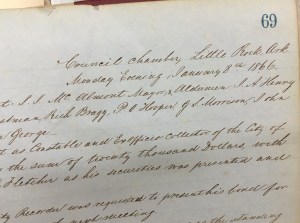
 One hundred and fifty two years ago today, Little Rock City Hall resumed functioning after the Civil War. The City government had disbanded in September 1863 after the Battle of Little Rock. From September 1863 through the end of the war (on on through part of Reconstruction), Little Rock was under control of Union forces.
Following the April 1865 conclusion of the Civil War, plans were made to restart local government in Little Rock. Even though Arkansas would not have Congressional representation in Washington until June 1868 (becoming the second Confederate state after Tennessee), the establishment of local government took place in January 1866.
The first City Council meeting took place on Monday, January 8, 1866. The council met again on Tuesday, January 9 and Monday, January 15 as they were trying to establish committees and rules for the new government.
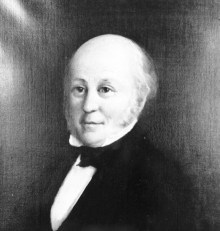
The first post-Civil War mayor was Dr. J. J. McAlmont, who was a physician and pharmacist. Following his service as the city’s chief executive, he would later be a co-founder of what is now UAMS. The initial aldermen were I.A. Henry (who had been on the City Council when it ceased in 1863), Henry Ashley, M. H. Eastman, Rick Bragg, Dr. P. O. Hooper, G. S. Morrison, John Collins and Alexander George.
Their first action was to approve the bond of Thomas C. Scott as Constable and City Collector. Vouching for him were S. H. Tucker and John Gould Fletcher. The Recorder was asked to present his bond and the next meeting.
The Mayor then established several committees of the City Council and named his appointments. Among the committees were Finances, Streets, Ordinances, Mount Holly Cemetery, Fire Department and Police.
That meeting and the following two meetings, the City continued to approve motions, resolutions and ordinances to set up the duties and responsibilities of a government.
Ordinance Number 1 established the rates of Licenses for 1866. Among those were:
- $100 for the privilege of selling goods at auction
- $20 for a one-horse wagon, paid quarterly
- $35 for a two-horse wagon, paid quarterly
- $50 for a four-horse wagon, paid quarterly
- $25 to run a cab or bus (which would have been in some horse drawn conveyance), paid quarterly
- $40 a month to sell liquor, wine, ale, beer, etc., by the glass or bottle to be consumed in a store, tavern, shop or store
- $25 each quarter for each billiard table
- $50 each quarter for each ten pin alley
 Future Little Rock Mayor John Gould Fletcher was born on January 6 in 1831. The son of Henry Lewis and Mary Lindsey Fletcher, he later served as a Captain in the Capital Guards during the Civil War. One of his fellow soldiers was Peter Hotze.
 In November 1915, there were public meetings in Little Rock and Pulaski Heights to discuss the issue. As a part of the annexation, Little Rock promised to build a fire station in the area and to install traffic lights, sidewalks and pave more streets.
 On Monday, January 2, 1826, Little Rock voters elected their first Board of Trustees. This five member governing body was authorized by the Arkansas General Assembly in October 1825. The five men getting the most votes were Bernard Smith, Isaac Watkins, James C. Collins, Ezra Owens and Sam C. Roane.
 In the first few decades of Little Rock, municipal elections usually took place on January 1. While occasionally they would take place on another day, it was usually when January 1 fell on a Sunday.
 Little Rock Culture Vulture