
Little Rock Look Back: September 12, 1958–a day of educational chaos in Little Rock

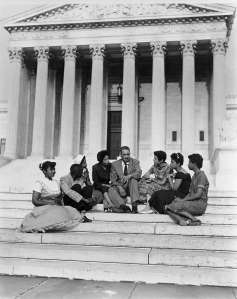
Thurgood Marshall, of the NAACP, sits on the steps of the Supreme Court Building after he filed an appeal in the integration case of Little Rock’s Central High School. (AP Photo, file)

The Court found that “the federal judiciary is supreme in the exposition of the law of the Constitution” and all state officials must adhere to the Court’s decisions and follow the rules laid down in those decisions in similar future cases.

Following the decision, the Little Rock School Board issued a statement that the schools would open as planned on Monday, September 15, 1958.  One of the School Board members, Henry V. Rath, resigned his position on the board that day. He was frustrated that the School Board was caught between federal law and state law.

Later that afternoon, Governor Faubus signed several bills into law which had been passed in a special session. These bills were designed to make it more difficult to integrate public schools.  One of them gave the Governor the authority to temporarily close schools to keep them segregated.  The Governor would then call a special election for the voters in that district to decide whether to remain closed or be opened and integrated. (One of the other laws, which would come in to play later during the school year, laid out the plans for a recall of school board members.)

Shortly after signing the law which gave him the authority to close the schools, Governor Faubus did just that.  He announced that Little Rock’s four public high schools would not open on Monday, September 15.  He set October 7 as the date for the special election about keeping the schools closed.

No one seemed to know what the next steps were.

That night, high school football took place, as previously scheduled.  Central came from behind to defeat West Monroe, Louisiana, by a score of 20 to 14.

Over the weekend, there were many meetings and phone conversations as people were trying to figure out what to do.

One meeting that took place on September 12 was at the home of Mrs. Adolphine Fletcher Terry.  She invited a few friends over to discuss what role the women of the city could play in solving this crisis.  The group decided to meet on the following Tuesday, September 16, at Terry’s house.  It would eventually grow to over 1,300 members and have the name of Women’s Emergency Committee to Open Our Public Schools.

Little Rock Look Back: Sharon Priest

Little Rock’s 70th mayor, Sharon Priest, celebrates her birthday on September 12.
She began her public service at the grassroots level when she led the effort to bring flood relief to Southwest Little Rock and Pulaski County following the devastating flood of 1978 that killed 13 people in central Arkansas.

Sharon was appointed to the Little Rock City Beautiful Commission.  Following that, she challenged an incumbent City Director and won her first elective office in 1986. In January 1989, she was named Vice Mayor of Little Rock by her colleagues on the City Board.  Two years later, she was selected Mayor becoming only the second female to serve as Mayor of Little Rock.  During her service to the City of Little Rock, she spearheaded the effort to create a Little Rock flag.  At the conclusion of her second four year term on the City Board, she decided to run for Secretary of State.

In November 1994, she elected Secretary of State, becoming the first woman to be elected to that position in Arkansas.  She was reelected in 1998.   In the summer of 2000, she became President of the National Association of Secretaries of State. After the 2000 presidential election, she was thrust into the forefront of the movement toward election reform. Ms. Priest testified before U.S. House and Senate Committees on election reform. As Secretary of State, restoring the Governor’s Reception Room and the Old Supreme Court Chamber of the State Capitol to their original splendor and restoring the rotunda marble are a few of her proudest achievements.

In January 2003, Priest was selected to serve as Executive Director of the Downtown Little Rock Partnership. She served in that capacity until early 2015.  She has also been a leading champion for the redevelopment of MacArthur Park, the City’s oldest park.

Little Rock Look Back: The Man behind Little Rock’s Villa Marre

On September 11, 1842, future Little Rock Alderman Angelo Marre was born in Borzonaca, Italy.  He immigrated to Tennessee with his parents in 1854.

During the Civil War, he served in the Confederate Army. From 1865 to 1868, Angelo Marre worked for the Memphis Police Department but was forced to resign after he was accused of killing a man during an argument.  After his acquittal, he returned to the saloon business.  In 1872 Marre was convicted of stealing money and sentenced to three years in prison.

Tennessee Governor John Brown granted Marre a full pardon two years into his sentence, and he regained his citizenship in 1879.

After getting out of prison, he claimed an inheritance and joined his brothers in Little Rock.  He worked as a bartender at the Metropolitan Hotel.  He later opened a saloon and billiard parlor.

By the mid-1880s, Marre owned two saloons, a liquor import business, an office building in downtown LR, 3,000 sharesof stock in mining companies operating in Garland and Montgomery counties, and he was the first president of Edison Electric Company of LR.

In 1883, he was elected as an alderman on the Little Rock City Council.  He lost is bid for reelection in 1885. In 1888, he was an unsuccessful candidate for Pulaski County Sheriff.

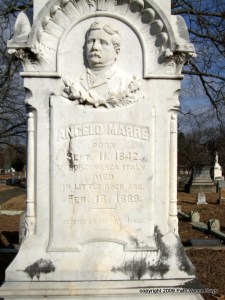
villamarreAngelo Marre died February 18, 1889, as a result of his infection.  He is buried at Calvary Cemetery in LR. His custom designed, marble monument was ordered from Florence, Italy, and cost $5,000.

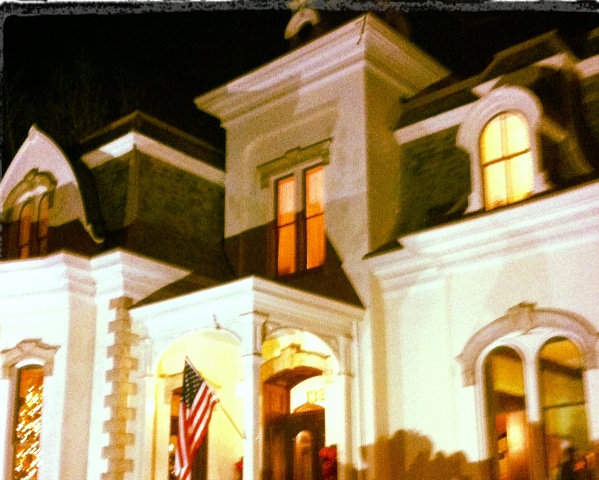
Marre is probably best known today as the builder of the structure now known as the Villa Marre.  Built in 1881, it is designed in the Italianate and Second Empire styles.  It was built in 1881 and 1882 on Block 21, Lots 5 & 6 of the Original City of Little Rock.  The cost was $5,000.

It was originally a red brick structure and has been modified and expanded several times as well as painted white.  It did not bear the name Villa Marre until the 1960s when historic preservation advocate Jimmy Strawn gave it that name.

After serving as the headquarters for the Quapaw Quarter Association for several years, it was returned to a private residence.  It is now available for special events and rentals.

The Villa Marre is probably best known locally and nationally for serving as the facade for the Sugarbaker design firm on the CBS sitcom “Designing Women.”  Though the interior of the house does not match the interior on TV, the building was featured in the opening credits as well as in exterior shots each week.

Little Rock Arts Community Response on September 11, 2001

As all sectors did, the Little Rock arts and culture community responded to September 11.

Two of the groups in particular come to mind. When airspace was closed on September 11, several flights were grounded in Little Rock. The passengers on those planes became unexpected visitors to Little Rock.   Little Rock Mayor Jim Dailey and Assistant City Manager Bruce Moore led efforts to make sure that everyone had a place to stay that evening.

The Arkansas Rep had opened its production of You Can’t Take It with You on Friday, September 7. The show was already scheduled to be dark on September 11, but on Wednesday, September 12, 2001, the performances resumed. That night the Rep offered these unexpected Little Rock guests free tickets to the performance.

Seeing a play which was both heartwarming, comic and full of Americana was the perfect balm for audiences who were weary, confused and nervous in the wake of the terrorist attacks. Most of the cast of that production was from New York City. Luckily, all of their friends and family back in New York were all safe.

Also on September 12, 2001, the Arkansas Symphony Orchestra presented a previously scheduled concert with Michael Bolton.  He had been traveling by bus so was able to get to Little Rock.  His concert was cathartic for the 2000 plus attendees at Robinson Center Music Hall. It offered not only a communal experience but also a welcome break from 24 hour coverage.

Three days later, on September 15, the ASO kicked off its MasterWorks series.  As has been tradition since the days of Francis McBeth as conductor, that first concert of the season began with the National Anthem.  The audience and musicians gathered and sang and played with unprecedented gusto that night.

155 years ago today: the “Battle” of Little Rock

The Civil War came to an end for Little Rock 155 years ago today (September 10) as Federal troops took control of the city.  Unlike some other Southern capitols, there was no long siege or bloody battle.

On September 10, 1863, Confederate forces under General Sterling Price evacuated Little Rock in advance of Federal forces, thus ending the Little Rock Campaign. By 5:00pm, his forces had left the city and at 7:00pm, civil authorities formally surrendered. Little Rock became the fourth Southern capital to come under Federal control.

The battle was the culmination of a campaign launched by Maj. Gen. Fred Steele, on August 1, 1863 to capture Little Rock. The campaign includes engagements at Westport, on 14 August, Harrison’s Landing, on 16 August, Brownsville on 25 August, the Reed’s Bridge, on 27 August, and Ashley’s Mills on 7 September 1863. After the Union army affected a river crossing east of Little Rock, effectively flanking the Confederate defenses north of the river, the Confederates staged a brief delaying action at Bayou Fourche to allow for evacuation of Little Rock.

As local historian Dr. Bobby Roberts has noted, “It was really more of a ‘skirmish’ than an actual ‘battle.’”

City of Little Rock leaders must have been anticipating the result of the battle.  In August 1861, they took the City’s treasury to an undisclosed location and started scaling back on City government.

The Battle of Little Rock is also known as the Battle of Bayou Fourche.

Little Rock Look Back: Arkansas’ first Miss America comes to Little Rock

Tonight a new Miss America will be crowned.  The competition has had a tumultuous year with many changes behind the scenes as well as alterations to the event format.

It seems a good time to hearken back to a earlier, simpler time when Donna Axum first brought the Miss America title to Arkansas.

A native of El Dorado and a student at the University of Arkansas, during her reign as Miss America Miss Axum (or simply Donna as the newspaper headlines referred to her) made four public visits to Little Rock.  As the first Miss Arkansas to become Miss America, the state’s Capitol City was very interested in giving her a warm welcome.

After being crowned on September 7, 1963, Axum’s first official visit to Arkansas was November 1 through 3.  In addition to stops in Hot Springs and El Dorado, she appeared in Little Rock to attend events including an Arkansas Razorback football game at War Memorial Stadium.  Her entourage included the top four runners up from the Miss America pageant.

In February 1964, she made a brief appearance in Little Rock which included a press conference.

Donna Axum spent nearly two weeks in Arkansas in May 1964 attending several pageants as well as spending time with family.  During that visit she appeared in Little Rock twice.  The second time she headlined a concert with the Arkansas Symphony (not related to the current Arkansas Symphony Orchestra) and the Arkansas Choral Society. It took place at Robinson Auditorium.

Little Rock Look Back: 1959 Labor Day Bombings

Labor Day Bomb

ARKANSAS GAZETTE photos showing the exterior and interior of the LRSD building after the bomb blast.

A

On September 7, 1959, a peaceful Labor Day in Little Rock was shattered by the explosions of three dynamite bombs.

The locations were Fire Chief Gene Nalley’s driveway on Baseline Road at 10:20pm, Baldwin Company offices at Fourth and Gaines at 10:53pm (where Little Rock Mayor Werner Knoop was a partner–the company is now known as Baldwin Shell), and the School District offices at 10:58pm (then located at Eighth and Louisiana streets).

Given the three targets, it was fairly quickly assumed that there was a connection between the bombings and the lingering effects of the 1957 integration crisis. In light of that, police officers were stationed at the homes of all Little Rock City Directors and School Board members.

The investigation into the bombings turned up a purported fourth location for a bomb. That was the office of Letcher Langford. (Culture Vulture Editorializing Note:  This could have been a ploy to throw investigators off the scent. Langford was the only City Director who had been backed by segregationist candidates and had been openly hostile to the Women’s Emergency Committee — to the point of threatening them with legal action for not disclosing their membership rolls.)

Investigators determined that the bombing had been planned in late August by members of the Ku Klux Klan.  Five individuals were arrested.  They were J. D. Sims, Jesse Raymond Perry, John Taylor Coggins, Samuel Graydon Beavers, and E. A. Lauderdale.  The latter had twice been an unsuccessful candidate for the City Board of Directors.

Sims pleaded guilty and started serving a prison term later in September 1959.  Perry, Coggins and Beavers all went to trial in October and November.  Each was found guilty. Their terms ranged from three to five years.  Lauderdale was convicted, but appealed his decision. Though the Arkansas Supreme Court upheld the verdict against him, he did not start serving his sentence until the court decision in February 1961.

Governor Faubus commuted the sentences of Perry, Coggins and Beavers.  All three served less than six months.  Lauderdale’s sentence was reduced by Faubus so that he, too, was eligible for release after six months.  Sims, who was first to plead, served the longest: nearly two years.

Sadly, this would not be the last bombing in Little Rock tied to 1957. In February 1960, Carlotta Walls’ house was bombed.