

Little Rock Look Back: First night of first TABRIZ

After over a decade of the Beaux Arts Bal (it was spelled the French way with only one “L”), a change was afoot in 1971. Because of the need to raise more money for the Arkansas Arts Center, the Fine Arts Club decided to replace their evening of dining and dancing with an auction event.

While there had undoubtedly been thrift sales and small-scale bidding on items to raise money in Little Rock, this effort would be the first large-scale endeavor to use an auction as part of a fundraiser.   In order to maximize the fundraising potential, it was decided this would be a two-night event. The first night (Friday, February 12) would be casual with a silent auction while the second (Saturday, February 13) would be formal.

There were two major reasons the Fine Arts Club needed to raise more money.  The National Endowment for the Arts had issued the Arts Center a challenge grant which required a $10,000 match. In addition, the Arkansas Arts Center was trying to build up an endowment for future purchases.  (This was less than three years after the facility had been faced with closing its doors.)

The name Tabriz was chosen because it was the name of a cultural city in the Mideast known for its marketplace.  The first edition had the tagline of “A Persian Market of All Things.”

The logo was designed by Jim Johnson of the firm then-known as Cranford/Johnson Associates. The decorations echoed the exotic theme employing palm trees, ferns, ceramic elephants, paisley fabric swaths, and turbans.

Among those working on the first Tabriz were Jane McGehee Wilson, Betty Mitchell, Betty Terry, Frances Cranford, Feetie Hurst, Tina Poe, Annette Connaway, Willie Oates, Phyllis Brandon, Jane Wolfe, and Mary Worthen.

Over 650 people attended the Friday night event. Admission of $5 provided sandwiches (conflicting newspaper accounts indicate either coldcut sandwiches or hot dogs) and beer.  Mixed drinks were an additional $1.

Newspaper coverage indicated that men wore “sports outfits,” suits without ties, or colorful parkas. It attracted men with “longhair and beards” and “conventional haircuts.” (Depending on who the writer was, “longhair” could have meant anything over one inch.)  The women that Friday favored maxi or midi skirts. There were no mini skirts on hand, but a Gazette reporter noted that some women were wearing hot pants which might make a mini skirt look long.

Music was provided by the trio of Tom, Jerry, and Barbara.

Because a Silent Auction was such a new thing, newspaper coverage pointed out that the rooms were actually quite full of sound as people chatted with each other both about bidding on the items and socializing in general.

To give people a preview of the auction items, the Arts Center galleries had been opened for viewing on the Sunday and Monday prior to the Friday and Saturday events.  An auction catalog was also available for pickup in advance of Friday.

Among the items up for bid were tennis and golf lessons, visits to beauty salons, credit at a pharmacy, a tour of the Municipal Courts building and lunch with city prisoners, a tour of the Little Rock Zoo, jewelry, artwork, tickets to Razorback games, a football jersey worn by Lance Alworth, a week in Las Vegas (one of only three items with a minimum bid), and a subscription to an answering service.

When all was said and done, the evening raised $9,500 for the Arkansas Arts Center.
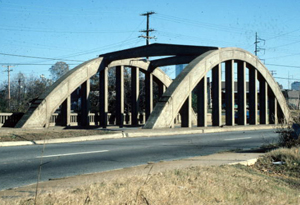
On Lincoln’s Birthday – A Lincoln Viaduct Portrait

Photo courtesy of the Arkansas Historic Preservation Program

Since today is Abraham Lincoln’s birthday, it is a good day to pay tribute to the Lincoln Avenue Viaduct.  This arched bridge is traversed by thousands of cars each day, with most having no idea the name of the structure.  The Lincoln Avenue Viaduct is the arched bridge connecting LaHarpe with Cantrell Road which (literally) bridges downtown with the west along Highway 10.

The Lincoln Avenue Viaduct is a reinforced concrete rainbow arch bridge. It was opened at 2:05 p.m. on Friday, December 28, 1928, and, despite later alterations, it remains particularly well-preserved. The Missouri Pacific Railroad Company, considered the most important railroad company in the state, constructed the bridge amid a series of improvements in Little Rock made necessary by the damage wrought by the infamous spring floods of 1927.

Though the bridge was constructed by the railroad, the City had to give authorization to do so, this was accomplished by the passing of Ordinance 4,335, at the May 28, 1928, City Council meeting.

Lincoln Avenue was one of several names for stretches of Highway 10 in Little Rock. By the 1960s, the areas west of the Lincoln Avenue viaduct were all renamed Cantrell in honor of the man who had developed much of the area west of the Heights. The longest stretch of the road already carried that name. There had been an effort to rename Highway 10 (including sections named Lincoln, Q, and Cantrell) in Little Rock for Senator Joseph Taylor Robinson in 1930. He declined the offer because he did not want to diminish the contributions of Mr. Cantrell.  Over time the entire stretch bore the name Cantrell.

The stretches east of the viaduct which involved a couple of names were renamed La Harpe Boulevard in honor of the French explorer who first saw the Little Rock. (La Harpe was originally an extension of Riverfront Drive. But with changes to development along the Arkansas River and the coming of I-30, the streets were reconfigured significantly in the 1950s and early 1960s.)

Though the street has been renamed, the bridge still carries the name of the 16th President of the United States.

Temporary Home for Arkansas Arts Center announced

The Arkansas Arts Center will temporarily relocate to 2510 Cantrell Road in the Riverdale Shopping Center for two and a half years during the center’s upcoming renovation and expansion project.
The temporary location, about three miles from the AAC’s MacArthur Park site, will include studio space for Museum School classes, design and rehearsal space for the Children’s Theatre and additional flexible spaces for offices, retail, facilities storage and educational programs.

“The AAC’s impact in our community, both in Central Arkansas and across the state, is immense and enduring,” said Merritt Dyke, President of the AAC board. “In addition to the nearly 200,000 visitors to MacArthur Park, the AAC’s statewide outreach numbers approach half a million people. We’ve been working with numerous community partners to ensure that we can continue to fulfill our mission and to serve these people while the AAC is under construction.”

“The support we’ve received throughout this endeavor has been overwhelming, and we are grateful to Harriet and Warren Stephens who are chairing our lead gifts capital campaign,” said Dyke. “Without their leadership, this project would not be where it is today. I am greatly appreciative to the AAC and Foundation boards, staff and all our community partners for their role in realizing this important vision.”

The AAC’s staff of approximately 100 full-and part-time employees will office out of this location during the renovation. Groundbreaking on the AAC’s transformational building project is scheduled for fall 2019, with the project anticipated to be completed in early 2022. The MacArthur Park facility will be available for all regular summer programming, with the new temporary Riverdale location opening sometime in September.

“The AAC’s programs are a vital part of our community,” said Bobby Tucker, Chairman of the AAC’s Foundation board. “We feel it’s of maximum importance that they continue to be offered while the center is under construction. Our commitment to the success of this transformational project in MacArthur Park is unwavering, as is our commitment to the organization as a whole.”

The Cantrell Road location will offer convenient, secure parking and new amenities for AAC program participants. With 15,200 square feet of studio space, the Museum School will offer nearly all its current program of classes and workshops, including drawing, painting, ceramics, jewelry, glass, small metals, woodworking and printmaking for its nearly 3,000 students per year. Fall Quarter classes will begin in the Riverdale location in September.

“We’ve been working diligently for more than a year to ensure that our students have a creative space, with the equipment needed to continue to engage in our classes in a temporary location,” said Rana Edgar, Director of Education and Programs. “Over the next three years, we plan to welcome our students into well-appointed studios, with all our core classes currently being offered, in addition to offering expanded opportunities to build their talents.”

In the Children’s Theatre’s 14,200 square-foot workshop, theatre staff will create sets, sew costumes, and build props for the AAC’s productions, including touring programs. Children’s Theatre on Tour, part of the AAC’s Statewide ArtsReach program, serves more than 35,000 students and families in communities across Arkansas every year with traveling professional theatre productions.

“The work of the Children’s Theatre team doesn’t stop when the stage lights go down in MacArthur Park,” said Bradley Anderson, Artistic Director in the Children’s Theatre. “We create theatre productions each season that travel the state, in addition to our local summer theatre academies, theatre classes and performances at the AAC. This move will allow those programs to continue – and possibly even expand.”

The AAC Museum Shop will also move its retail storefront into 1,500 square feet of space, joining many other local restaurants and businesses in the area. Administrative, facilities, equipment storage and flexible educational spaces will round out a total of 65,000 square feet of space at the temporary facility.

The move is one piece of the AAC’s commitment to remaining accessible to the community while its MacArthur Park facility is under construction, and to working with arts partners across the region to expand programming reach.

“The AAC is more than any one space or one building. Our programs will continue to span across communities and extend across the state over the next two and a half years,” said Laine Harber, Interim Executive Director and Chief Financial Officer. “This would not be possible without the commitment and dedication of our board leadership in continuing to fulfill our mission and vision while we undergo these much-needed renovations.”

AAC exhibition programs will also pop up in locations across Central Arkansas and beyond, including the continuation of the popular Delta and Young Arkansas Artists exhibitions. Works from the collection will also travel to other institutions across the country and across Arkansas, in addition to select objects from the contemporary craft collection remaining on view at 15 Central Arkansas Library System locations.

More details about additional programs and partnerships locally and across the state will continue to be announced throughout 2019.

Rock the Oscars 2019: THE HANGING TREE

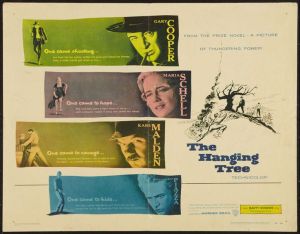
On February 11, 1959, THE HANGING TREE was released.  This film was the first Hollywood movie in with Little Rock native Ben Piazza appeared.  For the film, Piazza received a coveted “and introducing Ben Piazza” credit.

The movie starred Oscar winners Gary Cooper and Karl Malden, along with Maria Schell.  Future Oscar winner George C. Scott, was fifth billed for his scenery chewing role of a religious zealot.

The title song, “The Hanging Tree,” written by Jerry Livingston and Mack David, was sung by Marty Robbins in the film.  It was nominated for the Oscar for Best Song.

Filming began in June 1958 in Washington state.  Shooting took place from June through August 1958 mainly near Yakima, Washington.  The film was directed by Delmer Daves, who was probably best known as screenwriter of Love Affair and director of 3:10 to Yuma.  In conjunction with filming The Hanging Tree, Piazza appeared in a TV special on western movies.  Most of the others appearing in the special were well-established Hollywood western personalities including Little Rock natives Bronco Billy Anderson and Gail Davis.

The Hanging Tree had a budget of $1.35 million ($11.5 million today—about half of the typical modest film budget).  A good portion of this expense was the construction of a mining town.  Once production began, Daves became ill and had to be hospitalized for ulcers. Co-star Karl Malden was approached to complete the film.  He had recently finished his first directing assignment.  He had reservations, but agreed to direct because of support of Cooper. (There are discrepancies as to the length of time Daves was out of commission.)

Ben received positive notices.  One reviewer referred to him as being a “laconic, doe-eyed rebel.” Another said he was a “handsome and mean-looking boy…with curls like a golden poodle.”     Several reviewers referenced James Dean when discussing Piazza in a positive light.

The film was released to respectful notices in February 1959.  It earned around $2.2 million, which meant it turned a profit.

THE BOOK OF MORMON at Robinson Center from February 12 to 17

Hello!

THE BOOK OF MORMON, winner of nine Tony Awards® including Best Musical has been brought to Little Rock by Celebrity Attractions. Performances begin Tuesday, February 12 and continue through Sunday, February 17. Show times are at 7:30pm each evening with matinees on Saturday and Sunday.

THE BOOK OF MORMON features book, music and lyrics by Trey Parker, Robert Lopez and Matt Stone.  Tony Award-winner Lopez is co-creator of the long-running hit musical comedy, Avenue Q.  The musical is choreographed by Tony Award-winner Casey Nicholaw (Monty Python’s Spamalot, The Drowsy Chaperone) and is directed by Nicholaw and Parker.

THE BOOK OF MORMON is the winner of nine Tony Awards, including Best Musical, Best Score (Trey Parker, Robert Lopez, Matt Stone), Best Book (Trey Parker, Robert Lopez, Matt Stone), Best Direction (Casey Nicholaw, Trey Parker), Best Featured Actress (Nikki M. James), Best Scenic Design (Scott Pask), Best Lighting Design (Brian MacDevitt), Best Sound Design (Brian Ronan) and Best Orchestrations (Larry Hochman, Stephen Oremus); the New York Drama Critics Circle Award for Best Musical; five Drama Desk Awards including Best Musical, the 2011 Grammy Award for Best Musical Theater Album; four Outer Critics Circle Awards, including Best Musical, and the Drama League Award for Best Musical.

THE BOOK OF MORMON features set design by Scott Pask, costume design by Ann Roth, lighting design by Brian MacDevitt and sound design by Brian Ronan.  Orchestrations are by Larry Hochman and Stephen Oremus.  Music direction and vocal arrangements are by Stephen Oremus.

The Original Broadway Cast Recording for THE BOOK OF MORMON, winner of the 2011 Grammy Award for Best Musical Theater Album, is available on Ghostlight Records.

Ticket buyers are reminded that for Celebrity Attractions’ productions, Celebrity Attractions and Ticketmaster are the only official retail ticket outlets and the only way to guarantee that you are paying face value for legitimate tickets.  Ticket buyers who purchase tickets from a ticket broker or any third party should also be aware that Celebrity Attractions is unable to reprint or replace lost or stolen tickets and is unable to contact patrons with information regarding time changes or other pertinent updates regarding the performance.

Juror for 61st Arkansas Arts Center Delta Show announced; Deadline to apply is February 13

Image result for kevin cole artistAtlanta-based artist Kevin Cole will serve as guest juror for the 61st Annual Delta Exhibition, on view May 3 through June 30 at the Arkansas Arts Center. The deadline for artists to submit work to be considered for the exhibition is February 13, 2019.

Kevin Cole is a contemporary artist best known for sculptural works, paintings, and intentional use of color. An Arkansas native, Cole’s artwork has been featured in more than 475 national and international exhibitions, including the 42nd Annual Delta Exhibition (1999) at the Arkansas Arts Center.

His work can be found in notable private and public collections around the country. Among his public commissions are a fifteen-story mural commissioned by the Coca-Cola Company for the 1996 Centennial Olympic Games in Atlanta and a twenty-foot high by fifty-five feet long sculpture commission at Hartsfield-Jackson International Airport, Atlanta. His recent sculpture, When My Scars are my Testimony, is featured in the 2019 Atlanta Biennial at the Atlanta Contemporary Art Center.

Cole has been a member of AfriCOBRA since 2003 and was inducted into the Arkansas Black Hall of Fame in 2018.

Rock the Oscars 2019: Opening of the Clinton Presidential Center

Probably the largest gathering of Oscar winners and Oscar nominees in Little Rock’s history took place in November 2004.

Though some Oscar winners and nominees had been present for the Clinton election night parties in 1992 and 1996, the opening of the Clinton Presidential Center brought luminaries from Hollywood en masse.

Among those present were Oscar winning actors Barbara Streisand, Robin Williams, and (of course) Arkansan Mary Steenburgen.  Future Oscar winner Morgan Freeman was also in attendance. Among the Oscar nominees who were present were Bono and The Edge (who performed at the ceremony) and Alfre Woodard.

Senator John Glenn, who had been featured as a character in the Oscar winning film The Right Stuff was also present for the festivities.  Former Vice President Al Gore did not actually win an Oscar for An Inconvenient Truth (the documentary awards go to the director), but was closely identified with this Oscar winning documentary.

There were plenty of rumors about other Oscar winners and nominees in town, though they were not true.