
Little Rock Look Back: Implosion of the Grady Manning and the Marion

On February 17, 1980, a cold and clear Sunday morning, over seven decades of Arkansas history came tumbling down as the Hotel Marion and Grady Manning Hotel were imploded.

Thousands of people watched from places in downtown Little Rock and along the Arkansas River.  Many more were able to watch from live coverage carried on KATV, KARK and KTHV.  Those that missed it were able to see the replays multiple times on the news.

It was the first large-scale implosion in Little Rock’s history.  (It was likely the first implosion, but there could have been a small one that is not known.)  The two hotels were torn down to make way for the construction of the Excelsior Hotel and the Statehouse Convention Center.

The Hotel Marion, named after the builder Herman Kahn for his wife, opened in 1907. For four years it was Arkansas’ tallest structure.  It was the largest and grandest hotel in the City. For decades it would be the host to many dignitaries, conventions, and gala celebrations.

The Grady Manning Hotel was originally known as the Hotel Ben McGhee when it opened in 1930.   Manning was the head of the company which owned both the Marion and Ben McGhee properties.  Upon his untimely death by drowning in September 1939, the property was subsequently renamed in his memory.

The Manning Hotel, though taller, was never as grand a hotel as the Marion.  It was more of a mid-range property in pricing.

By the 1970s, both hotels were suffering from neglect and disinterest.  Changes in the lodging industry combined with a decline in downtown Little Rock had left both facilities with little business.

When Little Rock civic and government leaders decided to construct a larger convention center downtown with an adjacent hotel, it was decided that neither of these facilities could be properly renovated to be part of the project.  Instead, the land on which they stood (and the space in between) would be prime for the new hotel and center.

So, on the cold Sunday morning, the explosives were detonated, and the buildings came down.   Sunday morning was chosen because it would have the least impact on traffic flows since it would cause numerous streets to be closed for safety reasons.  The blast was delayed due to a rumor that someone might be in one of the buildings.  After checking both sites and finding them empty, the charges were set off.

And the Marion and Grady Manning became as much a memory as the long gone people who had once populated them.

The University of Arkansas’ Pryor Center for Oral and Visual History has a video of the implosion.

Little Rock Look Back: Polk Stanley Wilcox joins Studio Gang Architects in planning for reimagined Arkansas Arts Center

On February 16, 2017, the Arkansas Arts Center announced the selection of Polk Stanley Wilcox Architects as associate architect for its upcoming building project. Polk Stanley Wilcox will work in partnership with Studio Gang Architects on a reimagined Arkansas Arts Center. Studio Gang was selected as design architect for the expansion and renovation in December.

Polk Stanley Wilcox Architects is a programming, architectural, planning and interior design firm with offices in Little Rock and Fayetteville. The firm has experience working with clients in a variety of industries, including healthcare, nonprofit, cultural, education, corporate and worship. Polk Stanley Wilcox also focuses on sustainability and creating buildings that operate on minimal energy usage.

“We are thrilled to partner with the Arkansas Arts Center and Studio Gang on this transformative project,” Polk Stanley Wilcox Principal David Porter said. “AAC has cast an exciting vision to rethink not only how the Center upgrades the interior and exterior spaces, but how the AAC connects to and enriches the broad arts and cultural tapestry of Little Rock. Studio Gang is a uniquely talented firm to lead the design effort. PSW is honored to bring our extensive experience from years of important projects in downtown Little Rock to come alongside them and the AAC to help create this next critical milestone for the city, state and region.”

Polk Stanley Wilcox has previously worked on a number of local projects, including the William J. Clinton Presidential Library, Heifer International Headquarters, the Arkansas Studies Institute and the recently opened Robinson Center expansion and renovation.

“We look forward to working with the team at Polk Stanley Wilcox,” said Studio Gang Founding Principal Jeanne Gang. “We hope to build on their strong history of collaborations in the area and believe that their knowledge of Little Rock will be a huge asset as we expand the impact of the Arkansas Arts Center in Little Rock, and in the region.”

Polk Stanley Wilcox Architects was selected from among three finalists to work in partnership with Studio Gang. Ten local firms responded to the RFQ issued last month. Allison and Partners and Cromwell Architects were also finalists.

The three finalist firms presented to the selection committee on February 16. The selection committee for the associate architect included AAC Executive Director Todd Herman, three representatives from Studio Gang, and international museum consultant Deborah Frieden, and AAC Board member Sara Hendricks Batcheller.

“Each of the finalists are strong, well-respected firms,” Arts Center Executive Director Todd Herman said. “Ultimately, Polk, Stanley, Wilcox was the best complement to Studio Gang in terms of experience and strengths. Their work at Robinson auditorium – similar in both scope and complexity – will be an asset as we move through the project. We are very pleased to have PSW on board for this important project that will create wonderful new spaces for the people of Little Rock and Arkansas to enjoy the arts. Having our architectural team in place is a major milestone. We are very excited to move the project forward.”

Tonight’s QQA Preservation Conversation explores the National Register of Historic Places

In this month’s Preservation Conversation, the National Register of Historic Places will be discussed.  The program, featuring Callie Willliams, begins today (February 14) with a 5:30 reception and a 6:00 lecture.  It will be in the Mixing Room at the Old Paint Factory in the East Village (1306 East 6th Street).  Preservation Conversations are a program of the Quapaw Quarter Association.

RSVP: The event is free and open to the public, but please RSVP because space is limited.

Parking: There is parking directly in front of the doors that are marked “Live,” “Print,” “Meet.” If those spots are taken. park in the parking lot to the right. There is also street parking in front of the building.

Entrance: Enter the event space through the door facing 6th Street marked “Meet.”

Questions? Call 501-371-0075 ext. 3 or email qqa@quapaw.com

Cfd7e5ed 5b07 457a 8688 f8f5b807f487The National Register of Historic Places is the official list of the Nation’s historic places worthy of preservation. Authorized by the National Historic Preservation Act of 1966, the National Park Service’s National Register of Historic Places is part of a national program to coordinate and support public and private efforts to identify, evaluate, and protect America’s historic and archeological resources. The Arkansas Historic Preservation Program (AHPP) is responsible for National Register implementation in Arkansas. February’s presentation will be on the history and development of the National Register of Historic Places (NRHP) as well as the research and process used to pursue listing in the Register.
Callie is a native of Arkansas and graduated from the University of Arkansas in 2008 with a Bachelors of Science in Architectural Studies. In 2010 she earned a Masters in Architectural History from the University of Virginia. As part of her graduate requirements, she completed a thesis entitled “Euine Fay Jones: Architecture is invention-is innovation-but it is also remembering”. After completing her graduate degree, she worked as the University of Virginia Registrar aboard the Semester at Sea Spring 2011 voyage around the world. In 2011, Callie returned to Arkansas and now works for AHPP. As the Education and Outreach Coordinator, she has worked with individuals and groups across the state to identify, research, and nominate historic structures to the National Register of Historic Places.

Landscape Architecture Now! Case Studies in Mexico and Latin America is topic of lecture tonight

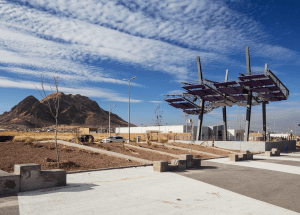
Vistas Cerro Grande Linear Park in Chihuahua City: A Public Mile Designed with and for the Community. Photos by Delfoz.

Vistas Cerro Grande Linear Park in Chihuahua City: A Public Mile Designed with and for the Community. Photos by Delfoz.

Architecture and Design Network (ADN) continues its 2018/2019 June Freeman lecture series by diving into the discipline and profession of landscape architecture by analyzing a double context:  first, the larger context of the Latin American continent; and second, Mexico as a specific context.

The program will begin at 6:00pm tonight at the Arkansas Arts Center. A reception will precede it at 5:30pm.

Gabriel Diaz Montemayor, Assistant Professor of Landscape Architecture at The University of Texas at Austin and Founder of Labor Studio, will present these findings in ADN’s second lecture of 2019 year, “Landscape Architecture Now!  Case Studies in Mexico and Latin America.”

The discipline and profession of Landscape Architecture is not the same in Latin America as in the United States. It should not be the same. A brief historic chronology will be traced to explain the different origins and meaning of public space in this continent while addressing the need to identify the unique national and regional differences, avoiding -often done- common generalizations. Recent project case studies will be synthesized to portray the current condition of the discipline in the Latin American context.

The contemporary condition of Public Space in Mexico will be explained as one of the unique conditions assembling the Latin American mosaic. The country has recently gone through dramatic changes in public life, society, culture, and politics. A set of case studies in Landscape Architecture and Public Space, where Montemayor has been involved in different capacities, will be employed to explain the challenges and opportunities for Landscape Architecture in Mexico.

The Mexican projects include applied academic studios trying to fill the void between the planning and the implementation of public infrastructure projects needing landscape architectural methods and matter. These will also include professional public space commissions based on community reconstruction, engagement, and participation. Both applied studios and professional projects operate in a third context, northern Mexico. This will lead to a final proposition reflecting on a potential future for the border region between the United States and Mexico, one where societies are reconciled with their common ground.

Gabriel Diaz Montemayor, ASLA, is an Assistant Professor of Landscape Architecture at the School of Architecture at The University of Texas at Austin. Through Spring 2019, he will hold the Garvan Chair and Visiting Professorship in Landscape Architecture at the Fay Jones School of Architecture and Design.

Montemayoris an architect educated at the School of the Desert:  The Superior Institute of Architecture and Design (ISAD) at Chihuahua, Mexico, from where he graduated in 1998. He holds an architect degree from the Autonomous University of Chihuahua, Mexico, and received his Master of Landscape Architecture from Auburn University in 2007.  Montemayoris a founder of LABOR Studio, an architecture, urban design and landscape architecture practice based in Chihuahua, Mexico, since 2002. The studio has engaged in a variety of private and public commissions.

Architecture and Design Network lectures are free and open to the public. No reservations are required.  Supporters of ADN include the Fay Jones School of Architecture and Design, the Central Section of the Arkansas Chapter of the American Institute of Architects and friends in the community.

Sandwich in History at Mosaic Templars today (2/1) at noon

Image may contain: sky, cloud, tree and outdoorThe Arkansas Historic Preservation Program each month sponsors a Sandwiching in History tour which familiarize people who live and work in central Arkansas with the historic structures and sites around us.

The tours take place on Fridays at noon, last less than an hour, and participants are encouraged to bring their lunches so that they can eat while listening to a brief lecture about the property and its history before proceeding on a short tour.

Today (February 1) at 12 noon, this month’s tour is at Mosaic Templars State Temple (906 S. Broadway).  Built in 1921, the Mosaic Templars State Temple was designed by African American architect Walter Thomas Bailey. The building was built by the Mosaic Templars of America, an important late 19th- and early 20th-century African American fraternal organization, as part of its headquarters and originally contained offices, a lodge hall and a hospital space.

For February, the schedule for the tour will be a little different than normal. At noon, the MLK Commission will hold a ribbon cutting for their offices in the building, which will be followed by the lecture on the building. The lecture will be held in the Auditorium of the Mosaic Templars Cultural Center and will likely start about 12:15-12:30. After the lecture, feel free to tour the building.

The Arkansas Historic Preservation Program is an agency of the Department of Arkansas Heritage.

TINY HOUSE NATION focus of Clinton School talk this evening

Image result for tiny house nation tvIn “Tiny House Nation,” renovation experts and hosts, John Weisbarth and Zack Giffin, travel across America to show off ingenious small spaces and the inventive people who live in them, as well as help new families design and construct their own mini-dream home in a space no larger than 500 square feet.

This evening (February 1) at the Clinton School at 6:00pm, Weisbarth and Giffin with discuss Tiny House Nation.

From a micro-apartment in New York City to a caboose car turned home in Montana to a micro-sized mobile home for road tripping – this is a series that celebrates the exploding movement of tiny homes. From pricey to budget friendly, “Tiny House Nation” is not a typical design show, but one that proves size doesn’t always matter – it’s creativity that counts.

With more than a decade of live television experience and six regional Emmy Awards to his name, host John Weisbarth brings his high energy and award-winning style to Tiny House Nation.

Giffin is a professional skier and contractor who is co-host of Tiny House Nation. He has so much love for tiny homes that he built a mobile tiny ski house for himself, and has lived in it full-time for years.

Zack manages each project and build crew and his innovative tricks of the tiny trade always wow. For each home Zack designs a special build project that is tailored to the homeowner’s needs, and his creations are not only super space saving inventions, they’re works of art too.

All Clinton School Speaker Series events are free and open to the public. Reserve your seats by emailing publicprograms@clintonschool.uasys.edu or by calling (501) 683-5239

Annual Members meeting tonight for Quapaw Quarter Association

Image may contain: outdoor

Join the Quapaw Quarter Association for its yearly members only reception at the beautifully rehabilitated Mills-Davis house!

Built in 1878, this Italianate house was home to Abraham Anderson Mills and his wife Eliza. Abraham was sheriff and county judge. They lived in the house until the 1940s when it was sold to Dr. Emmett N. Davis, who passed the house on to his son, famed photographer William “Bill” Davis. The house was purchased by Jennifer Carman in 2016, and rehabilitated by Jennifer Carman and Donna Thomas. It is now home to J. Carman,Inc. fine art advisory and appraisal services, and Norton Arts, Inc., a nationally known art conservation firm.

This event is for members only, but memberships can be purchased at the door for as little as $35.00. Members who need to renew their memberships will also have the chance to do so at the event.

Event Location: Mills-Davis House, 523 E. 6th St Little Rock, AR.

Time: 5:30 pm to 7:30 pm

Parking: There is parking a block down the street at Curran Hall, or in the Curran Hall parking lot at 620 E. 6th street. There is also street level parking on Capitol (one block north), Sherman, 7th Street, and 8th Street.

Questions? Call 501-371-0075 ext. 3 or e-mail qqa@quapaw.com.

RSVP: Please let them know you are coming by clicking here.