
LANTERNS! 2019 this weekend at Wildwood Park

Image may contain: text

Wildwood’s annual deep-winter festival celebrates the first full moon of the lunar new year. Held over three magical evenings, guests are transported to far away lands and times as they stroll through the beautifully lit pathways of Wildwood’s gardens. Cultural vistas feature live entertainment, food, drink, games and more throughout the Park’s Butler Arboretum and inside the Lucy Lockett Cabe Festival Theatre.

This year’s vistas include Germany, Mexico, China, Scotland, and the rest of the United Kingdom. Our American vista is Prohibition Chicago. As always, a trip to the Moon is a must, but this year be sure to stop by Area 51 as you just might find some aliens at our Moon vista.

Once you’re inside the gate, purchase your WildBucks at any of four locations and enjoy food and beverages at every vista. Prices range from $1 to $8. (ATM available inside the Park.) All proceeds support Wildwood Park for the Arts’ programs, gardens and operations.

TICKETS:

Tickets to the event are available online: $10 for adults, $5 for children age 6 – 12, Admission to LANTERNS! is FREE for children 5 and younger. At noon on each day of the festival, admission for that evening will increase to $12 for adults and $7 for children. Tickets at the gate are $12 for adults and $7 for children. Admission to LANTERNS! for children 5 and younger is FREE.

If you choose to purchase your ticket at the gate, we recommend bringing cash to avoid credit card fees and ticket lines!

Shuttles will run between The Promenade at Chenal and Wildwood Park beginning at 6 pm nightly until 30 minutes past the Festival’s closing. The festival closes at 10 pm on Friday & Saturday, 9 pm on Sunday. Arkansas Destinations shuttles will pick up passengers in the mall’s Courtyard located on the west side of the mall. Parking is ample. 

Off-street parking is also available along Denny Road in front of Wildwood Park. Guests enter the park on foot through two gates; no festival patron automobiles are allowed inside the park.

Tonight’s QQA Preservation Conversation explores the National Register of Historic Places

In this month’s Preservation Conversation, the National Register of Historic Places will be discussed.  The program, featuring Callie Willliams, begins today (February 14) with a 5:30 reception and a 6:00 lecture.  It will be in the Mixing Room at the Old Paint Factory in the East Village (1306 East 6th Street).  Preservation Conversations are a program of the Quapaw Quarter Association.

RSVP: The event is free and open to the public, but please RSVP because space is limited.

Parking: There is parking directly in front of the doors that are marked “Live,” “Print,” “Meet.” If those spots are taken. park in the parking lot to the right. There is also street parking in front of the building.

Entrance: Enter the event space through the door facing 6th Street marked “Meet.”

Questions? Call 501-371-0075 ext. 3 or email qqa@quapaw.com

Cfd7e5ed 5b07 457a 8688 f8f5b807f487The National Register of Historic Places is the official list of the Nation’s historic places worthy of preservation. Authorized by the National Historic Preservation Act of 1966, the National Park Service’s National Register of Historic Places is part of a national program to coordinate and support public and private efforts to identify, evaluate, and protect America’s historic and archeological resources. The Arkansas Historic Preservation Program (AHPP) is responsible for National Register implementation in Arkansas. February’s presentation will be on the history and development of the National Register of Historic Places (NRHP) as well as the research and process used to pursue listing in the Register.
Callie is a native of Arkansas and graduated from the University of Arkansas in 2008 with a Bachelors of Science in Architectural Studies. In 2010 she earned a Masters in Architectural History from the University of Virginia. As part of her graduate requirements, she completed a thesis entitled “Euine Fay Jones: Architecture is invention-is innovation-but it is also remembering”. After completing her graduate degree, she worked as the University of Virginia Registrar aboard the Semester at Sea Spring 2011 voyage around the world. In 2011, Callie returned to Arkansas and now works for AHPP. As the Education and Outreach Coordinator, she has worked with individuals and groups across the state to identify, research, and nominate historic structures to the National Register of Historic Places.

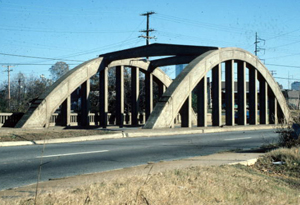
On Lincoln’s Birthday – A Lincoln Viaduct Portrait

Photo courtesy of the Arkansas Historic Preservation Program

Since today is Abraham Lincoln’s birthday, it is a good day to pay tribute to the Lincoln Avenue Viaduct.  This arched bridge is traversed by thousands of cars each day, with most having no idea the name of the structure.  The Lincoln Avenue Viaduct is the arched bridge connecting LaHarpe with Cantrell Road which (literally) bridges downtown with the west along Highway 10.

The Lincoln Avenue Viaduct is a reinforced concrete rainbow arch bridge. It was opened at 2:05 p.m. on Friday, December 28, 1928, and, despite later alterations, it remains particularly well-preserved. The Missouri Pacific Railroad Company, considered the most important railroad company in the state, constructed the bridge amid a series of improvements in Little Rock made necessary by the damage wrought by the infamous spring floods of 1927.

Though the bridge was constructed by the railroad, the City had to give authorization to do so, this was accomplished by the passing of Ordinance 4,335, at the May 28, 1928, City Council meeting.

Lincoln Avenue was one of several names for stretches of Highway 10 in Little Rock. By the 1960s, the areas west of the Lincoln Avenue viaduct were all renamed Cantrell in honor of the man who had developed much of the area west of the Heights. The longest stretch of the road already carried that name. There had been an effort to rename Highway 10 (including sections named Lincoln, Q, and Cantrell) in Little Rock for Senator Joseph Taylor Robinson in 1930. He declined the offer because he did not want to diminish the contributions of Mr. Cantrell.  Over time the entire stretch bore the name Cantrell.

The stretches east of the viaduct which involved a couple of names were renamed La Harpe Boulevard in honor of the French explorer who first saw the Little Rock. (La Harpe was originally an extension of Riverfront Drive. But with changes to development along the Arkansas River and the coming of I-30, the streets were reconfigured significantly in the 1950s and early 1960s.)

Though the street has been renamed, the bridge still carries the name of the 16th President of the United States.

Landscape Architecture Now! Case Studies in Mexico and Latin America is topic of lecture tonight

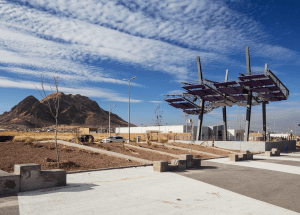
Vistas Cerro Grande Linear Park in Chihuahua City: A Public Mile Designed with and for the Community. Photos by Delfoz.

Vistas Cerro Grande Linear Park in Chihuahua City: A Public Mile Designed with and for the Community. Photos by Delfoz.

Architecture and Design Network (ADN) continues its 2018/2019 June Freeman lecture series by diving into the discipline and profession of landscape architecture by analyzing a double context:  first, the larger context of the Latin American continent; and second, Mexico as a specific context.

The program will begin at 6:00pm tonight at the Arkansas Arts Center. A reception will precede it at 5:30pm.

Gabriel Diaz Montemayor, Assistant Professor of Landscape Architecture at The University of Texas at Austin and Founder of Labor Studio, will present these findings in ADN’s second lecture of 2019 year, “Landscape Architecture Now!  Case Studies in Mexico and Latin America.”

The discipline and profession of Landscape Architecture is not the same in Latin America as in the United States. It should not be the same. A brief historic chronology will be traced to explain the different origins and meaning of public space in this continent while addressing the need to identify the unique national and regional differences, avoiding -often done- common generalizations. Recent project case studies will be synthesized to portray the current condition of the discipline in the Latin American context.

The contemporary condition of Public Space in Mexico will be explained as one of the unique conditions assembling the Latin American mosaic. The country has recently gone through dramatic changes in public life, society, culture, and politics. A set of case studies in Landscape Architecture and Public Space, where Montemayor has been involved in different capacities, will be employed to explain the challenges and opportunities for Landscape Architecture in Mexico.

The Mexican projects include applied academic studios trying to fill the void between the planning and the implementation of public infrastructure projects needing landscape architectural methods and matter. These will also include professional public space commissions based on community reconstruction, engagement, and participation. Both applied studios and professional projects operate in a third context, northern Mexico. This will lead to a final proposition reflecting on a potential future for the border region between the United States and Mexico, one where societies are reconciled with their common ground.

Gabriel Diaz Montemayor, ASLA, is an Assistant Professor of Landscape Architecture at the School of Architecture at The University of Texas at Austin. Through Spring 2019, he will hold the Garvan Chair and Visiting Professorship in Landscape Architecture at the Fay Jones School of Architecture and Design.

Montemayoris an architect educated at the School of the Desert:  The Superior Institute of Architecture and Design (ISAD) at Chihuahua, Mexico, from where he graduated in 1998. He holds an architect degree from the Autonomous University of Chihuahua, Mexico, and received his Master of Landscape Architecture from Auburn University in 2007.  Montemayoris a founder of LABOR Studio, an architecture, urban design and landscape architecture practice based in Chihuahua, Mexico, since 2002. The studio has engaged in a variety of private and public commissions.

Architecture and Design Network lectures are free and open to the public. No reservations are required.  Supporters of ADN include the Fay Jones School of Architecture and Design, the Central Section of the Arkansas Chapter of the American Institute of Architects and friends in the community.

TINY HOUSE NATION focus of Clinton School talk this evening

Image result for tiny house nation tvIn “Tiny House Nation,” renovation experts and hosts, John Weisbarth and Zack Giffin, travel across America to show off ingenious small spaces and the inventive people who live in them, as well as help new families design and construct their own mini-dream home in a space no larger than 500 square feet.

This evening (February 1) at the Clinton School at 6:00pm, Weisbarth and Giffin with discuss Tiny House Nation.

From a micro-apartment in New York City to a caboose car turned home in Montana to a micro-sized mobile home for road tripping – this is a series that celebrates the exploding movement of tiny homes. From pricey to budget friendly, “Tiny House Nation” is not a typical design show, but one that proves size doesn’t always matter – it’s creativity that counts.

With more than a decade of live television experience and six regional Emmy Awards to his name, host John Weisbarth brings his high energy and award-winning style to Tiny House Nation.

Giffin is a professional skier and contractor who is co-host of Tiny House Nation. He has so much love for tiny homes that he built a mobile tiny ski house for himself, and has lived in it full-time for years.

Zack manages each project and build crew and his innovative tricks of the tiny trade always wow. For each home Zack designs a special build project that is tailored to the homeowner’s needs, and his creations are not only super space saving inventions, they’re works of art too.

All Clinton School Speaker Series events are free and open to the public. Reserve your seats by emailing publicprograms@clintonschool.uasys.edu or by calling (501) 683-5239

Little Rock Look Back: Installation of Lorri Acott’s PEACE Sculpture in 2015

On January 26, 2015, the City of Little Rock and Sculpture at the River Market installed Lorri Acott’s PEACE sculpture at the southeast corner of the intersection of Main Street and Second Street.

Peace was the winner of the 2014 Sculpture at the River Market Show and Sale public monument competition. The 12-feet-tall sculpture is made of bronze. It features a human figure standing with hands outstretched over its head. In between the hands is an arc made up of origami cranes.

The Sculpture at the River Market Committee commissioned the $60,000 sculpture and donated it to the City of Little Rock. “Peace” is made of bronze and features a long silhouette with colorful bronze origami cranes, known as symbols of peace and hope.

The sculpture design has won several accolades, including an “Art to Change the World” award from the American Civil Liberties Union and the 2014 World Citizens Artist Award from an international competition featuring art inspired the theme of peace.

Arkansas Preservation Awards tonight

No photo description available.

The Arkansas Preservation Awards will honor outstanding achievements in historic preservation from all over the state, including this year’s recipients of the Parker Westbrook Award for Lifetime Achievement, Hot Springs architects Anthony Taylor and Bob Kempkes.

The awards are presented by Preserve Arkansas. Rex Nelson will be the emcee for the awards. The evening will begin with a reception at 5:30pm at the Albert Pike Masonic Center.

Anthony Taylor and Bob Kempkes founded Taylor/Kempkes Architects, P.A. in Hot Springs in 1986. Over the years, Taylor and Kempkes have demonstrated a strong commitment to the preservation of our state’s built environment and the revitalization of downtown Hot Springs. Their notable Hot Springs projects include the restoration and/or rehabilitation of the Mountain Valley Spring Company Building, Old Post Office, Quapaw Bathhouse, and the Thompson Building.

Other award recipients are:

Excellence in Heritage Preservation – Ginger Sandy – “Cedar Grove/Mobley Historical Preservation” Facebook page

Excellence in Preservation through Rehabilitation
– Des Arc Public Library (Historic First Presbyterian Church), Des Arc
– Griffin Auto Company Building, El Dorado
– ScholarMade Achievement Place, Ivy Hill Academy of Scholarship (Historic James Mitchell School), Little Rock

Excellence in Preservation through Restoration
– Brunson House, Historic Washington State Park
– Methodist Manse, Cane Hill
– Shiloh Meeting Hall, Springdale

Outstanding Achievement in Preservation Education – University of Arkansas Fay Jones School of Architecture + Design, Department of Landscape Architecture for “Rising Above – Rohwer Reconstructed: Interpreting Place through Experience” website

Outstanding Achievement in Preservation Advocacy – U.S. Congressman Bruce Westerman, Representing Arkansas’s 4th District, for his efforts to save the Federal Historic Tax Credit during tax reform

Ned Shank Award for Outstanding Preservation Publication – University of Arkansas Press for “It’s All Done Gone”: Arkansas Photographs from the Farm Security Administration Collection, 1935-1943 by Patsy G. Watkins

Excellence in Personal Projects

  • Commercial: Mary Ann Lee, Indigo Blue Coffeehouse, Pine Bluff
  • Residential: Greg Gallagher, 1919 Beech Street, Texarkana
  • Honorable Mention: Cecil and Denise Ennett, Kleinschmidt House, Little Rock