Heritage Month – Lamar Porter Field

Lamar PorterLamar Porter Athletic Field is located in the Stifft Station neighborhood. Construction started in 1934 and continued for 18 months by the Works Progress Administration on a 10 acre site.

The 1,500 seat grandstand included club rooms, shower and locker rooms and a concession stand. It was first used by Boys’ Club teams in 1936. By 1937, City leagues and American Legion teams used it.  A playground, softball field and tennis courts were constructed next to the baseball field.

Lamar Porter Field is remarkable not only for its architecture, but also for its history.  Thousands of boys growing up in Little Rock played ball here.  One of those was future Baltimore Oriole Hall of Fame third baseman Brooks Robinson.  He has come back numerous times and has aided in fundraising efforts to restore the field.

The baseball sequence from A Soldier’s Story with Denzel Washington was filmed at Lamar Porter Field.

The field is named in memory of Lamar Porter, whose family donated the land and some money to help with the construction.  A Little Rock native, he was killed in May 1934 while he was attending Washington and Lee University.

Today Lamar Porter Field and the multipurpose field are home to RBI (Reviving Baseball in the Inner-city) which is an official program of Major League Baseball. Both Catholic High School and Episcopal Collegiate use Lamar Porter as their home field.

Lamar Porter Field was placed on the National Register of Historic Places on December 6, 1990.

Heritage Month – Joseph T. Robinson House

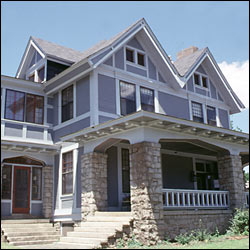
JT Robinson HouseThe Robinson House or the Foster-Robinson House is located at 2122 Broadway.

It was designed by Frank W. Gibb and built in 1904 for lumber man H. H. Foster.  Senator Robinson purchased the home from Foster’s widow and the house remained in the Robinson family until 1972 (following the Senator’s death in 1937 and his widow’s death in 1958). While visiting the state, President Roosevelt stayed at this house.

The Robinson house is a 2-1/2 story wood frame structure resting on a foundation of granite and brick. The exterior is sheathed in clapboards, and the roof is steeply pitched with a complex and irregular plan. There are four chimneys, two of brick and two of granite and brick. The main facade consists of a full-width porch supported by three square granite posts, above which are two pairs of sash windows, topped by a pair of gable ends, each with two small square windows. The gable ends are finished in stucco with decorative half-timbering. The porch is decorated with flattened Tudor-style arches and ornamental brackets, and shelters the main entrance, which is under the right gable, and paired windows under the left gable.

The interior has a wealth of high-quality woodwork, made using some of the choicest and most unusual cuts available at the time.

In addition to the house, the property includes a carriage house built using the same methods as the house. The yard is enclosed by an iron fence on the south and east sides, and a rock wall on the north and west sides.

It was listed in the National Register of Historic Places on March 28, 1975.  On October 12, 1994, it was designated a National Historic Landmark.

Heritage Month – Hotze House

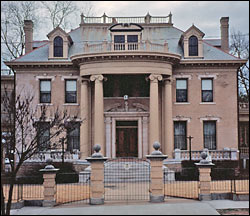
Hotze hosueThe Hotze House, located at 1619 Louisiana in Little Rock’s historic Quapaw Quarter district, was built by one of Arkansas’ most successful and prominent businessmen.  Designed by Charles L. Thompson, Little Rock’s most prominent architect and constructed in 1900, the house reflects the Beaux Arts tradition combined with Georgian influence.  The interior was reputed to have been designed by Tiffany Studios of New York.  The house has been remarkably well preserved and remains practically unaltered.

Peter Hotze was born in Innsbruck, Austria, on October 12, 1836.  He was young at the time of his father’s death, but Mrs. Hotze’s inheritance made it possible for her three sons to attend the University of Innsbruck.  In 1857 Peter Hotze moved to Little Rock and went into the general merchandise business.

Returning to Little Rock after service and imprisonment in the Civil War, Hotze went into a business as a merchant in partnership with Capt. John G. Fletcher, who had been his company commander.  Each man put $2,500 into the business.  After a while, they limited their business exclusively to the cotton trade.  In 1873 it was decided that Hotze should move to New York to handle that end of the firm’s business.  He lived there for 27 years, in a fashionable neighborhood near Central Park.

In 1900, Hotze retired and returned to Little Rock.  Upon his return in 1900 he built the large house in which he lived with his daughter Clara and son Frederick until his death on April 12, 1901.  He chose to build his home directly behind the small frame house he had built about l869 and lived in during his previous residence in Little Rock.

The Hotze House is one of the finer homes remaining in the state which expresses the opulence of the period in which it was constructed, particularly in the interiors, which are extraordinarily rich in quality. Resting on three and one-half lots, the Hotze House is remarkably well preserved and appears practically the same as when it was first constructed.

It was added to the National Register of Historic Places on August 11, 1975.


Heritage Month – Fordyce House

FordyceThe Fordyce House was built in 1904 for Mr. and Mrs John R. Fordyce.  The house was designed architect Charles L. Thompson in an Egyptian Revival style.  The Egyptian Revival style is rarely seen in houses in the United States,  major features of the style include the porch columns resembling bundles of stalks tied together and flared at the top and the “battered” walls that slant inward as they rise.

The Fordyce ‘s lived in the house until 1920 when it was sold to James Shipton who lived in the house until 1950.  The house has remained a single family home through the years.

It was added to the National Register of Historic Places on August 9, 1975.

New Visual Arts Building Announced for UALR thanks to gift from Windgate Foundation

With a target date to open in fall 2017, the University of Arkansas at Little Rock’s newest building will be among the finest higher education facilities in the country for visual arts education.

UALR unveiled the design concept for the 71,636 square-foot building today during a news conference in the Stella Boyle Smith Concert Hall. The visual arts building will be funded by a $20.3 million grant award approved by the Trustees of the Windgate Charitable Foundation, headquartered in Siloam Springs. The grant, designated for building construction and equipment, is the second largest gift in UALR’s history.

UALR serves about 1,000 students each year who are enrolled in visual arts classes. This semester, 180 students have designated visual arts as their major, and there are 16 full-time faculty devoted to visual arts programs.
Entry Drive
The new facility, to be located on the UALR campus at 28th Street and East Campus Drive, will bring together under one roof the applied design program currently located at University Plaza and the art history and studio arts programs currently in the Fine Arts Building, a structure built in 1977 to house the departments of art and music.

The new building will integrate UALR’s Applied Design, Art History and Studio Arts classes into a facility that promotes collaboration and creativity between students, faculty and guests under one roof. Drawing/Painting/Printmaking/Art History and 2D Design and Illustration classrooms will be located on the north side of the building to make use of the large expanse of glass along 28th Street.

Faculty and administrative offices will be oriented on the south side to take advantage of the campus and natural plaza views. Photography and Graphic Design spaces will complete the programs that are housed within the visual arts track.

Students and visitors have the opportunity to experience two generous art galleries within the building showcasing both permanent and transitional exhibits or attend a guest lecturer speaking in the 80-seat lecture hall and reception venue on the ground floor.

The Applied Design spaces will be organized within a single story industrial high bay section of the building to take advantage of the expansive volumes of space necessary for Sculpture/Metalsmithing/Furniture Design /3D Craft & Fibers/Ceramics. Each of these spaces has access to an outdoor studio space that allows work on large pieces with natural ventilation and sunlight.

The building will be designed to achieve a LEED Silver rating with the USGBC LEED (Leadership in Energy and Environmental Design) rating system.

The Bachelor of Fine Arts (BFA) in Art/Applied Design track, a unique program in Arkansas, primarily serves students interested in the study of traditional arts and crafts representative of the South Central region of the U.S., with particular emphasis upon craft practices within Arkansas.

“The vision of the Department of Art is to be a destination center for students intent on pursuing lifelong careers in the visual arts,” said department chair Tom Clifton. “This new facility will enable the department to embrace traditional, contemporary, and technological approaches to the visual arts in central Arkansas and provide opportunities for students throughout the southern region of the United States.

The Windgate Charitable Foundation has provided consistent and visionary support of the UALR Department of Art through scholarships, program support, visiting artists, workshops and gallery exhibitions.

Heritage Month – Fones House

FonesThe Fones House, located at 902 West Second, has two areas of significance.  Architecturally, the house is a leading example of the Victorian Italianate style, which is rare in Little Rock.  Secondly, the builder, Daniel G. Fones, was a leading Little Rock businessman.

The two and one-half storey Fones House is constructed of red brick.  The exterior features a bracketed frieze topped by a steep gabled roof with wrought iron cresting, decorative window heads in several different styles and ornately railed balconies.

Daniel Gilbert Fones was born in Decatur, Georgia, on August 19, 1837, the eldest son of Alvan T. and Adelia A. Cone Fones.  Though raised in relatively luxurious surroundings, after his father’s death he was apprenticed as a tinsmith at the age of 15.  In 1855, he came to Pine Bluff, and in 1859, moved to Little Rock.  That year, he formed the Fones Brothers’ partnership which would eventually became known as Fones Brothers’ Hardware and existed until 1987.

At the outbreak of the Civil War, Fones enlisted in the Confederate Army; after the war he returned to Little Rock.  He remained a civic leader throughout the rest of his life.  The Fones House was constructed in 1878 for Fones and his wife.

Fones was president of the Fones Brothers’ Hardware Company, President of the Arkansas Building and Loan Association, Vice President of the Equitable Building and Loan Association, President of the German National Bank and was associated with many other financial enterprises.  He served as an alderman in Little Rock and in 1916 was elected to the Little Rock School Board.

Fones married Texanna Dustan Reaves on May 30, 1867, who died in 1893.  In 1899 he was married to Mrs. James Hennegan Tucker.  Fones, who had no descendants, died May 28, 1916.

The Fones House was added to the National Register of Historic Places on August 19, 1975.

Heritage Month – Curran Hall

Curran HallCurran Hall, sometimes known as the Walters-Curran-Bell House, stands at 615 East Capitol Avenue and is one of the few remaining antebellum properties in Little Rock.  It was built in 1842 and was listed on the National Register of Historic Places on January 1, 1976.

Curran Hall was constructed in the Greek Revival style. The original one-story structure of the house was made with walls three bricks thick, cypress interior and exterior, and solid wood trimming and was settled on a raised foundation. The original interior floor plan was a four-room, central-hall type, although it was later added to by various owners. Each of the four rooms contains its original fireplace and classically designed mantel. The original interior of the house remains relatively undisturbed; however, the two rear additions have been fully transformed. In 1848, a children’s playhouse was constructed at the back of the house. The existing playhouse was reconstructed in the 1960s with materials from various historic houses in Little Rock.

Over the years, Curran Hall has been owned by several important Arkansas families. It changed hands fairly frequently from 1842 until the 1881.  At that point in time, Mary Eliza Bell, the daughter of Gazette founder William E. Woodruff moved in.  Her descendants stayed in the house until 1993.  In 1996, the structure was sold to the City of Little Rock.  The City’s Advertising & Promotion Commission and a private foundation raised money to restore the building.  After six years and $1.4 million, the house was formally opened to the public as the Little Rock Visitor Information Center on May 18, 2002.

In March 2007, the Quapaw Quarter Association took over the management of Curran Hall as the City’s official visitor information center.  The building is open daily for visitors to tour as well as learn about activities throughout the City.

Today, (Sunday, May 10), Curran Hall is one of the featured properties on the 51st Annual Quapaw Quarter Association Spring Tour of Homes.