
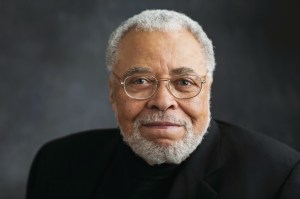
Rock the Oscars: James Earl Jones

Actor James Earl Jones has made several appearances in Central Arkansas over the years.  He has appeared at Robinson Center with the Arkansas Symphony Orchestra.  On February 12, 1999, he narrated Aaron Copland’s “Lincoln Portrait” and Alexander Miller’s “Let Freedom Ring” with the Symphony in a concert at Robinson Center.  (It was the 190th birthday for Lincoln.)

Born in Mississippi, he spent most of his childhood in Michigan.  After service in the Army during the Korean War, he moved to New York to study theatre.  In the late 1950s he started alternating between Broadway (where he often played a servant) and Off Broadway (where he played leading roles).  His first film appearance was in Dr. Strangelove….  From the 1960s onward he has alternated between stage, film and TV.  In the 1980s, he added voice work to his repertoire.

In 1969 and in 1987, he won Tony Awards for Actor in a Play (The Great White Hope and Fences, respectively).  His other Tony nominations have been for revivals of On Golden Pond and The Best Man.  He was nominated for an Oscar in 1970 for reprising The Great White Hope on film.  He received two Emmy Awards in 1991 – the only actor to ever win two in the same year.

In 2008, he won the Screen Actors Guild Lifetime Achievement Award, and in 2011 he was given an Honorary Oscar.  In 2002, he was a Kennedy Center Honors recipient.

He is probably best loved for his work as the voice of Darth Vader in many of the Star Wars films as well as his voicework in The Lion King.
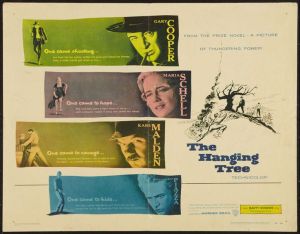
Rock the Oscars: THE HANGING TREE

On February 11, 1959, THE HANGING TREE was released.  This film was the first Hollywood movie in with Little Rock native Ben Piazza appeared.  For the film, Piazza received a coveted “and introducing Ben Piazza” credit.
The movie starred Oscar winners Gary Cooper and Karl Malden, along with Maria Schell.  Future Oscar winner George C. Scott, was fifth billed for his scenery chewing role of a religious zealot.

The title song, “The Hanging Tree,” written by Jerry Livingston and Mack David, was sung by Marty Robbins in the film.  It was nominated for the Oscar for Best Song.

Filming began in June 1958 in Washington state.  Shooting took place from June through August 1958 mainly near Yakima, Washington.  The film was directed by Delmer Daves, who was probably best known as screenwriter of Love Affair and director of 3:10 to Yuma.  In conjunction with filming The Hanging Tree, Piazza appeared in a TV special on western movies.  Most of the others appearing in the special were well-established Hollywood western personalities including Little Rock natives Bronco Billy Anderson and Gail Davis.

The Hanging Tree had a budget of $1.35 million ($11.5 million today—about half of the typical modest film budget).  A good portion of this expense was the construction of a mining town.  Once production began, Daves became ill and had to be hospitalized for ulcers. Co-star Karl Malden was approached to complete the film.  He had recently finished his first directing assignment.  He had reservations, but agreed to direct because of support of Cooper. (There are discrepancies as to the length of time Daves was out of commission.)

Ben received positive notices.  One reviewer referred to him as being a “laconic, doe-eyed rebel.” Another said he was a “handsome and mean-looking boy…with curls like a golden poodle.”     Several reviewers referenced James Dean when discussing Piazza in a positive light.

The film was released to respectful notices in February 1959.  It earned around $2.2 million, which meant it turned a profit.

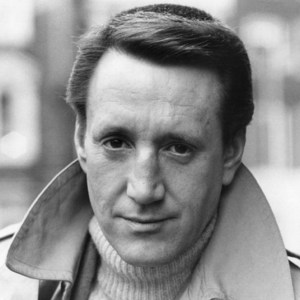
Rock the Oscars: Roy Scheider

Actor Roy Scheider’s connection to Little Rock is a sad one.  He visited the City quite frequently for the last years of his life as he was getting treated at the University of Arkansas for Medical Sciences.  Despite UAMS’s best efforts, Scheider died in Little Rock on February 10, 2008.

In the 1970s, Scheider received two Oscar nominations. His first, for Best Supporting Actor, was in The French Connection.  While Scheider did not pick up the Oscar, the film itself was named Best Picture.  It won four other Oscars that night. (As a side note: it was the first R-rated movie to win Best Picture.  Though Midnight Cowboy was re-released as an R-Rated movie after winning the Best Picture Oscar, it was initially released as an X-rated movie.)

Scheider’s second Oscar nomination came for playing Bob Fosse’s stand-in in the movie All That Jazz.  It, too, won four Oscars, though Scheider’s nomination would not result in a win.

Among Scheiders other films, Jaws would win three Oscars, while 2010 would receive five nominations.

Rock the Oscars: Nine from Little Rock

On April 5, 1965, the Academy Award for Best Documentary, Short Subject went to the film “Nine from Little Rock.”

Narrated by Jefferson Thomas, Charles Guggenheim’s documentary looks at the nine African-American students who enrolled in Little Rock Central High School in 1957. Thomas, one of the students reflects on the state of race relations in the seven years that had elapsed (up to 1964).  The film also focuses on Ernest Green, Elizabeth Eckford and Thelma Mothershed.

Guggenheim both directed and co-wrote the film. The latter credit was shared with Shelby Storck, who also produced the film.   The film had been commissioned by George Stevens, Jr., for the United State Information Agency.

The Oscar that night was Guggenheim’s first of four.  His others would be for: 1968’s “Robert Kennedy Remembered” (Live Action Short), 1989’s “The Johnstown Flood” (Documentary Short) and 1994’s “A Time for Justice” (Documentary Short).  His son Davis Guggenheim won the Oscar for Documentary, Feature for An Inconvenient Truth.

The film was digitally restored by the Motion Picture Preservation Lab for the 50th anniversary of its win for Best Short Documentary at the 1965 Academy Awards.  It is available for purchase on DVD and can also be viewed in its entirety on YouTube

Rock the Oscars: Mary Steenburgen

It is Oscar month, so it is fitting to highlight at Arkansas’ own Academy Award winning actress, Mary Steenburgen on her birthday.  She was born on February 8, 1953, in Newport, Arkansas.  After moving to North Little Rock as a schoolgirl, she had her first starring role as Emily in the 1971 Northeast High School production of Our Town, which was the new school’s first play.

Her big break in the movies came when Oscar winner Jack Nicholson picked her to star opposite of him in Goin’ South.  This was followed by Time after Time before she appeared in Melvin and Howard.  For that film, she won the Oscar for Best Supporting Actress.  It also marked the first of three times she starred with Jason Robards (the other two being Parenthood and Philadelphia).  Over the years, her films have run the gamut from period piece (Ragtime, Cross Creek) to sophisticated comedy (Romantic Comedy, A Midsummer Night’s Sex Comedy) to fantasy (Back to the Future III) to holiday comedy (Elf).  She has been hard to pigeonhole into a specific “type” of actor because she has played so many different types of roles.

Her upcoming projects include Book Club with fellow Oscar winners Jane Fonda, Diane Keaton and Richard Dreyfuss, as well as Oscar nominees Candice Bergen and Andy Garcia; and also Antiquities — filmed in Arkansas and featuring many members of the growing Arkansas film community.

Throughout her career, Mary Steenburgen has been a champion of the arts in Central Arkansas.  In 1986, she starred in and was executive producer of End of the Line, filmed in Central Arkansas, directed and co-written by Arkansan Jay Russell, and also starring Kevin Bacon, Wilfred Brimley, Levon Helm, Barbara Barrie and Holly Hunter.  More recently, Steenburgen has also been an active supporter of the Oxford American magazine as well as South on Main restaurant and performance venue.

Rock the Oscars: Past Clinton School speaker Geena Davis

On February 7, 2012, Academy Award-winning actor Geena Davis spoke in Little Rock.  She was hosted by the University of Arkansas Clinton School for Public Service and the William J. Clinton Foundation.

Davis founded the Geena Davis Institute on Gender in Media in 2004. The institute is the only research-based organization working within the media and entertainment industry to engage, educate and influence the need for gender balance, reducing stereotyping and creating a wide variety of female characters in entertainment. Davis won the Academy Award for Best Supporting Actress for her role in “The Accidental Tourist” in 1988.

She was again nominated for an Academy Award and Golden Globe for her performance as Thelma in Ridley Scott’s “Thelma and Louise,” in which she co-starred with Susan Sarandon.  She received a Golden Globe nomination for Best Actress for her portrayal of baseball phenomenon Dottie Hinson in “A League of Their Own.”

Geena Davis is not only an Oscar and Golden Globe winning actor, but a world-class athlete (at one time the nation’s 13th-ranked archer), a member of the genius society Mensa, and is becoming recognized for her tireless advocacy of women and girls nearly as much as for her acting accomplishments. She is the founder of the non-profit Geena Davis Institute on Gender in Media and its programming arm See Jane, which engages film and television creators to dramatically increase the percentages of female characters — and reduce gender stereotyping — in media made for children 11 and under.

Davis is also a former trustee of the Women’s Sports Foundation, serves on the Board of the White House Project, is an appointee to the California Commission on the Status of Women, and is an official partner of UN Women in their effort to change the way media represents women and girls worldwide.

Davis holds honorary degrees from Boston University, Bates College and New England College.

Rock the Oscars: Loretta Lynn

Loretta Lynn and Sissy Spacek during 53rd Annual Academy Awards’ Governor’s Ball at Beverly Hilton Hotel in Beverly Hills, California, United States. (Photo by Ron Galella/WireImage)

The spate of 1980s musical biopics can be traced to the success of 1980’s Coal Miner’s Daughter.  Nominated for seven Oscars, it captured a Best Actress statuette for Sissy Spacek, who played the title character.

Loretta Lynn, has never been nominated for an Oscar (yet) but wrote the book and lived the life on which the film was based.  (Arkansan Levon Helm was robbed of a nomination for playing Lynn’s father in the film.)

Over her career, Lynn has made numerous appearances in Little Rock, gradually moving up the billing until she was the star attraction.  Among her most recent appearances were a 2007 concert at Robinson Center (with three generations of Lynns and Webbs–the latter being her maiden name), and a 1997 concert at Wildwood Park.

While musical biopics were quite popular in the 1930s through 1950s, by the 1960s and 1970s, they had fallen out of favor.  But the success of Coal Miner’s Daughter led to numerous (countless?) on the big screen and TV.  Spacek ably captured Lynn’s grit, warmth, and talent in a well-deserved Oscar turn.