
Little Rock Look Back: Mardi Gras in the Rock–1870s edition

In the post-Civil War era, Mardi Gras was a major event in Little Rock.  By the 1870s, newspapers would have stories for several days about preparations for parties and parades which would be followed by coverage summarizing the events.

For instance, the Ash Wednesday 1877 edition of the Arkansas Gazette carried a front page story that discussed Mardi Gras in New Orleans and Memphis.  Inside the paper there were a series of stories about the downtown Little Rock Mardi Gras parade.  It started at Markham and Rock Streets.  Because of the crowd assembled for it, organizers had to reroute the parade that afternoon.  Among the entries were the Fat Men’s Club, Butchers’ Benevolent Association (which rode on horses), the Mystic Krewe, and several trade groups.  In addition there were many people who marched along in masks.  The unnamed writer bemoaned the fact that the masked revelers’ clothing had no theme.

On Thursday, February 15, 1877, there were stories about some of the Mardi Gras balls which had taken place two nights earlier.  The paper’s deadline probably was earlier than the parties ended, which is why they were not in the paper until two days later.  Among the various events were the Knights of Pythian Ball at the Grand Opera House, the aforementioned Fat Men at a special pavilion set up in the Main Street Cotton Shed, the Mystic Krewe at O’Haras Hall, and the Cosmopolitans at Concordia Hall.  There were other events that the writer was not able to attend due to lack of time.

Some of the venues also played host to balls in advance of Mardi Gras.  The February 10 Gazette previews some events set for Friday and Saturday night.

By the start of the 20th Century, Mardi Gras was no longer a major social event in Little Rock.  But while it lasted, it was quite the production.  It appealed to all classes and races of Little Rock’s citizenry. Though most of the events were segregated, the parade did allow for African Americans to participate as well as the white revelers.
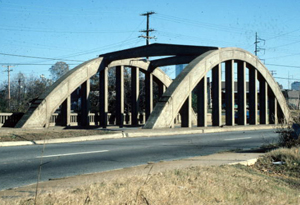
A Lincoln Viaduct Portrait

Photo courtesy of the Arkansas Historic Preservation Program

Since today is Abraham Lincoln’s birthday, it is a good day to pay tribute to the Lincoln Avenue Viaduct.  This arched bridge is traversed by thousands of cars each day, with most having no idea the name of the structure.  The Lincoln Avenue Viaduct is the arched bridge connecting LaHarpe with Cantrell Road which (literally) bridges downtown with the west along Highway 10.

The Lincoln Avenue Viaduct is a reinforced concrete rainbow arch bridge. It was opened at 2:05 p.m. on Friday, December 28, 1928, and, despite later alterations, it remains particularly well-preserved. The Missouri Pacific Railroad Company, considered the most important railroad company in the state, constructed the bridge amid a series of improvements in Little Rock made necessary by the damage wrought by the infamous spring floods of 1927.

Though the bride was constructed by the railroad, the City had to give authorization to do so, this was accomplished by the passing of Ordinance 4,335, at the May 28, 1928, City Council meeting.

Lincoln Avenue was one of several names for stretches of Highway 10 in Little Rock. By the 1960s, the areas west of the Lincoln Avenue viaduct were all renamed Cantrell in honor of the man who had developed much of the area west of the Heights. The longest stretch of the road already carried that name. There had been an effort to rename Highway 10 (including sections named Lincoln, Q, and Cantrell) in Little Rock for Senator Joseph Taylor Robinson in 1930. He declined the offer because he did not want to diminish the contributions of Mr. Cantrell.  Over time the entire stretch bore the name Cantrell.

The stretches east of the viaduct which involved a couple of names were renamed La Harpe Boulevard in honor of the French explorer who first saw the Little Rock. (La Harpe was originally an extension of Riverfront Drive. But with changes to development along the Arkansas River and the coming of I-30, the streets were reconfigured significantly in the 1950s and early 1960s.)

Though the street has been renamed, the bridge still carries the name of the 16th President of the United States.

Little Rock Look Back: First meeting of Central and Hall in football

lrchs-lrhhsHall High opened its doors and started playing football in 1957. As a new school with a largely younger student body, it only played smaller schools that initial season.  The first Hall vs. Central game was set for Thanksgiving 1958 (November 27).
During the 1958-1959 school year, Little Rock’s high schools were closed for the ill-conceived, ill-advised reason to keep them from being integrated schools.  Though classes were not in session, football teams practiced and played.  The Arkansas Gazette noted that most of those games that season drew only 1,000 spectators, which was down from the usual 5,000 to 8,000 a game.

With the future of Little Rock’s high schools in doubt, there was some hand wringing about whether the 1958 Thanksgiving Day game would be not only the first meeting between Hall and Central, but perhaps also the last.

In only its second year of playing, Hall was undefeated and poised to win the state championship heading into the Thanksgiving game.  Central surprised the Warriors by winning 7-0 before a crowd of 5,000, which cost Hall the undefeated season and the championship (El Dorado became state champs).  This game set the tone for the high stakes of the rest of the series.

Little Rock Look Back: More Tricks than Treats on Halloween Streets

A recent romp through an ARKANSAS GAZETTE gave insight into Halloween in Little Rock in the middle of the 20th Century.

Apparently by late afternoon on Halloween 1950, downtown Little Rock was filled with kids and teens in costumes. Much of the focus seemed to be on tricks as many of these revelers were utilizing water guns to soak people, throwing enough talcum powder to create an aroma downtown, shooting off firecrackers, and soaping store windows. Several industrious store owners had coated there windows with glycerine so that soap would not mark them.

The mayhem was enough to cause even more problems to traffic at rush hour. Police officers were helpless as they were directing traffic.  One city bus filled with passengers was attacked by a phalanx of waterguns, until the windows were all closed.

GAZETTE writer noted that two teen boys were dressed rather convincingly as girls. One was described as “rather pretty.” It was not until the teen let out an expletive (which the paper reported as “g— d—–”) that the reporter was certain it was a male.

Not everyone was focused on tricks.  Merchants in the Heights neighborhood created a block party with a carnival. It was deemed to be so successful that it would become an annual event.

Mother’s Day Look Back: Little Rock’s first mother – Eliza Cunningham

Eliza CunninghamEliza Wilson Bertrand Cunningham was the First Lady of Little Rock.  She literally was the first lady and the founding mother.
She became the first permanent female resident when she joined her husband Matthew Cunningham in Little Rock.  She gave birth to Chester Ashley Cunningham, the first baby born in Little Rock, as well as several other children with Cunningham.  When he became the first Mayor of Little Rock, she was the first First Lady of Little Rock. They hosted the first Little Rock Council meeting at their house on what is now the block downtown bounded by Third, Main, Fourth and Louisiana Streets.  Her son Charles P. Bertrand, from her first husband, later served as Mayor of Little Rock, making her the only woman to be married to a Mayor and be mother of a Mayor.

Born in Scotland in December 1788, she emigrated with her parents to the United States as a young girl.  In 1804 or 1805, she married a French businessman, Pierre Bertrand in New York City.  She lived in New York City, while he traveled to his various business ventures.  He never returned from a trip to his coffee plantation in Santo Domingo and was presumed to have died in 1808 or 1809.  She and Bertrand had three children, Charles Pierre, Arabella and Jane. (Jane may have died in childhood, because records and lore only indicated Charles and Arabella coming to Little Rock with their mother.)

Eliza married Dr. Matthew Cunningham in New York City.  He later moved to Saint Louis and settled in Little Rock in early 1820.  Eliza and her two children came to Little Rock in September 1820.  In 1822, she gave birth to Chester Ashley Cunningham, the first documented baby born in Little Rock.  (There are unsubstantiated reports that at least one slave child may have been born prior to Chester.)  She and Matthew also had Robert, Henrietta, Sarah and Matilda.  The latter married Peter Hanger, after whom the Hanger Hill neighborhood is named.

Dr. Cunningham died in June 1851.  Eliza died in September 1856. They and Chester (who died in December 1856) are buried in the Hanger family plot at Mount Holly Cemetery.

Little Rock Look Back: The Return of STAR WARS Day

Today, May the 4th, is Star Wars Day.  This year marks 40 years since the first (fourth?) movie first opened!
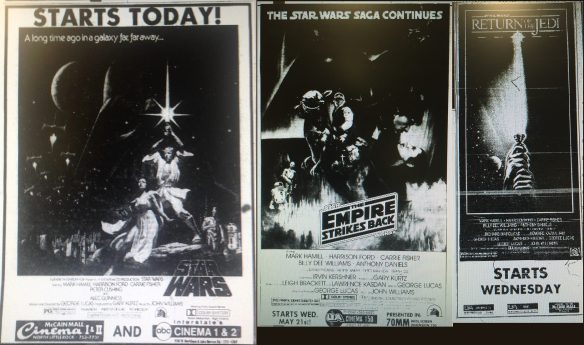
The classic film first opened in May 1977 (though after May 4).  It did not reach Little Rock until June 24, 1977.

Given its status as a sleeper hit, it is no surprise that it came into Little Rock largely unnoticed.  In that day, major films opening on a Friday would be heralded the previous Sunday with a substantial advertisement.  The first Star Wars ad ran on Thursday, June 23, 1977, the day before it opened.  By contrast, Herbie Goes to Monte Carlo, which would play at the same theatre, had a large ad on Sunday, June 19.

While Star Wars would seem like the perfect movie for the great UA Cinema 150, it did not play there.  The film playing at the 150 was A Bridge Too Far, which was, at least an action movie.  Star Wars did not even open at a UA theatre.  It opened at the ABC Cinema 1 & 2 (located at Markham and John Barrow) and at the McCain Mall Cinema.  (The ABC Cinema location is now home to discount cellphone and discount clothing businesses; a cinema has returned to McCain Mall, but now in the location of the former MM Cohn’s store.)

The day it opened, there was a fairly large ad which incorporated the familiar beefcake Luke, Leia in flowing gowns, and Darth Vader mask.  On the Sunday after it opened, there was a slightly smaller ad with the same artwork.  McCain Mall also ran a small add for both Star Wars and Herbie. It noted that Star Wars was a film that management “does not recommend for children.”

Three years later, The Empire Strikes Back opened nationwide on May 21, 1980. Opening a film on the same date was a newer phenomenon, due in part to the success of Star Wars.  For the opening weeks, The Empire Strikes Back played an exclusive showing at the UA Cinema 150.  It would eventually play at other theatres in Little Rock.   It is interesting to note what was playing at the two theatres which had originally screened the 1977 film.  The McCain Mall Cinema was showing Coal Miner’s Daughter and The Fog. The former ABC Cinema was now the Plitt Southern Theatre and showed the Bill Murray comedy Where the Buffalo Roam and the “Get Smart” movie The Nude Bomb.  None were likely to attract the same number of audience members as The Empire Strikes Back.

On the day The Empire Strikes Back opened, the Arkansas Gazette had four different stories about the movie in that day’s edition.  While the Arkansas Democrat did not have any stories that day (though they would in subsequent days), they did carry a story on David Letterman preparing to start his (what would turn out to be short-lived) morning TV show.

On May 25, 1983, The Return of the Jedi opened.  Like the first film, though it would have been perfect for the Cinema 150, it did not play there.  Instead it played at the UA Cinema City (Breckenridge Village), the UA Four (at Geyer Springs and I-30 – now the Ron Sherman production studios), and at McCain Mall.  Flashdance was playing at the Cinema 150. In a forerunner of what is now standard practice, The Return of the Jedi played simultaneously on two of the seven screens at UA Cinema City and two of the four screens at UA Four.  While this is now part of the modus operandi, at the time, it was extremely rare to have a movie play on more than one screen in the same complex.  Though each of the theatres was smaller than the Cinema 150, the five combined exceeded the availability if it had played an exclusive run at the Cinema 150.

By the time The Return of the Jedi opened, the former ABC Cinema was now part of the ill-fated locally-based Rand Cinema chain and was known as the Markham 1 & 2.  It was showing the Roy Scheider film Blue Thunder and Dan Aykroyd in Dr. Detroit.

The cost to see The Return of the Jedi in Little Rock in 1983 was $5.00 for adults and $2.50 for children.  (That would be the equivalent of $12.37 today for an adult ticket.)

An Easter Parade of Bronze Bunnies

Downtown Little Rock has at least three different sculptures of rabbits.  Since today is Easter Sunday and the Easter Bunny is making his rounds, it seems a good day to highlight these sculptures.
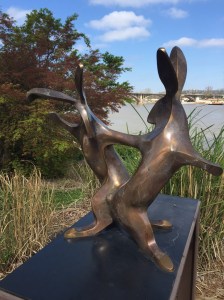
In the Vogel Schwartz Sculpture Garden, Laurel Peterson Gregory’s Bunny Bump has been providing whimsy since 2010.

After she sculpts an animal in wax or oil-based clay, traditional lost-wax casting processes immortalize the design in bronze. One aspect of particular interest to me, and one for which I plan early in the sculpting phase, is the complex and rich patinas that constitute another hallmark of my limited-edition sculptures. Multiple layers of chemicals and oxides are applied to the heated bronze to achieve a range of unique effects, both translucent and opaque, that complement each design.

Two stylized rabbits make for an interesting piece of artwork when they are not only dancing, but also doing the butt bump while dancing. The smooth surface and color of the bronze add to the illusion. This small piece has been placed on a pedestal to elevate more to eye level.

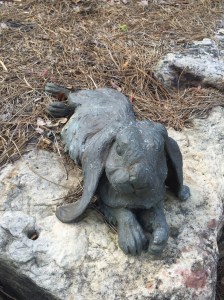
A few yards from the bumping bunnies, James Paulsen’s Lopsided presents a much more laconic rabbit.

Paulsen is a self-taught artist. Alternately studying the wilds of the northern forest, and the open beauty of the American Southwest, he concentrates his work on natural subjects he has grown up with, and is heavily influenced by his family’s artistic background, being raised by an artist-illustrator and an author. In his work, he explores merging the beauty he sees in the natural world with the expressiveness of clay and bronze.

While having most of his work in galleries or private collections across the country, he has recently completed two public commissions

And at the corner of President Clinton Avenue and Sherman Street, Tim Cherry’s Rabbit Reach welcomes visitors to the River Market.

The sculpture is located at the corner of Sherman Street and President Clinton Avenue across from the Museum of Discovery.

The sculpture is a gift from Whitlow Wyatt and the Carey Cox Wyatt Charitable Foundation. It was given in memory of George Wyatt and Frank Kumpuris.  Those two gentlemen were the fathers of Whitlow Wyatt and Dean & Drew Kumpuris.

Cherry’s sculpture was selected for this spot because of its proximity to children at the Museum and in the River Market district.  The design and size of the sculpture encourages children to climb on it and to play around the rabbit.  While some public art is situated so it cannot be touched, this one is situated to be touched as part of the appreciation experience.

There will probably be more bunnies on display this weekend when the 10th Sculpture at the River Market Show and Sale takes place on April 22 & 23.  On April 21, there will be a preview party at 6:30pm.

For more information on the show & sale, visit the the show’s website.