
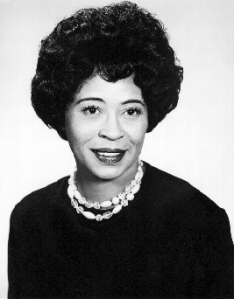
Little Rock Look Back: SCOTUS decision in BATES v LITTLE ROCK case

On February 23, 1960, the U. S. Supreme Court handed down a decision in the case of Daisy BATES et al., Petitioners, v. CITY OF LITTLE ROCK et al.  This case had been argued before the Court in November 1959.

Daisy Bates of Little Rock and Birdie Williams of North Little Rock were the petitioners.  Each had been convicted of violating an identical ordinance of an Arkansas municipality by refusing a demand to furnish city officials with a list of the names of the members of a local branch of the National Association for the Advancement of Colored People. The question for decision was whether these convictions can stand under the Due Process Clause of the Fourteenth Amendment to the United States Constitution.

The Little Rock ordinance (10,638) was passed on October 14, 1957. It charged that certain non-profits were actually functioning as businesses and using non-profit status to skirt the law. Therefore it required the non-profits to disclose their members and sources of dues.  North Little Rock passed an identical ordinance.

(Mayor Woodrow Mann was not present at the meeting of the LR Council when the ordinance was passed. But he signed all of the resolutions and ordinances approved that night.  Ordinance 10,638 was the only legislation that night which had also been signed by Acting Mayor Franklin Loy.  Mayor Mann crossed through Loy’s name and signed his own.)

Mrs. Bates and Mrs. Williams as keepers of the records for their respective chapters of the NAACP refused to comply with the law.  While they provided most of the information requested, they contended they did not have to provide the membership rosters and dues paid.

After refusing upon further demand to submit the names of the members of her organization, each was tried, convicted, and fined for a violation of the ordinance of her respective municipality. At the Bates trial evidence was offered to show that many former members of the local organization had declined to renew their membership because of the existence of the ordinance in question. Similar evidence was received in the Williams trial, as well as evidence that those who had been publicly identified in the community as members of the National Association for the Advancement of Colored People had been subjected to harassment and threats of bodily harm.

Each woman was convicted in the court of Pulaski Circuit Court, First Division, William J. KirbyJudge. They were fined $25 a person.  On appeal the cases were consolidated in the Supreme Court of Arkansas in 1958. The convictions were upheld by five justices with George Rose Smith and J. Seaborn Holt dissenting.

Mrs. Bates and Mrs. Williams then appealed to the U. S. Supreme Court.  The pair’s legal team included Robert L. Carter and George Howard, Jr. (who would later become a federal judge).  Little Rock City Attorney Joseph Kemp argued the case for the City.  The arguments before the U. S. Supreme Court were heard on November 18, 1959.

The SCOTUS decision was written by Associate Justice Potter Stewart.  He was joined by Chief Justice Earl Warren and Associate Justices Felix Frankfurter, Tom C. Clark, John M. Harlan II, William J. Brennan and Charles E. Whittaker.  Justices Hugo Black and William O. Douglas wrote a concurring opinion.

The U. S. Supreme Court reversed the lower courts.

In sum, there is a complete failure in this record to show (1) that the organizations were engaged in any occupation for which a license would be required, even if the occupation were conducted for a profit; (2) that the cities have ever asserted a claim against the organizations for payment of an occupation license tax; (3) that the organizations have ever asserted exemption from a tax imposed by the municipalities, either because of their alleged nonprofit character or for any other reason.

We conclude that the municipalities have failed to demonstrate a controlling justification for the deterrence of free association which compulsory disclosure of the membership lists would cause. The petitioners cannot be punished for refusing to produce information which the municipalities could not constitutionally require. The judgments cannot stand.

In their concurring opinion, Justices Black and Douglas wrote that they felt the facts not only violated freedom of speech and assembly from the First Amendment, but also aspects of the Fourteenth Amendment. They wrote that the freedom of assembly (including freedom of association) was a principle to be applied “to all people under our Constitution irrespective of their race, color, politics, or religion. That is, for us, the essence of the present opinion of the Court.”

Neither the Gazette or Democrat carried any reaction from City leaders. There was a City Board meeting the evening of the decision. If it was mentioned, the minutes from the meeting do not reflect it.

Arkansas Attorney General Bruce Bennett, on the other hand, was very vocal in his outrage. The city laws were known as Bennett Laws because they had been drafted by him as ways to intimidate African Americans and others he viewed as agitators.

In 1960 Bennett was challenging Governor Orval Faubus for the Democratic gubernatorial nomination.  In reaction to the to the Supreme Court he vowed that, if elected Governor, he would “de-integrate” (a term he proudly took credit for coining) the state.

For his part, and not to be outdone by the AG, Faubus fretted that the Court’s decision meant that Communists would be able to give money to the NAACP.

Little Rock Look Back: Museum of Discovery opens in River Market

Museum of Discovery Logo when it opened in 1998

Founded in 1927 as the Arkansas Museum of Natural History and Antiquities in a downtown storefront, by 1997, the museum had been located in at least two other spots and had several different names.

On February 21, 1998, it reopened as the Museum of Discovery in its new location in the recently launched River Market district.  It occupied space on the first floor and basement of the Museum Center building (formerly the Terminal building the erstwhile train station which later was used for printing the Arkansas Democrat.)

The new name and new space reflected a greater emphasis on the science aspect of the museum’s mission.  It featured many hands on and interactive exhibits.

The museum spent one-third of its $10.6 million cost on exhibits.  Of the $10.2 million pledged for the museum, 47 percent — or about $4 million — came from a half-cent city sales tax approved by voters about five years ago. Another 14 percent came from foundations and 2 percent from private organizations and individuals. The remaining 37 percent came from corporations, sometimes in connection with specific exhibits.

Following a February 20, 1998, preview party, the official grand opening was held on February 21, 1998.

The previous museum space (inside the Arsenal building in MacArthur Park) occupied 14,000 square feet, 8,000 of which was display space. After the move, the museum had 35,000 square feet of display space.

Little Rock Look Back: First Elvis performance in LR

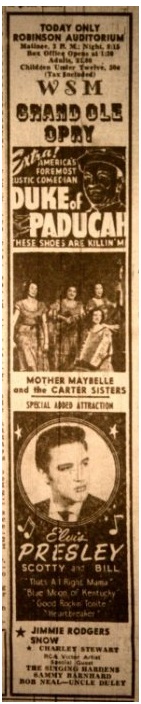
Sixty-four years ago today, on February 20, 1955, Elvis Presley made his first appearance on stage in Little Rock. He performed at Joseph Taylor Robinson Memorial Auditorium.

He was billed as “an added attraction” to a Grand Ole Opry Show headlined by the Duke of Paducah.  Others on the bill included Mother Maybelle and the Carter Sisters, Jimmie Rodgers Snow, Charlie Stewart, the Singing Hardens, Sammy Barnhart, Bob Neal, Uncle Dudley and Smilin’ Mac Cyclone. (It is interesting to note that at least some of the advance tickets billed it as The Elvis Presley Show, though the newspaper ads billed the Duke of Paducah as the headliner.)

This concert was part of a weeklong tour of Arkansas and Louisiana.  There were two shows that day – one at 3p.m. and the other at 8:15p.m.  Tickets on the day of the concert were $1.00 for adults and fifty cents for children.  Advanced tickets had sold for 75 cents at Walgreens.

The night before, Elvis played the Louisiana Hayride in Shreveport.  Following his Little Rock appearance (for which he and his band were paid $350 instead of their usual $200), they played in Camden, Hope, and Pine Bluff.

It is believed that Elvis’ parents attended this concert in Little Rock. Gladys Presley was a big fan of the Duke of Paducah. Elvis apparently also wanted his parents to meet with Colonel Tom Parker, who would become inexorably linked with Elvis’ career.

Little Rock Look Back: Arkansas Arts Center celebrates with week of Grand Reopening activities in February 2000

On February 17, 2000, over three thousand people attended the Arkansas Arts Center members preview of the new and renovated galleries as part of a week long celebration. It culminated in Big Art Weekend in which the building was open for 72 hours with around the clock programming.

Donors to the project, media, and Arkansas museum professionals had each received sneak peeks of the new facility earlier in the week. On Friday, February 18, the Big Art Weekend got underway with a gallery tour of a variety of Little Rock galleries. (This was before 2nd Friday Art Night.)  Lectures, tours, and other special events populated the building on Saturday and Sunday the 19th and 20th.  In addition, the Children’s Theatre was performing Aladdin and the Wonderful Lamp..

The renovation had taken over 18 months and cost $12 million.  It added 30,000 square feet of gallery space.  The expanded gallery space featured these exhibits: Paul Signac Watercolors and Drawings: Selections from the James T. Dyke Collection; Without Parameters: Selections from the Permanent Collection; Recent Acquisitions; Prophets, Parables and Paradoxes: Recent Drawings by David Bailin; Artistic Processes: Drawing; Living with Form: The Horn Collection of Contemporary Crafts; and European Paintings and Drawings.

The latter exhibit included eight pieces that were promised gifts from the Jackson T. Stephens collection.  They were Edgar Degas’ Dance in Blue (Before the Class, Three Dancers (c. late 1880s), Pablo Picasso’s Still Life with Red Bull’s Head (1938), Claude Monet’s Apple Trees Near Vetheuil (1878), Pierre-Auguste Renoir’s Three Partridges (c. 1888-1890), Alfred Sisley’s Road on the Edge of the Loing (1891), Camille Pissarro’s The Raised Terrace of the Pont-Neuf, Place Henri IV in Morning Rain (1902), Berthe Morisot’s The Flute Player (1890) and Bertrand Redon’s Vase of Flowers (c. 1890).

Little Rock Look Back: Implosion of the Grady Manning and the Marion

On February 17, 1980, a cold and clear Sunday morning, over seven decades of Arkansas history came tumbling down as the Hotel Marion and Grady Manning Hotel were imploded.

Thousands of people watched from places in downtown Little Rock and along the Arkansas River.  Many more were able to watch from live coverage carried on KATV, KARK and KTHV.  Those that missed it were able to see the replays multiple times on the news.

It was the first large-scale implosion in Little Rock’s history.  (It was likely the first implosion, but there could have been a small one that is not known.)  The two hotels were torn down to make way for the construction of the Excelsior Hotel and the Statehouse Convention Center.

The Hotel Marion, named after the builder Herman Kahn for his wife, opened in 1907. For four years it was Arkansas’ tallest structure.  It was the largest and grandest hotel in the City. For decades it would be the host to many dignitaries, conventions, and gala celebrations.

The Grady Manning Hotel was originally known as the Hotel Ben McGhee when it opened in 1930.   Manning was the head of the company which owned both the Marion and Ben McGhee properties.  Upon his untimely death by drowning in September 1939, the property was subsequently renamed in his memory.

The Manning Hotel, though taller, was never as grand a hotel as the Marion.  It was more of a mid-range property in pricing.

By the 1970s, both hotels were suffering from neglect and disinterest.  Changes in the lodging industry combined with a decline in downtown Little Rock had left both facilities with little business.

When Little Rock civic and government leaders decided to construct a larger convention center downtown with an adjacent hotel, it was decided that neither of these facilities could be properly renovated to be part of the project.  Instead, the land on which they stood (and the space in between) would be prime for the new hotel and center.

So, on the cold Sunday morning, the explosives were detonated, and the buildings came down.   Sunday morning was chosen because it would have the least impact on traffic flows since it would cause numerous streets to be closed for safety reasons.  The blast was delayed due to a rumor that someone might be in one of the buildings.  After checking both sites and finding them empty, the charges were set off.

And the Marion and Grady Manning became as much a memory as the long gone people who had once populated them.

The University of Arkansas’ Pryor Center for Oral and Visual History has a video of the implosion.

Little Rock Look Back: Polk Stanley Wilcox joins Studio Gang Architects in planning for reimagined Arkansas Arts Center

On February 16, 2017, the Arkansas Arts Center announced the selection of Polk Stanley Wilcox Architects as associate architect for its upcoming building project. Polk Stanley Wilcox will work in partnership with Studio Gang Architects on a reimagined Arkansas Arts Center. Studio Gang was selected as design architect for the expansion and renovation in December.

Polk Stanley Wilcox Architects is a programming, architectural, planning and interior design firm with offices in Little Rock and Fayetteville. The firm has experience working with clients in a variety of industries, including healthcare, nonprofit, cultural, education, corporate and worship. Polk Stanley Wilcox also focuses on sustainability and creating buildings that operate on minimal energy usage.

“We are thrilled to partner with the Arkansas Arts Center and Studio Gang on this transformative project,” Polk Stanley Wilcox Principal David Porter said. “AAC has cast an exciting vision to rethink not only how the Center upgrades the interior and exterior spaces, but how the AAC connects to and enriches the broad arts and cultural tapestry of Little Rock. Studio Gang is a uniquely talented firm to lead the design effort. PSW is honored to bring our extensive experience from years of important projects in downtown Little Rock to come alongside them and the AAC to help create this next critical milestone for the city, state and region.”

Polk Stanley Wilcox has previously worked on a number of local projects, including the William J. Clinton Presidential Library, Heifer International Headquarters, the Arkansas Studies Institute and the recently opened Robinson Center expansion and renovation.

“We look forward to working with the team at Polk Stanley Wilcox,” said Studio Gang Founding Principal Jeanne Gang. “We hope to build on their strong history of collaborations in the area and believe that their knowledge of Little Rock will be a huge asset as we expand the impact of the Arkansas Arts Center in Little Rock, and in the region.”

Polk Stanley Wilcox Architects was selected from among three finalists to work in partnership with Studio Gang. Ten local firms responded to the RFQ issued last month. Allison and Partners and Cromwell Architects were also finalists.

The three finalist firms presented to the selection committee on February 16. The selection committee for the associate architect included AAC Executive Director Todd Herman, three representatives from Studio Gang, and international museum consultant Deborah Frieden, and AAC Board member Sara Hendricks Batcheller.

“Each of the finalists are strong, well-respected firms,” Arts Center Executive Director Todd Herman said. “Ultimately, Polk, Stanley, Wilcox was the best complement to Studio Gang in terms of experience and strengths. Their work at Robinson auditorium – similar in both scope and complexity – will be an asset as we move through the project. We are very pleased to have PSW on board for this important project that will create wonderful new spaces for the people of Little Rock and Arkansas to enjoy the arts. Having our architectural team in place is a major milestone. We are very excited to move the project forward.”

Little Rock Look Back: Opening of Robinson Center Performance Hall

On February 16, 1940, after three years of planning and construction including several delays due to lack of funding, the Joseph Taylor Robinson Memorial Auditorium officially opened. It was a cold, rainy night, but those in attendance did not care.  (The concept of a municipal auditorium for Little Rock had first been raised in 1904, so this evening was truly a long time in the works.)

Searchlights painting arcs in the sky greeted attendees. They were borrowed from the Arkansas National Guard. Newspaper accounts noted that only a few of the men who attended were in tuxedos, most were simply in suits. The work to get the building opened had been so harried, that it was discovered there was not an Arkansas flag to fly in front of the building. Mayor Satterfield found one at the last minute courtesy of the Arkansas Department of the Spanish War Veterans.

The weather delayed arrivals, so the program started fifteen minutes late. Following a performance of Sibelius’ Finlandia by the fledgling Arkansas State Symphony Orchestra, Mayor J. V. Satterfield, Ewilda Robinson (the Senator’s widow), Emily Miller (the Senator’s sister-in-law and a member of the Auditorium Commission) and D. Hodson Lewis of the Chamber of Commerce participated in a brief ribbon cutting ceremony. Mrs Robinson cut the ribbon on her second attempt (once again proving that nothing connected with getting the building open was easy).

The ceremony was originally set to be outside of the building but was moved indoors due to the inclement weather. The ribbon cutting took place on the stage with the ribbon stretched out in front of the curtain. The opening remarks were broadcast on radio station KGHI.

Mr. Lewis, Mrs. Miller and Mayor Satterfield look on as Mrs. Robinson cuts the ribbon

Mr. Lewis, Mrs. Miller and Mayor Satterfield look on as Mrs. Robinson cuts the ribbon

Tickets for the event, advertised as being tax exempt, were at four different pricing levels: $2.50, $2.00, $1.50 and $1.00.

The estimated attendance was 1700. Following the ribbon cutting, the main performance took place. The headliner for the grand opening was the San Francisco Opera Ballet accompanied by the new Arkansas State Symphony Orchestra (not related to the current Arkansas Symphony Orchestra). The featured soloist with the ballet was Zoe Dell Lantis who was billed as “The Most Photographed Miss at the San Francisco World’s Fair.”

Auditorium Commission chairman E. E. Beaumont, a local banker, noted that while event planners knew the evening of ballet and classical music would not appeal to everyone, it was intended to show the wide range of offerings that would be suitable in the new space.  Earlier in the week, children’s theatre performances had been offered to school groups through the auspices of the Junior League of Little Rock.

At the same time that the gala was going on upstairs in the music hall, a high school basketball double-header was taking place in the downstairs convention hall. North Little Rock lost to Beebe in the first game, while the Little Rock High School Tigers upset Pine Bluff in the marquee game.