RobinsoNovember: Senator Joseph Taylor Robinson

150px-joseph_t-_robinson_croppedThis month, Robinson Center Music Hall will reopen after a two year renovation/restoration/remodeling/reconstruction.  To commemorate that, each day in November, the Culture Vulture will look at a person or event connected to Robinson Center Music Hall.

Up first, the eponym for the building.

Senator Joseph Taylor Robinson was born in Lonoke in 1872.  In 1894 Robinson was elected to the Arkansas General Assembly for one term.  From 1903 until 1913, he served in the US House of Representatives as a Congressman from Arkansas’ then-Sixth District.

He chose not to seek another term in Congress and ran for Governor in 1912.  On January 3, 1913, sitting US Senator Jeff Davis died in office.  Robinson was sworn in as Governor on January 16, 1913. Twelve days later he was chosen by the Arkansas General Assembly to become the next US Senator. He became the final US Senator to be selected by a legislator instead of popular vote.  At the time, Senate terms started in March, so Robinson served as governor until March 8, 1913.

He rose through the ranks of the Senate and eventually became the first person to hold the title of Senate Majority Leader.  In 1928, he was the Vice Presidential nominee for the Democratic Party.  Four years later, he rode with Franklin and Eleanor Roosevelt to the inauguration ceremonies before FDR took the oath.  He would be President Roosevelt’s go-to man on legislative issues.


Senator Robinson died in Washington D.C. on July 14, 1937.  His wife was in Little Rock making preparations for a trip the couple was to take. Following his demise, Mrs. Robinson went to Washington to accompany her husband’s body back to Arkansas.

The Senator was honored with a memorial service in the Senate chambers on Friday, July 17.  President Roosevelt and the cabinet joined members of the senate on the floor in what was described as a state funeral without pomp.  Mrs. Robinson sat with her brothers and two nephews as well as Bernard Baruch and Arkansas Power & Light’s Harvey Couch, who were Senator Robinson’s closest friends.  Eleanor Roosevelt was one of the many crowded in the senate galleries observing the service.  Following the service his body remained in the chambers until it was transferred to a train to make the journey to Little Rock.

The funeral train bore his body, his family, 50 senators and over twenty congressmen. It reached Little Rock around 8am on Sunday the 19th.  From there, Senator Robinson’s body was taken to his house on Broadway Street until noon.  It subsequently lay in state at the Arkansas State Capitol until being escorted by military to First Methodist Church.

As the funeral procession reached Roselawn Cemetery, thunder echoed. The skies which had alternated between sun and rain that day, returned to rain. A deluge greeted the end of the service and sent visitors hurrying for shelter at the end.

It was not until December 1937, that Senator Robinson’s name became attached to the municipal auditorium which Little Rock voters had approved in January 1937.
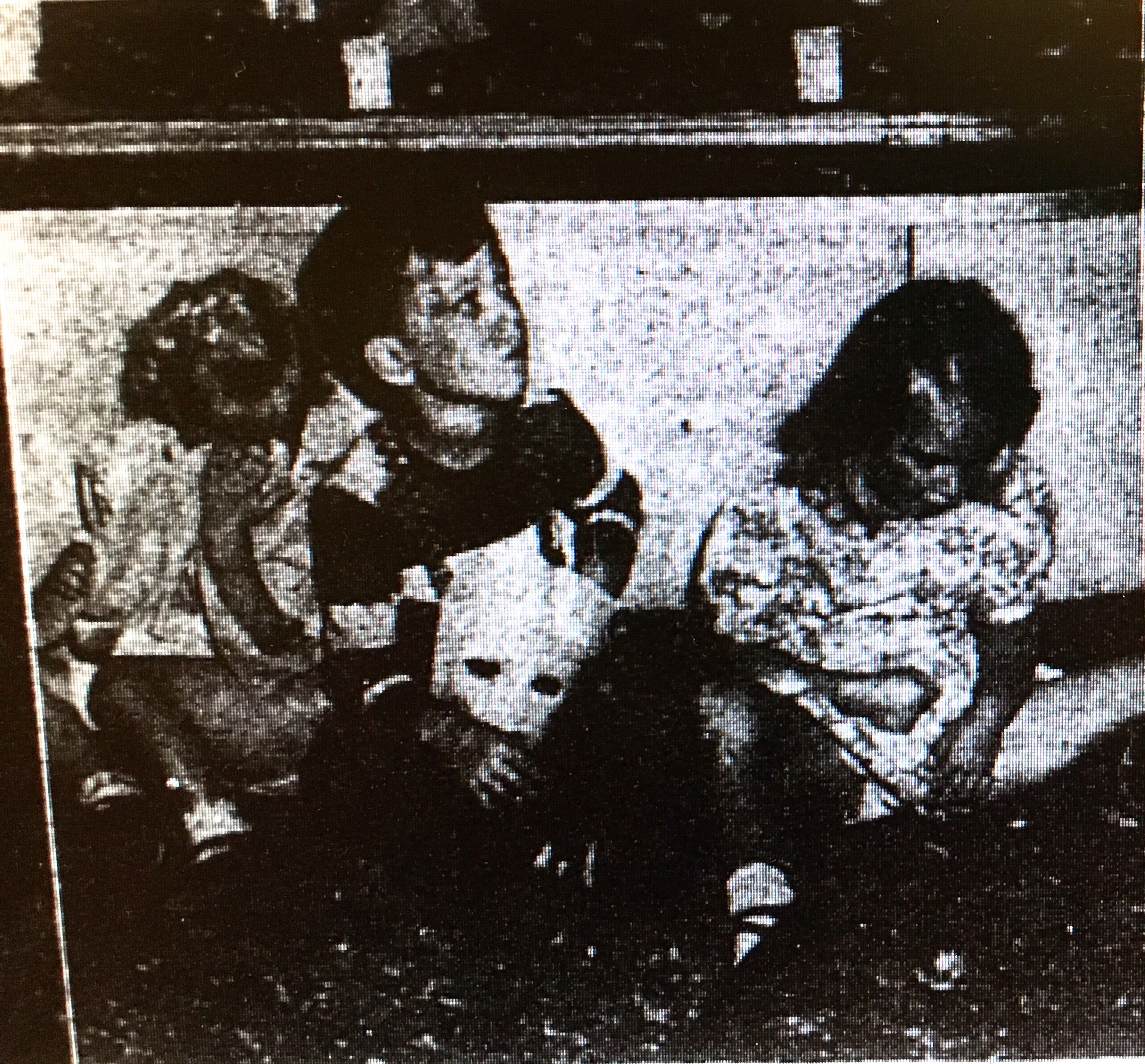
Little Rock Look Back: Halloweens Past

A recent romp through an Arkansas Gazette gave insight into Halloween in Little Rock in the middle of the 20th Century.

Apparently by late afternoon on Halloween 1950, downtown Little Rock was filled with kids and teens in costumes. Much of the focus seemed to be on tricks as many of these revelers were utilizing water guns to soak people, throwing enough talcum powder to create an aroma downtown, shooting off firecrackers, and soaping store windows. Several industrious store owners had coated there windows with glycerine so that soap would not mark them.

The mayhem was enough to cause even more problems to traffic at rush hour. Police officers were helpless as they were directing traffic.  One city bus filled with passengers was attacked by a phalanx of waterguns, until the windows were all closed.

A Gazette writer noted that two teen boys were dressed rather convincingly as girls. One was described as “rather pretty” until letting out an expletive which the paper reported as “g— d—–” and thus outing the individual as a male.

Not everyone was focused on tricks.  Merchants in the Heights neighborhood created a block party with a carnival. It was deemed to be so successful that it would become an annual event.

Little Rock Look Back: Miss America comes to Little Rock

miss america axumToday, Miss America 2017 Savvy Shields comes to Little Rock as part of her official homecoming to Arkansas after winning the crown.  In honor of that, we take a look back to the first visit to Arkansas by Donna Axum, who was the first Miss Arkansas to win the title of Miss America.

A native of El Dorado and a student at the University of Arkansas, during her reign as Miss America Miss Axum (or simply Donna as the newspaper headlines referred to her) made four public visits to Little Rock.  As the first Miss Arkansas to become Miss America, the state’s Capitol City was very interested in giving her a warm welcome.

After being crowned on September 7, 1963, her first visit to Arkansas was November 1 through 3.  In addition to stops in Hot Springs and El Dorado, she appeared in Little Rock to attend events including an Arkansas Razorback football game at War Memorial Stadium.  Her entourage included the top four runners up from the Miss America pageant.

In February 1964, she made a brief appearance in Little Rock which included a press conference.

Donna Axum spent nearly two weeks in Arkansas in May 1964 attending several pageants as well as spending time with family.  During that visit she appeared in Little Rock twice.  The second time she headlined a concert with the Arkansas Symphony (not related to the current Arkansas Symphony Orchestra) and the Arkansas Choral Society. It took place at Robinson Auditorium.

Little Rock Look Back: Final ARKANSAS GAZETTE

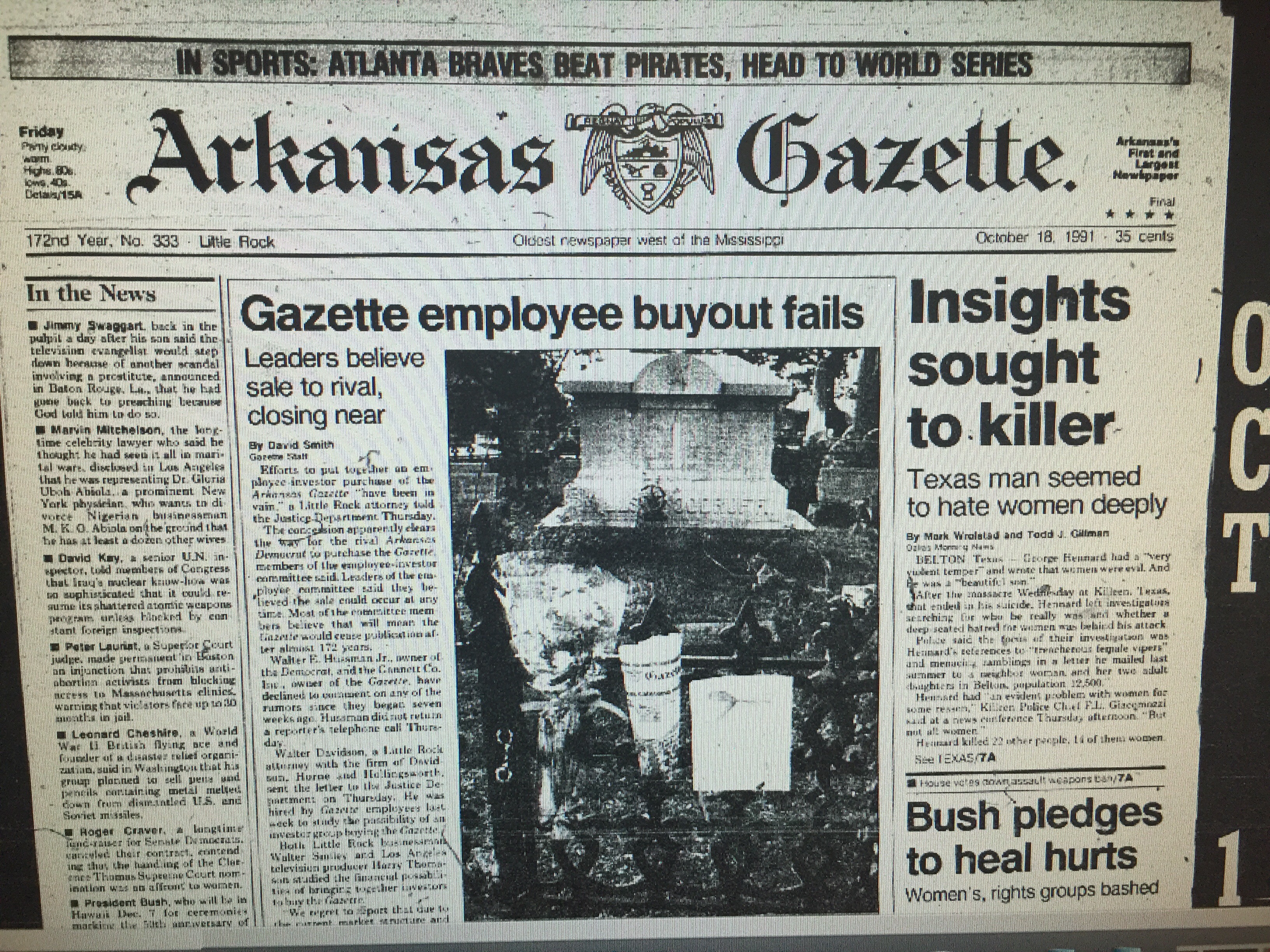
Twenty-five years ago today, on October 18, 1991, the final edition of the Arkansas Gazette was delivered. 

The front page featured a story on the demise of a Gazette employee effort to buy the paper. 

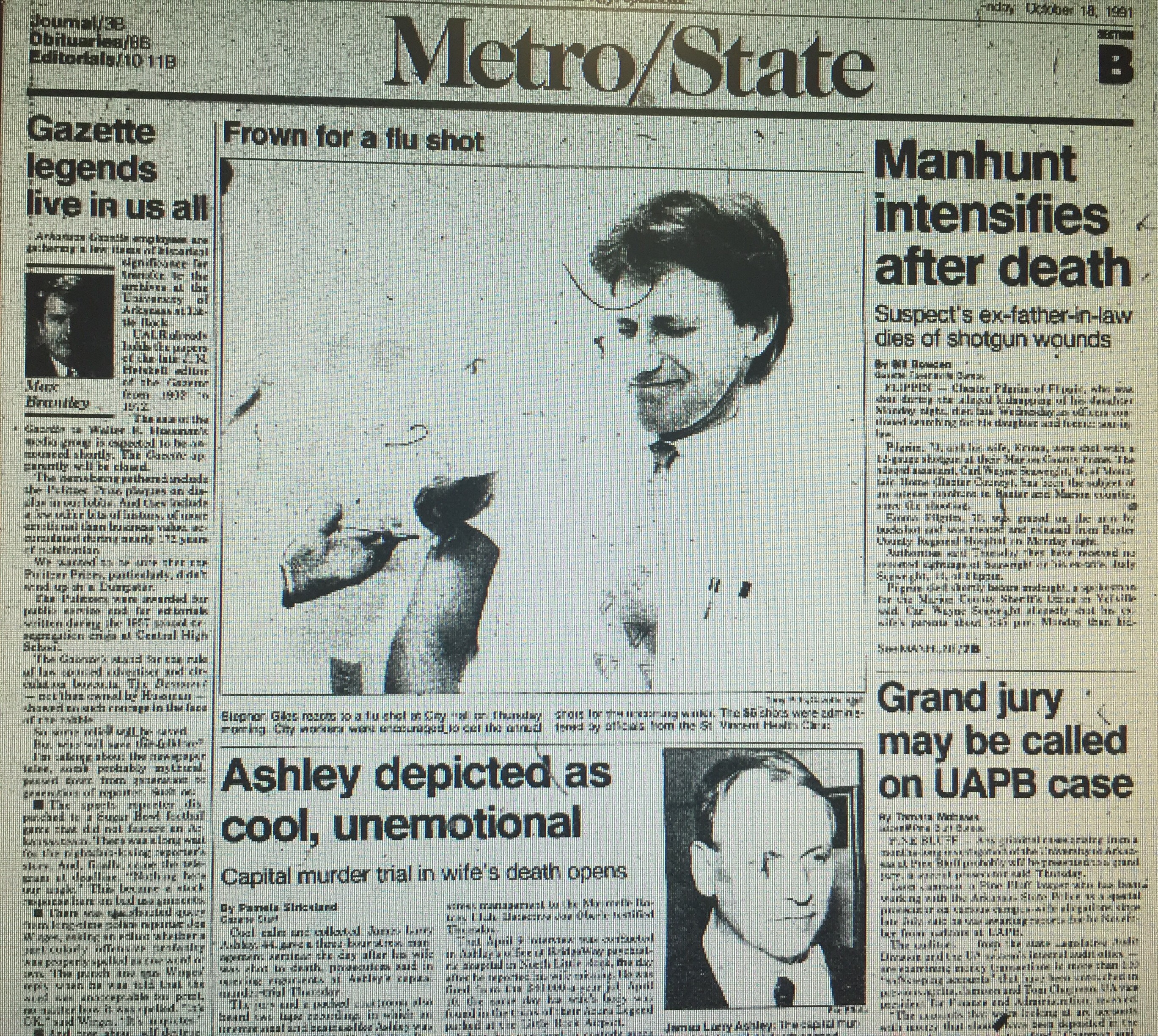
Max Brantley’s column on the front page of the B section also addressed the then-eminent end of the paper. However, as a newspaper all of the sections spent most of their space on the news of the day. While Gazette staffers felt the end was likely near, few felt that the paper on October 18, 1991, would be the final edition.  

The back page of the last section of the Gazette featured an ad for Premiere Pontiac Nissan Audi which was throwing a “Beat Texas” party featuring Craig O’Neill.  The Arkansas Razorbacks were scheduled to play the Texas Longhorns on Saturday, October 19. 

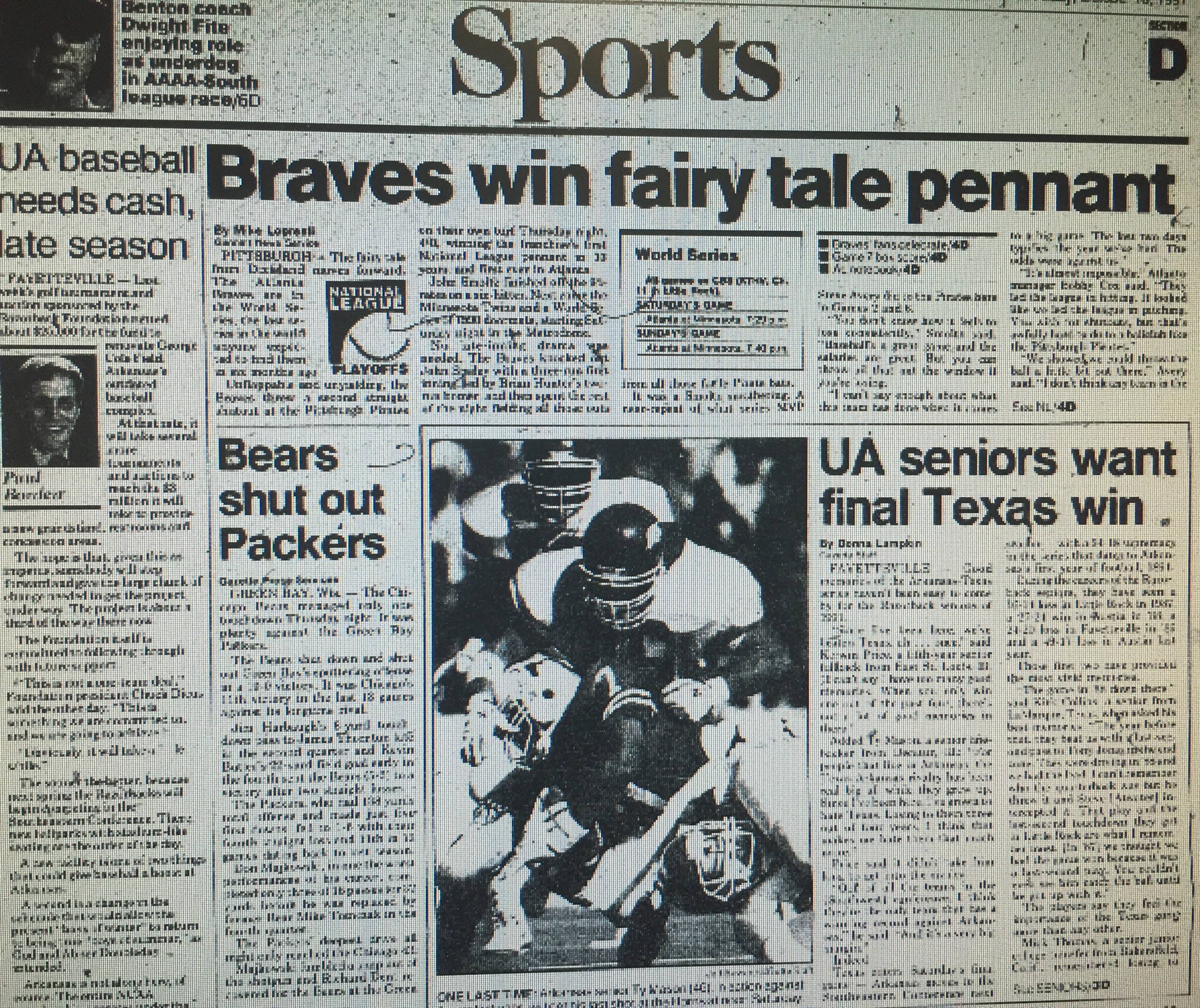
Here are the top halves of the front pages of sections B, C, D, and E for the final Atkansas Gazette.  They tell the storie of trials, football games, corporate earnings, and cultural events. 


Little Rock Look Back: Broadway Bridge Arch Completed

At approximately 10am this morning (October 11), the arch on the Broadway Bridge is to be imploded into the Arkansas River. 

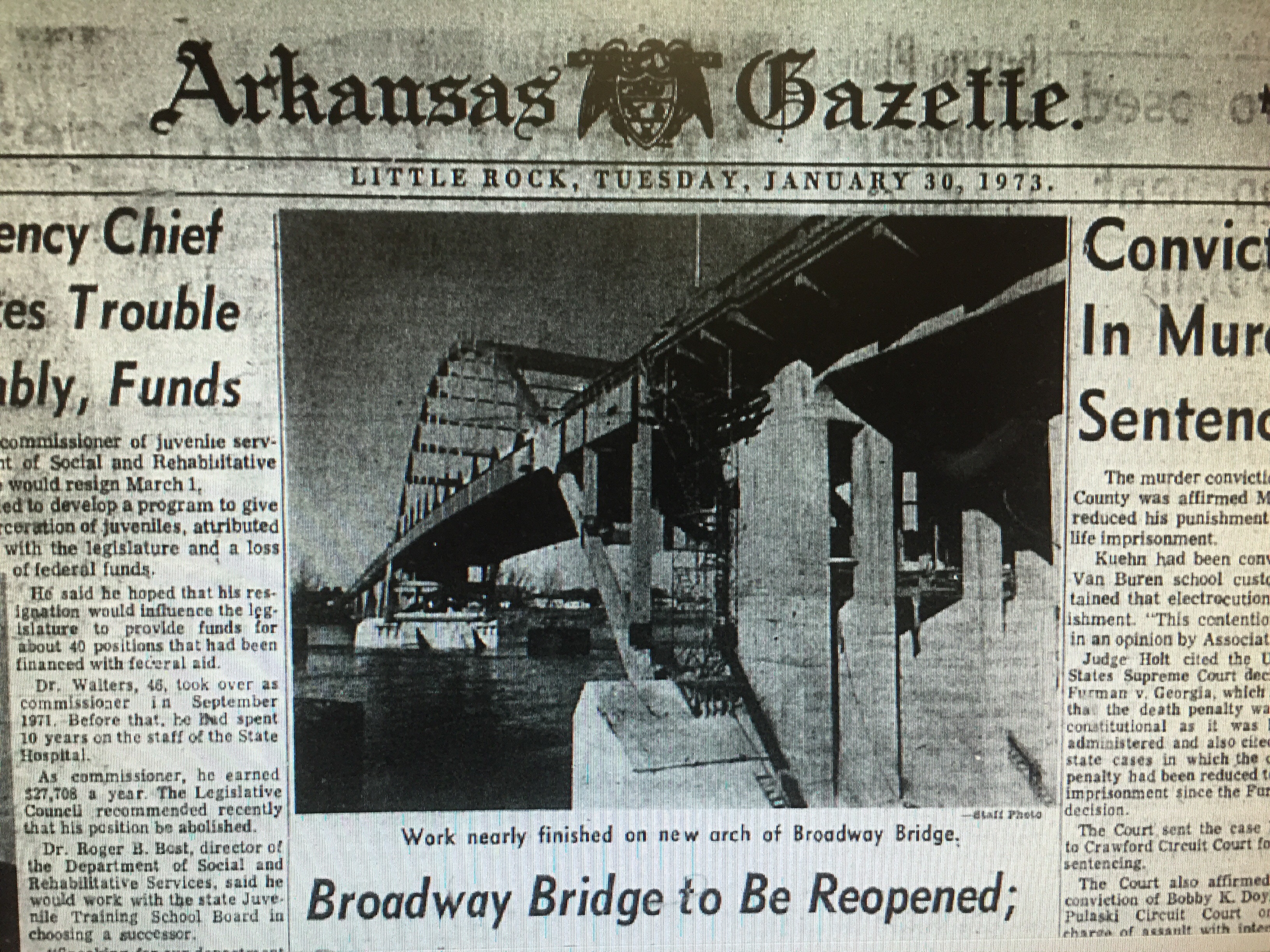
The arch was installed in late 1972 and early 1973. Two sections of the 1923 bridge were blasted away in September 1972 to make way for the arch. 

The new portion of the bridge was wider and had more vertical clearance. This was part of the McClellan-Kerr Arkansas River Navigation project. 

The bridge had closed to traffic on May 25, 1972 and reopened the week of February 5, 1973.  That time it took 8 months to replace one section.  The current project will completely replace an entire bridge with an expected closure of six months.  

The steel for the arch came from Japan. The arch was assembled there and the dismantled before being shipped to Little Rock. Then it was reassembled in place.  

After the Broadway Bridge reopened, work began on building a new Main Street Bridge. 

LR Look Back: JFK in LR (and Greers Ferry)

JFK LROn October 3, 1963, President John F. Kennedy delivered remarks at the Arkansas State Fairgrounds.  Only a few weeks later, he would be felled by an assassins bullet in Texas.

In the speech, the President praised Arkansas’ congressional delegation including Senators John McClellan and J. William Fulbright and Congressmen Took Gathings, Bill Trimble, Wilbur Mills and Oren Harris.  Each of these men held senior leadership positions in key committees.  The main focus of the speech was to discuss President Kennedy’s vision for a new economy in the South.

The President was actually in the state to speak at the dedication of the Greers Ferry Dam. He agreed to make that appearance as a part of a negotiation with Congressman Mills as they were deadlocked over changes to the tax code.  He had previously visited Little Rock in 1957 when he came to the state to address the Arkansas Bar Association meeting in Hot Springs.

President Kennedy continued the string of 20th Century Presidents to visit Little Rock.  Presidents Theodore Roosevelt, William Howard Taft, Franklin Roosevelt and Harry Truman had all visited while in office.  Woodrow Wilson, Herbert Hoover and Dwight Eisenhower all visited prior to attaining the presidency.

Little Rock Look Back: Razorback Football Launches War Memorial Stadium

wms1948-first-gameIn honor of the Arkansas Razorbacks taking on Alcorn State today in Little Rock, a look back at the first football game (or event of any kind) at War Memorial Stadium.

On September 18, 1948, the Hogs took on Abilene Christian and won the game by a score of 40 to 6.  It was the first game of the season, and the Razorbacks went into the game ranked #13. They maintained that ranking for four weeks before falling out of national standings.  The team ended up with a season record of five wins and five losses. Playing four of their games at War Memorial that season, they were two and two in Little Rock. They were one and two in Fayetteville and amassed a 2-1 record on the road.

Dedication ceremony in 1948. Photo courtesy of the War Memorial Stadium Commission.

Dedication ceremony in 1948. Photo courtesy of the War Memorial Stadium Commission.

Prior to the game, the stadium was dedicated to the veterans of World War I and World War II in a ceremony led by former Razorback standout and Medal of Honor recipient Maurice “Footsie” Britt.  Though he would later be known for entering politics and becoming Arkansas’ first Republican Lieutenant Governor, in his college days he was known statewide as an outstanding Razorback football and baseball athlete.  During World War II, his bravery and courage allowed him to become first person in American history to earn all the army’s top awards, including the Medal of Honor, while fighting in a single war.

Also participating in the opening ceremony were a mass of high school marching bands from across the state. Reports indicate up to forty bands were on the field to play the National Anthem as part of the event.

The construction of the stadium had been a dream of Governor Ben T. Laney. He had encouraged the Arkansas General Assembly to create the stadium during the 1947 session.  In August of 1947, Little Rock was chosen as the location over Hot Springs and North Little Rock. West Memphis had abandoned its bid when it was unable to secure the necessary financial pledges.  Construction started in 1947 and continued up until opening day.  On the day of the game, newspaper photos showed heavy equipment grading the parking lot prior to paving.  Though it had been Laney’s dream, with the passing of the guard, a newspaper photo on the day after the dedication focused on the incoming governor, Sid McMath.  Because Arkansas was such a Democratic heavy state, the paper referred to him as Governor-designate even though it was six weeks prior to the 1948 General Election when he would face off against C. R. Black.  McMath won the race with 89.4% of the vote.