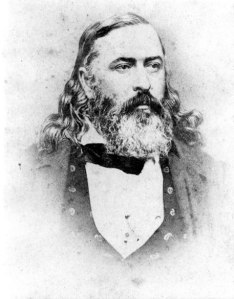
 Albert Pike was a lawyer who played a major role in the development of the early courts of Arkansas and played an active role in the state’s politics during the middle 19th Century. He was also a soldier, a national leader of masonry, and poet & writer.
Born in Boston in December 1809, he grew up in the greater Boston area. Pike was admitted to Harvard, but could not afford it. He began teaching school. In 1831, he left Massachusetts for Mexico. After spending some time in Santa Fe, he headed east and ended up in Fort Smith. Based on some political writings, he was invited to Little Rock by Charles Bertrand (a future Little Rock mayor).
In Little Rock he flourished as a writer and attorney. He also became involved in military matters first with the Mexican War and then with Confederate army during the Civil War. He also married and fathered several children. At the end of the Civil War, Pike moved to New York City, then for a short time to Canada. After receiving an amnesty from President Andrew Johnson on August 30, 1865, he returned for a time to Arkansas and resumed the practice of law. He then moved to Memphis and later Washington DC.
After he ceased practicing law, Pike’s real interest was the Masonic Lodge. He had become a Mason in 1850. He held several national posts in the Mason organization. Pike died at the Scottish Rite Temple in Washington DC on April 2, 1891. He was buried in Oak Hill Cemetery there. His Masonic brothers erected a statute to him in 1901 in Washington DC, making him the only former Confederate general to have a monument there.
The house he built in Little Rock still stands, and is known as the Pike-Fletcher-Terry House. It was the boyhood home of Pulitzer Prize winning poet John Gould Fletcher. Though he is buried in Washington DC, there is a memorial to him erected in Mount Holly Cemetery. It can be seen every day, but especially today during the Mount Holly Rest in Perpetuity fundraiser picnic.
Pike began to write poetry as a young man, which he continued to do for the rest of his life.
NIGHT ON THE ARKANSA (1838)
Night comes upon the Arkansa with swift stride, —
Its dark and turbid waters roll along,
Bearing wrecked trees and drift, — deep, red, and wide.
The heavy forests sleeps on either side,
To the water’s edge low-stooping; and among
The patient stars the moon her lamps has hung,
Lit with the spirit of the buried sun.
No blue waves dance the stream’s dark bosom on,
Glittering like beauty’s sparkling starry tears;
No crest of foam, crowning the river dun,
Its misty ridge of frozen light uprears:
One sole relief in the great void appears —
A dark, blue ridge, set sharp against the sky,
Beyond the forest’s utmost boundary.
Not so wast thou, O, brave old Merrimac!
As I remember the; as thou art seen
By the Soul’s eyes, when, dreaming, I go back
To my old home, and see the small boats tack
On thy blue waters, gliding swift between
The old gray rocks that o’er them fondly lean,
Their foreheads scarred with lightning. There, around
Grim capes the surly waterswhirl and bound;
And here and there grave patriarchal trees
Persuade the grass to clothe the reluctant ground
And frowning banks with green. Still villages
Sleep in the embraces of the cool sea-breeze: —
Ah, brave old stream! – thou seemest to infold
My heart within thy waters, as of old.

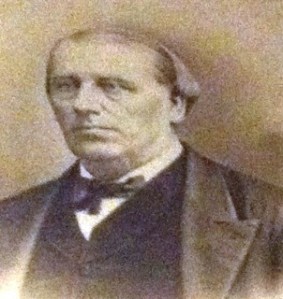 Future Little Rock Mayor John Wassell was born on February 15, 1813 in Kidderminster, England.
 Little Rock Culture Vulture