
Warhol, Lichtenstein and More as Arkansas Arts Center opens POP! Out of the Vault exhibit

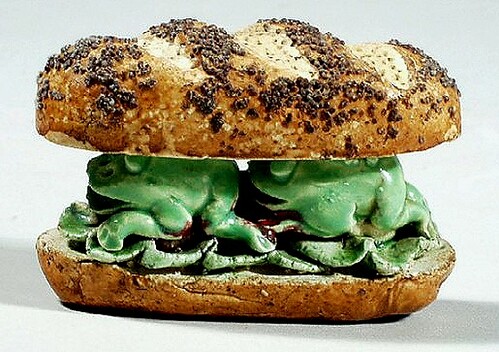
Mini Frog Sub

David Gilhooly, American (Auburn, California, 1943 – 2013, Newport, Oregon), Mini Frog Sub, 1980, hand-built, glazed low-fire whiteware, 2 ¼ x 1 3/8 inches, Arkansas Arts Center Foundation Collection: Gift from the Diane and Sandy Besser Collection, 1987.043.003.

POP! Out of the Vault, on view February 19 through July 7, 2019 at the Arkansas Arts Center, features more than 50 works from the Arkansas Arts Center Foundation Collection by some of Pop Art’s most influential figures, including Andy Warhol, Roy Lichtenstein, Claes Oldenburg, and Mel Ramos.

In 2013, the Arkansas Arts Center received a book of Polaroids by Andy Warhol as a gift from the Warhol Foundation. Throughout his career, Warhol was fascinated with Polaroids. In the 1970s, long before digital photography, these photographs that instantly developed themselves were a wonder – and very convenient for artists. The “Prince of Pop Art” made hundreds of Polaroids as sketches for his Pop Art portraits. The Arts Center’s 1975 Little Red Book #9 (Warhol produced hundreds of such books) features images of Easha McCleary. The Polaroids served as source material for a portfolio of prints related to a suite of 105 paintings, both titled Ladies and Gentlemen and commissioned by an Italian art dealer.

To show Warhol’s Polaroids of drag queens and transgender women of color in context, the curators of the Arkansas Arts Center went to the vaults in search work by of Warhol’s peers. They found a treasure trove of Pop Art and art from related movements.

POP! Out of the Vault will feature some rare examples of the first iterations of Pop Art, which arose in Britain in the 1950s. There, the artists of the Independent Group created collages that used American magazine pictures to mock the commercialism of contemporary life. Eduardo Paolozzi, a leading Independent Group artist, made collages, but also gathered popular imagery in prints, drawings, and sculptures like the Arts Center’s Triple Fuse.

In the early 1960s, young American artists created their own, independent version of Pop Art as they turned away from the hyper-expressive Abstract Expressionist works that had dominated American art through the 1940s and 1950s. Lichtenstein, Warhol, Oldenburg, and  Ramos were among the first American Pop artists. They shocked art critics by making fine art paintings and sculpture that appropriated mass-produced commercial images.

Lichtenstein used the colorful, hard-edged visual language of commercial art to reimagine a procession of different artistic subjects and movements from comic books to Cubism. Warhol mass-produced his paintings and prints of soup cans and celebrities using silkscreen – a process previously only used to print posters and packaging. Oldenburg turned the dignified tradition of monumental sculpture on its head with his giant hamburgers and clothes pins. Ramos, who was working in California while the others worked on the East Coast, appropriated images of Superman, Wonder Woman, and other heroes before he began creating his signature paintings pin-up advertising women and his sendups of famous art works.

At about the same time that American Pop artists were beginning their work, other artists found their own ways of reacting against Abstract Expressionism. In England, painter and printmaker Patrick Caulfield found an elegant modernist approach to every-day subject matter. Often referred to as a Pop artist, Caulfield abhorred the label. In California’s San Francisco Bay Area, an irreverent approach to art took the form of self-depreciating, ironic Funk Art. Funk artist David Gilhooly even founded his own ceramic amphibian-based planet – The FrogWorld.

POP! Out of the Vault is organized by the Arkansas Arts Center.

Little Rock Look Back: Arkansas Arts Center celebrates with week of Grand Reopening activities in February 2000

On February 17, 2000, over three thousand people attended the Arkansas Arts Center members preview of the new and renovated galleries as part of a week long celebration. It culminated in Big Art Weekend in which the building was open for 72 hours with around the clock programming.

Donors to the project, media, and Arkansas museum professionals had each received sneak peeks of the new facility earlier in the week. On Friday, February 18, the Big Art Weekend got underway with a gallery tour of a variety of Little Rock galleries. (This was before 2nd Friday Art Night.)  Lectures, tours, and other special events populated the building on Saturday and Sunday the 19th and 20th.  In addition, the Children’s Theatre was performing Aladdin and the Wonderful Lamp..

The renovation had taken over 18 months and cost $12 million.  It added 30,000 square feet of gallery space.  The expanded gallery space featured these exhibits: Paul Signac Watercolors and Drawings: Selections from the James T. Dyke Collection; Without Parameters: Selections from the Permanent Collection; Recent Acquisitions; Prophets, Parables and Paradoxes: Recent Drawings by David Bailin; Artistic Processes: Drawing; Living with Form: The Horn Collection of Contemporary Crafts; and European Paintings and Drawings.

The latter exhibit included eight pieces that were promised gifts from the Jackson T. Stephens collection.  They were Edgar Degas’ Dance in Blue (Before the Class, Three Dancers (c. late 1880s), Pablo Picasso’s Still Life with Red Bull’s Head (1938), Claude Monet’s Apple Trees Near Vetheuil (1878), Pierre-Auguste Renoir’s Three Partridges (c. 1888-1890), Alfred Sisley’s Road on the Edge of the Loing (1891), Camille Pissarro’s The Raised Terrace of the Pont-Neuf, Place Henri IV in Morning Rain (1902), Berthe Morisot’s The Flute Player (1890) and Bertrand Redon’s Vase of Flowers (c. 1890).

Little Rock Look Back: Polk Stanley Wilcox joins Studio Gang Architects in planning for reimagined Arkansas Arts Center

On February 16, 2017, the Arkansas Arts Center announced the selection of Polk Stanley Wilcox Architects as associate architect for its upcoming building project. Polk Stanley Wilcox will work in partnership with Studio Gang Architects on a reimagined Arkansas Arts Center. Studio Gang was selected as design architect for the expansion and renovation in December.


Polk Stanley Wilcox Architects is a programming, architectural, planning and interior design firm with offices in Little Rock and Fayetteville. The firm has experience working with clients in a variety of industries, including healthcare, nonprofit, cultural, education, corporate and worship. Polk Stanley Wilcox also focuses on sustainability and creating buildings that operate on minimal energy usage.

“We are thrilled to partner with the Arkansas Arts Center and Studio Gang on this transformative project,” Polk Stanley Wilcox Principal David Porter said. “AAC has cast an exciting vision to rethink not only how the Center upgrades the interior and exterior spaces, but how the AAC connects to and enriches the broad arts and cultural tapestry of Little Rock. Studio Gang is a uniquely talented firm to lead the design effort. PSW is honored to bring our extensive experience from years of important projects in downtown Little Rock to come alongside them and the AAC to help create this next critical milestone for the city, state and region.”

Polk Stanley Wilcox has previously worked on a number of local projects, including the William J. Clinton Presidential Library, Heifer International Headquarters, the Arkansas Studies Institute and the recently opened Robinson Center expansion and renovation.

“We look forward to working with the team at Polk Stanley Wilcox,” said Studio Gang Founding Principal Jeanne Gang. “We hope to build on their strong history of collaborations in the area and believe that their knowledge of Little Rock will be a huge asset as we expand the impact of the Arkansas Arts Center in Little Rock, and in the region.”

Polk Stanley Wilcox Architects was selected from among three finalists to work in partnership with Studio Gang. Ten local firms responded to the RFQ issued last month. Allison and Partners and Cromwell Architects were also finalists.

The three finalist firms presented to the selection committee on February 16. The selection committee for the associate architect included AAC Executive Director Todd Herman, three representatives from Studio Gang, and international museum consultant Deborah Frieden, and AAC Board member Sara Hendricks Batcheller.

“Each of the finalists are strong, well-respected firms,” Arts Center Executive Director Todd Herman said. “Ultimately, Polk, Stanley, Wilcox was the best complement to Studio Gang in terms of experience and strengths. Their work at Robinson auditorium – similar in both scope and complexity – will be an asset as we move through the project. We are very pleased to have PSW on board for this important project that will create wonderful new spaces for the people of Little Rock and Arkansas to enjoy the arts. Having our architectural team in place is a major milestone. We are very excited to move the project forward.”

Little Rock Look Back: First TABRIZ Gala in 1971

After a casual evening on Friday, February 12, 1971, the next night, several hundred people donned their tuxedos and maxi-length formal wear to attend the first Tabriz Gala.

After eating a gourmet dinner, guests were treated to a live auction with over 90 items.  The auctioneers were Edwin C. Jenkins of Los Angeles and Little Rock’s Dalton Dailey.

Among the items in the live auction (which raised $30,000)  were usage of a billboard for a month, a five day cruise in the Bahamas and the opportunity to help create a sculpture.  One of the more unique items was a lot in Pleasant Valley, which went for $11,500 (the equivalent of $72,000 in 2019).  The final item in the live auction was lunch with Martha Mitchell. The Pine Bluff native was married to US Attorney General John Mitchell. Little did anyone know at the time that President Nixon would one day blame Watergate on Martha Mitchell making life difficult for John Mitchell.

The Fine Arts Club had desired that Tabriz would be a unique event in Little Rock’s social calendar.  It appeared they succeeded.  The Arkansas Gazette noted that the crowd was livelier than normally happened at black tie events in Little Rock.

Due to the success of Tabriz, the Arts Center more than had the money it needed for the National Endowment for the Arts challenge match program.

Little Rock Look Back: First night of first TABRIZ

After over a decade of the Beaux Arts Bal (it was spelled the French way with only one “L”), a change was afoot in 1971. Because of the need to raise more money for the Arkansas Arts Center, the Fine Arts Club decided to replace their evening of dining and dancing with an auction event.

While there had undoubtedly been thrift sales and small-scale bidding on items to raise money in Little Rock, this effort would be the first large-scale endeavor to use an auction as part of a fundraiser.   In order to maximize the fundraising potential, it was decided this would be a two-night event. The first night (Friday, February 12) would be casual with a silent auction while the second (Saturday, February 13) would be formal.

There were two major reasons the Fine Arts Club needed to raise more money.  The National Endowment for the Arts had issued the Arts Center a challenge grant which required a $10,000 match. In addition, the Arkansas Arts Center was trying to build up an endowment for future purchases.  (This was less than three years after the facility had been faced with closing its doors.)

The name Tabriz was chosen because it was the name of a cultural city in the Mideast known for its marketplace.  The first edition had the tagline of “A Persian Market of All Things.”

The logo was designed by Jim Johnson of the firm then-known as Cranford/Johnson Associates. The decorations echoed the exotic theme employing palm trees, ferns, ceramic elephants, paisley fabric swaths, and turbans.

Among those working on the first Tabriz were Jane McGehee Wilson, Betty Mitchell, Betty Terry, Frances Cranford, Feetie Hurst, Tina Poe, Annette Connaway, Willie Oates, Phyllis Brandon, Jane Wolfe, and Mary Worthen.

Over 650 people attended the Friday night event. Admission of $5 provided sandwiches (conflicting newspaper accounts indicate either coldcut sandwiches or hot dogs) and beer.  Mixed drinks were an additional $1.

Newspaper coverage indicated that men wore “sports outfits,” suits without ties, or colorful parkas. It attracted men with “longhair and beards” and “conventional haircuts.” (Depending on who the writer was, “longhair” could have meant anything over one inch.)  The women that Friday favored maxi or midi skirts. There were no mini skirts on hand, but a Gazette reporter noted that some women were wearing hot pants which might make a mini skirt look long.

Music was provided by the trio of Tom, Jerry, and Barbara.

Because a Silent Auction was such a new thing, newspaper coverage pointed out that the rooms were actually quite full of sound as people chatted with each other both about bidding on the items and socializing in general.

To give people a preview of the auction items, the Arts Center galleries had been opened for viewing on the Sunday and Monday prior to the Friday and Saturday events.  An auction catalog was also available for pickup in advance of Friday.

Among the items up for bid were tennis and golf lessons, visits to beauty salons, credit at a pharmacy, a tour of the Municipal Courts building and lunch with city prisoners, a tour of the Little Rock Zoo, jewelry, artwork, tickets to Razorback games, a football jersey worn by Lance Alworth, a week in Las Vegas (one of only three items with a minimum bid), and a subscription to an answering service.

When all was said and done, the evening raised $9,500 for the Arkansas Arts Center.

Temporary Home for Arkansas Arts Center announced

The Arkansas Arts Center will temporarily relocate to 2510 Cantrell Road in the Riverdale Shopping Center for two and a half years during the center’s upcoming renovation and expansion project.

The temporary location, about three miles from the AAC’s MacArthur Park site, will include studio space for Museum School classes, design and rehearsal space for the Children’s Theatre and additional flexible spaces for offices, retail, facilities storage and educational programs.

“The AAC’s impact in our community, both in Central Arkansas and across the state, is immense and enduring,” said Merritt Dyke, President of the AAC board. “In addition to the nearly 200,000 visitors to MacArthur Park, the AAC’s statewide outreach numbers approach half a million people. We’ve been working with numerous community partners to ensure that we can continue to fulfill our mission and to serve these people while the AAC is under construction.”

“The support we’ve received throughout this endeavor has been overwhelming, and we are grateful to Harriet and Warren Stephens who are chairing our lead gifts capital campaign,” said Dyke. “Without their leadership, this project would not be where it is today. I am greatly appreciative to the AAC and Foundation boards, staff and all our community partners for their role in realizing this important vision.”

The AAC’s staff of approximately 100 full-and part-time employees will office out of this location during the renovation. Groundbreaking on the AAC’s transformational building project is scheduled for fall 2019, with the project anticipated to be completed in early 2022. The MacArthur Park facility will be available for all regular summer programming, with the new temporary Riverdale location opening sometime in September.

“The AAC’s programs are a vital part of our community,” said Bobby Tucker, Chairman of the AAC’s Foundation board. “We feel it’s of maximum importance that they continue to be offered while the center is under construction. Our commitment to the success of this transformational project in MacArthur Park is unwavering, as is our commitment to the organization as a whole.”

The Cantrell Road location will offer convenient, secure parking and new amenities for AAC program participants. With 15,200 square feet of studio space, the Museum School will offer nearly all its current program of classes and workshops, including drawing, painting, ceramics, jewelry, glass, small metals, woodworking and printmaking for its nearly 3,000 students per year. Fall Quarter classes will begin in the Riverdale location in September.

“We’ve been working diligently for more than a year to ensure that our students have a creative space, with the equipment needed to continue to engage in our classes in a temporary location,” said Rana Edgar, Director of Education and Programs. “Over the next three years, we plan to welcome our students into well-appointed studios, with all our core classes currently being offered, in addition to offering expanded opportunities to build their talents.”

In the Children’s Theatre’s 14,200 square-foot workshop, theatre staff will create sets, sew costumes, and build props for the AAC’s productions, including touring programs. Children’s Theatre on Tour, part of the AAC’s Statewide ArtsReach program, serves more than 35,000 students and families in communities across Arkansas every year with traveling professional theatre productions.

“The work of the Children’s Theatre team doesn’t stop when the stage lights go down in MacArthur Park,” said Bradley Anderson, Artistic Director in the Children’s Theatre. “We create theatre productions each season that travel the state, in addition to our local summer theatre academies, theatre classes and performances at the AAC. This move will allow those programs to continue – and possibly even expand.”

The AAC Museum Shop will also move its retail storefront into 1,500 square feet of space, joining many other local restaurants and businesses in the area. Administrative, facilities, equipment storage and flexible educational spaces will round out a total of 65,000 square feet of space at the temporary facility.

The move is one piece of the AAC’s commitment to remaining accessible to the community while its MacArthur Park facility is under construction, and to working with arts partners across the region to expand programming reach.

“The AAC is more than any one space or one building. Our programs will continue to span across communities and extend across the state over the next two and a half years,” said Laine Harber, Interim Executive Director and Chief Financial Officer. “This would not be possible without the commitment and dedication of our board leadership in continuing to fulfill our mission and vision while we undergo these much-needed renovations.”

AAC exhibition programs will also pop up in locations across Central Arkansas and beyond, including the continuation of the popular Delta and Young Arkansas Artists exhibitions. Works from the collection will also travel to other institutions across the country and across Arkansas, in addition to select objects from the contemporary craft collection remaining on view at 15 Central Arkansas Library System locations.

More details about additional programs and partnerships locally and across the state will continue to be announced throughout 2019.

Juror for 61st Arkansas Arts Center Delta Show announced; Deadline to apply is February 13

Image result for kevin cole artistAtlanta-based artist Kevin Cole will serve as guest juror for the 61st Annual Delta Exhibition, on view May 3 through June 30 at the Arkansas Arts Center. The deadline for artists to submit work to be considered for the exhibition is February 13, 2019.

Kevin Cole is a contemporary artist best known for sculptural works, paintings, and intentional use of color. An Arkansas native, Cole’s artwork has been featured in more than 475 national and international exhibitions, including the 42nd Annual Delta Exhibition (1999) at the Arkansas Arts Center.

His work can be found in notable private and public collections around the country. Among his public commissions are a fifteen-story mural commissioned by the Coca-Cola Company for the 1996 Centennial Olympic Games in Atlanta and a twenty-foot high by fifty-five feet long sculpture commission at Hartsfield-Jackson International Airport, Atlanta. His recent sculpture, When My Scars are my Testimony, is featured in the 2019 Atlanta Biennial at the Atlanta Contemporary Art Center.

Cole has been a member of AfriCOBRA since 2003 and was inducted into the Arkansas Black Hall of Fame in 2018.