
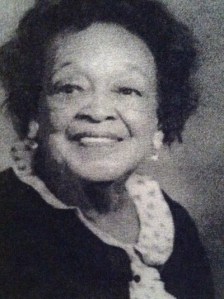
Women’s History Month – Sue Cowan Williams

Sue Cowan Williams was an educator who fought for fair treatment.

After being educated in Alabama and Illinois, she returned to Arkansas, and began her teaching career in 1935 at Dunbar High School in Little Rock.  In 1942, Williams became the plaintiff in a lawsuit aimed at equalizing the salaries of black and white teachers in the Little Rock School District. The NAACP’s Legal Defense Fund, including its director-counsel Thurgood Marshall, assisted in the case. The trial ended after a week with a verdict against Williams, and her teaching contract was not renewed for the 1942-43 school year. Other black educators left the school as a result of their involvement in the lawsuit.

In 1945, Williams successfully appealed the verdict to the Eighth Circuit Court of Appeal in St. Louis, which ordered equal pay for black and white teachers in Little Rock. Dr. Christophe, the new principal of Dunbar High School, demanded Williams’s reinstatement in the fall of the same year, but it was not granted until 1952. In the intervening years, she taught classes at what is now UAPB and Arkansas Baptist College as well as at the Ordnance Plant in Jacksonville.  Upon returning to the LRSD, Williams taught at Dunbar until 1974, when she retired. She died in 1994.

The Central Arkansas Library Branch located in the Dunbar neighborhood was named for her when it opened in 1997.  She is honored with inclusion in the Arkansas Civil Rights Heritage Trail.
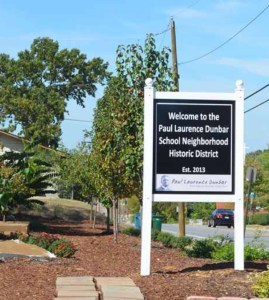
Black History Spotlight – Dunbar Historic Neighborhood

DunbarNeighborhoodThe new Arkansas Civil Rights History Audio Tour was launched in November 2015. Produced by the City of Little Rock and the University of Arkansas at Little Rock allows the many places and stories of the City’s Civil Rights history to come to life an interactive tour.  This month, during Black History Month, the Culture Vulture looks at some of the stops on this tour which focus on African American history.
The Paul Laurence Dunbar School Historic District played an important role as the center of Little Rock’s African American community from the mid-1800s to the mid-1900s.  Development began around Wesley Chapel, organized in 1853.

The neighborhood expanded after the Civil War to become home to many African Americans noted for their success in a number of fields, including business, politics, religion, education, law, music, and medicine. Among the historically black institutions that were founded in the neighborhood and remain there today are several churches, including Wesley Chapel United Methodist, Bethel A.M.E., Mount Pleasant Baptist, Mount Zion Baptist, and Union A.M.E.; and two colleges, Arkansas Baptist and Philander Smith.

The existing Dunbar School replaced an older high school that was named for Mifflin Gibbs, a prominent African American lawyer and political leader who lived in the neighborhood.  Today, Gibbs Elementary School continues the recognition of Gibbs.

The app, funded by a generous grant from the Arkansas Humanities Council, was a collaboration among UALR’s Institute on Race and Ethnicity, the City of Little Rock, the Mayor’s Tourism Commission, and KUAR, UALR’s public radio station, with assistance from the Little Rock Convention and Visitors Bureau.

Black History Month Spotlight – Arkansas Baptist College

The new Arkansas Civil Rights History Audio Tour was launched in November 2015. Produced by the City of Little Rock and the University of Arkansas at Little Rock allows the many places and stories of the City’s Civil Rights history to come to life an interactive tour.  This month, during Black History Month, the Culture Vulture looks at some of the stops on this tour which focus on African American history.


Arkansas Baptist College, established in 1884 by Rev. E. C. Morris and the National Baptist Convention, trained black students to become ministers and teachers. One of the earliest historically black colleges in the state, Arkansas Baptist College was first hosted by neighborhood churches, including Mt. Zion Baptist. In 1885, the College finally settled at what is now 16th and Dr. Martin Luther King, Jr., Drive.

Reverend Joseph A. Booker was appointed president of Arkansas Baptist College in 1887 and served for nearly forty years. Born into slavery, Booker was later educated at Nashville Institute in Tennessee. He not only scored early success for the college but also won acclaim as editor of Baptist Vanguard, a weekly publication produced on campus. Noted as a staunch opponent of Jim Crow segregation laws in Little Rock, Booker fought the Separate Coach Law of 1891.

In 2006, the College launched the African American Leadership Institute and in 2015 the Scott Ford Center for Entrepreneurship and Community Development. Dr. Fitzgerald Hill has directed the resurgence of Arkansas Baptist College, securing federal grants and recruiting more students.

The app, funded by a generous grant from the Arkansas Humanities Council, was a collaboration among UALR’s Institute on Race and Ethnicity, the City of Little Rock, the Mayor’s Tourism Commission, and KUAR, UALR’s public radio station, with assistance from the Little Rock Convention and Visitors Bureau

Black History Month Spotlight – Louis Jordan

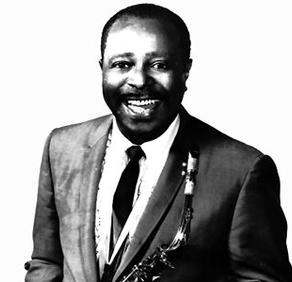
bhm louis-jordanSince tonight is the 57th Grammy Awards presentation, today’s spotlight looks at a musician who has several entries in the Grammy Hall of Fame – Louis Jordan.

Louis Thomas Jordan was born on July 8, 1908 in Brinkley. The son of a musician, he learned to play the saxophone as a youth and majored in music later at Arkansas Baptist College and performed with Jimmy Pryor’s Imperial Serenaders in Little Rock. He also toured with the famed Rabbit Foot Minstrels, who were the backing musicians for a number of blues legends. In the mid-Thirties, Jordan, now an accomplished jazz saxophonist, moved to New York, working with such jazz greats as Louis Armstrong. He joined drummer Chick Webb’s swing band in 1936.

After honing up his singing skills, he left the band in 1938 to start up his own band. Called the Elks Rendez-Vous Band, after the name of the club where they were playing a long-term engagement, Jordan signed with the Decca label. The band’s name was changed to the Tympany Five in 1939 and between 1941 and 1949; they had a series of hit records that were distinct of the “jump style” rhythm and blues style of music. These included “Choo Choo Cha Boogie,” “Saturday Night Fish Fry,”  and “Let The Good Times Roll.”

Jordan’s hits continued into the early 1950s, by which time his popularity on the R&B scene was enormous. His musical influence was far more reaching, with future rock ‘n’ roll stars like Bill Haley and Chuck Berry, fashioning their sound after Jordan’s style, particularly his vocal approach, song structures and lyrics and treatment of the guitars and horns. When Jordan left Decca in 1954, his popularity began to diminish quickly.

He continued to record and tour throughout the 1950s and 1960s, but rock ‘n’ roll, the music he helped foster, was a major contributing factor in his downfall. Louis Jordan died from heart failure in Los Angeles on February 4, 1975. In the early 1990’s, a revue called Five Guys Named Moe, based on Jordan’s music, was performed on London’s West End and New York’s Broadway.

Louis Jordan was inducted into the Rock ‘n’ Roll Hall of Fame in 1987.  He was posthumously inducted into the Arkansas Entertainers Hall of Fame in 1998 and the Arkansas Black Hall of Fame in 2005. In 2008, the centennial year of his birth, he was featured on a postage stamp.

For more on Louis Jordan and other inductees into the Arkansas Black Hall of Fame, visit the permanent exhibit at the Mosaic Templars Cultural Center. That museum is an agency of the Department of Arkansas Heritage.

Black History Month Spotlight: Hazel Shanks Hynson

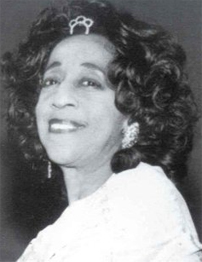
bhm hazelEducator and Musician Extraordinaire Hazel Shanks Hynson was a renowned educator and an extraordinary musician who through the years trained many accomplished musicians including the late jazz musician Art Porter.

Hynson earned a Bachelor of Arts degree in music, with a major in piano, from Atlanta University. She completed further study in piano, including advanced theory and harmony, with master musicians and instructors hailing from Oberlin College, the University of London and the Julliard School of Music, to cite a few When she moved to Little Rock, Hynson joined Mt. Zion Baptist Church where she served as its pianist for more than 25 years. Through her Hazel Shanks Hynson Music Studio, she presented her students in memorable piano recitals each year with as many as 20 baby grand pianos in use.

Recognized nationally for her outstanding musicianship, Hynson served as pianist for the Arkansas Baptist State Convention for 26 years and for the National Baptist Convention for 27 years. She also served a stint as pianist and choir director for Arkansas Baptist College which awarded Hynson an honorary doctorate in 1990 and named its multi-purpose building in her honor.

A charter and Golden Life member of the Little Rock Alumnae Chapter of Delta Sigma Theta Sorority, Inc., she was named Delta of the Year in 1992. She is also a charter member of the Little Rock chapter of The Links, Inc.

Known as a grand lady of grace and elegance, a superb teacher and pianist, arranger, composer, and musician’s musician, Hazel Shanks Hynson’s love of music has touched and shaped the lives of people across the globe.

In 2004, she was inducted into the Arkansas Black Hall of Fame.  For more on Hazel Shanks Hynson and other inductees into the Arkansas Black Hall of Fame, visit the permanent exhibit at the Mosaic Templars Cultural Center. That museum is an agency of the Department of Arkansas Heritage.