Final Dunbar High School Graduation – May 27, 1955

On May 27, 1955, on the stage of Robinson Auditorium, the Dunbar High School senior class graduated. This academic year marked not only the 25th anniversary of Dunbar’s opening, but it was the last year that the school building would offer junior high through junior college classes.

In the fall of 1955, the new Horace Mann High School would open. Dunbar would continue to be open, but only as a junior high.  (Though no reason was ever publicly given, the junior college component ended in May 1955.)

The new Mann High School was constructed, in part, as a way to delay any integration plans for the Little Rock School District.  With a new second all-white high school in the works for Little Rock, it was thought that a new African American school would placate the African-American community by not only giving them a new building, but relieving the overcrowding at Dunbar.

But on May 27, 1955, and the days leading up to it, the focus was on celebrating the final graduation class and the 25th anniversary of Dunbar High School.  On May 25, teachers who had taught for 25 years at the school, and original teachers who retired from the school were honored.

The school’s original principal, Dr. John H. Lewis, was the commencement speaker.  The current principal, Dr. L. W. Christophe presided over the awarding of the diplomas and announcements of scholarships.  Among the higher education institutions to which they received scholarships were the University of Michigan, Wiley College, Tennessee State, Arkansas AM&N, Talladega College, and Philander Smith College.

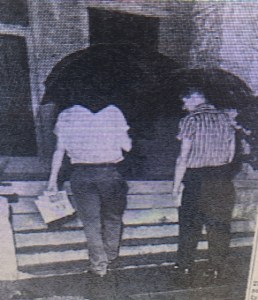
While the Arkansas Gazette and Arkansas Democrat  both DID run stories on the graduation, it was hardly equal to the coverage they gave Central High School.  In fact, on the day after Dunbar’s graduation, the Democrat ran a photo of two Central graduates huddled under an umbrella in the rain – three days after the ceremony took place.

In 1971, Mann ceased its status as a high school as well.  Today, both Mann and Dunbar serve as middle schools within the Little Rock School District.

Memorial Day – Remember the Fallen

Today is Memorial Day – a time to pay tribute to the men and women in uniform who died in service to their country.
As a way to give this recognition, today would be a good day to visit a cemetery. One of Little Rock’s most storied cemeteries is Mount Holly Cemetery. There are numerous persons buried there who died while in service to their country.

One of them is 2Lt Carrick W. Heiskell, son of Arkansas Gazette editor J. N. Heiskell.  2Lt Heiskell died while flying for the Air Transport Command in the Himalayas during World War II.  He was posthumously the recipient of the Distinguished Unit Emblem, Purple Heart, and the Air Medal.

Founded in 1843, Mount Holly has been called “The Westminster Abbey of Arkansas.” Thousands of visitors come each year. Those interested in history come to see the resting places of the territorial citizens of the state, including governors, senators, generals, black artisans, and even a Cherokee princess. For others the cemetery is an open air museum of artistic eras: Classical, Victorian, Art Deco, Modern––expressed in gravestone styles from simple to elaborate. Some come to read the epitaphs that range from heartbreaking to humorous to mysterious.

Though a City of Little Rock facility, the cemetery is maintained by the Mount Holly Cemetery Association, a non-profit organization with a volunteer Board of Directors. The cemetery is located at 1200 South Broadway in Little Rock. Gates are open from 8 a.m. until 5 p.m. in the summer and from 8 a.m. until 4 p.m. in the winter.

Little Rock Look Back: Final Saturday in May 1959 Recall Election Campaign

May 23, 1959, was a Saturday. It was also two days before the School Board recall election.  With it being a Saturday, it was the last full day for door knocking as supporters for all sides were busy trying to get out the vote.
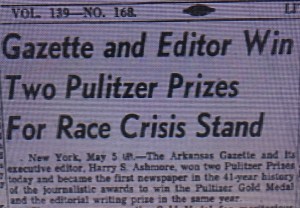
Both sides were confident of victory.  Before a crowd of 1,000 in MacArthur Park, segregationists Rep. Dale Alford and Mississippi congressman John Bell Williams berated Harry Ashmore and the Arkansas Gazette.

STOP chair Dr. Drew Agar and campaign chair William Mitchell predicted it would be the largest turnout in Little Rock school election history.  They also stated that Gov. Faubus’ TV appearance criticizing STOP had actually pushed people over to their side.

Echoing Agar and Mitchell, the Pulaski County Election Commission predicted 30,000 of the district’s 42,000 registered voters would cast ballots.  The previous record of 27,000 had been cast in September 1958 when voters decided to keep the high schools closed.  By contrast, 14,300 voted in the December 1958 election which had selected the six school board members now on the ballot for recall.  On May 22, the final day of absentee ballot voting, 205 absentee votes had been cast bringing it to a total of 455 absentee ballots.

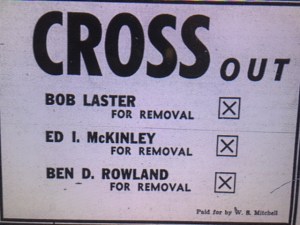
William S. Mitchell, who in addition to being a renowned attorney, apparently had a wicked sense of humor.  He used CROSS’s name against them in ads (placed throughout the newspaper) which urged voters to “Cross” out the names of the three candidates being backed by CROSS.

And the Pulitzer goes to SOUTH PACIFIC

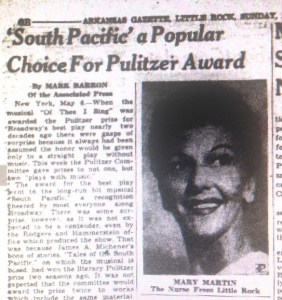
On May 5, 1950, the Rodgers and Hammerstein musical South Pacific captured the Pulitzer Prize in Drama. This would receive special attention in the Arkansas Gazette. The reason this carried such weight in Arkansas was that the musical had a connection to Little Rock.
The 1950 Pulitzer for Drama went to a musical for only the second time in the history of the awards. The recipient was South Pacific by Richard Rodgers, Oscar Hammerstein II and Joshua Logan. The character was the leading lady of Nellie Forbush. She was an Navy ensign and a nurse stationed on an exotic island during World War II. The musical was based on a Pulitzer Prize winning novel, James Michener’s Tales of the South Pacific.

In the Michener novel, Miss Forbush is not from Little Rock. She is actually from a small town in Alabama. But the book does mention Nellie and her mother visiting Little Rock.  The part was written for Mary Martin from Weatherford, Texas. Rodgers, Hammerstein & Logan did not discuss why they relocated Nellie’s birthplace.

Originally the musical contained a song entitled “My Girl Back Home” in which Nellie sang of being from “Little Rock, A-R-K” while another character sang of being from “Philadelphia, P-A” and “Princeton, N-J.” It is possible the change to Little Rock was made because it offered more lyrical possibilities, but that is only a supposition on the part of the Culture Vulture. That song did appear in the movie version in which Mitzi Gaynor played Nellie Forbush. It was also featured in the 2008 Broadway revival, this time with Kelli O’Hara playing Nellie.

In the musical, Nellie struggles with her own prejudices. This issue of prejudice became an instance of fact meeting fiction. In 1957, a few weeks after Eisenhower sent troops into Little Rock to ensure that Central High would be desegregated, a production of South Pacific on Long Island was temporarily halted when the audience booed and yelled after Nellie mentioned she was from Little Rock. Interestingly, the movie was released in 1958, but retained references to Little Rock. That was either a testament to the expense of re-editing it, or the fact that audience reaction had lessened.

The Return of the STAR WARS Day

Today, May the 4th, is Star Wars Day.

This year marks 42 years since the first (now subtitled Episode 4) movie opened!

The classic film first opened in fewer than 40 theatres nationwide on May 25, 1977.  It did not reach Little Rock until June 24, 1977.

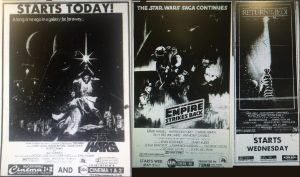
Given its status as a sleeper hit, it is no surprise that it came into Little Rock largely unnoticed.  In that day, major films opening on a Friday would be heralded the previous Sunday with a substantial advertisement.  The first Star Wars ad ran on Thursday, June 23, 1977, the day before it opened.  By contrast, Herbie Goes to Monte Carlo, which would play at the same theatre, had a large ad on Sunday, June 19.

The day it opened, there was a fairly large ad which incorporated the familiar beefcake Luke, Leia in flowing gowns, and Darth Vader mask.  On the Sunday after it opened, there was a slightly smaller ad with the same artwork.  McCain Mall also ran a small add for both Star Wars and Herbie. It noted that Star Wars was a film that management “does not recommend for children.”

Three years later, The Empire Strikes Back opened nationwide on May 21, 1980. Opening a film on the same date was a newer phenomenon, due in part to the success of Star Wars.  For the opening weeks, The Empire Strikes Back played an exclusive showing at the UA Cinema 150.  It would eventually play at other theatres in Little Rock.

On the day The Empire Strikes Back opened, the Arkansas Gazette had four different stories about the movie in that day’s edition.  While the Arkansas Democrat did not have any stories that day (though they would in subsequent days), they did carry a story on David Letterman preparing to start his (what would turn out to be short-lived) morning TV show.

On May 25, 1983, The Return of the Jedi opened.  The cost to see The Return of the Jedi in Little Rock in 1983 was $5.00 for adults and $2.50 for children.  (That would be the equivalent of $12.37 today for an adult ticket.)