 Two times Cliff Baker declined to hire me.
The first was, upon reflection, a “what the hell he thinking even interviewing me I was nowhere qualified for that job?!” situation.
The second time I had three interviews. Met the entire staff. And at the last minute some board members wanted to restructure staffing and go another direction.
I was disappointed. But because it was Cliff, I was not bitter.
I mean, that elfin grin. Those sparkling eyes. You could tell there were fifty-thousand ideas going through his mind at once. He was an encourager and a dreamer.
Cliff Baker willed Arkansas Rep into existence. He had a merry band of players to join him. But in the end, it was his vision, his determination, his blood, his sweat, and his tears that made the dream a reality.
The genesis for the Rep predates even the Arkansas Philharmonic Theatre. It goes back to the theatre program of the Arkansas Arts Center during its degree granting days. Cliff worked with Dugald MacArthur who led the dramatic arts section during most of the four years the school existed. Cliff was part of Of Prisons and Men, the environmental staging production of a new play which was critical of the Arkansas prison system. It was aborted due partially to the involvement of actual inmates in the production (to the dismay of some in prison leadership system). Though not publicly stated, there was also some discomfort with the tone and tenor of the play.
Earlier this year, Cliff and I talked about this play. Sometime over the years, he had lost his papers on it. But longtime Arts Center trustee Jeane Hamilton had hers and gave them to Cliff. As the theatre production was cancelled and later the entire degree granting program dropped for budget reasons, Jeane had encouraged Cliff to keep dreaming of theatre for Little Rock. When Mimi Dortch was helping Cliff launch the Rep, Jeane was excited to join in. (And it was Jeane who recruited Ruth Shepherd to become involved with the Rep.)
I was fascinated to hear Cliff talk about the visits to the prison, the rehearsal process, and the disappointment for the way it ended. But fifty years later, it was just one stop on his career providing anecdotes from his youthful baptism into the Little Rock theatrical scene.
As a child, I was taken to a production at Cliff’s Arkansas Philharmonic Theatre in Hillcrest. I could not tell you what it was, nor do my parents remember. One of my babysitters was in the play. I may not remember the play or the plot (I was five or six), but I vividly remember the cramped space. There was an electricity to it. And it showed that theatre did not have to take place in a large auditorium.
The next year, the Arkansas Rep was born in an abandoned church space adjacent to MacArthur Park. Operating for the first few years as a true repertory company, the same core cadre acted, sold tickets, built sets, and cleaned the building. What Cliff was creating in Little Rock was rare at the time. Professional theatre did not exist in cities of its size.
My first personal interaction with Cliff was at Arkansas Governor’s School. They were touring the musical Quilters to campus. Since I was in Drama at AGS, Cliff and some cast members visited with us. I don’t remember anything profound he said, but I remember him treating this group of 21 seventeen-year olds with respect. Later that evening, the light board was not cooperating. So the show actually started with only house lights until the light board started functioning. Before the show, Cliff gave brief remarks about the show. He apologized for the technical glitch, but “the show must go on.” About 15 minutes into it, the theatrical lighting appeared.
Over the years, I saw many shows he directed. Cliff was at home in so many different styles of theatre.
Perhaps one of my favorite Cliff memories was a decade or so back when the Rep produced A Chorus Line. I and some friends were at an event which involved a behind-the-scenes talk about the production. By this point, Cliff had been retired from the Rep (the first time) for several years but was directing the production. He and I were sitting at the same table. A friend of mine who was relatively new to town quite innocently asked, “So what is your connection to the Rep?” I just about did a Danny Thomas spit take to the drink I was sipping. Cliff very humbly said, “Well, I have been involved since the first days of it and am now back directing this show.” He was not upset that someone did not know who he was. He was actually very glad to see many new people continuing to be involved with the Rep.
The Cliff stories keep coming back as I write this. We all have them. He had the ability to make people feel connected, to make you feel you were the most important person in the room. It was that gift that made him a good director, actor, producer, and fundraiser.
My last conversation with Cliff was on the opening night of Gridiron. We had chatted earlier in the evening. Then after the show, I saw he and Guy, right after I had passed Herb Rule. The three of them played the key male roles in the Rep’s first production: The Threepenny Opera. I teased Cliff that it was time for a revival of that production. He smiled and said, “It was such a fun show to do.” We shook hands and parted ways. I knew he needed to work the room. This was a space filled with people who wanted to support the Rep as it refreshed itself.
When the announcement of the Rep suspending operations was made in April, one of my first thoughts was, quite selfishly, “Damn, I won’t be able to see a Cliff Baker God of Carnage.” It was the show I had most been anticipating from this season. As the Rep was working to plan for a new season, I was hopeful that Cliff would be able to mount that production in the new season. A very dark comedy, it is reminiscent of some of his best work. Alas, just as the Rep is on the cusp of a new phase, Cliff won’t be there to direct.
But Cliff WILL be there. He will always be a part of the Rep. It is more than him, but it is very much him.
For the rest of us – those who are left to mourn, to support Guy, to face life after Cliff, I keep thinking of a line from Lincoln’s Gettysburg Address. In it, he said, “It is for us the living, rather, to be dedicated here to the unfinished work.” And there is much unfinished work. The Rep needs to return to regular programming to be sure. But it is more than that. We need to all redouble our efforts to exhibit the compassion, the passion, the wit, and the sincerity he showed. To inspire others to be their best whether in the arts or whatever field they choose.
Cliff Fannin Baker was a Pied Piper, and we were all glad to follow along.

 October is Arts and Humanities Month. This year, each day a different past Arkansas Repertory Theatre production will be featured. This is, in part, a tribute to the late Cliff Baker, and also a countdown to the Rep’s re-emergence.
 The Arkansas Repertory Theatre has issued another progress report today. And Progress is the operative word!
 As all sectors did, the Little Rock arts and culture community responded to September 11.

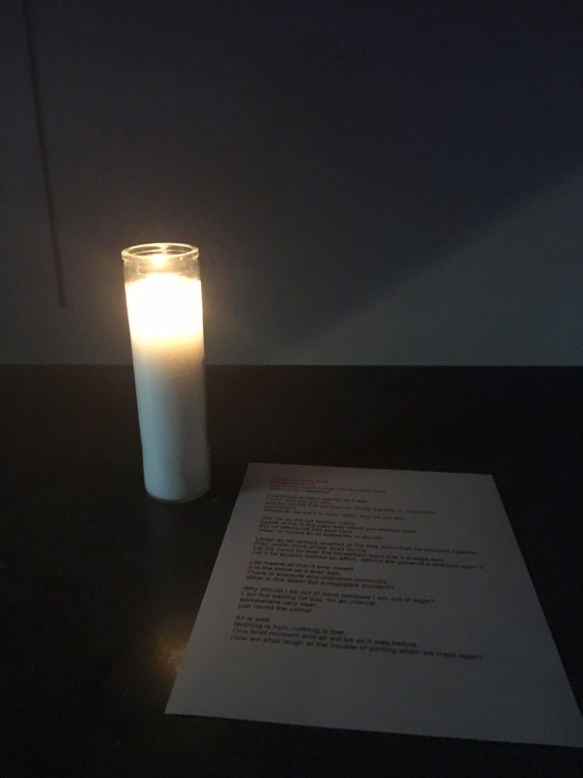



 On Thursday, September 6, at 8pm (CDT), the Arkansas Rep will light a candle in memory of its founder Cliff Fannin Baker.
 Little Rock Culture Vulture