Little Rock Look Back: W W Stevenson

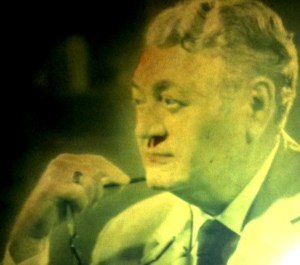
On January 29, 1797, future Little Rock Mayor William Wilson “W. W.” Stevenson was born in South Carolina.

In 1811, he came to Arkansas when his family settled in Batesville.  An ordained Presbyterian minister, he married Ruana Trimble in 1821 and had two children. After she died, he married Maria Tongray Watkins in 1831 and had two more children.

In 1831, he ran for Little Rock Mayor in the first election for the office but was defeated by Dr. Matthew Cunningham.  The next year he ran to succeed Cunningham and was elected.  After leaving the Mayor’s office on December 31, 1833, he continued public service.  He was asked to run for Mayor later in the 1830s, but declined.  He did serve as State Commissioner for Public Buildings in 1839.

In 1849, he delivered the funeral oration at the ceremony for Hon. Ambrose H. Sevier.  Later that year, he was hired as a geologist for the Little Rock and California Association which was created to take advantage of the gold rush.  He and his two oldest sons moved to California and never returned to Arkansas. He died in 1888.

Little Rock Look Back: LR finally takes possession of Robinson Auditorium

On January 25, 1940, the City of Little Rock officially took complete possession of the Joseph Taylor Robinson Memorial Auditorium. By assuming custody of the structure from the contractor and the PWA, the City accepted responsibility for any of the remaining work to be completed.

This event happened one day shy of the third anniversary of the election which approved plans to issue bonds for an auditorium.  The act took place only about five months behind schedule.

E. E. Beaumont, the Auditorium Commission chairman, stated that an opening date could not be set until more work was completed. A major unfinished task was the laying of the front sidewalk which had been delayed due to cold weather.

The night before Little Rock took possession, Robinson Auditorium had been a topic of discussion at the Little Rock Chamber of Commerce annual meeting. The new Chamber president Reeves E. Ritchie (who as an Arkansas Power & Light executive had been engaged in the lengthy discussions about the installation of the steam line and transformers of the building) pledged that the Chamber would work to bring more and larger conventions to Little Rock at the Joseph Taylor Robinson Memorial Auditorium.

Haco Hijacked, or 50 years ago this month Little Rock’s Mayor made an unscheduled trip to Havana

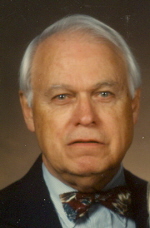
Less than a week after being selected Little Rock’s 58th mayor, Haco Boyd made an unscheduled stop in Cuba when the Eastern Airlines Boeing on which he was flying was hijacked.

The seventy passengers, including 44 from Arkansas, were hijacked to Cuba on January 9 on a flight that was originally scheduled to go from Miami to Nassau for an insurance convention.

Shortly after takeoff, a passenger, who described himself as a student at Purdue University, sat next to a flight attendant, told her the plane was going to Cuba, and showed her a knife.

After landing in Cuba, the plane, its crew, and two passengers (Mr. and Mrs. Keith Thrash of Little Rock) were allowed to return to Miami. The Thrashes were allowed to stay on the plane due to illness.  Several hours later, another plane picked up the remaining passengers and returned them to Miami.

Eastern Airlines then flew the passengers on to Nassau without further incident. Mayor Boyd’s wife was flying with him on the plane.

Once the media found out that Little Rock’s mayor was on the plane, he became of great interest to reporters.  “They treated us real well in Havana.” Boyd told the press. “They gave us the blue plate special treatment.” Boyd said everything was “just fine, no sweat, it’s just one of those things.” He went on to describe the hijacker (who stayed in Cuba) as “a rather decent looking person, except for his nose and his mouth, which were a little weak.

Mayor Boyd was back at City Hall to preside over the January 20, 1969, City Council meeting. It appears that the reminder of his airline flights went to their appropriate destinations.  During World War II, he had been a decorated pilot for the Army Air Corps.

Little Rock Look Back: Opening of 1868 LR City Hall

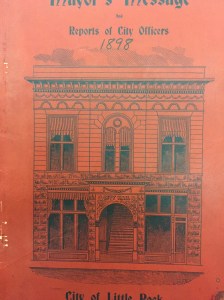
The 1868 City Hall as featured on a city report.

On January 22, 1868, a charity ball (including a supper) was the first special event held in the new Little Rock City Hall located at 120 to 122 West Markham.

The two story building featured city offices downstairs, including an engine house for the volunteer fire department. Upstairs was the council chambers and a special event space. The facility was the width of two storefronts. The upstairs was accessed by a central staircase which went from street level through an archway directly up to the second floor. The first floor had a stone exterior and the second floor was a combination of brick and woodwork.

Records do not indicate when the first city council in the new building took place. At the January 21, 1868, meeting, the body formally accepted the building and cancelled any clauses in the contract about penalties should the contractor not meet the construction deadline. But there is no indication whether that meeting took place in the new building or in the previous city hall. (The location of that prior city hall is a mystery.). The minutes from the council meetings just prior to and just after the January 21 meeting give no indication as to which building was the site for the meeting.

It IS known that March 30, 1908, was the date of the final council meeting in the 1868 City Hall. After that meeting, city offices completed their move to the edifice at Markham and Broadway, which still serves as Little Rock City Hall.

As early as November 1867, the City Council was getting requests for special events to be held in the new city hall. In November and December the council refused to take action on any requests because the building was still under construction.

The January 22, 1868, event was created to help the destitute in Little Rock. The ARKANSAS GAZETTE encouraged people to be generous and purchase tickets. Even the day before the event, the weekly version of the GAZETTE (which at the time had added daily editions in addition to its weekly issue) was assuring people there would be plenty of space in the splendid new building so there was still room for additional ticket purchases. Tickets were $5 to admit a lady and a gentleman.  (That would be the equivalent of $83.71 today. While cheap for two people to attend a Little Rock event in 2018, in the post-Civil War era, it was a definite hit to the pocketbook.)

The unnamed organization which put on the charity event was led by W. W. Wilshire (president), George W. Clark (secretary), Joseph Meyer (treasurer) and a standing committee of Dr. C. M. Taylor, Dr. P. O. Hooper, A. Adams, F. H. Moody, and E. Langley.  Donations could be made to any of the officers.  The arrangements for the event were handled by Joseph Meyer, A. Adams, J. P. Jones, Alexander George, Jr., Joseph W. Bossert, and Daniel Ottenheimer.  The reception committee was W. D. Blocher, H. C. Ashley, A. McDonald, P. W. McWhorter, T. Lafferty, and F. H. Moody.   Tickets could be purchased at the stores of J. E. Reardon, G. H. Gibbs, Joseph Meyer, Lafferty & Raleigh, S. L. Griffith, McAlmont & Stillwell, Beideman & Co., and Dodge & Co as well as at the Anthony and Commercial Houses.  (It is interesting to note how so many people at the time were publicly listed by only their first initial.)

The building stood for 56 years after City Hall vacated it.  It housed a variety of businesses over the years.  The building was torn down in 1964 as part of Urban Renewal.  Today it is the site of part of the Statehouse Convention Center.  It is directly across from the One-Eleven restaurant side of the Capital Hotel.

Little Rock Look Back: Elijah A. More

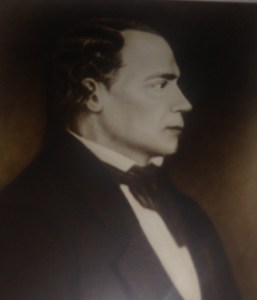
On January 20, 1799, Elijah A. More was born in Kentucky.  By the early 1830s, he was residing in Hempstead County and practicing law. Because of the court system being based in Little Rock, he spent a great deal of time in Pulaski County.

By January 1834, he had obviously established a permanent residence in Little Rock, because he was chosen as the third mayor.  He served from January 1834 until January 1835.

According to records, he apparently continued to alternate between residing near what is now Hope and living in Little Rock.  In 1839, his wife Caroline Owens More died and was buried in Little Rock. Though not originally buried at Mount Holly (it did not open until 1843), she is now buried there.

In 1840, More was the subject of a court case before the Arkansas Supreme Court resulting from actions he had taken as an executor of an estate and subsequently as Pulaski County Probate Judge.

By 1864, More resided in Missouri. There is a record of him swearing a loyalty oath to the Governor of Missouri in that year (presumably in response to actions associated with the Civil War).

He died on April 15, 1878 and is buried in Columbia Cemetery in Columbia, Missouri.

Little Rock Look Back: HAIR brings Age of Aquarius to Robinson Center

Ad for the original production of HAIR in Little Rock. Note the ticket prices. And that they could be purchased at Moses Music Shops.

Forty-seven years ago today, on January 18, 1972, the musical Hair settled in for a week-long run at Robinson Auditorium.  The saga to bring the national tour to Little Rock had actually begun eleven months earlier.

In February 1971, a young Little Rock attorney named Phil Kaplan petitioned the Little Rock Board of Censors to see if it would allow a production of Hair to play in the city. He was asking on behalf of a client who was interested in bringing a national tour to Arkansas’ capital city. The show, which had opened on Broadway to great acclaim in April 1968 after an Off Broadway run in 1967, was known for containing a nude scene as well for a script which was fairly liberally sprinkled with four-letter words. The Censors stated they could not offer an opinion without having seen a production.

By July 1971, Kaplan and his client (who by then had been identified as Southwest Productions) were seeking permission for a January 1972 booking of Hair from the City’s Auditorium Commission which was charged with overseeing operations at Robinson Auditorium. At its July meeting, the Commissioners voted against allowing Hair because of its “brief nude scene” and “bawdy language.”

Kaplan decried the decision. He stated that the body couldn’t “sit in censorship of legitimate theatrical productions.” He noted courts had held that Hair  could be produced and that the Auditorium Commission, as an agent for the State, “clearly can’t exercise prior censorship.” He proffered that if the production was obscene it would be a matter for law enforcement not the Auditorium Commission.

The Commission countered that they had an opinion from City Attorney Joseph Kemp stating they had the authority. One of the Commissioners, Mrs. Grady Miller (sister-in-law of the building’s namesake the late Senator Robinson, she had served on the Commission since 1940), expressed her concern that allowing Hair would open the door to other productions such as Oh! Calcutta!

On July 26, 1971, Southwest Productions filed suit against the Auditorium Commission. Four days later there was a hearing before federal Judge G. Thomas Eisele. Judge Eisele offered a ruling on August 11 which compelled the Auditorium Commission to allow Hair to be performed. Prior to the ruling, some of the Auditorium Commissioners had publicly stated that if they had to allow Hair, they would close it after the first performance on the grounds of obscenity. To combat this, Judge Eisele stated that the Commission had to allow Hair to perform the entire six day engagement it sought.

Upon hearing of the Judge’s ruling, Commissioner Emily Miller offered a succinct, two word response. “Oh, Dear!”

In the end, the production of Hair at Robinson would not be the first performance in the state.  The tour came through Fayetteville for two performances in October 1971 at Barnhill Arena.

On January 18, 1972, Hair played the first of its 8 performances over 6 days at Robinson Auditorium.  In his review the next day, the Arkansas Gazette’s Bill Lewis noted that Hair “threw out all it had to offer” and that Little Rock had survived.

The ads promoting the production carried the tagline “Arkansas will never be the same.”  Tickets (from $2 all the way up to $8.50–the equivalent of $12 to $51 in 2019 dollars) could be purchased at Moses Melody Shops both downtown and in “The Mall” (meaning Park Plaza). That business is gone from downtown, but the scion of that family, Jimmy Moses, is actively involved in building downtown through countless projects. His sons are carrying on the family tradition too.

Little Rock was by no means unique in trying to stop productions of Hair.  St. Louis, Birmingham, Los Angeles, Tallahassee, Boston, Atlanta, Charlotte NC, West Palm Beach, Oklahoma City, Mobile and Chattanooga all tried unsuccessfully to stop performances in their public auditoriums.  Despite Judge Eisele’s ruling against the City of Little Rock, members of the Fort Smith City Council also tried to stop a production later in 1972 in that city. This was despite warnings from City staff that there was not legal standing.

Within a few years, the Board of Censors of the City of Little Rock would be dissolved (as similar bodies also were disappearing across the US). Likewise, the Auditorium Commission was discontinued before Hair even opened with its duties being taken over by the Advertising and Promotion Commission and the Convention & Visitors Bureau staff.  This was not connected to the Hair decision; it was, instead, related to expanding convention facilities in Robinson and the new adjacent hotel.  Regardless of the reasons for their demise, both bygone bodies were vestiges of earlier, simpler and differently focused days in Little Rock.

Little Rock Look Back: 57th Mayor Martin Borchert

On January 16, 1916, future Little Rock Mayor Martin Borchert was born in Stuttgart.  After graduating high school he moved to Little Rock.  During World War II, he served as a bomber.  He started work at ACME Brick and spent 21 years there before engaging in other business interests.  Among these businesses were Martin Borchert Co., ASCO Hardware, Detection Systems Inc. and Component Systems Inc.  In 2005 he was inducted into the Arkansas Construction Hall of Fame.

Mayor Borchert was elected to the Little Rock City Board of Directors in 1964 and served from January 1965 through December 1968. He chose not to seek a second term.  In 1967 and 1968 he served as Mayor of Little Rock. During this time, he laid out the vision for what has become Riverfront Park along the Arkansas River.

Other civic achievements included being a member of the Board of the Little Rock Chamber of Commerce, being on the Governor’s Citizens Advisory Committee, a member of the Pulaski County Quorum Court, vice chairman of the Arkansas Planning Commission, and being on the Little Rock Air Force Base Community Council. In 1967 he served on the President’s National Advisory Council to the Small Business Administration.

Mayor Borchert served on the Little Rock Water Commission, including a tenure as chairman. In 1985, he was chairman of the Metropolitan Transit Policy Board and as chairman oversaw the transfer of the Central Arkansas Transit system to the Central Arkansas Transit Authority. One of the achievements of which he was very proud of was that he was one of the very first in Arkansas to receive an Adopt the Highway road.

Mayor Borchert was married for 57 years to Rosemary “Biddy” Branch Borchert.  They had two children, a son, John “Topper” Borchert and a daughter, Leslie Borchert Wilson.  He died on May 11, 2007.