Chairman of the National Endowment for the Arts to visit Little Rock

NEA LRDr. Jane Chu, a former resident of Arkadelphia, is the new chairman of the National Endowment for the Arts.  On Tuesday, October 7, she will be in Little Rock.

At 1:30, she will be part of a presentation at the Arkansas Repertory Theatre.  Steve Luoni of the University of Arkansas Community Design Center, will lead a discussion of the Creative Corridor.  Dr. Chu will also make remarks.  Mayor Mark Stodola will be the host of the event.  The public is invited to attend.

During her visit in Little Rock, Dr. Chu will also take part in a variety of meetings and tours.

LR Creative Corridor featured on National Endowment for the Arts website

NEA websiteThe National Endowment for the Arts recently featured Little Rock’s plans for the Creative Corridor on its website.

The entry discussed the next phases in the NEA’s Creative Placemaking grant process.  There were many other images the NEA could have used, but they selected this one.  It is a testament to the planning done by the University of Arkansas Community Design Center and Marlon Blackwell Architect and the support by the Little Rock community for this plan.

Planning for the Creative Corridor dates back to 2007 when Mayor Mark Stodola attended the Mayors’ Institute on City Design. It is a program jointly sponsored by the U. S. Conference of Mayors and the NEA.


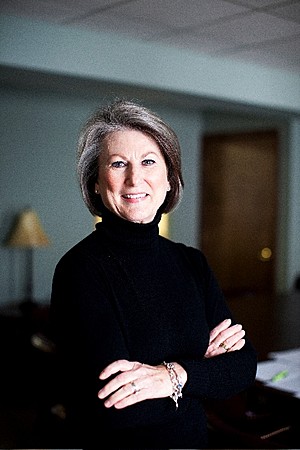
Little Rock Look Back: Sharon Priest, LR’s 70th Mayor

Photo courtesy of the Downtown Little Rock Partnership

On September 12, 1947, future Little Rock Mayor Sharon Priest was born in Montreal, Canada. After marrying Bill Priest, she came to Little Rock. She began her public service at the grassroots level when she led the effort to bring flood relief to Southwest Little Rock and Pulaski County following the devastating flood of 1978 that killed 13 people in central Arkansas.

She was appointed to the Little Rock City Beautiful Commission.  Following that, she challenged an incumbent City Director and won her first elective office in 1986. In January 1989, she was named Vice Mayor of Little Rock by her colleagues on the City Board.  Two years later, she was selected Mayor becoming only the second female to serve as Mayor of Little Rock.  During her service to the City of Little Rock, she spearheaded the effort to create a Little Rock flag.  At the conclusion of her second four year term on the City Board, she decided to run for Secretary of State.
In November 1994, she elected Secretary of State, becoming the first woman to be elected to that position in Arkansas.  She was reelected in 1998.   In the summer of 2000, she becamePresident of the National Association of Secretaries of State. After the 2000 presidential election, she was thrust into the forefront of the movement towardelection reform. Ms. Priest testified before U.S. House and Senate Committees on election reform. As Secretary of State, restoring the Governor’s Reception Room and the Old Supreme Court Chamber of the State Capitol to their original splendor and restoring the rotunda marble are a few of her proudest achievements.
In January 2003, Ms.Priest was selected to serve as Executive Director of the Downtown Little Rock Partnership. Priest reorganized the Partnership during that first year. The Partnership is spearheading the revitalization of Main Street in collaboration with stakeholders and the City of Little Rock, focusing on the redevelopment of existing structures, streetscape and safety. She has also been a leading champion for the redevelopment of MacArthur Park, the City’s oldest park.

Prior to her work as an elected official, she worked as Director of Membership for Little Rock Chamber of Commerce and was founder and owner of the Delvin Company, a property management firm. She was a Toll Fellow in 1995, and has won numerous distinctions including the Excellence in Leadership Fellowship, Women Executives in State Government, 1997 and TIME/NASBE Award for Outstanding Leadership in Voter Education, 1996.  In 2013, she was the featured honoree at the Big Brothers/Big Sisters Roast and Toast, becoming the first (and to date only) female to be so honored.

Creative Corridor work to close a block of Main Street for a few weeks

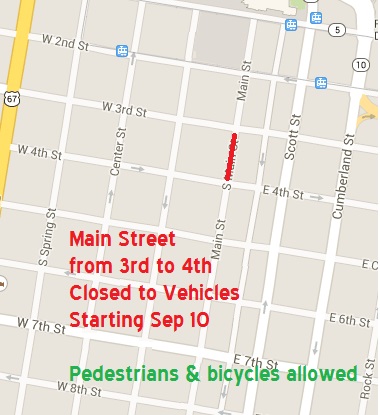
Main Street closureBeginning Wednesday, Sept. 10 at 7 a.m., Main Street between Third and Fourth streets will be closed to thru vehicle traffic.

The closure is expected to last three to four weeks.  During this time period, pedestrian and bicycle traffic to businesses, residences and job sites will be allowed at all times.

The closure is needed to continue progress on the Main Street Creative Corridor project. The lack of vehicular traffic will maintain a safe working environment for construction crews and the general public.

The 300 block of Main Street will be one of the gateways to the Creative Corridor, featuring a plaza with rain and light gardens.


April 4 Architeaser

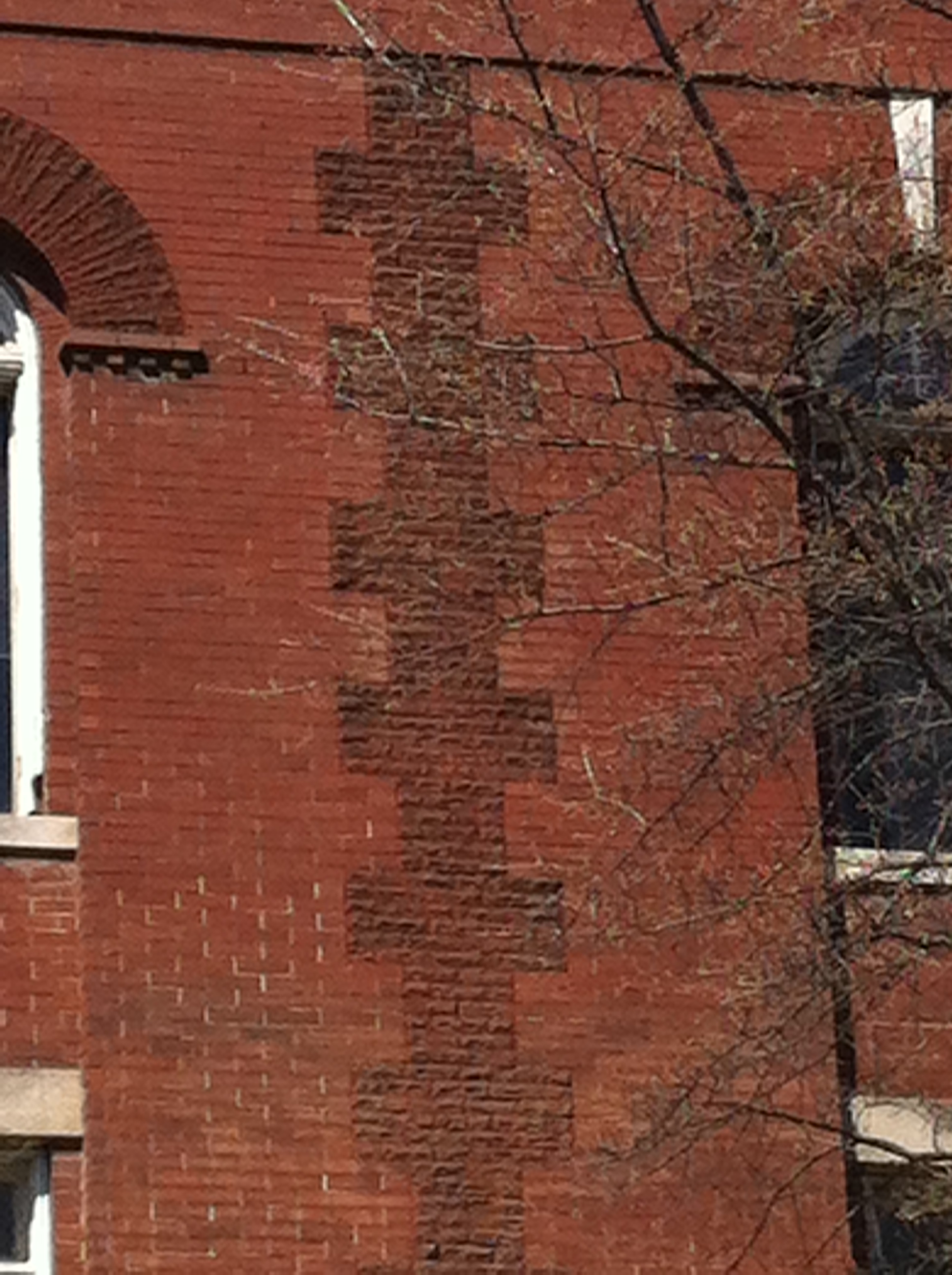
IMG_4699This two-toned and two-surfaced brick work is an early example of using different surfaces to showcase a building in a fairly simple and inexpensive manner.  This is from the Fulk building at 3rd and Main Streets. The building was built after the February 1900 fire which destroyed parts of South Main Street.

The building is on land that once belonged to Dr. Matthew Cunningham. The first Little Rock Council meeting took place at Dr. Cunningham’s house when it was on this property.

This building is one of several being envisioned for new life as part of the Creative Corridor plan along Main Street.

Architeaser: April 1

IMG_4668The Architeaser feature returns.  It starts with a recent Culture Vulture discovery along Main Street.  On the eastern side of the 500 block of Main, there is a building with six of these classical figures looking out. They are on the second floor level, partially obscured from the street level by an architectural awning.

The building was built in 1925 and sits at what was once 505 and 507 South Main.  Technically that is still the address, but in 1986 this building became part of a block long redevelopment.  The facade of this building and another from the 1920s were retained. But the interiors were gutted and combined with the new buildings which were built on the rest of the block.

Today much of the building is occupied by state offices.  The building is in the midst Mayor Mark Stodola’s Creative Corridor initiative.  Though the building itself is not in the plans, the plans for landscaping the block would enhance the building and perhaps draw more attention to these wonderful treasures.