Little Rock Look Back: Mayor Charles Bertrand

Bertra1Two hundred and five years ago today, on November 23, 1808, future Mayor Charles P. Bertrand was born in New York.  He was the son of Pierre and Eliza Wilson Bertrand; his father died in 1809 in an uprising in Haiti and his mother eventually remarried.  With her new husband, Dr. Matthew Cunningham, she and the family moved to Little Rock in 1820.

After apprenticing with family friend William Woodruff at the Arkansas Gazette, Bertrand opened the Arkansas Advocate newspaper.  He later studied law under Robert Crittenden and entered the legal profession.

In 1835-1836, he served as State Treasurer for the Arkansas Territory, and in 1836 as secretary for the first constitutional convention. He was a member of the Arkansas House of Representatives from 1840-1841 and 1844-1849.

Bertrand followed in his stepfather’s footsteps and became Mayor of Little Rock.  (Dr. Cunningham had been the first Little Rock Mayor in 1831.)  He was in office from January 1855 through January 1857, serving two one-year terms.  He later served on the City Council and filled in as acting mayor. (Another influence on his upbringing was studying under future Mayor Jesse Brown who taught at the first school in Little Rock.)

Bertrand, as acting mayor, was involved in the negotiations of the surrender of Little Rock to federal troops in 1863.  He also later corresponded with President Lincoln on behalf of Little Rock citizens.  Though a staunch Confederate, his good will toward the Union soldiers and federal officials is credited with helping to save Little Rock from the destruction which befell many other Southern cities.  He is also credited with delaying the start of the Civil War.  Prior to the attack on Fort Sumner, members of the Arkansas Militia were planning to attack the Federal Arsenal at Little Rock during the absence of Governor Rector.  This would have been viewed as an act of war.  Bertrand was able to dissuade them from the attack.  Had he been unsuccessful, the Civil War would have likely started in Arkansas instead of South Carolina.

He had put his considerable fortune into Confederate money during the war. At the Civil War’s conclusion, the family was financially ruined. Though they had vast land holdings, those would be sold off in parcels to pay for taxes.

Bertrand died August 27, 1865, shortly after the conclusion of the Civil War.  He, like his mother, step-father, and several other relatives is buried in Mt. Holly Cemetery.

Little Rock Look Back: City Government Closes Up

Final 1863 minutesOn September 21, 1863, the City of Little Rock government shut down.  Following the occupation of Little Rock by federal troops (on September 10, 1863), the city was now under control of the United States Army.

The City Council met on September 21 and voted to disband the police force and to suspend the collection of taxes.  Mayor William E. Ashley was not present.  The five aldermen present were Charles P. Bertrand (a former mayor and stepson of Little Rock’s first mayor Dr. Matthew Cunningham), S. H. Tucker, W. B. Wait, I . A. Henry, and Louis George.  Following the actions regarding the police and taxes, the council adjourned.

The month before, on August 24, 1863, the City’s funds were “placed in the hands of a reliable party that was well known to the Council.”  Records in City Hall do not indicate who that was or if those funds were ever returned following the war. (Or if those funds were in Confederate dollars which would have been rendered useless.)

Following the September 21, 1863 meeting, there was not a City Council meeting until January 8, 1866.  I. A. Henry, who had been at the final 1863 City Council meeting was also an alderman on January 8, 1866.

Little Rock Look Back: Mayor Matthew Cunningham

M_Cunningham_fDr. Matthew Cunningham was born on July 5, 1782 in Pennsylvania. After receiving his medical degree from the University of Pennsylvania, he ended up in New York City.

It was there he met and married a young widow, Eliza Wilson Bertrand. After a brief stint in St. Louis, Dr. Cunningham was one of the first settlers of Little Rock in February 1820. He became the first physician in Little Rock.

In September 1820, Mrs. Cunningham and her children joined him. She became the first female in the Little Rock settlement. Dr. and Mrs. Cunningham had a son, Chester, who was the first white baby born in Little Rock. (There is some thought that one of the African American slaves they had gave birth to a child before Chester was born.) The Cunninghams also had a daughter, Matilda, who would later marry Peter Hangar.  (The Hangar Hill neighborhood is named after Peter Hangar.)

In 1831, Dr. Cunningham was elected the first Mayor of Little Rock. He won the race 23 to 15 over Rev. W. W. Stevenson. The first City Council meeting took place at the Cunningham house at the southwest corner of what is now 3rd and Main Streets (where Bennett’s Military Surplus is located).

Dr. Cunningham served one year as Mayor. He lived until June 15, 1851 and is buried at Mt. Holly Cemetery. His wife, son, daughter and her family are buried next to him.  His stepson – Charles P. Bertrand – also served as Mayor of Little Rock.

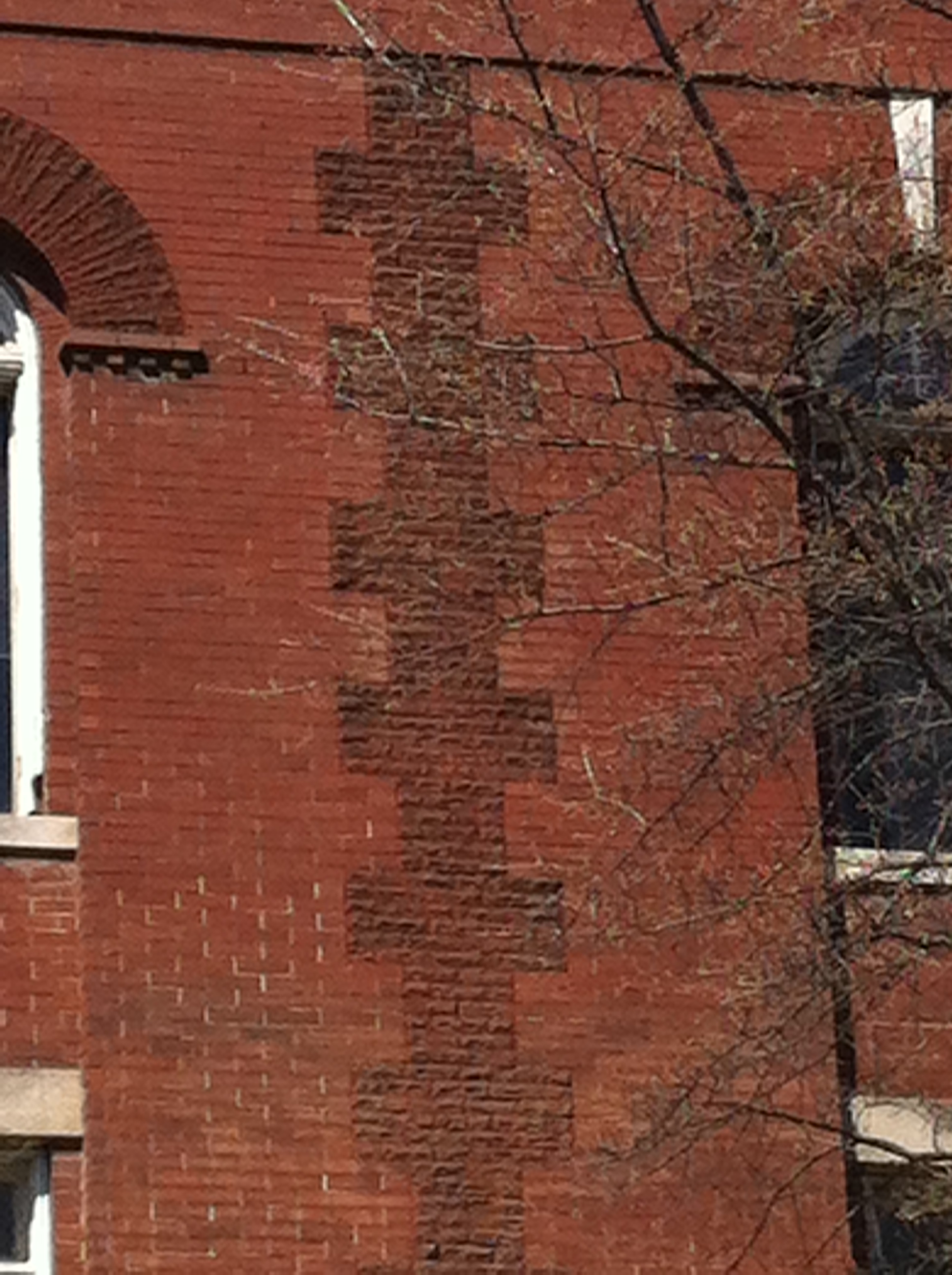
April 4 Architeaser

IMG_4699This two-toned and two-surfaced brick work is an early example of using different surfaces to showcase a building in a fairly simple and inexpensive manner.  This is from the Fulk building at 3rd and Main Streets. The building was built after the February 1900 fire which destroyed parts of South Main Street.

The building is on land that once belonged to Dr. Matthew Cunningham. The first Little Rock Council meeting took place at Dr. Cunningham’s house when it was on this property.

This building is one of several being envisioned for new life as part of the Creative Corridor plan along Main Street.

LR Look Back: Mayor W. W. Stevenson

On this date in 1797, future Little Rock Mayor William Wilson Stevenson was born in South Carolina.  In 1811, he came to Arkansas when his family settled in Batesville.  An ordained Presbyterian minister, he married Ruana Trimble in 1821 and had two children.  After she died, he married Maria Tongray Watkins in 1831 and had two more children.

In 1831, he ran for Mayor in the first election for the office but was defeated by Dr. Matthew Cunningham.  The next year he ran to succeed Cunningham and was elected.  After leaving the Mayor’s office on December 31, 1833, he continued public service.  He was State Commissioner for Public Buildins in 1839.

In 1849, he delivered the funeral oration at the ceremony for Hon. Ambrose H. Seveier.  Later that year, he was hired as a geologist for the Little Rock and California Association which was created to take advantage of the gold rush.  He and his two oldest sons moved to California and never returned to Arkansas. He died in 1888.

No known photograph of Mayor Stevenson is known to exist.

Little Rock Look Back: First Council Meeting in Little Rock

TowncouncilplaqueOn this date, January 16, 1832, the very first Town Council meeting took place in Little Rock.  It was held at the home of Dr. Matthew Cunningham, Little Rock’s first Mayor. (Prior to the establishment of a City Hall, the Mayor was responsible for hosting the Council meetings.)

Dr. Cunningham owned several properties in Little Rock.  His home was situated on a block at  the southwest intersection of Markham and what is now 3rd Street.  Currently Bennett’s Military Supply anchors that corner in the Fulk building.  The block also includes the Mann on Main project, which is comprised of the buildings originally constructed for the Gus Blass Department store.

Little Rock was chartered as a town in 1831 and elections were subsequently held.  Dr. Cunningham outpolled Rev. W. W. Stevenson to become the first Mayor.

Joining Mayor Cunningham at the first meeting were the original four Town Council members – Charles Caldwell, Benjamin Clemens, David Holt and John McLain.

In 1931 a plaque, as part of Little Rock’s Centennial, a plaque was erected to note the first meeting.  The plaque erroneously implies that the first meeting was in 1831. This mistake is understandable since the first election was in 1831.  The plaque also refers to the body as the City Council.  It was, in fact, the Town Council.  There would not be a City Council until 1835 when Little Rock was elevated to City status.

(Incidentally, the plaque is not the only incorrect date regarding City meeting places.  The date stone above the entrance to City Hall reads 1907. Though construction of the building was largely finished in 1907, City offices did not move in until 1908. The building was not officially dedicated until April 1908.  When the plaque was installed it was probably due to wishful thinking.)

Little Rock Look Back: Charles P. Bertrand

On November 23, 1808, future Mayor Charles P. Bertrand was born in New York.  He was the son of Pierre and Eliza Wilson Bertrand; his father died in 1809 in an uprising in Haiti and his mother eventually remarried.  With her new husband, Dr. Matthew Cunningham, she and the family moved to Little Rock in 1820.

After apprenticing with family friend William Woodruff at the Arkansas Gazette, Bertrand opened the Arkansas Advocate newspaper.  He later studied law under Robert Crittenden and entered the legal profession.

In 1835-1836, he served as State Treasurer for the Arkansas Territory, and in 1836 as secretary for the first constitutional convention. He was a member of the Arkansas House of Representatives from 1840-1841 and 1844-1849.

Bertrand followed in his stepfather’s footsteps and became Mayor of Little Rock.  (Dr. Cunningham had been the first Little Rock Mayor in 1831.)  He was in office from January 1855 through January 1857, serving two one-year terms.  He later served on the City Council and filled in as acting mayor. (Another influence on his upbringing was studying under future Mayor Jesse Brown who taught at the first school in Little Rock.)

Bertrand, as acting mayor, was involved in the negotiations of the surrender of Little Rock to federal troops in 1863.  He also later corresponded with President Lincoln on behalf of Little Rock citizens.  Though a staunch Confederate, his good will toward the Union soldiers and federal officials is credited with helping to save Little Rock from the destruction which befell many other Southern cities.

He had put his considerable fortune into Confederate money during the war. At the Civil War’s conclusion, the family was financially ruined. Though they had vast land holdings, those would be sold off in parcels to pay for taxes.

Bertrand died August 27, 1865, shortly after the conclusion of the Civil War.  He, like his mother, step-father, and several other relatives is buried in Mt. Holly Cemetery.