 As part of the monthly Architecture & Design Network architecture lecture, Peter MacKeith will discuss Aalto’s Identities tonight.
Dean MacKeith, an internationally recognized design educator, assumed the deanship of the Fay Jones School of Architecture on July 1, 2014. Before joining the Fayetteville school, McKeith was a professor and associate dean at Washington University’s Sam Fox School of Design and Visual Arts, Saint Louis. Prior to his tenure there, he directed the Master of Architecture program at Helsinki University of Technology, now Aalto University.
He will offer an informed perspective on the life and work of Finland’s foremost Twentieth Century architect/designer, Alvar Aalto (1898-1976), an international icon in his own right. Iterations of the furniture, textiles and glassware he designed continue to have a significant presence in American homes and numerous public spaces.
The program will take place tonight at 6pm in the lecture hall of the Arkansas Arts Center. A reception will precede at 5:30.
MacKeith began his tenure at Washington University in 1999 as a faculty member and assistant dean of the School of Architecture. In 2001, he became the associate dean of architecture, and was later named the associate dean of the Sam Fox School in 2006. He also serves as adjunct associate curator of architecture and design at the Mildred Lane Kemper Art Museum.
Before joining the Sam Fox School faculty and administration, MacKeith was the director of the Master of Architecture – International Program at the Helsinki University of Technology (now Aalto University) in Finland. He previously held faculty appointments in architecture at the University of Virginia, the University of Ljubljana in Slovenia, and Yale University.
MacKeith received a bachelor’s degree in English and international relations from the University of Virginia and a master of architecture from Yale University. His architectural teaching has been recognized nationally with two Creative Achievement Awards in architectural education from the Association of Collegiate Schools of Architecture (2007-2008, 2013-2014).
MacKeith has worked in architecture and design practices in both the United States and Finland, notably with the renowned Finnish architect Juhani Pallasmaa. He has written, lectured and published extensively in the United States, Finland, and other Nordic countries on modern and contemporary Finnish and Nordic architecture. His particular emphasis is on the work of Alvar Aalto. In 2012, MacKeith was the curator and designer of “Light Houses: On the Nordic Common Ground,” the exhibition of contemporary Nordic architecture at the Nordic Pavilion at the 13th Venice Architecture Biennale.
MacKeith is the author and editor of Archipelago, Essays on Architecture(2006), the editor of Encounters: Architectural Essays, volumes 1 and 2 – two selections of essays by Pallasmaa (2005, 2012) – and the author of The Dissolving Corporation: Contemporary Architecture and Corporate Identity in Finland (2005) and The Finland Pavilions: Finland at the Universal Expositions 1900-1992 (1993). He is the outgoing editor of The SOM Journal, a professional review of history and criticism, having overseen numbers 8 (“On Teamwork and Collaboration”) and 9 (“On Leadership and Authorship”). He is the recipient of a Fulbright Fellowship to Finland (1990) and research grants from The Graham Foundation for Advanced Studies in the Visual Arts and the Brookings Institution, among others.
In February 2014, MacKeith was recognized by the President of Finland for his contributions to the culture and architecture of Finland with the insignia of Knight, First Class, of the Order of the Lion of Finland.
For additional information contact ardenetwork@ icloud.com. Check out ADN on Facebook. Supporters of the Architecture and Design Network (ADN) include the Arkansas Arts Center, the Fay Jones School of Architecture, the Central Arkansas Section of the Arkansas Chapter of the American Institute of Architects and friends in the community.

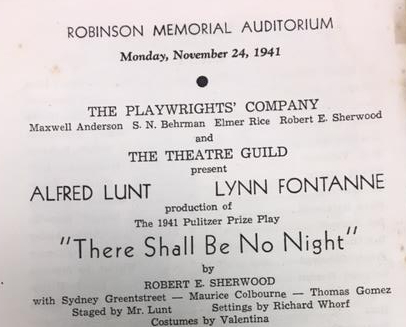 On the eve of the US entry into World War II, Alfred Lunt and Lynn Fontanne returned to Little Rock in the national tour of Robert E. Sherwood’s Pulitzer Prize winning There Shall Be No Night. It played at Robinson Memorial Auditorium on Monday, November 24, 1941.
 Little Rock Culture Vulture