
Turkey Day Football in LR – Beating a Variety of Opponents from 1914 to 1933

Turkey Day 1921From the first Thanksgiving football game for Little Rock High School in 1914 until 1933, the Tigers played a variety of opponents.  They faced off against other Arkansas high schools, out of state high schools, a college and a team of soldiers.  Their record in these twenty games was 18 wins and 2 losses.  While the opponent may have varied, each year the Tiger eleven lined up against their foes at home in Little Rock. The team had enough of a reputation that they could invite opponents and never had to travel.

Playing games on Thanksgiving had become a tradition by the time Little Rock joined in the fray in 1914. Their first Thanksgiving Day opponent was Texarkana High School.  The Tigers won by a score of 20 to 0. The crowd of 1,500 at West End Park (now the site of Quigley Stadium) not only witnessed the high school game, but also saw Arkansas College (now Lyon College) defeat Little Rock College (no association with UALR) by a score of 40 to 0.  With their win, Little Rock captured the state championship – their fourth since 1907.

By the next Thanksgiving Day, the field at West End Park was known as Kavanaugh Field. It would have that name until it was replaced by Quigley Stadium in 1936.  From 1915 until 1933, Little Rock would defeat three Arkansas high schools Van Buren, Benton and Hot Springs as well as high schools from Oklahoma, Mississippi, Louisiana, Texas, Alabama, Kansas, Illinois and Missouri.  Three of their out of state opponents returned for a second time, so even though these schools were generally overwhelmed by Little Rock High, it was obviously viewed as a positive experience.  Playing out of state teams garnered other benefits. In 1920, they played Tupelo Military Institute, which held the Mississippi-Alabama championship. By defeating them, Little Rock High School claimed the state championship of four states: Arkansas, Alabama, Tennessee and Mississippi.

In 1917, they beat the college team of Arkansas State Normal School (now UCA) by a score of 45 to 0. (The Tigers so overpowered State Normal that the Gazette mused that the extremely muddy field was all that kept LR from scoring more than 45 points.)

The Tigers’ only two defeats came in 1918 and 1924.  The first Thanksgiving Day defeat came in 1918 when Little Rock played a team of soldiers from Camp Pike. The soldiers were an average of 20 pounds heavier than the Tigers. They used that weight to their advantage to defeat the high schoolers by a score of 42 to 0.  This was at the height of the US involvement in The Great War. So this game was certainly part of Little Rock’s war effort as the City worked to extend hospitality to soldiers. The Tigers’ 1924 defeat was at the hands of Atlanta Tech High School by a score of 35 to 7.

While the Thanksgiving games were serious business for the Tigers and their fans, they also provided for moments of entertainment.  In 1923, the Gazette reported that the Tigers had hosted a dance at the Capital Hotel for the visiting Ensley High football team from Birmingham, Alabama.  One wonders if there were a motive to their hospitality considering that the next day the Tigers won by a score of 20-7. Perhaps distracting the opposing players the night before the game was all part of Coach Earl Quigley’s strategy.  On Thanksgiving 1929, Little Rock hosted previously undefeated Soldan High from Saint Louis. At halftime of the game (which would end with LR scoring 26 to their opponent’s 6), there was a performance by the Little Rock High School band as well as a group of girls called Quigley’s Quackers.

Based on their reputation as a powerhouse, Little Rock would continue to play teams from other states. But after 1933, Little Rock would play a close rival: first North Little Rock (1934-1957) and then Hall High (1958-1982).  During the two decades of playing various teams, the Little Rock Tigers achieved ten shutouts and suffered one shut out.  The Tigers scored 492 points and gave up 133 points.

1914 Little Rock 20 Texarkana 12
1915 Little Rock 40 Muskogee Central High 0
1916 Little Rock 46 Van Buren 0
1917 Little Rock 45 Arkansas State Normal 0
1918 Little Rock 0 Camp Pike 42
1919 Little Rock 52 Benton 0
1920 Little Rock 6 Tupelo Military Institute 3
1921 Little Rock 21 New Orleans Warren Easton High 3
1922 Little Rock 7 Bryan (TX) High 0
1923 Little Rock 20 Birmingham Ensley High 7
1924 Little Rock 7 Atlanta Technical High 35
1925 Little Rock 6 New Orleans Warren Easton High 0
1926 Little Rock 18 Birmingham Ensley High 6
1927 Little Rock 37 Wichita Central High 0
1928 Little Rock 18 Chicago Lindblom High 0
1929 Little Rock 26 Saint Louis Soldan High 6
1930 Little Rock 33 Chicago Lindblom High 13
1931 Little Rock 31 Dallas Woodrow Wilson High 0
1932 Little Rock 6 Saint Louis Cleveland High 0
1933 Little Rock 13 Hot Springs 6
  • Muskogee Central High has been known as Muskogee High since the 1970 integration of the formerly all-white school with an African American high school.
  • Tupelo Military Institute existed from 1913 to 1937.
  • Warren Easton High is Louisiana’s oldest high school. After Hurricane Katrina it is now a charter high school.
  • Bryan High School was replaced by Stephen F. Austin High School, which was replaced by a new Bryan High School.
  • Ensley High in Birmingham closed in 2006.
  • Atlanta Technical High closed in 1947. A charter school with the same name operated from 2004 to 2012.
  • Wichita Central High has been known as Wichita East High since 1929. It is the largest high school in Kansas.
  • Chicago Lindblom High now educates under the name Lindblom Math and Science Academy.
  • Saint Louis Soldan High now educates as Soldan International Studies High School
  • Woodrow Wilson High School continues to operate in the Lakewood neighborhood of East Dallas.
  • Saint Louis Cleveland High now educates as Cleveland Junior Naval Academy and is no longer in the longtime Grover Cleveland High School building.
Turkey Day Football in LR – An Overview

thanks-grid-lrc-lrh102 years ago, Little Rock High School (then located on Scott Street) kicked off a 69-year tradition of playing football on Thanksgiving Day.  (Though the date of Thanksgiving floats anywhere from the 22nd to the 28th, Thanksgiving Day 1914 was on November 26.)

From 1914 until 1933, the Little Rock High School Tigers played a variety of different schools.  Then from 1934 until 1957, they played North Little Rock. From 1958 until 1982, the Little Rock Central Tigers took on the Warriors of Little Rock Hall.

Thanksgiving Day football was a tradition not just for high schools in Little Rock but also all levels throughout the state and country.  The Friday after Thanksgiving, newspapers carried stories and scores for professional, college and high school football.  It was probably the only day of the year to see all three levels of football covered in the paper, and often high school games received the most ink.  This mix of football continued for decades.  In 1969, there were four football games played in Pulaski County on Thanksgiving Day: Little Rock Hall vs. Little Rock Central, Little Rock Catholic vs. North Little Rock, Horace Mann vs. Scipio Jones, and the Arkansas Razorbacks vs. Texas Tech.

By the 1970s, both high school and college football games on Thanksgiving were on the wane.  While college games on Turkey Day have regained some popularity, they are nowhere near approaching the level they once had.  High school football on Thanksgiving disappeared in Arkansas following the 1982 game between Hall and Central.  That rivalry had been the final series on Turkey Day to still be played.

While they lasted, Thanksgiving Day high school football games were civic focal points. They were about bragging rights.  For students who had grown up attending the games, the chance to play or cheer in a Turkey Day classic was a rite of passage.  Alumni home from college or visiting the family for Thanksgiving would descend on the stadium ensuring the largest attendance of the season.

High school football on Thanksgiving Day in Little Rock tells the tale of not just football; it reflects changes in the city and society.  What started out as two small high schools from neighboring cities changed as both schools grew. The addition of a second Little Rock high school reflected the city’s growth.  (Indeed the 1954 Little Rock High School yearbook, in discussing the school’s new designation as Central High, mentions vaguely that the second high school would be built at some yet to be determined location in “west” Little Rock.)

The presence of segregated high schools in separate but unequal football rivalries (lasting nearly two decades after the Supreme Court’s Brown v. Board decision) is an indictment of an unjust parallel education system.  As Little Rock continued to grow and diversify, the two high schools playing on Thanksgiving were no longer always the predominant schools in football – or other activities.  With state championships once again on the line, the last few years of the Hall and Central Thanksgiving rivalry were, in a way, a return to the halcyon days of the early faceoffs (though this time, thankfully, with fully integrated teams). In addition to trading the top spots in football, the two schools were piling accolades. In fact, all three Little Rock public high schools had achieved a stasis that inadvertently rotated areas of excellence academically, athletically and artistically fairly equally among the three.

There were undercurrents at work that hinted at future instabilities to come.  Indeed by 1982, the same year of the final game, Little Rock had filed suit against the North Little Rock and the Pulaski County Special School Districts claiming the schools in those neighboring districts were siphoning off white students from the Little Rock schools. The ensuing realignment of schools and districts would probably have brought an end to Central vs. Hall games even if athletic reclassification had not.

Central is now much larger than Hall, Parkview is a magnet school, two formerly county high schools (and several elementary schools and junior highs) were brought into the LR school district in the late 1980s.  Where once the Little Rock high schools were roughly equal in enrollment, they now are so varied they play in three different classifications.

It is up to the alternative historians to envision what continued Turkey Day classics would have looked like after 1982. Little Rock has grown and diversified. There are six public high schools and five private high schools playing football within the Little Rock city limits each season. With all these competing interests it is unlikely to envision the same citywide level of interest in one football game.

But back in the day…

Little Rock Look Back: Razorback Football Launches War Memorial Stadium

wms1948-first-gameIn honor of the Arkansas Razorbacks taking on Alcorn State today in Little Rock, a look back at the first football game (or event of any kind) at War Memorial Stadium.

On September 18, 1948, the Hogs took on Abilene Christian and won the game by a score of 40 to 6.  It was the first game of the season, and the Razorbacks went into the game ranked #13. They maintained that ranking for four weeks before falling out of national standings.  The team ended up with a season record of five wins and five losses. Playing four of their games at War Memorial that season, they were two and two in Little Rock. They were one and two in Fayetteville and amassed a 2-1 record on the road.

Dedication ceremony in 1948. Photo courtesy of the War Memorial Stadium Commission.

Dedication ceremony in 1948. Photo courtesy of the War Memorial Stadium Commission.

Prior to the game, the stadium was dedicated to the veterans of World War I and World War II in a ceremony led by former Razorback standout and Medal of Honor recipient Maurice “Footsie” Britt.  Though he would later be known for entering politics and becoming Arkansas’ first Republican Lieutenant Governor, in his college days he was known statewide as an outstanding Razorback football and baseball athlete.  During World War II, his bravery and courage allowed him to become first person in American history to earn all the army’s top awards, including the Medal of Honor, while fighting in a single war.

Also participating in the opening ceremony were a mass of high school marching bands from across the state. Reports indicate up to forty bands were on the field to play the National Anthem as part of the event.

The construction of the stadium had been a dream of Governor Ben T. Laney. He had encouraged the Arkansas General Assembly to create the stadium during the 1947 session.  In August of 1947, Little Rock was chosen as the location over Hot Springs and North Little Rock. West Memphis had abandoned its bid when it was unable to secure the necessary financial pledges.  Construction started in 1947 and continued up until opening day.  On the day of the game, newspaper photos showed heavy equipment grading the parking lot prior to paving.  Though it had been Laney’s dream, with the passing of the guard, a newspaper photo on the day after the dedication focused on the incoming governor, Sid McMath.  Because Arkansas was such a Democratic heavy state, the paper referred to him as Governor-designate even though it was six weeks prior to the 1948 General Election when he would face off against C. R. Black.  McMath won the race with 89.4% of the vote.

Little Rock Look Back: Central & Hall Football at 2-0

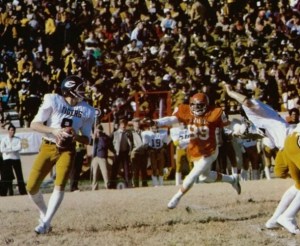
lrchs-lrhhsAfter two weeks of prep gridiron (that is high school football to those who don’t write like a 1950s inky wretch), Little Rock Central and Little Rock Hall are both posting records of 2 wins and 0 losses.  This feat has not been achieved in quite a while.
How long?  37 seasons!  It was 1979, the last time that the Tigers and Warriors were both out of the gate at 2-0.

1979

Jimmy Carter was in the White House. Bill Clinton was in his first term as Governor. First Lady Hillary Rodham was several months pregnant with Chelsea. Hall High and Razorback standout Webb Hubbell was Mayor of Little Rock.  The City’s population was in the 150,000s (it would be 159,151 after the 1980 census).  Little Rock had an area of approximately 80 square miles.  (Today it is approximately 200,000 citizens over 122 square miles.)

Lou Holtz was coaching the Arkansas Razorbacks in the Southwest Conference.  Harry Hall was in his first season as Commissioner of the Arkansas Intercollegiate Conference.  Rex Nelson was a student at Ouachita.  Paul Eells was in his second year with KATV, while Dave Woodman was finishing his first decade at KARK.  Gary Hogan was anchoring sports for KTHV.  Hogs football games were broadcast on KAAY radio.  While Bob Buice and Jim Elder were ruling the airwaves at KARN, Craig O’Neill was dominating mornings at KLAZ.

Orville Henry, Jim Bailey, and Wadie Moore covered college and high school sports for the Arkansas Gazette.  The Arkansas Democrat had switched to morning delivery and hired John Robert Starr as editor.  Both papers carried ads for Kempners, Golds, M.M. Cohn, Skaggs Albertsons, Minute Man, Union National Bank, Commercial National Bank, Worthen National Bank, and First National Bank.

Metrocentre Mall existed with bricked over streets on Main and Capitol. The Grady Manning Hotel and Hotel Marion still stood (though in their twilight days before their February 1980 date with demolition.)

So a lot has changed since Central and Hall previously achieved this.  In the interval, Central has been 2-0 a dozen times and Hall has achieved that a brace. But the schools never managed it during the same season.  Three times the schools both managed 1-1 seasons and seven times they each started at 0-2.

The 1979 Warriors were helmed by C. W. Keopple, who would lead the team from the 1960s into the 1980s winning four conference/state titles. (When your conference is statewide, winning one got you the other.)  Bernie Cox was in his fifth season as the Tigers’ mentor, with two state championships already under his belt, five more would be in his future.

The teams stayed tied through the fourth week. But in the fifth week, while Central won, Hall lost to Parkview by a score of 7-0.  The following week, the Warriors rebounded, while the Tigers settled for a 0 to 0 tie with Ole Main.  Weeks seven through ten saw both teams notching another win each week.  This set up a Thanksgiving Day classic with the state’s top two teams facing off.  Central was slightly favored, but season records seldom carried any weight when the two cross-town rivals played on Thanksgiving afternoon.  In an upset, Hall bested Central by a score of 17 to 0.

From 1987 to 1990, the second game of the season was the Hall-Central matchup, which meant that it would have been impossible to both start with a 2-0 record.  This second week matchup was made necessary by the fact that not only could the two teams no longer face off on Thanksgiving after 1982, but the two schools were not in the same conference from 1983 through 2000. So the faceoff was early in the season, during the non-conference portion.

Due to subsequent restructurings by the Arkansas Activities Association, the two schools have not played a football game since 2005.  The bell from the “Battle of the Bell” which was supposed to replace the pageantry and intense rivalry of the Thanksgiving Day matchups, sat forlornly and largely forgotten in the trophy case at Central following the 2005 edition which Central won by a score of 24 to 7.  (That season Central started at 0-2 on the way to a 5-5 record and Hall started at 1-1 on the way to a 3-7 record.)  UPDATE: As noted in a comment on this piece, the Bell has now been refurbished and sits proudly at Quigley Stadium.  Thank you Belinda Stilwell for the information!

Who knows how the 2016 season will turn out for these two teams?  In the past 2-0 has led both to State Championships and to a 6-4 record.  But for two schools that have struggled in the past few seasons, to start with a 2-0 record is quite an accomplishment. For both to start with that record is remarkable.


While the blog hiatus and a restructuring continue, this was a bit of history that needed mentioning.

Super Bowl Sunday Little Rock Look Back: Copper Bowl

Copper Bowl

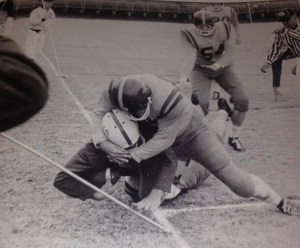
A Little Rock police officer tackles a NLR player in one of the Copper Bowls.

Today is Super Bowl Sunday, so it seems to be a good time to remember the five year series of football games in Little Rock known as the Copper Bowl.

From December 1959 through December 1963, the Little Rock Police Department played the North Little Rock Police Department in a series of football games.  The Copper Bowl games were fundraisers to help the LRPD provide food and presents for needy families during the Christmas season.

The agreement was that the teams would play for five years. The team with the most wins would permanently receive the Copper Bowl trophy.  The LRPD was outfitted with uniforms from Little Rock University and Louisiana State University (thanks to the efforts of Sgt. Harold Zook).  The games were played at Quigley Stadium.

Before the final game on December 1, 1963, the series was tied at 2-2.  The LRPD team won the game and permanently captured the trophy.  Over the five year period several thousand dollars were raised.

PIGSKIN TURKEY DAY IN THE ROCK, Part 5 – Little Rock Catholic vs. NLR

Turkey Bowl Catholic NLRFollowing the demise of their Turkey Day rivalry with Little Rock High School, North Little Rock set their Thanksgiving sights on Little Rock Catholic.  In 1958, they started a 21-year tradition of meeting on the fourth Thursday in November.  (Previously Cathlolic had not been in a regular Thanksgiving rivalry. In fact, they sometimes did not even play on that day.)

The 1958 game, held at Wildcat Stadium, started where NLR’s previous Thanksgiving series had left off. A Little Rock team, now the Rockets of Catholic High, achieved a lopsided win over the NLR Wildcats.  The final score was 26-0, in favor of Catholic.

The next several years saw close games. Sometimes Catholic would win, other times NLR was the victor.  In 1960, Catholic lost the game, but won the conference championship (which was tantamount to a state championship at the time) due to results of other games.  In 1965, NLR won the game AND the conference/state championship.

From 1966 to 1969, NLR ran up a string of convincing victories over Catholic High.  This streak ended in 1970.  That year, NLR had been ranked number 1 heading into the game.  They lost the game to Catholic by a score of 21 to 16.  This also marked the first meeting of the teams to take place at the Catholic home field of War Memorial Stadium.  All previous meetings had been at NLR’s Wildcat Stadium.

Starting in 1970, they alternated hosting the game at their respective home stadium.  In 1971, Catholic again won the game and a state championship. The following year, NLR won both the game and a championship.  By that time, the northside school bore the name Ole Main to distinguish it from the new NLR high school: Northeast.  The 1972 game would be the final time that the game between the Rockets and Wildcats had championship implications.

From 1973 through 1978, Catholic and NLR alternated winning the game with the home team coming out on top.  Due to conference realignment, Catholic High dropped from AAAAA to AAAA starting with the 1979 football season. With that, they no longer played NLR on Thanksgiving Day.

Though in 1970 NLR had acquired its own cross-town rival with the opening of NLR Northeast, the creation of an all-NLR Thanksgiving Day tradition was never started. Likewise, Catholic did not start playing the new Little Rock high school, Parkview, on Turkey Day. Both would have probably created stronger Thanksgiving Day rivalries, but by this time, the Arkansas Activities Association was trying to discourage the tradition of playing on Thanksgiving.  Having a game that late in the season interfered with conference tournaments.  The AAA had actually tried to dissuade teams from playing on the holiday as early as 1961, but were rebuffed by the larger schools who saw no need to give up the tradition.

In 1958, there were at least 23 high school football games played throughout the state on Thanksgiving.  By 1965, that number had shrunk to 13. In 1970, there were only two games: Hall v. Central and NLR v. Catholic.

The final tally of Thanksgiving meetings between NLR and Catholic was NLR 12 wins, Catholic 8 wins and one tie.  Catholic twice shut out NLR, and the Wildcats blanked the Rockets three times.  The northside team scored 267 points over 21 years, while the southsiders earned 223 points.


Year NLR Catholic

1958

0 26

1959

6 0

1960

20 14

1961

14 7

1962

7 14

1963

0

14

1964 6

6

1965 14

7

1966 33

0

1967 19

7

1968

40 13

1969

21 12

1970

16 21

1971

6 21

1972

7 6
1973 25

7

1974 3

8

1975 9

6

1976 7

14

1977 7

0

1978 7

20


PIGSKIN TURKEY DAY IN THE ROCK, Part 4 – Horace Mann vs. Scipio Jones

Turkey Day MannFrom the 1930s to the early 1960s, Thanksgiving Day high school football in Arkansas was the time for big rivals to meet.  In addition to Little Rock playing NLR (later morphing into Central playing Hall), many a Thanksgiving Day schedule involved seeing Jonesboro face off against Paragould or El Dorado play Camden. Fayetteville vs. Springdale, Morrilton vs. Conway, Newport vs. Batesville, and DeQueen vs. Texarkana were all longtime traditions.

In these days, football classifications were much more fluid.  It would not be until the 1960s that the Arkansas Activities Association would permanently institute state playoffs in football.  This led to the demise of Thanksgiving Day games throughout the state.  Either the schools were not in the same classification and/or they were in a classification that had playoffs starting in mid-November.  Gone were the days when a regular football season extended from September to Thanksgiving.

The two exceptions to this were the largest classification of schools and the segregated African American schools.  The largest class, which eventually became known as the AAAAA (it had previously been the Big 6, 8, 9–whatever number of schools were in it), had few enough members that they were all in one conference.  A conference championship was tantamount to a state championship.

The African American schools were ignored in athletics as they were in other areas.  While the schools fielded teams and played each other, they did not have playoffs or Arkansas Activities Association recognized championships.  Up through the late 1950s, a mention of their games in the Arkansas Gazette or Arkansas Democrat was rare.

For several years, Little Rock’s Dunbar High School Bearcats took on the Scipio Jones Dragons of North Little Rock on Thanksgiving Day.  Due to the lack of coverage in newspapers, there are few records of these games.  Unfortunately the yearbooks of neither school shed any light. Due to limited budgets which led to thinner yearbooks, the football team usually got one page that was devoted to showing the players and left no room for details about their exploits on the gridiron.

In the 1955-1956 school year, Little Rock opened a new high school for African American students – Horace Mann High School. The Bearcat mascot of Dunbar (now a junior high) became the new Horace Mann mascot.  Mann carried on the tradition of playing Jones on Thanksgiving.

Many seasons the African American LR-NLR football game was the second meeting of the two teams.  They usually played against each other in September and then again on Thanksgiving.  This second game seems to have been as much about ensuring that their students, fans, and alumni had the chance to have a Thanksgiving Day game – just as most white schools throughout the state had.

Due to the lack of African American high schools fielding football teams in Arkansas, often the LR and NLR schools would also play out-of-state teams.  While it was not unusual for Little Rock’s white high school to play teams from other states, this was because of prestige, not necessity.  The same luxury was not afforded African American schools.  In 1963, for instance, Horace Mann played teams from Oklahoma, Tennessee, Louisiana and Texas.  Their in-state rivals that year were segregated schools in North Little Rock, El Dorado, Pine Bluff (two schools), Camden, Hope, Hot Springs and Texarkana. Horace Mann’s travel schedule was much more extensive than either Central or Hall had on a weekly basis.

From 1956 through 1965, Mann and Jones met at Wildcat Stadium. After that season, the Thanksgiving game would alternate between Wildcat and Quigley.  Since the Central v. Hall and NLR v. Catholic matchups were in the morning, the Mann v. Jones games were afternoon affairs.

As the Little Rock School District was gradually integrating its high schools in the 1960s, the Mann vs. Jones game continued.  (North Little Rock was even slower in integrating its high school than LR had been with its high schools. Both seemed to be more focused on the “deliberate” part of the Supreme Court directive than on the “speed” aspect.)   With the demise of Jones High in the spring of 1970, the Mann vs. Jones series ended.

Because of the lack of records of the Dunbar games, here is the breakdown only of the Mann games.  In the fourteen Mann vs. Jones games, Horace Mann won ten of the outings, while Jones captured four.  The Bearcats shut out the Dragons twice, while NLR only once blanked LR.  Horace Mann scored 332 points over the fourteen Thanksgiving games to Scipio Jones’s 126 points.


Horace Mann Scipio Jones

1956

14 0

1957

27

13

1958

0

13

1959

40

7

1960

45

0

1961

31

6

1962

31 18

1963

14

20

1964 27

6

1965 51

9

1966

20 7

1967

13 14
1968 19

13

1969 8

19