Little Rock Look Back: The first steps to Little Rock government

LR sealLittle Rock started functioning as the capitol of Arkansas in June 1821. But by 1825 the settlement know as Little Rock was little more than a loosely defined group of structures. One hundred and eighty-nine years ago today, on October 27, 1825,Territorial Governor George Izard signed legislation which started establishing a framework for Little Rock to function as a city.

It established that Little Rock citizens could elect a board of trustees to decide matters. Those trustees would choose one of their own to be a presiding officer. Though Little Rock would not be officially incorporated until 1831, this was the first step towards incorporation. The first trustees, elected for 1826, were Robert Crittenden, Joseph Henderson, Nicholas Peay, Bernard Smith and Isaac Watkins. Smith was chosen to be the presiding officer.

Crittenden had been largely responsible for the relocation of the capitol to Little Rock, where he owned a lot of land. He was a major political force in Arkansas politics during the territorial days. Watkins was a nephew of a signer of the Declaration of Independence. He had established the first tavern in Little Rock in 1821 and later he first mill in 1826. He was murdered in 1827 and the perpetrator was never captured.

Peay bought the tavern from Watkins in 1826 and continued in the tavern and hotel business the rest of his life. He later served on the Little Rock City Council and was acting mayor. His son Gordon Neill Peay served as Mayor of Little Rock. The Peay family also cofounded Worthen Bank and Christ Episcopal Church. Nicholas Peay’s great-great grandson Joseph B. Hurst, Sr. served on the Little Rock City Board from 1967 to 1970. Mr. Hurst’s daughter-in-law, Stacy, is currently on the City Board.

Little Rock Look Back: William Ashley – LR’s 22nd & 24th Mayor

W E Ashley signature

On August 6, 1823, future Little Rock Mayor William Eliot Ashley was born in Little Rock.  He would go on to become the first Little Rock Mayor to be born in Little Rock.  Ashley was the son of Mary and Chester Ashley; his father would later serve as a U. S. Senator from Arkansas.  He was the second of the couple’s seven children.

Though he was raised in Little Rock, he did receive some schooling out of state. The State History Commission has correspondence between eleven year old William, studying in New York, and his father. Part of the letter is a request for money.

LR sealOn October 26, 1846, he married Frances Eliza Grafton at Christ Episcopal Church.  They were the first Little Rock residents to be married in that church.  The couple had five children, including triplets.  Only one of the children, Frances (who was one of the triplets) survived to adulthood.

Ashley was first elected Mayor of Little Rock in 1857. After completing a two year term, he was succeeded by Gordon N. Peay (another scion of a prominent Little Rock family).  In 1861, Ashley returned to the office of Mayor.  He was reelected to a third term in 1863.  In September 1863, following the defeat of Confederate troops by the Union forces at the Battle of Little Rock, the City of Little Rock ceased operations.  On September 21, 1863, Little Rock municipal government closed its doors, stopped collection of taxes and disbanded.  Thus Ashley’s third term ended.

In addition to his interest in local government, Ashley was a member of St. John’s College Board and a director of the newly-formed Little Rock Gas Company.

William Elliot Ashley died on August 16, 1868 at the age of 45.  He was buried in Mt. Holly Cemetery (which sat partially on land that had once belonged to his family). His parents, wife and children are all buried in Mt. Holly as well.

Interestingly, for someone who grew up in a prominent family, there does not appear to be a surviving likeness of Mayor Ashley – either in painting or photograph.  Several exist of his parents, but none of him.

Septaquintaquinquecentennial of Christ Church in Little Rock (that means 175 years)

christchurch_scaledThough there have been several churches and institutions in downtown Little Rock for over a century, Christ Episcopal Church has been at Scott and Capital Streets since 1840. That marks probably the longest continuous single use of one location in Little Rock’s history.

Today, the church marks its Septaquintaquinquecentennial.  The first church service was held on March 10, 1839, at Little Rock’s Presbyterian Church, which was then on what is now Second Street. The Rt. Rev. Leonidas Polk, missionary bishop of Arkansas, conducted the service.  After it was concluded, a group met in the home of Senator Chester Ashley and organized Christ Episcopal Church, named after Christ Church in Alexandria, Virginia, of which several of those present had been members.

Among the early members of the church were several future Little Rock Mayors including Lambert J. Reardon, John Wassell, Samuel Webb and Gordon Peay.  Nicholas Peay, Gordon’s father and a member of the church, served on the Little Rock City Council.  Future Little Rock Mayor William Ashley was the first Little Rock resident to be married at Christ Church.

The first sanctuary was constructed in 1840-1841 and was later destroyed by fire in 1873 (most likely due to a lightning strike).  After meeting in a variety of places, a chapel was constructed on the property and served as the church’s primary place of worship while the new sanctuary was being built.  It opened in 1887.  It was in the chapel that future General Douglas MacArthur was baptized as an infant while his family resided in Little Rock.

In 1928, a Parish Hall was built. This was one of the first church buildings in the South which featured a gym and other spaces available for use not just by church members but by the entire city.  It would later serve as the temporary sanctuary of Christ Church.  On October 1, 1938, the second sanctuary burned just as a renovation had been completed.  Though there was no official cause of the fire, it was most likely due to spontaneous combustion of construction materials.

The cornerstone for the third, and current, sanctuary was laid on October 1, 1940.  Construction was completed in 1941.  It was designed by Edwin Cromwell with the unofficial assistance of the then-Rector, Rev. Dr. William Postell Witsell. (Dr. Witsell appreciated architecture and the arts. He was very instrumental in the design of the stained glass windows which hang in the church today.  Charles Witsell, one of the founders of the Witsell, Evans, Rasco firm, is a grandson of Dr. Witsell.) In the 1980s, an addition was built along Scott Street to connect the sanctuary with the Parish Hall.

Along with the revitalization of downtown, Christ Church has been active in implementing innovative programming in a variety of areas including sustainability and the arts. The Rector, Rev. Scott Walters, and Associate Rector, Rev. Dr. Kate Alexander, often pepper their sermons with references to poetry, music (both sacred and secular), writers, artists and even comedians.

The Arts at Christ Church program has brought such varied artists as Mavis Staples, Baltimore Konsort and the Vienna Boys Choir to Little Rock. In 1990, Nichols & Simpson, a Little Rock based organ builder of international renown, constructed a new organ for the Christ Church sanctuary replacing a 1954 organ.  While used in worship, it is also used for a variety of organ recitals throughout the year.  Christ Church has been a sponsor of the Arkansas Literary Festival for the past several years and participates in the 2nd Friday Art Night with a rotating gallery of Arkansas artists. In addition, the Undercroft debuted in late 2013. This intimate music space is located underneath the sanctuary and offers a venue for acoustic music.

To mark the 175th anniversary, Rt. Rev. Larry R. Benfield, the thirteenth Bishop of the Diocese of Arkansas will be conducting an Evensong service this evening.  Prior to being named Bishop, he served as Rector of Christ Church.

Little Rock Look Back: Mayor Gordon Neill Peay

On this date in 1819 future Little Rock Mayor Gordon Neill Peay was born.  The Peay family arrived in Arkansas from Kentucky in 1825.  They quickly became one of Little Rock’s leading families.  Mayor Peay’s father, Nicholas Peay served on the Little Rock Board of Trustees (which existed before the town was incorporated) and later served on the City Council and was acting mayor.

Godon N. Peay served as mayor of Little Rock from 1859 to 1860.  During the Civil War, Peay served as Captain and later Colonel of the Capital Guard.  He later received a pardon from the federal government.

The Peay family owned the Peay Hotel, Little Rock’s first hotel, and were also co-founders of what became Worthen Bank.  They were also a founding family of Christ Episcopal Church. Mayor Peay later served as Pulaski County Chancery Clerk.

He died on December 14, 1876 and is buried at Mt. Holly Cemetery along with many members of his family.  A nephew of his, Ashley Peay, served on the City Council in the 1920s.  Mayor Peay’s great-grandson Joseph Barber Hurst, Sr. served on the Little Rock City Board of Directors from 1967-1971. His great-great-granddaughter-in-law Stacy J. Hurst currently serves on the City Board of Directors.

Little Rock Look Back: Early Organization of Little Rock

20131027-093707.jpg

Little Rock was designated as the capitol of Arkansas in 1821. But by 1825 the settlement know as Little Rock was little more than a loosely defined group of structures. One hundred and eighty-eight years ago today, on October 27, 1825, Territorial Governor George Izard signed legislation which started establishing a framework for Little Rock to function as a city.

It established that Little Rock citizens could elect a board of trustees to decide matters. Those trustees would choose one of their own to be a presiding officer. Though Little Rock would not be officially incorporated until 1831, this was the first step towards incorporation. The first trustees, elected for 1826, were Robert Crittenden, Joseph Henderson, Nicholas Peay, Bernard Smith and Isaac Watkins. Smith was chosen to be the presiding officer.

Crittenden had been largely responsible for the relocation of the capitol to Little Rock, where he owned a lot of land. He was a major political force in Arkansas politics during the territorial days. Watkins was a nephew of a signer of the Declaration of Independence. He had established the first tavern in Little Rock in 1821 and later he first mill in 1826. He was murdered in 1827 and the perpetrator was never captured.

Peay bought the tavern from Watkins in 1826 and continued in the tavern and hotel business the rest of his life. He later served on the Little Rock City Council and was acting mayor. His son Gordon Neil Peay served as Mayor of Little Rock. The Peay family also cofounded Worthen Bank and Christ Episcopal Church. Nicholas Peay’s great-great grandson Joseph B. Hurst, Sr. served on the Little Rock City Board from 1967 to 1970. Mr. Hurst’s daughter-in-law, Stacy, is currently on the City Board.

Little Rock Look Back: Mayor William Ashley

W E Ashley signatureOn August 6, 1823, future Little Rock Mayor William Eliot Ashley was born in Little Rock.  He would go on to become the first Little Rock Mayor to be born in Little Rock.  Ashley was the son of Mary and Chester Ashley; his father would later serve as a U. S. Senator from Arkansas.  He was the second of the couple’s seven children.

Though he was raised in Little Rock, he did receive some schooling out of state. The State History Commission has correspondence between eleven year old William, studying in New York, and his father. Part of the letter is a request for money.

LR sealOn October 26, 1846, he married Frances Eliza Grafton at Christ Episcopal Church.  They were the first Little Rock residents to be married in that church.  The couple had five children, including triplets.  Only one of the children, Frances (who was one of the triplets) survived to adulthood.

Ashley was first elected Mayor of Little Rock in 1857. After completing a two year term, he was succeeded by Gordon N. Peay (another scion of a prominent Little Rock family).  In 1861, Ashley returned to the office of Mayor.  He was reelected to a third term in 1863.  In September 1863, following the defeat of Confederate troops by the Union forces at the Battle of Little Rock, the City of Little Rock ceased operations.  On September 21, 1863, Little Rock municipal government closed its doors, stopped collection of taxes and disbanded.  Thus Ashley’s third term ended.

In addition to his interest in local government, Ashley was a member of St. John’s College Board and a director of the newly-formed Little Rock Gas Company.

William Elliot Ashley died on August 16, 1868 at the age of 45.  He was buried in Mt. Holly Cemetery (which sat partially on land that had once belonged to his family). His parents, wife and children are all buried in Mt. Holly as well.

Interestingly, for someone who grew up in a prominent family, there does not appear to be a surviving likeness of Mayor Ashley – either in painting or photograph.  Several exist of his parents, but none of him.

Little Rock Tree Week – Capital Hotel

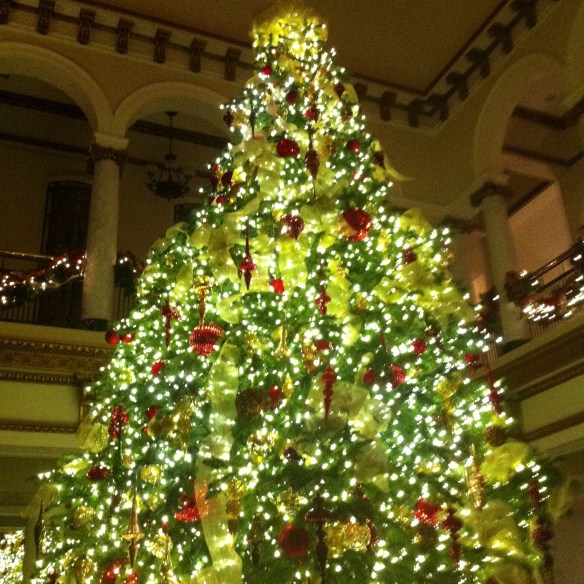
IMG_3580As Little Rock Tree Week continues, today’s feature is the Capital Hotel.  In addition to enjoying the tree, visitors to the Capital Hotel can admire Chef Tandra’s gingerbread village as well as musical performances in the lobby.

The schedule for the remainder of this week is:

• Don Roberts Elementary on Tue, Dec 18 at Noon
• Violinists on Tue, Dec 18 at 5:30pm
• Capital String Quartet on Wed, Dec 19 at 5:30pm
• St. Paul United Methodist Bells on Wed, Dec 19 at 7pm
• Booker Arts Magnet on Thu, Dec 20 at 10:15am

Among the groups performing earlier this month have been: Forest Heights Middle School, Horace Mann Magnet, eSTEM, Pulaski Academy, Williams Magnet, Episcopal Collegiate, Mount St. Mary Academy, Central Arkansas Christian, Sylvan Hills High School, Holy Souls School, Bale Elementary, Cabot Middle School and the UCA Hornaments.

The arrival of the tree at the Capital Hotel.

The arrival of the tree at the Capital Hotel.

The tree and other decorations at the Capital Hotel are overseen by Tipton Hurst.  The Hurst family is descended from Little Rock’s first hoteliers, the Peay family. The Peay Hotel stood a few blocks away from where the Capital Hotel was constructed in the 1870s.

The tree arrived on a Friday afternoon. It took several hours to get it raised into place and secured.  It took all weekend for a crew to decorate the tree, which has thousands of lights wrapped around its branches.  The tree was officially lit on Monday, December 3.