A Prized Cemetery – Mount Holly on Pulitzer Day

The Pulitzer Prizes are to be announced today.  Mount Holly Cemetery not only touts that it is the site of a whole host of elected officials, it is also the only place in Arkansas where two Pulitzer Prize recipients are buried.
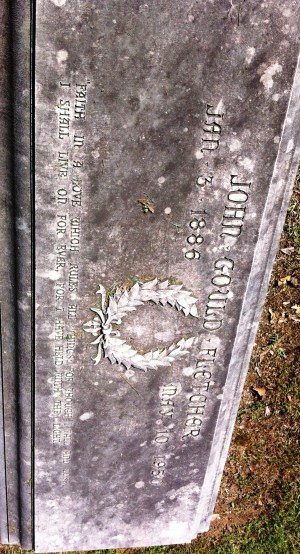
In 1939, John Gould Fletcher became the first Southern poet to win the Pulitzer Prize for Poetry.  He was born into a prominent Little Rock family in 1886.  Fletcher was awarded the prize for his collection Selected Poems which was published by Farrar in 1938.  Two years earlier, he had been commissioned by the Arkansas Gazette to compose an epic poem about the history of Arkansas in conjunction with the state’s centennial.

Fletcher is buried next to his wife, author Charlie May Simon and his parents (his father was former Little Rock Mayor John Gould Fletcher).  Other relatives are buried nearby in the cemetery.

The other Pulitzer Prize winner buried in Mount Holly is J. N. Heiskell, the longtime editor of the Arkansas Gazette.  It was Heiskell, in fact, who asked Fletcher to compose the poem about Arkansas.  Heiskell served as editor of the Gazette from 1902 through 1972.  He died at the age of 100 in 1972.

Under his leadership, the Gazette earned two Pulitzer Prizes for its coverage of the 1957 desegregation of Little Rock Central High.  One was for Harry Ashmore’s editorial writing and the other was for Public Service.

Heiskell remained in charge of the Gazette until his death in 1972.  He is buried alongside his wife with other relatives nearby.  Also not too far from Mr. Heiskell are two of his nemeses, proving that death and cemeteries can be the great equalizer. In the early days of his Gazette stewardship, he often locked horns with Senator (and former Governor) Jeff Davis. Later in Mr. Heiskell’s career, he vehemently disagreed with Dr. Dale Alford, who had been elected to Congress on a segregationist platform.

CALS Heiskell Lecture Tonight – Thomas Patterson discusses the rise of misinformation

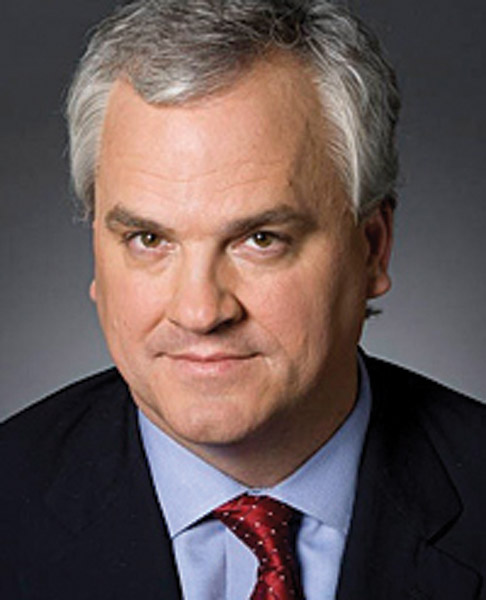
9780345806604The rise of misinformation among the American public will be addressed by Thomas Patterson, author of Informing the News at the Central Arkansas Library System’s (CALS) J.N. Heiskell Distinguished Lecture on Tuesday, October 15, at 6:30 p.m. at the Hillary Rodham Clinton Children’s Library and Learning Center, 4800 W. 10th Street.

Informing the News: America’s Need for Trustworthy and Relevant News, and Why We’re Not Getting It will describe where the misinformation among the American public is coming from, the impact of partisan talk shows and blogs, how the mainstream press have contributed, and what can be done about it. The event is free and open to the public. A book signing and reception will follow the program. Reservations are appreciated, but not required. RSVP to pedwards@cals.org or 918-3009.

Patterson is Bradlee Professor of Government and the Press and teaches at Harvard University’s John F. Kennedy School of Government. He has written several books on public opinion, voting, and the media’s political role. His first book, The Unseeing Eye, was named by the American Association for Public Opinion Research as one of the fifty most influential books on public opinion in the past half century.

The Heiskell Distinguished Lecture is named for J.N. Heiskell, the longest-serving member of the Library’s Board of Trustees and editor of the Arkansas Gazette for more than seventy years. Speakers and programs honor Mr. Heiskell’s commitment to excellence in journalism as well as his support of the library.

Pulitzer Day at Mount Holly

The Pulitzer Prizes are to be announced today.  Though Mt. Holly Cemetery touts that it is the site of a whole host of elected officials, it is also the only place in Arkansas where two Pulitzer Prize recipients are buried.

In 1939, John Gould Fletcher became the first Southern poet to win the Pulitzer Prize for Poetry.  He was born into a prominent Little Rock family in 1886.  Fletcher was awarded the prize for his collection Selected Poems which was published by Farrar in 1938.  Two years earlier, he had been commissioned by the Arkansas Gazette to compose an epic poem about the history of Arkansas in conjunction with the state’s centennial.

Fletcher is buried next to his wife, author Charlie May Simon and his parents.  Other relatives are buried nearby in the cemetery.

The other Pulitzer Prize winner buried in Mt. Holly is J. N. Heiskell, the longtime editor of theArkansas Gazette.  It was Heiskell, in fact, who asked Fletcher to compose the poem about Arkansas.  Heiskell served as editor of the Gazette from 1902 through 1972.  He died at the age of 100 in 1972.

Under his leadership, the Gazette earned two Pulitzer Prizes for its coverage of the 1957 desegregation of Little Rock Central High.  One was for Harry Ashmore’s editorial writing and the other was for Public Service.

Heiskell remained in charge of the Gazette until his death in 1972.  He is buried alongside his wife.


CALS J. N. Heiskell Lecture to feature Douglas A. Blackmon

Douglas A. Blackmon will present the Central Arkansas Library System’s J.N. Heiskell Distinguished Lecture on Friday, May 11, at 6:30 p.m. in the Main Library’s Darragh Center at 100 Rock Street.

Blackmon’s book, Slavery by Another Name: The Re-Enslavement of Black Americans from the Civil War to World War II, was awarded the 2009 Pulitzer Prize for General Non-Fiction and was a New York Times bestseller. The book is a searing examination of how the enslavement of African Americans persisted deep into the 20th century, profoundly sculpting current American life. A documentary film based on Slavery by Another Name is scheduled for broadcast on PBS in late 2012.

Blackmon has written extensively over the past 25 years about the American quandary of race-exploring the integration of schools during his childhood in a Mississippi Delta farm town, lost episodes of the Civil Rights movement, and, repeatedly, the dilemma of how a contemporary society should grapple with a troubled past.

The lecture is free and open to the public. A book signing and catered reception will follow the Friday evening lecture. For more information or to RSVP for the lecture, contact lblackwell@cals.org or 918-3029.

Prized Occupants

The Pulitzer Prizes were announced yesterday.  Though Mt. Holly Cemetery touts that it is the site of a whole host of elected officials, it is also the only place in Arkansas where two Pulitzer Prize recipients are buried.

In 1939, John Gould Fletcher became the first Southern poet to win the Pulitzer Prize for Poetry.  He was born into a prominent Little Rock family in 1886.  Fletcher was awarded the prize for his collection Selected Poems which was published by Farrar in 1938.  Two years earlier, he had been commissioned by the Arkansas Gazette to compose an epic poem about the history of Arkansas in conjunction with the state’s centennial.

Fletcher is buried next to his wife, author Charlie May Simon and his parents.  Other relatives are buried nearby in the cemetery.

The other Pulitzer Prize winner buried in Mt. Holly is J. N. Heiskell, the longtime editor of the Arkansas Gazette.  It was Heiskell, in fact, who asked Fletcher to compose the poem about Arkansas.  Heiskell served as editor of the Gazette from 1902 through 1972.  He died at the age of 100 in 1972.  Under his leadership, the Gazette earned two Pulitzer Prizes for its coverage of the 1957 desegregation of Little Rock Central High.  One was for Harry Ashmore’s editorial writing and the other was for Public Service.

Heiskell remained in charge of the Gazette until his death in 1972.  He is buried alongside his wife.

Sculpture Vulture: Brookin Memorial in Mount Holly

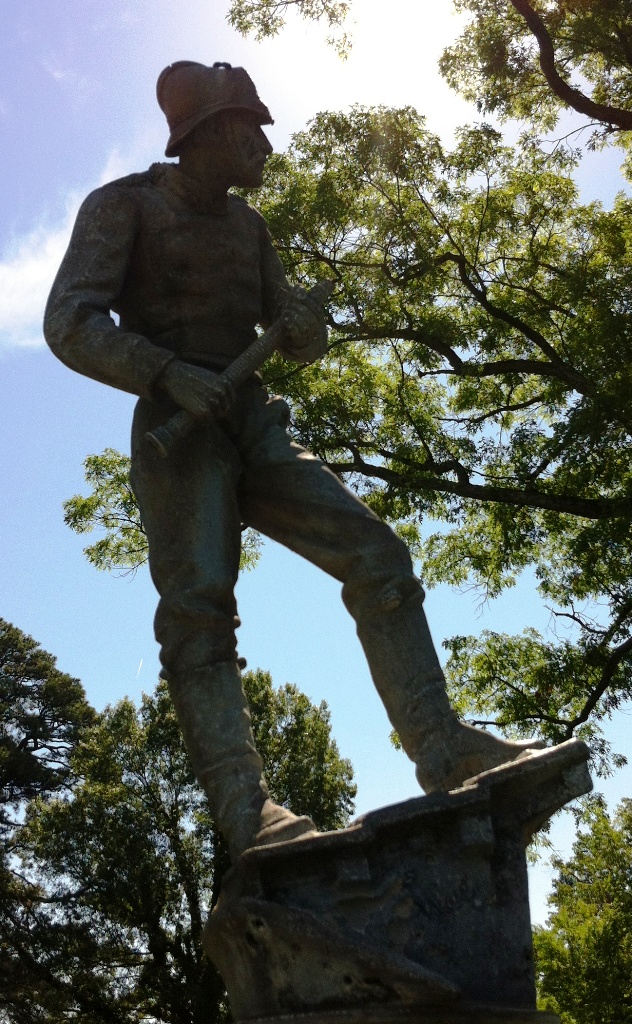
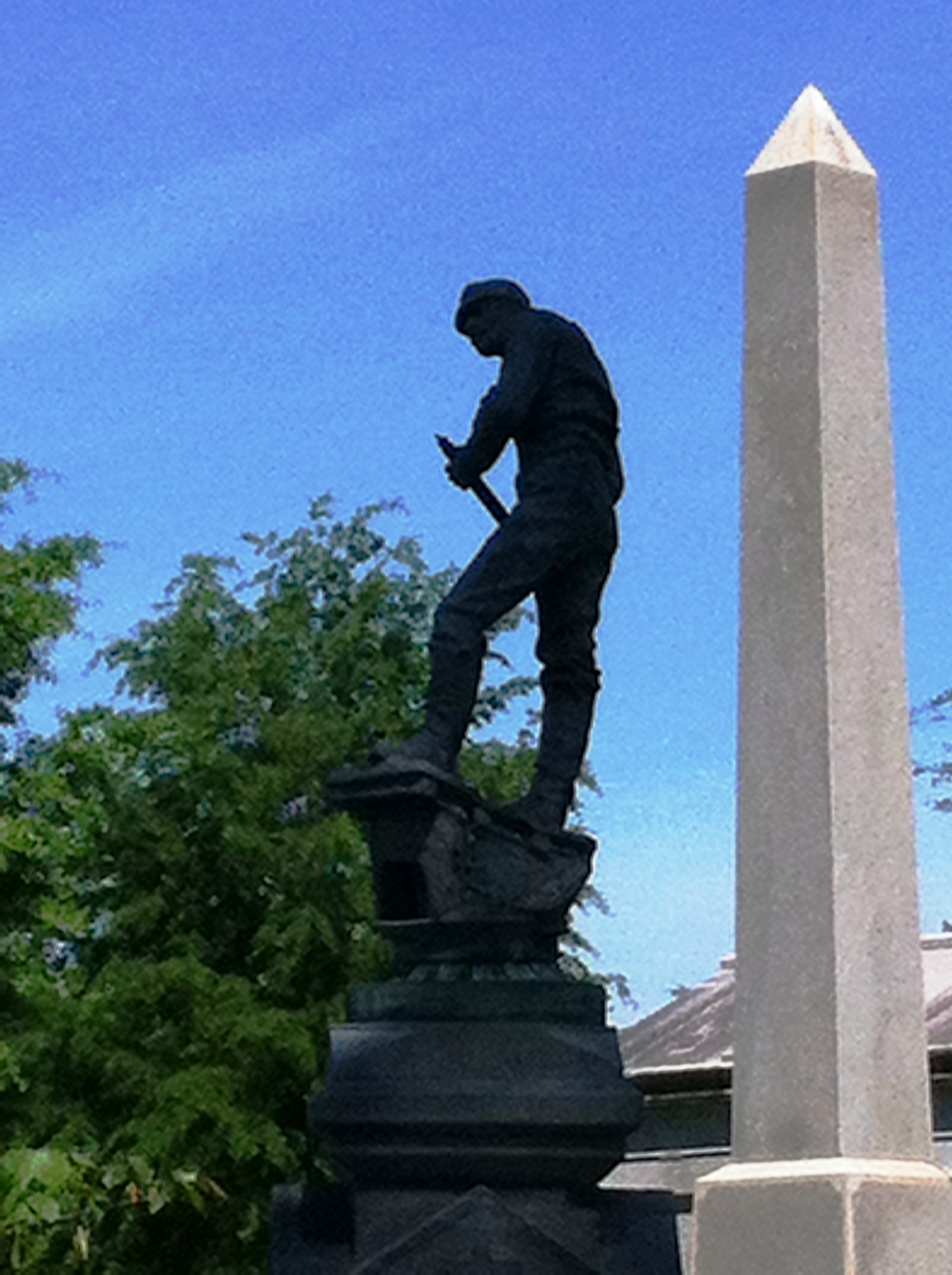
The Pulitzer Prizes are announced tomorrow.  Two previous Pulitzer Prize winners are buried in Mt. Holly – poet John Gould Fletcher and publisher J. N. Heiskell.  With an eye toward the Pulitzers as well as some of the sculpture in Mt. Holly, today the Sculpture Vulture focuses on a statue which honors the memory of Little Rock firefighter Henry C. Brookin.

The sculpture depicts a firefighter in a helmet holding a hose.  On the base is the inscription “Erected by the Volunteer Firemen of Little Rock to the memory of Henry C. Brookin. Born Mar. 23, 1852, Died Mar. 11, 1891. He Was Killed Responding.”

The statue, forged in metal, is only a couple of feet tall but stands on a stone pedestal of approximately four feet tall. It marks Mr. Brookin’s grave. It is the only metal statue in the cemetery and the only one which does not depict an angel, child or religious figure.