
Little Rock Look Back: Brown v. Board II Decision from the US Supreme Court

On May 31, 1955, the U.S. Supreme Court issued its ruling in Brown vs. Board of Education of Topeka II.  

One year after the landmark Brown v. Board decision which declared state laws establishing separate public schools for black and white students to be unconstitutional, the Supreme Court took up the case again.  This time the focus was on the implementation of desegregation

The original Brown v. Board grew out of a class action suit filed in Topeka, Kansas, by thirteen African American parents on behalf of their children.  The District Court had ruled in favor of the Board of Education, citing Plessy v. Ferguson.  When it was appealed to the Supreme Court, Brown v. Board was combined with four other cases from other jurisdictions.

After handing down the 1954 decision, the Supreme Court planned to hear arguments during the following court session regarding the implementation.  Because the Brown v. Board case was actually a compilation of several cases from different parts of the US, the Supreme Court was faced with crafting a ruling which would apply to a variety of situations.

In the arguments before the court in April 1955, the NAACP argued for immediate desegregation while the states argued for delays.

The unanimous decision, authored by Chief Justice Earl Warren, employed the now-famous (or infamous?) phrase that the states should desegregate “with all deliberate speed.”

In making the ruling, the US Supreme Court shifted the decision-making to local school districts and lower-level federal courts. The rationale was that those entities closest to the unique situation of each locality would be best equipped to handle the distinct needs of those schools and communities.

The Supreme Court did make it clear that all school systems must immediately starting moving toward racial desegregation.   But again failed to provide any guideposts as to what that meant.

In anticipation of the Supreme Court’s Brown II ruling, earlier in May the Little Rock School Board had adopted a draft of what became known as the “Blossom Plan” (named for the superintendent, Virgil Blossom).  The thought process seems to have been that if the LRSD had a plan in place prior to a Supreme Court decision, it might buy it more time had the court ruled that things had to happen immediately.

The Blossom Plan called for phased integration to start at the senior high level.  It anticipated the new Hall High School as having an attendance zone in addition to zones for Central and Mann high schools. But the way the zones were created, the only school which would be integrated at first would be Central High.  The junior highs and elementary schools would be integrated later.

With no immediate remedy from the US Supreme Court, the NAACP – both nationally and locally – had little recourse other than expressing their unhappiness continuing to verbally protest the lack of immediate desegregation. (This is an oversimplification of the NAACP efforts, but points out that there options were very limited.)

New play LITTLE ROCK, inspired by 1957 events, with roots at Arkansas Rep begins performances tonight in NYC

Tonight in New York City, a new play starts previews.  It is entitled Little Rock and is written and directed by Rajendra Ramoon Maharaj.

Eleven years ago, Maharaj was in a residency at the Arkansas Repertory Theatre creating It Happened in Little Rock, which was performed at the Rep in September 2007.  It was their contribution the community events commemorating the fiftieth anniversary of the integration of Little Rock Central High.

Though Maharaj’s current production is different from the 2007 Rep production, it was inspired by his time in Little Rock and the connections he made during his residency.

Here is the official description of Little Rock:

LITTLE ROCK tells the riveting true story of the Little Rock Nine, the first black students to attend their city’s formerly segregated central high school. What began as their quest for a better education soon became a national crisis, igniting the passions of a divided country and sparking a historic fight for justice in the Jim Crow South.

On the cusp of the Civil Rights Movement, a changing world watched as these nine children from Arkansas battled for their rights with only a book and pencil.

The cast includes Rebekah Brockman, Justin Cunningham, Charlie Hudson III, Ashley Robinson, Stephanie Umoh (who starred in the Arkansas Rep production of Pal Joey), Shanice Williams, Peter O’Connor, Damian Jermaine Thompson (who starred in the Arkansas Rep productions of The Whipping Man and the Scottish Play), Kea Trevett and Anita Welch.

The production officially opens on June 6 and is scheduled for a limited run through September 8.

This production illustrates why theatre is important and Arkansas Repertory Theatre specifically is important.  One, theatre is a chance to explore and explain moments from our past and present.  The Rep saw a role it could play in telling a variety of stories and perspectives while molding a narrative about events in 1957 and progress that had been made (or not) since then.

Additionally, it is important that the Arkansas Repertory Theatre provided an artistic home for a playwright and director to learn.  In addition to working on It Happened in Little Rock, over the years Maharaj directed A Raisin in the Sun, Dreamgirls, and Intimate Apparel for Arkansas Rep.  It was through his experiences in Little Rock in 2004 and 2006, that he was inspired to collaborate with Bob Hupp, Leslie Golden and the Rep staff on It Happened in Little Rock.  Developing a play is not easy, cheap, or quick.  It is vital to the future of theatre to have artistic homes which can support these initiatives.

As the Arkansas Rep is preparing for its “Next Act” it is important to remember the impact it has had artistically and as an agent for community conversation on not only Little Rock but the state of Arkansas.  Sometimes theatre sparks ideas that no other art-form can, or no amount of reading or listening to speeches can.

Repertorium Praeter Theatrum

UPDATE – on the afternoon of May 30, the producer announced that due to some technical difficulties, the production was being delayed a few days.

Little Rock Look Back: First Hall High Graduation in 1958

Another historic high school graduation took place on May 28, 1958.  It was the first graduation ceremony for Little Rock Hall High School.
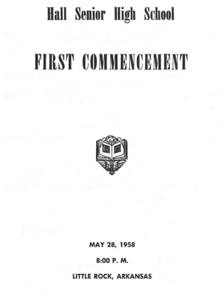
The school opened in September 1957 as Little Rock’s newest high school, located in “west” Little Rock.  (It is sometimes listed as the second Little Rock high school, ignoring the fact that Horace Mann high school existed.)

The first graduating class was smaller than future classes would be.  Because they had attended Central High School for their sophomore and junior years, many seniors who were zoned for Hall High chose to attend Central for their senior year.

Instead of processing in to Elgar’s “Pomp and Circumstance,” the Hall High seniors entered to Rimsky-Korsakov’s “Procession of the Nobles.”  The music for ceremony also included “The Star Spangled Banner,” Scarmolin’s “My Creed” and Handel’s “Sarabande and Bouree.”

Principal Terrell E. Powell (who would be tapped as superintendent of the district in a few months) presided over the ceremonies.  Superintendent Virgil Blossom (whose daughter had graduated from Central High the day before) spoke briefly to introduce the School Board members.  One of them, R. A. Lile, presented the students with their diplomas.
There were 109 seniors listed in the graduation program, seven were honor graduates.  The senior class officers were: Redding Stevenson, president; Amanda Jeanne “Toppy” Cameron, vice president; and Karl E. Stahlkopf, secretary. Porter Briggs was the first student body president. Linda Overstreet was student body vice president and Linda Neathery was 12th grade representative on the student council.

The Senior speakers were:  Anita Kluglose (“Toward a Pathless Wood”), Karl Stahlkopf (“Toward the Mysterious Stars”), Linda Neathery (“Toward Majestic Mountains”) and Thomas York (“Toward Unlimited Horizons”).  Other students participating were Redding Stevenson presenting the senior gift, Mary Ellen Lenggenhager giving the invocation, and Michael Ebert giving the benediction.

Little Rock Look Back: Ernest Green graduation from LR Central High

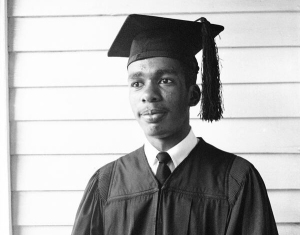
Last week, the Class of 2018 graduated from Little Rock Central High School.  Perhaps the most famous graduation ceremony in the long-storied history of Little Rock Central High took place on May 27, 1958.  It was on that date that Ernest Green became the first African American to graduate from the formerly all-white school.

Among those in the audience to witness this historic event was an up and coming minister named Dr. Martin Luther King, Jr.  A friend of L. C. and Daisy Bates, he attended the 1958 Central High School graduation to witness Green receiving a diploma. Each senior only received eight tickets to the ceremony at Quigley Stadium.   Dr. King was in the state to address the Arkansas AM&N (now UAPB) graduation.  Because he was going to be nearby, Dr. King wanted to witness the history.  Green did not know that Dr. King was in the stands until after the conclusion of the ceremony.  Later that evening, Dr. King gave Green a graduation present of $15.

Ernest Green, Dr. King and Daisy Bates share a relaxed moment — which was probably rare for the three in 1958

Because of fears about the event becoming a media circus, the Little Rock School District limited the press on the field to one Democrat and one Gazette photographer. Other press were limited to the press box normally filled with sportswriters covering the gridiron exploits of the champion Tigers.  There were photos taken of Green prior to the ceremony as well as during the ceremony.

During the graduation rehearsal, there had been concerns that some students or other people might try to disrupt the practice.  But it went off without a hitch.  Likewise, the ceremony itself went smoothly.  Local press reported that some members of the class briefly chatted with Green during the ceremony.  That the event took place without incident was a relief on many levels to City leaders.  Also in the class of 1958 were a son of Little Rock Mayor Woodrow Mann and a daughter of LRSD Superintendent Virgil Blossom.

Little Rock Look Back: 1959 Recall Election Day

The triumphant trio who were retained by Little Rock voters.

May 25, 1959, was not only the Recall Election Day, it was the last day of school for the Little Rock School District’s elementary and junior high students.  The results of that day’s vote would determine whether the ninth grade students would be in class come fall, or joining their older friends and neighbors in sitting out a school year.

While expectations that a new record of turnout would be set were off, over 25,000 of the 42,000 registered voters DID cast ballots in the May 25, 1959, Recall Election.

As the precinct results started coming in, some unexpected trends developed.  Some of the boxes in the more affluent, western neighborhoods which had been expected to be strongly in favor of keeping Everett Tucker, Russell Matson and Ted Lamb were not providing the anticipated overwhelming numbers.  Likewise, some of the more working class neighborhoods which had been projected to be strongly in favor of keeping Ed McKinley, Ben Rowland and Bob Laster were more receptive to keeping Tucker, Matson and Lamb.

As the night rolled onward, only Everett Tucker looked like a sure thing to be retained on the School Board.  At one point in the evening it appeared that the other five members would be recalled.  By the time they were down to four boxes still uncounted, the three CROSS-backed candidates were guaranteed to be recalled, but the status of Lamb and Matson was still undetermined.  Finally, with only two boxes remaining, there was a sufficient cushion to guarantee Matson and Lamb would continue as board members.

Two boxes from the Woodruff school were uncounted at the end of Monday. They had 611 votes between the two of them, which was not enough to change any outcomes.  They were being kept under lock and key to ensure there was no tampering with them.

Once it became apparent that Tucker, Lamb and Matson were retained, the STOP watch party erupted.  Six young men hoisted the triumphant three on their shoulders and paraded them through the crowd.  Dr. Drew Agar enthusiastically announced to the crowd, “Mission completely accomplished.”

At around 11:00 p.m. William S. Mitchell addressed the crowd.  “This is a great awakening of our home town…I have never seen such a wonderful demonstration of community spirit.”  He later went on to thank the thousands of people who volunteered in the effort.

At the CROSS headquarters, Ed McKinley and Rev. M. L. Moser were sequestered in a room poring over results.  When it appeared that 5 of the 6 might be recalled, McKinley issued what turned out to be a premature statement.

Back at the STOP party, the celebration continued.  While people knew that much work was still ahead, the men and women in attendance were enjoying a rare moment of joy after nearly two years of strife.

Little Rock Look Back: Brooks Robinson

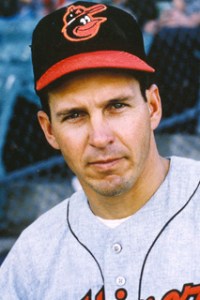
On May 18, 1937, Brooks Calbert Robinson, Jr. was born in Little Rock.  His father worked for Colonial Bakery and later the Little Rock Fire Department.  His mother worked for Sears and later state government.

As a boy, Brooks was a paper boy for the ARKANSAS GAZETTE and sold concessions at Lamar Porter Field.  He also played baseball there in youth leagues.

After graduating from Little Rock Central High School in 1955, he was drafted by the Baltimore Orioles.  He would spend his entire Major League Baseball career with the Orioles.   His primary position was Third Base for the team but also was a powerful batter.

When he retired at the end of the 1977 season, Robinson had amassed many honors including 2 World Series Championships, 1 World Series MVP, 1 American League MVP, 16 Golden Glove Awards, 18 times in the All-Star game.  At the end of his final season, his number 5 was retired by the Orioles.  In 1983, his first year of eligibility, he was selected to the Major League Baseball Hall of Fame.

He spent his career and since retirement engaged in a number of charitable endeavors. Robinson was beloved by teammates and fans, as well as respected by opponents and the media.  There is no telling how many babies in Baltimore were named Brooks or Robinson during and after his 23 season career.

Robinson has also leant his name and time to efforts to restore Lamar Porter Field here in Little Rock.


Scenes from Elizabeth Eckford bench groundbreaking

On May 17, 2018, Elizabeth Eckford joined with representatives of the National Park Service, Little Rock School District, Bullock Temple CME, and many other organizations to break the ground for a commemorative bench.

This bench is a reproduction of the one on which Ms. Eckford sat so famously on the morning of September 4, 1957.

The bench will be built over the summer and installed in September 2018.

Here are some scenes from the ceremony.

Elizabeth Eckford visits with Central High School Principal Nancy Rousseau.

David Kilton of the National Park Service speaks at the ceremony.

Attendees spilled out of the tent and lined the street for the event.

Ms. Eckford speaks to the crowd.

Ms. Eckford is joined by Central High students in breaking ground.