

Signs placed outside of Little Rock’s high schools erroneously cited the federal government as the source of school closures. They also had a glaring spelling error.
On Saturday, September 27, 1958, voters in Little Rock approved the continuation of the closure of the city’s high schools.
Using legislation passed by the General Assembly in a hastily called special session in summer of 1958, Governor Orval Faubus had ordered the closure of Little Rock’s four public high schools in order to keep them from being desegregated.
But that state law only allowed the closure of Central, Hall, Horace Mann and Technical high schools on a temporary basis. In order for them to be closed permanently, the city’s voters must approve it by a vote.
The election date was to be set by Governor Faubus. Originally scheduled for Tuesday, October 7, the date was moved to September 27. Speculation for the new date selection centered on:
- Faubus wanted it to be prior to the October 1 poll tax deadline so that only people who had paid their poll tax for the prior year were eligible
- The election was on a Saturday. Though Tuesday was the most common day of the week for elections, in the late 1950s Saturdays were used on elections as well. The school board elections, for instance, were on Saturdays in some years.
- On September 27, 1958, the Arkansas Razorbacks had a home football game in Fayetteville.
These were all designed to stifle voter turnout. In addition, the state law required a majority of eligible voters to approve reopening the schools. The law also spelled out the confusing wording of the ballot question. As historian Sondra Gordy points out in her book FINDING THE LOST YEAR, the ballot question was about only being for or against integration of the schools – it did not say anything about closure or opening of schools.
While the newly formed Women’s Emergency Committee did put forth efforts to educate voters about the issue and encourage a vote to reopen the schools, this nascent group was less than a fortnight old by the Saturday election day. On the other side, the Governor campaigned for the remaining closure of the schools including in television appearances.
On that Saturday, Little Rock voters voted 19,470 to keep schools segregated to 7,561 to integrate them.
The WEC was disappointed but remained even more determined. As some of the members have commented – having over 7,000 people be WITH them was encouraging.
It would be a long road ahead to reopen the schools. It would take two more elections before the City’s four public high schools would reopen.
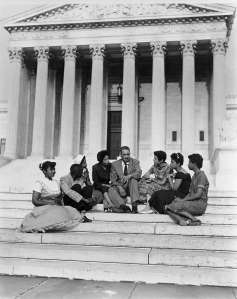
 On May 31, 1955, the U.S. Supreme Court issued its ruling in Brown vs. Board of Education of Topeka II.
  Another historic high school graduation took place on May 28, 1958. It was the first graduation ceremony for Little Rock Hall High School.
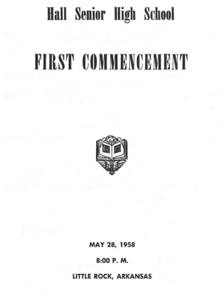 Principal Terrell E. Powell (who would be tapped as superintendent of the district in a few months) presided over the ceremonies. Superintendent Virgil Blossom (whose daughter had graduated from Central High the day before) spoke briefly to introduce the School Board members. One of them, R. A. Lile, presented the students with their diplomas.
 Fourteen years after graduating from Little Rock Hall High School, David Auburn received the 2001 Pulitzer Prize in Drama for his play Proof. In September 2002, Arkansas Repertory Theatre produced Proof while the original Broadway run was in its final months.
 Little Rock Culture Vulture