

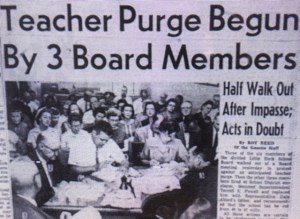
Arkansas Gazette photo of some of the patrons leaving Bale Elementary dedication
Following the May 5, 1959, firing of 44 administrators, teachers and staff, sections of the Little Rock community continued to coalesce in opposition to the actions taken by three members of the Little Rock School Board.
Later the evening of May 5, at a ceremony to dedicate Williams Elementary, Everett Tucker spoke against the teacher purge. His remarks were greeted enthusiastically by the patrons of the school.
On May 6, 1959, approximately 400 district patrons filled the auditorium at Forest Heights Junior High for a meeting. They expressed their opposition to the firing of the district employees. While the sight of the hands raised in support of the fired employees was an impressive visual, there was more community response to come.
May 7, 1959, had been set as the date for the dedication of the new Hardin Bale Elementary School. School Board President Ed McKinley, who had been one of the three who fired the 44 employees, was scheduled to give remarks at the ceremony. As he was starting the remarks, some patrons stood and challenged him. Then approximately 75 of them got up and walked out. McKinley then proceeded to use his remarks to defend his actions and to attack opponents.
Both Williams Elementary and Forest Heights Junior High served the more moderate-leaning Pulaski Heights neighborhood. That they would be in support of the fired employees was less of a surprise. It was a bit more unexpected that Bale Elementary patrons reacted in the way they did. That neighborhood was more working class and zoned for Central High, two elements that segregationist forces had been counting on for allies.
Mr. McKinley’s remarks were so strident that fellow School Board member Judge Robert Laster called a press conference distancing himself from Mr. McKinley. He used that opportunity to also criticize Mr. Tucker, Ted Lamb, and Russell Matson for what he termed the politicization of the Williams Elementary event. After Judge Laster’s comments, the remaining member, Ben Rowland, expressed support for Mr. McKinley. He further stated that he, Mr. McKinley and Judge Laster had previously discussed what Mr. McKinley would mention in his Bale Elementary remarks.
With a school board in turmoil, teachers uncertain as to the legality of their contracts or non-renewal of them, and civic organizations largely calling for the reversal of the firings, the Little Rock education scene was in turmoil. There was talk swirling through Little Rock about the need to recall school board members. But who would take the lead on this?
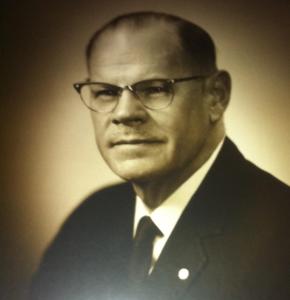 To Little Rock citizens under a certain age, the name Knoop means Knoop Park — a picturesque park tucked away in a pocket of Hillcrest. There are, however, still many who remember Werner C. Knoop as a business and political leader who helped shape Little Rock as a modern city.

 Charlotte Andrews Stephens was the first African American teacher in the Little Rock School District. Between 1910 and 1912, when an elementary school for African Americans was named after her, she became the first woman to have a public building in Little Rock named after her. For nearly fifty years, Stephens Elementary (which is now in its third building) would be the only LRSD building named after a woman.
 Mollie Irvin spent her life serving others. She was a wife, mother, and grandmother. She was a volunteer in her church and her children’s schools. She helped her friends. She may have never seen herself as someone who would start spending every Tuesday night at Little Rock City Hall.
 On February 9, 1960, a bomb was detonated at the home of Carlotta Walls. One of the Little Rock Nine as a sophomore, she was now in her senior year at Little Rock Central High. This followed the September 1959 Labor Day bombings in Little Rock.
 Little Rock Culture Vulture