Pulitzer Day at Mount Holly

The Pulitzer Prizes are to be announced today.  Though Mt. Holly Cemetery touts that it is the site of a whole host of elected officials, it is also the only place in Arkansas where two Pulitzer Prize recipients are buried.
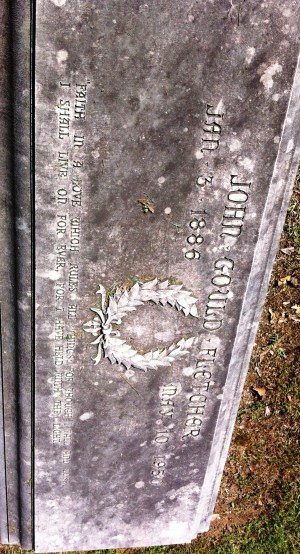
In 1939, John Gould Fletcher became the first Southern poet to win the Pulitzer Prize for Poetry.  He was born into a prominent Little Rock family in 1886.  Fletcher was awarded the prize for his collection Selected Poems which was published by Farrar in 1938.  Two years earlier, he had been commissioned by the Arkansas Gazette to compose an epic poem about the history of Arkansas in conjunction with the state’s centennial.

Fletcher is buried next to his wife, author Charlie May Simon and his parents.  Other relatives are buried nearby in the cemetery.

The other Pulitzer Prize winner buried in Mt. Holly is J. N. Heiskell, the longtime editor of theArkansas Gazette.  It was Heiskell, in fact, who asked Fletcher to compose the poem about Arkansas.  Heiskell served as editor of the Gazette from 1902 through 1972.  He died at the age of 100 in 1972.

Under his leadership, the Gazette earned two Pulitzer Prizes for its coverage of the 1957 desegregation of Little Rock Central High.  One was for Harry Ashmore’s editorial writing and the other was for Public Service.

Heiskell remained in charge of the Gazette until his death in 1972.  He is buried alongside his wife.
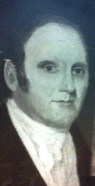
 

LR Look Back: Mayor David Fulton

MayorFultonOn this date in 1771 in Ireland, future Little Rock Mayor David Fulton was born.  He served as the fourth and final mayor of the Town of Little Rock in 1835. His term was cut short by the transition of Little Rock from town to city status. Once that happened in November 1835, a new election had to be held.

Mayor Fulton was also proprieter of the Tan Yard, a tanning operation in Little Rock.   He later served as a judge and was appointed as  Surveyor General of Public Lands in Arkansas by President Martin Van Buren in 1838.

Mayor Fulton married Elizabeth Savin in 1794 in Maryland.  Among their children was William Savin Fulton who served as Territorial Governor of Arkansas in 1835 and 1836 and was one of Arkansas’ first US Senators upon statehood in 1836.  Mayor Fulton was serving as Mayor at the same time his son was Governor.

Mayor Fulton died on August 7, 1843 and is buried at Mt. Holly Cemetery as are his wife and several other members of his family.

Little Rock Look Back: Charles P. Bertrand

On November 23, 1808, future Mayor Charles P. Bertrand was born in New York.  He was the son of Pierre and Eliza Wilson Bertrand; his father died in 1809 in an uprising in Haiti and his mother eventually remarried.  With her new husband, Dr. Matthew Cunningham, she and the family moved to Little Rock in 1820.

After apprenticing with family friend William Woodruff at the Arkansas Gazette, Bertrand opened the Arkansas Advocate newspaper.  He later studied law under Robert Crittenden and entered the legal profession.

In 1835-1836, he served as State Treasurer for the Arkansas Territory, and in 1836 as secretary for the first constitutional convention. He was a member of the Arkansas House of Representatives from 1840-1841 and 1844-1849.

Bertrand followed in his stepfather’s footsteps and became Mayor of Little Rock.  (Dr. Cunningham had been the first Little Rock Mayor in 1831.)  He was in office from January 1855 through January 1857, serving two one-year terms.  He later served on the City Council and filled in as acting mayor. (Another influence on his upbringing was studying under future Mayor Jesse Brown who taught at the first school in Little Rock.)

Bertrand, as acting mayor, was involved in the negotiations of the surrender of Little Rock to federal troops in 1863.  He also later corresponded with President Lincoln on behalf of Little Rock citizens.  Though a staunch Confederate, his good will toward the Union soldiers and federal officials is credited with helping to save Little Rock from the destruction which befell many other Southern cities.

He had put his considerable fortune into Confederate money during the war. At the Civil War’s conclusion, the family was financially ruined. Though they had vast land holdings, those would be sold off in parcels to pay for taxes.

Bertrand died August 27, 1865, shortly after the conclusion of the Civil War.  He, like his mother, step-father, and several other relatives is buried in Mt. Holly Cemetery.

Birthday of first Little Rock Mayor

Dr. Matthew Cunningham was born on July 5, 1782 in Pennsylvania. After receiving his medical degree from the University of Pennsylvania, he ended up in New York City. It was there he met and married a young widow, Eliza Wilson Bertrand. After a brief stint in St. Louis, Dr. Cunningham was one of the first settlers of Little Rock in February 1820. He became the first physician in Little Rock.

In September 1820, Mrs. Cunningham and her children joined him. She became the first female in the Little Rock settlement. Dr. and Mrs. Cunningham had a son, Chester, who was the first baby born in Little Rock. They also had a daughter, Matilda, who would later marry Peter Hanger.

In 1831, Dr. Cunningham was elected the first Mayor of Little Rock. He won the race 23 to 15 over Rev. W. W. Stevenson. The first City Council meeting took place at the Cunningham house at the southwest corner of what is now 3rd and Main Streets (where Bennett’s Military Surplus is located).

Dr. Cunningham served one year as Mayor. He lived until June 15, 1851 and is buried at Mt. Holly Cemetery. His wife, son, daughter and her family are buried next to him.

Sculpture Vulture – Worthen Obelisk

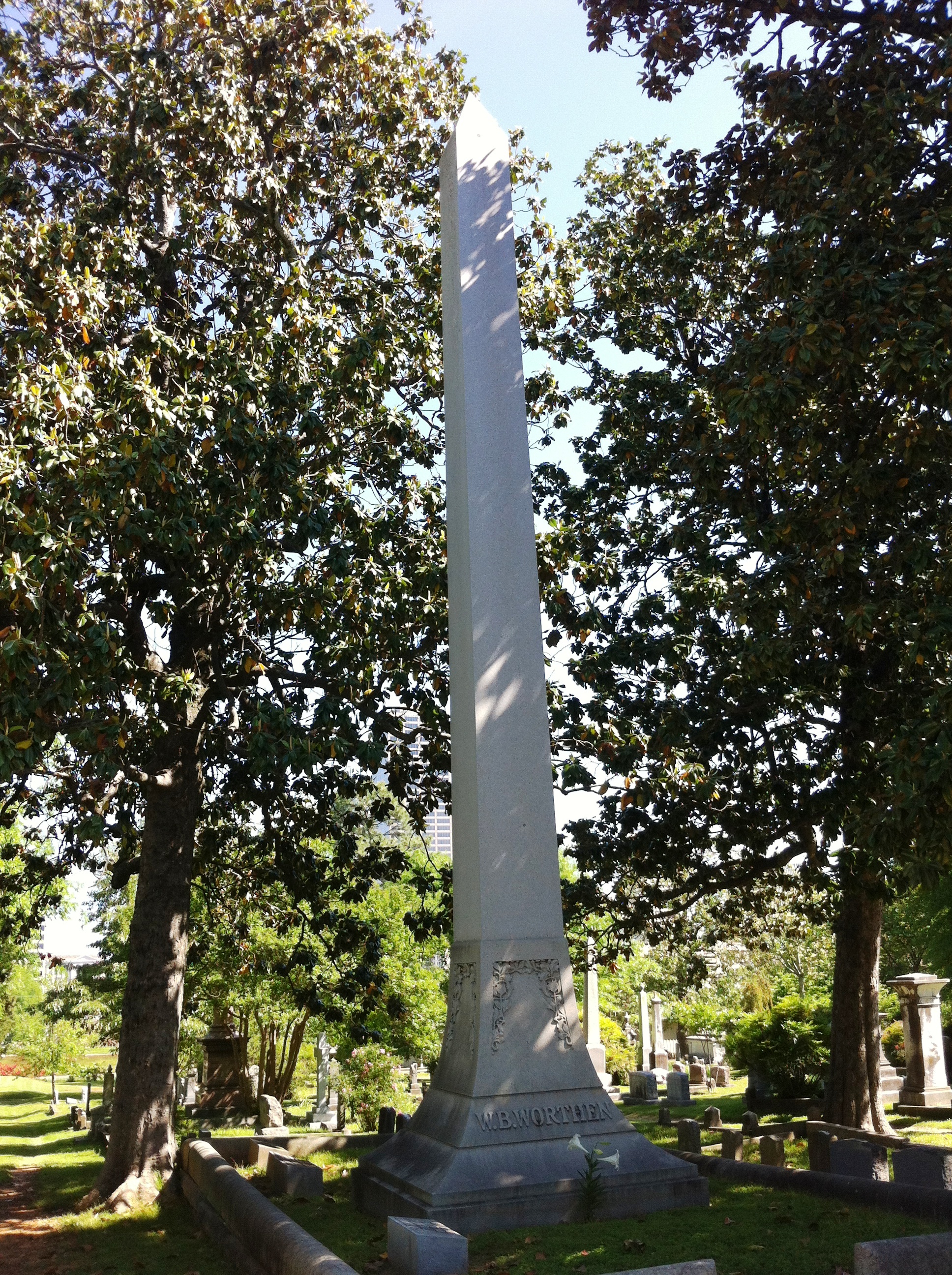
Today is the annual Mt. Holly Cemetery RIP (Rest in Perpetuity) picnic.  Today’s Sculpture Vulture feature is an obelisk in Mt. Holly which serves as a grave marker for Arkansas banker and author W. B. Worthen.

William Booker Worthen was born in Little Rock in 1852.  In 1874, he entered the banking business which in 1888 became known as W. B. Worthen and Company. Later known as Worthen Bank, it survived through recessions, world wars and the Great Depression.  Mr. Worthen also served as publisher of the Arkansas Gazette and wrote a history of the Arkansas banking industry.  He died in 1911.

The obelisk is the tallest structure in Mt. Holly Cemetery and is likely the tallest monument in Little Rock. Though it is still a very impressive structure, the trees which have grown up along side of it now obscure the obelisk from view outside of the cemetery.

The obelisk is four-sided with largely smooth faces until the pointed top.  At the base, in addition to Mr. Worthen’s name, there is some ornamentation for a couple of feet.  But by early 20th century standards the ornamentation is simple.

Other members of the Worthen family are buried in the plot marked by the obelisk, as well as throughout the cemetery.  Mr. Worthen’s granddaughter-in-law, Mary F. Worthen has been a member of the Cemetery Association since the 1950s.  One great-grandson, George, continues in the banking business while another, Bill, is director of Historic Arkansas Museum.

Mount Holly Picnic this Sunday

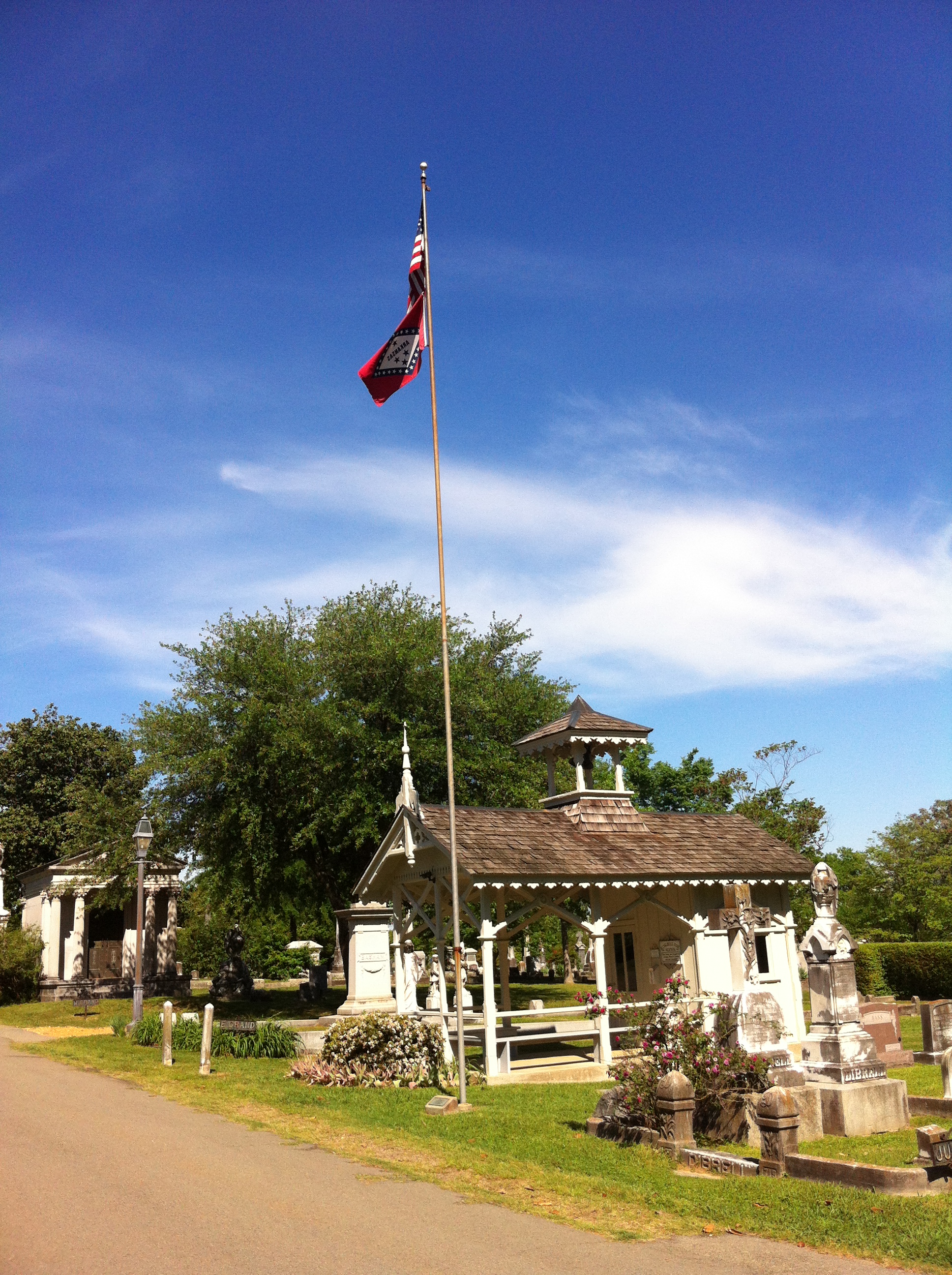
Mt. Holly Cemetery has been called the Westminster Abbey of Arkansas because so many distinguished Arkansans are buried there.  But it is also the final resting place of many every day, ordinary Arkansans. They may not have been famous, but they were no less special to their family members and friends.

Even if one has no relatives buried in Mt. Holly, it is worth a visit.  The cemetery boasts many interesting and unique headstones as well as bountiful flowers and landscaping.

As can be imagined, it costs money to keep up a cemetery. As a fundraiser, the Mt. Holly Cemetery Association created the “Restore in Perpetuity” picnic a few years ago.  RIP, or as the Culture Vulture likes to call it, “Dining with the Dead,” includes a picnic, silent auction, live music and tours of the cemetery.

The picnic this year is tomorrow, Sunday, April 29 from 5pm to 7pm.  Tickets are $75 for adults and $25 for children under 12.  In case of rain, it will be moved to Trinity Episcopal Cathedral.

Sculpture Vulture: Mount Holly Cameos

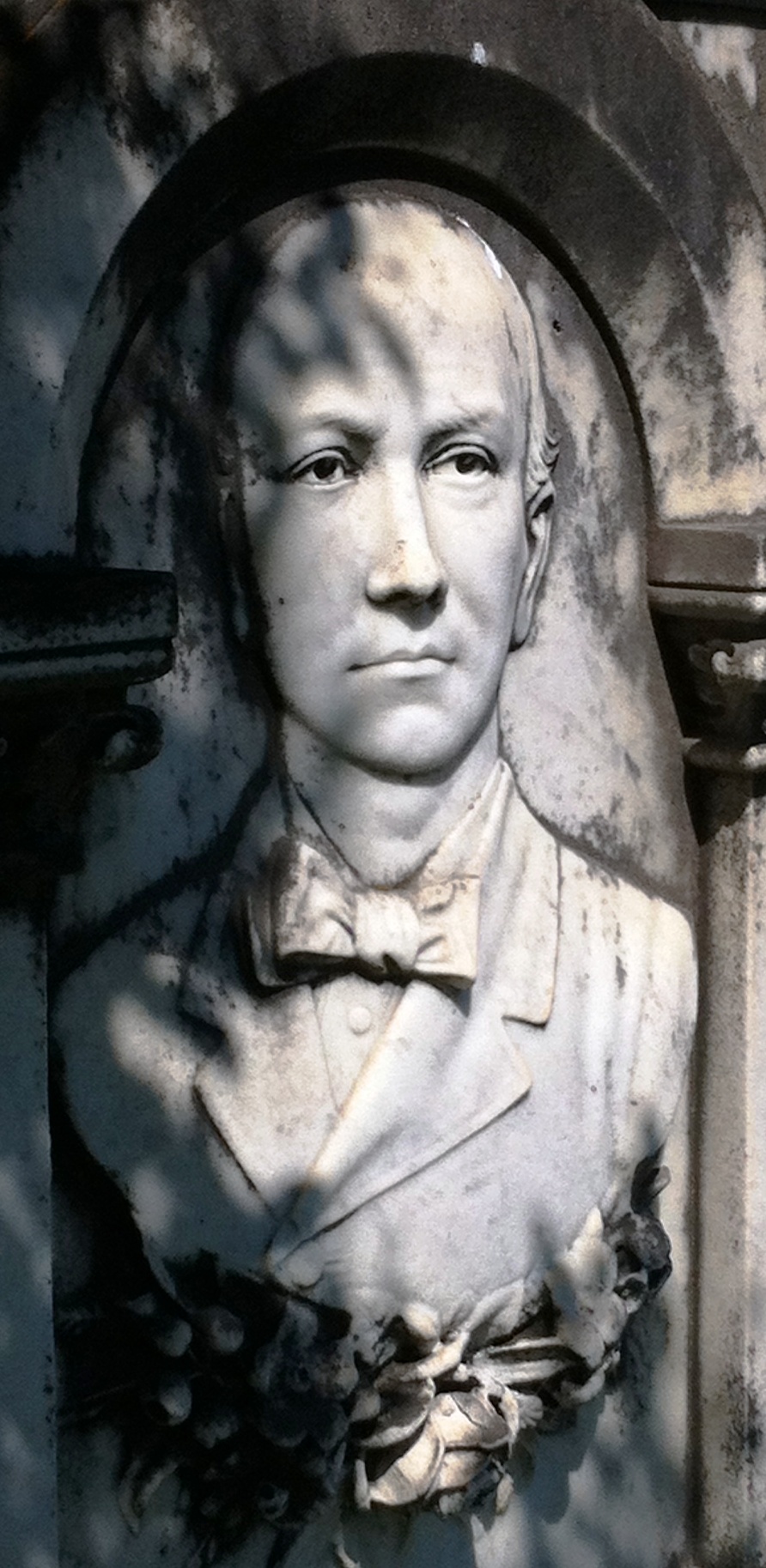
Today’s Sculpture Vulture returns to Mt. Holly Cemetery.  There are quite a few sculptures of angels and religious figures throughout the cemetery.   There are a few very unique sculptural ornamentations in the cemetery. These are carvings to represent the faces of the deceased which are mounted on grave markers.  Though this does not purport to be an exhaustive list of the carvings, it does showcase the ones the Culture Vulture noticed on a recent visit to Mt. Holly.

Hornibrook

James H. Hornibrook was born on July 8, 1840 and died on May 24, 1890.  He came to Little Rock from Toronto following the Civil War and ran a very successful saloon business.  He died of an “apoplectic stroke” just shy of his 50th birthday.  His house is now the Empress of Little Rock Bed & Breakfast located near the Governor’s Mansion.   He had feared his death and had commissioned a death mask to be made.

Johnson

Sydney J. Johnson was born February 12, 1866 and died on March 17, 1899.  He was a banker, Little Rock City Treasurer, and Pulaski County Deputy Circuit Clerk. He died from complications of a broken leg, an injury sustained while sledding.

Fones

Daniel Gilbert Fones was born on August 19, 1837 and died on May 28, 1912.  He was a hardware merchant who served as president of the German National Bank, the Arkansas Building & Loan Association, and the Equitable Building & Loan Association.  He served on the Little Rock School Board from 1883 to 1893.  Together with his brother James, he founded the Fones Brothers Hardware Company.  The final location of their warehouse, 100 Rock Street, opened in 1921. In 1997, after extensive renovation and repurposing the building reopened as the main branch of the Central Arkansas Library System.

LeFevre

Leon LeFevre was a farmer who owned a great deal of land north of the Arkansas River. He was born on April 19, 1808 and died on February 26, 1892. The house that he built in 1842 existed in what later became North Little Rock until 1966.  He was born on his family’s property prior to the establishment of Little Rock over a decade later. As Little Rock became formalized and grew to include both sides of the Arkansas River, he became a civic leader.

Peyton

Dr. Craven Peyton was born on November 30, 1823 and died on November 7, 1872.  He was a physician in Little Rock.  During the Civil War, he held the rank of Colonel and was commander of the 13th Regiment, Arkansas Militia.  He was Kentucky native who moved to Little Rock after graduating from Medical School. During the Mexican War he was commissioned as a surgeon in the Arkansas Regiment of Volunteers. He was one of the founders of Arkansas’s Medical School.