Sculpture Vulture: Easter Bunnys


For those who are around the River Market today, there are two “Easter” bunny sculptures they can visit.

In honor of that, today’s Sculpture Vulture features Tim Cherry’s Rabbit Reach.

The sculpture is located at the corner of Sherman Street and President Clinton Avenue across from the Museum of Discovery.

The sculpture is a gift from Whitlow Wyatt and the Carey Cox Wyatt Charitable Foundation. It was given in memory of George Wyatt and Frank Kumpuris.  Those two gentlemen were the fathers of Whitlow Wyatt and Dean & Drew Kumpuris.

Cherry’s sculpture was selected for this spot because of its proximity to children at the Museum and in the River Market district.  The design and size of the sculpture encourages children to climb on it and to play around the rabbit.  While some public art is situated so it cannot be touched, this one is situated to be touched as part of the appreciation experience.

IMG_3987Laurel Peterson Gregory’s Bunny Bump is featured in the Vogel Schwartz Sculpture Garden.  Two stylized rabbits make for an interesting piece of artwork when they are not only dancing, but also doing the butt bump while dancing. The smooth surface and color of the bronze add to the illusion. This small piece has been placed on a pedestal to elevate more to eye level.
The sculpture was completed in 2009 and installed in 2010.  Gregory has been featured at the Sculpture at the River Market show.  (The photo was taken during a December snow. It may be cold now, but not enough for that amount of snow.)

Science after Dark tonight: Extreme Weather

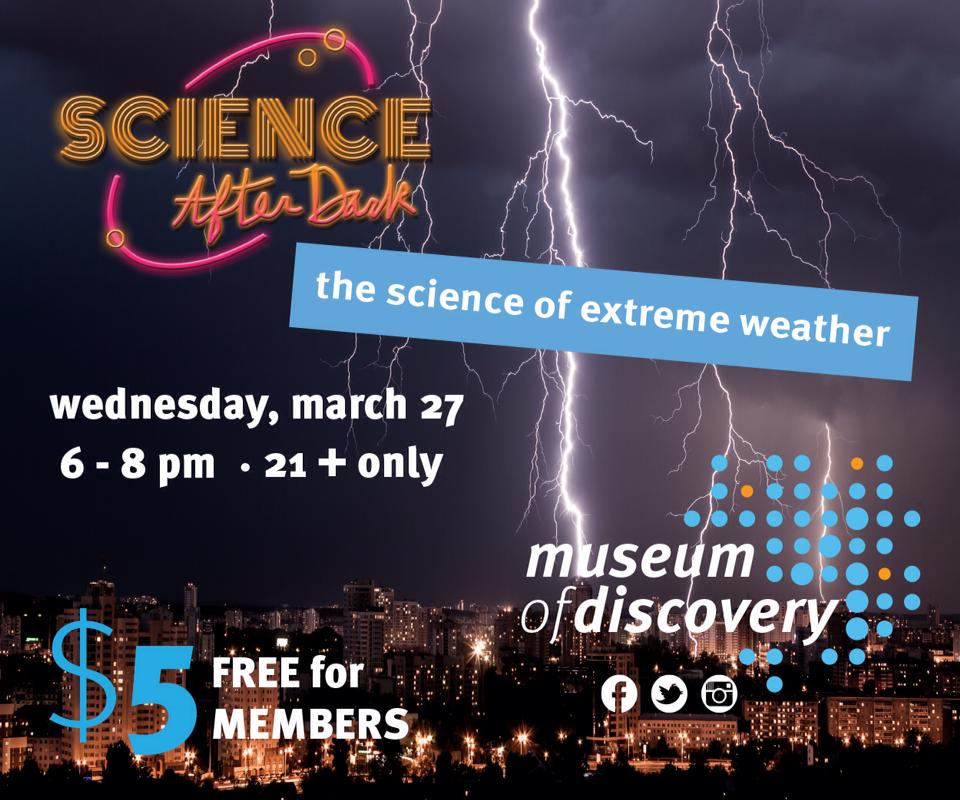
579189_304785576315615_574944738_nThis month’s Science After Dark is “In Like A Lion, Out Like A Lamb; The Science of Extreme Weather” and will be Wednesday, March 27.

Science after Dark occurs the last Wednesday of each month. Museum educators pick a science-related topic, and develop an event around it. The event is for ages 21 and older. General admission is $5 per person. Museum members get in free.

It is a great chance to explore the museum’s exhibits and enjoy downtown Little Rock.

LR Spring Break: MOD hosts a Cat with a Hat and a Big Red Dog

491The Museum of Discovery has partnered with the Arkansas Educational Television Network (AETN)  to bring the Cat in the Hat and Clifford the Big Red Dog to the museum for Family Fun Days during spring break March 21-22.

Families are invited to meet and take photos with the Cat in the Hat Thursday, March 21, and Clifford Friday, March 22, from 10 a.m. to 4 p.m. each day. PBS KIDS programming will be shown throughout the day, along with other educational activities and story time. Visitors are encouraged to dress as their favorite PBS KIDS characters to celebrate spring break.

The Museum of Discovery, 500 President Clinton Avenue, Suite 150, Little Rock, will be open its normal business hours, 9 a.m. to 5 p.m.

General admission is $10 for ages 12 and up, $8 for ages 1 to 11, and free for members and children under 1.

Little Rock Look Back: Mayor Pat L. Robinson

IMG_4517On this date in 1900, future Little Rock Mayor Pat L. Robinson was born.  While I cannot verify that he was indeed named after St. Patrick, it would be fairly reasonable to assume there might be a connection, especially given the fact that he was Catholic.

Robinson was a rising star of Little Rock Democratic politics.  In April 1929, just weeks after his 29th birthday, he was elected Mayor.  He had twice been elected as City Attorney (1926 and 1928) and was one of the youngest to serve in that position.

During Mayor Robinson’s tenure, he announced plans to construct a new airport.  That project led to the creation of what is now the Bill and Hillary Clinton National Airport.  Mayor Robinson was also involved in helping Philander Smith College secure the property where it is now located.  In addition, during his tenure, what is now the Museum of Discovery was folded into the City of Little Rock.

Single at the time he was in office and generally considered good looking, Mayor Robinson was sometimes referred to as the “Jimmy Walker of the Southwest.” Walker was the handsome and charming Mayor of New York City at the time.

Mayor Robinson ran afoul of some of the Democratic party leaders. Records don’t seem to indicate exactly what actions he took or did not take.  One thing that is brought up is that the City went into financial distress during his tenure.  Considering the Wall Street crash happened shortly after he took office, that financial state was not unique to Little Rock.

IMG_4532During this era in Little Rock, it was customary for an incumbent mayor to be given a second term. But City Clerk Horace Knowlton challenged Robinson in the primary.  It was a bitter campaign with Robinson linking Knowlton to disreputable denizens and Knowlton charging Robinson with “an orgy of spending.”  Robinson initially came out 17 votes ahead. But after a review and a lawsuit, it was found that Knowlton ended up with 10 more votes and became the nominee.  At the time, being the Democratic nominee was tantamount to election.

After he left office, Robinson practiced law for a few years in Little Rock and then left the city.  Records do not indicate where he went but he no longer appeared in the City of Little Rock directory by the early 1940s.

BRAIN AWARENESS DAY at Museum of Discovery

20120814-171022.jpgMuseum of Discovery will host Brain Awareness Day Saturday, March 16, in conjunction with National Brain Awareness Week.   The event will be held from 10 a.m. to 3 p.m. and will include demonstrations and exhibits presented by the Arkansas Chapter of the Society for Neuroscience. The first 725 visitors will receive $2 off their admission.

Representatives from the Center for Toxicological Research (NCTR), the University of Arkansas for Medical Sciences (UAMS), Hendrix College and University of Central Arkansas (UCA) will offer hands-on exhibits and demonstrations on the brain for visitors of all ages.

“Scientific outreach activities such as Brain Awareness events are very important to help kindle interest in science and encourage scientific achievement in young students who participate,” said Dr. Jeff Padberg, assistant professor of neuroscience at UCA. “Engaging the youth of Arkansas in scientific exploration of the world around them, as well as increasing scientific literacy of students at an early age, are the goals of this event.”


Brain Awareness Day demonstrations include:

  • “Your Brain on Jell-O” is an interactive exhibit that will allow children to touch artificial brains made of Jell-O and powdered milk.   The activity will show the fragility of the human brain as well as demonstrate its overall size, shape and form. Children 5 and older will use cake frosting to place artificial arteries on the Jell-O brains. Children 4 and younger will use a “brain mold” to make a moon sand brain.
  • “Behavioral Tasks” will show how an Operant Test Battery assesses the intelligence of a monkey
  • “Your Brain and You!” is a hands-on exhibit that will offer many activities describing the shape of the brain. Visitors can color and create their own brain headband and sculpt brains out of clay. Adults will receive information on magnetic resonance imaging (MRI) research being conducted at the Brain Imaging Research Center at UAMS while children will learn how MRIs work from a display using magnets and iron filings.
  • “What Can We Learn from Animal Brains?” will show why some animals can give clues as to how the human brain works. Stained sections of armadillo and rat brains will be presented on a microscope along with a rat atlas.
  • “Visual Illusions: Fooling the Brain!” will provide a variety of visual illusions and explain how the mechanisms employed by the eyes and brain that support visual perception can also be deceiving.

“Hosting Brain Awareness Day is in lockstep with our mission at the Museum of Discovery,” said Kelley Bass, museum CEO. “We strive to ignite a passion for science, technology and math in a dynamic, interactive environment – and that’s all about engaging the brains of our visitors. So many of our programs and exhibits are about helping visitors understand how things work, as are so many of the exhibits and demonstrations that will be featured during Brain Awareness Day. It’s a perfect fit.”

For more information on Brain Awareness Day at Museum of Discovery, contact 501-396-7050.

Science After Dark: The Science of Africa

science_after_darkThe Museum of Discovery, the University of Arkansas Clinton School of Public Service, UALR and the Little Rock Zoo are partnering to present “The Science of Africa” from 6 to 8 p.m. Wednesday, February 27, the latest in the Museum of Discovery’s monthly Science After Dark series.

The museum’s Great Hall will come alive with interactive, science-based experiences highlighting the physical and earth sciences of Africa. Dr. Warigia Bowman, assistant professor at the Clinton School, and Joel Gordon, visitor experience director at the Museum of Discovery, have collaborated to plan and execute an engaging series of interactive experiences

Other presenters will include Dr. Amin Akhnoukh of UALR, representatives of the Reptile Rescue Center, members of the education staffs of the Little Rock Zoo and the Museum of Discovery as well as Hamadi Njoroge, owner/operator of African Wildcats Adventure Safaris.

Those attending the 21-and-over-only event full of Africa science-based experiences will get the chance to:

  • Meet some African animals and learn more about many of the continent’s best-known inhabitants.
  • Examine some of the more exotic skeletons of African animals, pulled from the Museum of Discovery’s collection, as well as skulls, hides and other animal artifacts from the Little Rock Zoo.
  • Learn about the science and scientists of Africa, including troubling phenomena like the melting of the snow cap on Mount Kilimanjaro.
  • Explore “The Development of Construction from the Age of the Pharaoh to Modern Egypt,” as Dr. Akhnoukh talks about pyramids, pharaoh temples and newer projects such as the high dam in Aswan, Cairo Tower, the famous Alexandria Library, and the Egyptian Museum.
  • Enjoy African roots-based music.
  • And learn why deep down in our DNA, we are all African.

Dr. Bowman is an expert in the science of Africa. She earned her doctorate degree from Harvard University, where her Ph.D. research centered on the effect of technology in Kenya, Uganda, Tanzania and Rwanda. She has consulted for many African organizations, including the Kenya Institute for Public Policy Research and Analysis, the African Technology Policy Studies Network and the New Economic Partnership for African Development.

Dr. Akhnoukh, a native of Egypt, is an assistant professor of construction engineering at UALR. He has his Ph.D. in construction engineering from the University of Nebraska in Lincoln and his masters in civil engineering from Kansas State University. He research focuses on ultra-high strength concrete mixes. Dr. Akhnoukh is a registered professional engineer in Arkansas and Cairo. His board affiliations include serving on the board of the Arkansas chapter of the American Concrete Institute.

Hamadi is an expert on Kenyan animals, including many of the country’s 1,000 bird species as well as wild cats, including lions and leopards, and other important large game species including rhinos, elephants, giraffes and the numerous antelopes that make their home in the vast grasslands of East Africa.

Admission to Science After Dark is $5, free for Museum of Discovery members, and is payable at the door. Bosco’s will provide a cash bar, and visitors will have full access to the 85 interactive exhibits featured in the museum’s three galleries. For more information, visit www.museumofdiscovery.org and “like” Science After Dark on Facebook.

Museum of Discovery Earns National Recognition

20120814-171022.jpgThe Institute of Museum and Library Services announced last week that the Museum of Discovery was a National Medal for Museum and Library Service finalist. The National Medal is the nation’s highest honor conferred on museums and libraries for service to the community and celebrates institutions that make a difference for individuals, families, and communities.

“On behalf of the dedicated staff at the Museum of Discovery,” we’d like to thank IMLS for recognizing the impact our newly refurbished museum has had on the 170,000 people who visited us in the first year after our grand reopening,” said Kelley Bass, museum CEO. “Among the 33 institutions named as finalists, the Museum of Discovery is one of only six science and technology centers that target children, which makes this honor even more notable for us.”

Medal finalists are selected from nationwide nominations of institutions that demonstrate innovative approaches to public service, exceeding the expected levels of community outreach. This year’s finalists exemplify the nation’s great diversity of libraries and museums and include an aquarium and marine science center, conservatory and botanical gardens, county library systems, individual libraries, children’s museums, an art museum, science centers, and more, hailing from across the country.

“Museums and libraries serve as community gathering places and centers for lifelong learning, and we are very proud to announce Museum of Discovery as a finalist for the 2013 National Medal,” said Susan Hildreth, director of the Institute of Museum and Library Services. “This year’s finalists exemplify the many wonderful ways museums and libraries can respond to the needs and wants of the communities they serve.”

Finalists are chosen because of their significant and exceptional contributions to their communities. IMLS is encouraging community members who have visited Museum of Discovery to share their story on the IMLS Facebook page, http://www.facebook.com/USIMLS. Visit the IMLS Facebook page to learn more about how these institutions make an impact. National Medal for Museum and Library Service winners will be announced this spring.

To learn more about the 2013 National Medal finalists, visit http://www.imls.gov/medals.

About the Institute of Museum and Library Services

The Institute of Museum and Library Services is the primary source of federal support for the nation’s 123,000 libraries and 17,500 museums.  Our mission is to inspire libraries and museums to advance innovation, lifelong learning, and cultural and civic engagement. Our grant making, policy development, and research help libraries and museums deliver valuable services that make it possible for communities and individuals to thrive.  To learn more, visit http://www.imls.gov and follow us on Facebook and Twitter.

About the Museum of Discovery 

Located in Little Rock’s historic River Market District, the Donald W. Reynolds Science Center at the Museum of Discovery is central Arkansas’s premier science, technology and math center. With nearly 90 state-of-the-art interactive exhibits in three galleries focused on health, physical and earth sciences, and a highly trained staff, it is a leading resource for informal science-related education. The Donald W. Reynolds Science Center at the Museum of Discovery’s mission is to ignite a passion for science, technology and math in a dynamic, interactive environment.

The Donald W. Reynolds Foundation awarded the Museum a $9.2 million grant solely dedicated to the renovation. The money paid for the renovation of 44,000 square feet of existing space, a 6,000 square-foot addition and new exhibits throughout the facility.