LR Look Back: A Photo Seen Around the World

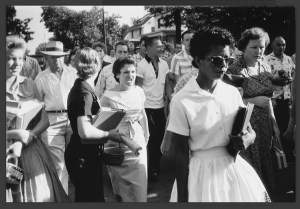
Will Counts (American, Little Rock, 1931 – 2001, Evansville, Illinois), It was not the plan for Elizabeth Eckford to walk along toward Central High, 1957 (printed 1997), gelatin silver print, 25 x 32 inches, Arkansas Arts Center Foundation Collection: Gift of the artist, Bloomington, Indiana. 1997.039.007

On September 4, 1957, the students known as the Little Rock Nine made their first attempt to enter all-white Little Rock Central High School.  This was the second day of the 1957-58 school year in Little Rock.  Over the preceding Labor Day weekend, it had been decided that the African American students would wait until the second day of school to officially start at Central.

As is now well known, NAACP leader Daisy Bates was not able to notify one of the students about meeting as a group of the Bates house.  That one student, Elizabeth Eckford, approached the school by herself and quickly realized the National Guard members surrounding the school were not their to protect her, but to ban her and the others.

Arkansas Democrat photographer Will Counts captured Eckford’s quiet determination in the face of the guards and the taunting crowds.  His photo of a white student screaming at Eckford was picked up by media outlets worldwide. It became not only a symbol for the Central High integration crisis, but for the Civil Rights movement.  Counts’ photo was the jury’s choice for the Pulitzer Prize in Photography in 1958. But the jury was overruled by the Pulitzer board, with no explanation given.

A copy of this photo is now on display at the Arkansas Arts Center.  In 1997, Counts gave the Arts Center several prints from his collection that were taken during the time period of August 1957 through September 1959.  The exhibit is on display through October 22.


Little Rock Look Back: Little Rock reacts to death of Martin Luther King, Jr.

On April 4, 1968, Dr. Martin Luther King, Jr., was assassinated in Memphis.  Thankfully Little Rock did not see the unrest that many cities did.

Part of that was probably due to quick action by Governor Winthrop Rockefeller. The Governor released a statement fairly quickly expressing his sorrow at the tragedy and calling for a day of mourning. He also made the State Capitol available for the NAACP to have a public memorial, as well as worked with a group of ministers to host an interdenominational service.

Little Rock Mayor Martin Borchert issued a statement as well:

We in Little Rock are disturbed about the incident in Memphis. We are disturbed regardless of where it had happened.  Killing is not the Christian solution to any of our problems today.

In Little Rock, we feel we have come a long way in 10 years toward solving some of our problems of living and working together regardless of race, creed or color.

The city Board of Directors in Little Rock has pledged itself toward continuing efforts to make Little Rock a better place in which to live and work for all our citizens.

We feel the efforts of all thus far have proved we can live in harmony in Little Rock and are confident such an incident as has happened will not occur in Little Rock.  We will continue our most earnest efforts toward the full needs of our citizens.

The day after Dr. King was assassinated, a group of Philander Smith College students undertook a spontaneous walk to the nearby State Capitol, sang “We Shall Overcome” and then walked back to the campus.  President Ernest T. Dixon, Jr., of the college then hosted a 90 minute prayer service in the Wesley Chapel on the campus.

On the Sunday following Dr. King’s assassination, some churches featured messages about Dr. King.  As it was part of Holy Week, the Catholic Bishop for the Diocese of Little Rock had instructed all priests to include messages about Dr. King in their homilies. Some protestant ministers did as well. The Arkansas Gazette noted that Dr. Dale Cowling of Second Baptist Church downtown (who had received many threats because of his pro-integration stance in 1957) had preached about Dr. King and his legacy that morning.

Later that day, Governor Rockefeller participated in a public memorial service on the front steps of the State Capitol. The crowd, which started at 1,000 and grew to 3,000 before it was over, was racially mixed. At the conclusion of the ceremony, Governor and Mrs. Rockefeller joined hands with African American ministers and sang “We Shall Overcome.”

That evening, Trinity Episcopal Cathedral was the site of an interdenominational service which featured Methodist Bishop Rev. Paul V. Galloway, Catholic Bishop Most Rev. Albert L. Fletcher, Episcopal Bishop Rt. Rev. Robert R. Brown, Rabbi E. E. Palnick of Temple B’Nai Israel, Gov. Rockefeller, Philander Smith President Dixon, and Rufus King Young of Bethel AME Church.

Earlier in the day, Mayor Borchert stated:

We are gathered this afternoon to memorialize and pay tribute to a great American….To achieve equality of opportunity for all will require men of compassion and understanding on the one hand and men of reason and desire on the other.

Women’s History Month – Sue Cowan Williams

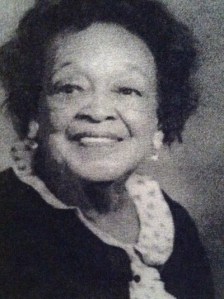
Sue Cowan Williams was an educator who fought for fair treatment.

After being educated in Alabama and Illinois, she returned to Arkansas, and began her teaching career in 1935 at Dunbar High School in Little Rock.  In 1942, Williams became the plaintiff in a lawsuit aimed at equalizing the salaries of black and white teachers in the Little Rock School District. The NAACP’s Legal Defense Fund, including its director-counsel Thurgood Marshall, assisted in the case. The trial ended after a week with a verdict against Williams, and her teaching contract was not renewed for the 1942-43 school year. Other black educators left the school as a result of their involvement in the lawsuit.

In 1945, Williams successfully appealed the verdict to the Eighth Circuit Court of Appeal in St. Louis, which ordered equal pay for black and white teachers in Little Rock. Dr. Christophe, the new principal of Dunbar High School, demanded Williams’s reinstatement in the fall of the same year, but it was not granted until 1952. In the intervening years, she taught classes at what is now UAPB and Arkansas Baptist College as well as at the Ordnance Plant in Jacksonville.  Upon returning to the LRSD, Williams taught at Dunbar until 1974, when she retired. She died in 1994.

The Central Arkansas Library Branch located in the Dunbar neighborhood was named for her when it opened in 1997.  She is honored with inclusion in the Arkansas Civil Rights Heritage Trail.

Women’s History Month – Dr. Edith Irby Jones

Dr. Edith Irby Jones was the first African American woman to attend and to graduate from the University of Arkansas for Medical Sciences.  At the time she was admitted, she became the first African American to attend any previously segregated medical school in the South.

Though she was admitted to the school, she was not allowed to use the same dining, lodging, or bathroom facilities as the white students.  She later noted that the African American janitorial staff placed a vase of fresh flowers on her table every day in the segregated dining room she shared with the staff.  While at UAMS, she traveled the state to promote the NAACP as a token of appreciation for the work that organization had done to help raise funds for her schooling and lodging.

After graduating from medical school, she practiced medicine in Hot Springs before she and her husband eventually relocated to Texas.  She practiced medicine in Houston for fifty years.

Little Rock Look Back: US Supreme Court decision in BATES V. LITTLE ROCK

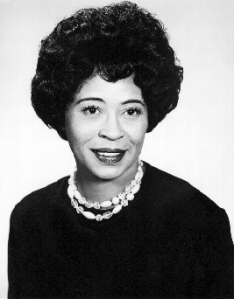
bates daisyOn February 23, 1960, the U. S. Supreme Court handed down a decision in the case of Daisy BATES et al., Petitioners, v. CITY OF LITTLE ROCK et al.  This case had been argued before the Court in November 1959.

Daisy Bates of Little Rock and Birdie Williams of North Little Rock were the petitioners.  Each had been convicted of violating an identical ordinance of an Arkansas municipality by refusing a demand to furnish city officials with a list of the names of the members of a local branch of the National Association for the Advancement of Colored People. The question for decision was whether these convictions can stand under the Due Process Clause of the Fourteenth Amendment to the United States Constitution.

The Little Rock ordinance (10,638) was passed on October 14, 1957. It charged that certain non-profits were actually functioning as businesses and using non-profit status to skirt the law. Therefore it required the non-profits to disclose their members and sources of dues.  North Little Rock passed an identical ordinance.

(Mayor Woodrow Mann was not present at the meeting of the LR Council when the ordinance was passed. But he signed all of the resolutions and ordinances approved that night.  Ordinance 10,638 was the only legislation that night which had also been signed by Acting Mayor Franklin Loy.  Mayor Mann crossed through Loy’s name and signed his own.)

Mrs. Bates and Mrs. Williams as keepers of the records for their respective chapters of the NAACP refused to comply with the law.  While they provided most of the information requested, they contended they did not have to provide the membership rosters and dues paid.

After refusing upon further demand to submit the names of the members of her organization, each was tried, convicted, and fined for a violation of the ordinance of her respective municipality. At the Bates trial evidence was offered to show that many former members of the local organization had declined to renew their membership because of the existence of the ordinance in question. Similar evidence was received in the Williams trial, as well as evidence that those who had been publicly identified in the community as members of the National Association for the Advancement of Colored People had been subjected to harassment and threats of bodily harm.

Each woman was convicted in the court of Pulaski Circuit Court, First Division, William J. KirbyJudge. They were fined $25 a person.  On appeal the cases were consolidated in the Supreme Court of Arkansas in 1958. The convictions were upheld by five justices with George Rose Smith and J. Seaborn Holt dissenting.

Mrs. Bates and Mrs. Williams then appealed to the U. S. Supreme Court.  The pair’s legal team included Robert L. Carter and George Howard, Jr. (who would later become a federal judge).  Little Rock City Attorney Joseph Kemp argued the case for the City.  The arguments before the U. S. Supreme Court were heard on November 18, 1959.

The SCOTUS decision was written by Associate Justice Potter Stewart.  He was joined by Chief Justice Earl Warren and Associate Justices Felix Frankfurter, Tom C. Clark, John M. Harlan II, William J. Brennan and Charles E. Whittaker.  Justices Hugo Black and William O. Douglas wrote a concurring opinion.

The U. S. Supreme Court reversed the lower courts.

In sum, there is a complete failure in this record to show (1) that the organizations were engaged in any occupation for which a license would be required, even if the occupation were conducted for a profit; (2) that the cities have ever asserted a claim against the organizations for payment of an occupation license tax; (3) that the organizations have ever asserted exemption from a tax imposed by the municipalities, either because of their alleged nonprofit character or for any other reason.

We conclude that the municipalities have failed to demonstrate a controlling justification for the deterrence of free association which compulsory disclosure of the membership lists would cause. The petitioners cannot be punished for refusing to produce information which the municipalities could not constitutionally require. The judgments cannot stand.

In their concurring opinion, Justices Black and Douglas wrote that they felt the facts not only violated freedom of speech and assembly from the First Amendment, but also aspects of the Fourteenth Amendment. They wrote that the freedom of assembly (including freedom of association) was a principle to be applied “to all people under our Constitution irrespective of their race, color, politics, or religion. That is, for us, the essence of the present opinion of the Court.”

Neither the Gazette or Democrat carried any reaction from City leaders. There was a City Board meeting the evening of the decision. If it was mentioned, the minutes from the meeting do not reflect it.

Arkansas Attorney General Bruce Bennett, on the other hand, was very vocal in his outrage. The city laws were known as Bennett Laws because they had been drafted by him as ways to intimidate African Americans and others he viewed as agitators.

In 1960 Bennett was challenging Governor Orval Faubus for the Democratic gubernatorial nomination.  In reaction to the to the Supreme Court he vowed that, if elected Governor, he would “de-integrate” (a term he proudly took credit for coining) the state.

For his part, and not to be outdone by the AG, Faubus fretted that the Court’s decision meant that Communists would be able to give money to the NAACP.

Black History Month – Duke Ellington refuses to play segregated Robinson Auditorium

Newspaper ad for the concert that was not to be

Newspaper ad for the concert that was not to be

Seventy-seven years ago today, Robinson Memorial Auditorium officially opened.  Today’s Black History Month feature is on an event that did NOT take place at Robinson.

In August 1961, it was announced that Duke Ellington would perform in concert at Robinson Center.  He had previously played there in the 1940s and early 1950s.  His concert was set to be at 8:30 pm on Tuesday, September 5.

Due to the changes of times, the NAACP had a relatively new rule that they would boycott performers who played at segregated venues.  When it became apparent that Robinson would remain segregated (African Americans restricted to the balcony), the NAACP announced they would boycott any future Ellington performances if he went ahead and played Robinson.

The music promoters in Little Rock (who were white) petitioned the Robinson Auditorium Commission asking them to desegregate Robinson – even if for only that concert.  The Commission refused to do so.  Though the auditorium was finding it harder to book acts into a segregated house, they felt that if it were integrated, fewer tickets would be sold.

Ellington cancelled the concert.

Robinson remained segregated until a 1963 judge’s decision which integrated all public City of Little Rock facilities (except for swimming pools).

RobinsoNovember: Duke Ellington

On September 1, 1961, Duke Ellington announced he was cancelling his upcoming appearance at Robinson Auditorium. Ellington, who had previously appeared at Robinson at least once prior (on November 7, 1951), had been announced for a concert in late August.

In those days, Robinson did not have a formal box office.  Tickets were sold at various businesses, usually record stores.  When some African Americans called to inquire about tickets and were told they were only available in the segregated seating section of the balcony, they protested to the NAACP.  The local chapter then announced that it would encourage Ellington to cancel his concert.  The NAACP had a policy that they would boycott performers who ever played at segregated houses.  Since Robinson was still segregated, future Ellington appearances would have been met with boycotts.

The local presenters for the Ellington concert tried to negotiate a deal with the Auditorium Commission.  They were not successful.  One misguided commissioner stated, “Integration may be the law of the land, but it is not the law of Robinson Auditorium.”  When they commission refused to back down, Ellington cancelled.

This was only the latest in a string of issues surrounding the desegregation of Robinson.  The theatrical and opera producer organizations had both indicated that their touring shows would no longer play at segregated houses.  More and more entertainers were declining to play at segregated houses.

The Auditorium Commission was trying to balance their fear of lost revenue from cancelled bookings with their fears of poor attendance by audiences that did not want integration.  In a decade of rapid change, the commissioners tended to be older less likely to embrace change.

In 1962, a lawsuit was filed to integrate Robinson, city parks, and other public facilities.  It was settled in 1963 when the federal judge ruled against the City.  The Duke Ellington incident was often mentioned in media stories around the lawsuit.