Little Rock Look Back: Bonds sold for Robinson Center in 1937

clr-res-1418On December 20, 1937, the Little Rock City Council adopted Resolution 1,418 which authorized the sale of municipal bonds to fund the municipal auditorium.

Earlier that year, Little Rock voters had authorized the sale of $468,000 of Municipal Auditorium Bonds.  Since that January election, city leaders had been undertaking various steps to plan for the project.  Finally, they were ready to sell the bonds.  On December 20, a public sale was held.  The US federal government made a bid for the purchase of $418,000 of the bonds. It was the only bid received.

The sale was accompanied by an Emergency Clause so that it would go into effect immediately.  The clause noted: “It is ascertained and declared that by reason of the present economic conditions many citizens of the City are out of work, and the improvements herein provided would furnish work for a large number of persons and thereby add to the peace and happiness of the City; further, that the City has no Municipal Auditorium or facilities for large conventions or gatherings…”

The offer by the US Government to purchase the bonds was in addition to an outright grant of $342,000 to help fund the auditorium.

While there would be other issues in financing and funding the project, the sale of the bonds on December 20, 1937, set things in motion which led to the February 16, 1940, opening.

RobinsoNovember: Mayor R. E. Overman

Overman AuditR. E. Overman assumed the office of Little Rock mayor in April 1935. Around that time, a new wave of New Deal programs were filtering down from Washington DC to cities.  It can be said of Mayor Overman that he did not meet a New Deal program he did not like.  From rebuilding the sewer system, to creating a public water utility, to constructing of structures for the Museum of Fine Arts, Little Rock Zoo, and Boyle Park, Mayor Overman signed the City up for program after program.

While the programs were all worthwhile, and in some cases absolute necessities, Mayor Overman did not seem to consider how these massive projects running concurrently would impact the City finances.  In November 1935, he submitted a proposal to the Public Works Administration for the construction of a new municipal auditorium to be located at the northeast corner of the intersection of Scott Street and Capitol Avenue. It would have taken up three/quarters of that block and wrapped around the Women’s City Club building (now the Junior League of Little Rock headquarters).  Because of other projects in the works, he did not pursue any further action on the auditorium project at the time.

In November 1936, Mayor Overman asked the City Council to place three bond issues on a special election ballot for January 1937, one of which was a municipal auditorium. Though a location had previously been identified in 1935, at this point in time supporters made a concerted effort to disclose that no location had been selected.  After the election was called, there was a concerted effort by supporters of the three separate bond issues to collaborate.  Voters overwhelmingly approved all three issues, and Little Rock’s journey to a municipal auditorium at last was underway. Perhaps.

Over the summer, architects and lawyers were selected. In the autumn, a consultant was hired to help with the selection for the site.  The month of October was consumed with City Council battles over the auditorium site.  Mayor Overman favored a location at Markham and Spring Streets (now site of the Cromwell Building and the Bankruptcy Courthouse). Because the Federal Government owned half the site and did not want to sell it, that location was deemed not feasible – though that did not stop Mayor Overman and others from repeatedly citing it as their first choice.  The only person who favored the location at Markham and Broadway did not have a vote: Planning Commission Chair J. N. Heiskell. Though he had no vote, he had the twin bully pulpits of Planning Commission and the Arkansas Gazette. As other sites fell by the wayside, he kept advocating for it.  Finally, the City Council approved of Heiskell’s choice, and the auditorium had a site.

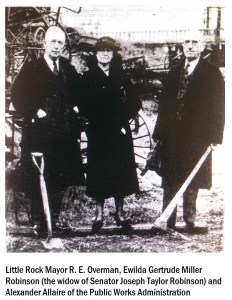
The groundbreaking had to take place by January 1, 1938, or the money would be rescinded. After finalizing a location, planning could get underway.  With a week to spare, the ground was broken on December 24, 1937.  Mrs. Joseph T. Robinson, widow of the recently deceased US Senator from Arkansas, joined Mayor Overman in the groundbreaking. This ceremony was the first mention of the building being named in memory of the fallen senator, who had died in the summer of 1937.

Construction progressed throughout 1938 and into 1939.  Because of the precarious state of the City’s finances, Mayor Overman lost the support of the business community.  In November 1938, he lost his bid for the Democratic nomination for Mayor and was denied a third two-year term.  He left office in April 1939.

Arkansas Heritage Month – LR Mayor Overman and a municipal auditorium

Overman AuditR. E. Overman assumed the office of Little Rock mayor in April 1935. Around that time, a new wave of New Deal programs were filtering down from Washington DC to cities.  It can be said of Mayor Overman that he did not meet a New Deal program he did not like.  From rebuilding the sewer system, to creating a public water utility, to constructing of structures for the Museum of Fine Arts, Little Rock Zoo, and Boyle Park, Mayor Overman signed the City up for program after program.

While the programs were all worthwhile, and in some cases absolute necessities, Mayor Overman did not seem to consider how these massive projects running concurrently would impact the City finances.  In November 1935, he submitted a proposal to the Public Works Administration for the construction of a new municipal auditorium to be located at the northeast corner of the intersection of Scott Street and Capitol Avenue. It would have taken up three/quarters of that block and wrapped around the Women’s City Club building (now the Junior League of Little Rock headquarters).  Because of other projects in the works, he did not pursue any further action on the auditorium project at the time.

In November 1936, Mayor Overman asked the City Council to place three bond issues on a special election ballot for January 1937, one of which was a municipal auditorium. Though a location had previously been identified in 1935, at this point in time supporters made a concerted effort to disclose that no location had been selected.  After the election was called, there was a concerted effort by supporters of the three separate bond issues to collaborate.  Voters overwhelmingly approved all three issues, and Little Rock’s journey to a municipal auditorium at last was underway. Perhaps.

Over the summer, architects and lawyers were selected. In the autumn, a consultant was hired to help with the selection for the site.  The month of October was consumed with City Council battles over the auditorium site.  Mayor Overman favored a location at Markham and Spring Streets (now site of the Cromwell Building and the Bankruptcy Courthouse). Because the Federal Government owned half the site and did not want to sell it, that location was deemed not feasible – though that did not stop Mayor Overman and others from repeatedly citing it as their first choice.  The only person who favored the location at Markham and Broadway did not have a vote: Planning Commission Chair J. N. Heiskell. Though he had no vote, he had the twin bully pulpits of Planning Commission and the Arkansas Gazette. As other sites fell by the wayside, he kept advocating for it.  Finally, the City Council approved of Heiskell’s choice, and the auditorium had a site.

The groundbreaking had to take place by January 1, 1938, or the money would be rescinded. After finalizing a location, planning could get underway.  With a week to spare, the ground was broken on December 24, 1937.  Mrs. Joseph T. Robinson, widow of the recently deceased US Senator from Arkansas, joined Mayor Overman in the groundbreaking. This ceremony was the first mention of the building being named in memory of the fallen senator, who had died in the summer of 1937.

Construction progressed throughout 1938 and into 1939.  Because of the precarious state of the City’s finances, Mayor Overman lost the support of the business community.  In November 1938, he lost his bid for the Democratic nomination for Mayor and was denied a third two-year term.  He left office in April 1939.

Little Rock Look Back: Groundbreaking for Robinson Auditorium

122437 GroundbreakOn December 24, 1937, at 11:30 a.m., Little Rock Mayor R. E. Overman, Ewilda Gertrude Miller Robinson (the widow of Senator Joseph Taylor Robinson) and  Alexander Allaire of the PWA turned dirt to participate in the brief groundbreaking ceremony for Little Rock’s municipal auditorium.  That morning, the Arkansas Gazette ran a brief story on the upcoming groundbreaking.  The story mentioned that the building would be named in memory of the late beloved Arkansas politician.  This appears to be the first public pronouncement of the Robinson name for this civic structure.

Among others in attendance at the groundbreaking were Mrs. Charles Miller (sister-in-law of Mrs. Robinson), Mr. and Mrs. Grady Miller (brother and sister-in-law of Mrs. Robinson), the mayor’s wife, the three architects (George Wittenberg, Lawson Delony and Eugene John Stern), and D. H. Daugherty and Will Terry of the City’s Board of Public Affairs.

Construction had to start by January 1, 1938, in order to receive PWA funds.  By breaking ground on December 24, there was over a week to spare.  The site had been selected in late October 1937, and the purchase had not been finalized.  But the PWA did give permission for the City to let a contract for excavation, demolition and filling on the site.

The groundbreaking took place at the corner of Garland and Spring Streets which was on the northeast corner of the block set aside for the auditorium.  Today, Spring Street does not extend north of Markham; the street was closed to make way for the parking structure and what is now the Doubletree Hotel.  Garland Street is basically an alley that runs parallel to Markham north of City Hall, Robinson Auditorium and the Doubletree Hotel.