Pulitzers Play Little Rock: AUGUST: OSAGE COUNTY

August Osage CastoTracy Letts won the Pulitzer for his sprawling family tale August: Osage County.  It was brought to life in Little Rock on the Arkansas Repertory Theatre stage.

Rep founder Cliff Baker, who starred in the Rep’s first production of The Threepenny Opera returned to the stage as an actor to portray the mysterious patriarch of the Weston clan.  Joining him were Susanne Marley as matriarch Violet and LeeAnne Hutchison, Kathy McCafferty and Brenny Rabine as their three daughters.  Marc Carver, Michael McKenzie,  and Mary Katelin Ward are family members of the three daughters.  Natalie Canerday, Richard Waddingham and Michael Patrick Kane played another branch of the family. Grant Neale and Cassandra Seidenfeld were two other residents of Osage County who are drawn into the family drama.

The design team includes Mike Nichols (set), Marianne Custer (costumes), Yael Lubetzky (lighting), Allan Branson (sound) and Lynda J. Kwallek (props).  Other members of the creative team include fight director D. C. Wright (and there is plenty of physical sparring in addition to the verbal sparring) and dialect coach Stacy Pendergraft.

2018 marks the 100th anniversary of the first Pulitzer Prize for Drama being given. To pay tribute to 100 years of the Pulitzer for Drama, each day this month a different Little Rock production of a Pulitzer Prize winning play will be highlighted.  Many of these titles have been produced numerous times.  This look will veer from high school to national tours in an attempt to give a glimpse into Little Rock’s breadth and depth of theatrical history.

Pulitzer plays Little Rock – YOU CAN’T TAKE IT WITH YOU at LR Central High

George S. Kaufman and Moss Hart’s screwball You Can’t Take It with You is one of the rare comedies to with the Pulitzer Prize for Drama.  This long-running play from the 1930s almost immediately became popular for stock, community, college and high school theatrical troupes.

In April 1980, Little Rock Central High School presented You Can’t Take It With You in one of many times the play has been performed in Little Rock.

Directed by Cheryl Shull with assistance from student director Kim Magee, the cast of nineteen included Mike Breedlove, Teri Thomas, Elizabeth Cobb, Jimmy Jarratt, Murry Newbern, Scott Thomas, Tammy Sellers, Susan Russell, Kevin Baer, Achim Gullatz, and Arnel Joiner.

Roosevelt Thompson as the eccentric Mr. Dipinna in the 1980 Central High production of YOU CAN’T TAKE IT WITH YOU

Also of note in the cast was Roosevelt Thompson, after whom the Central High School auditorium is now named.  (It was also sadly the site of his all-too-soon memorial service in 1984.)


Pulitzers play Little Rock – CLYBOURNE PARK

Clybourne

While A Raisin in the Sun did not win the Pulitzer, it did inspire a sort of prequel AND sequel which did win that award.  Bruce Norris’ Clybourne Park was inspired by the earlier play.  After an Off Broadway production in 2010, it won the 2011 Pulitzer for Drama. A subsequent Broadway production won the 2012 Tony for Best Play.

In 1959, a white couple sells their home to a black family (the fictional Younger family from A Raisin in the Sun), causing an uproar in their middle-class neighborhood. Fifty years later in 2009, the same house is changing hands again, but the stakes have changed.

As neighbors wage a hilarious and pitched battle over territory and legacy, Clybourne Park reveals just how far our ideas about race and identity have evolved.

In 2014, Arkansas Repertory Theatre brought the play to Little Rock in a production directed by the founder of the Rep, Cliff Baker (up next at the Rep with God of Carnage which closes out the 2017-2018 season).

The cast included Shaleah Adkisson, Ryan Barry, Katie Cunningham, Lawrence Evans, LeeAnne Hutchison, Robert Ierardi, Jason O’Connell, and David Tennal.  The creative team includes scenic designer Mike Nichols, costume designer Yslan Hicks, lighting designer Yael Lubetzky, sound designer Allan Branson and properties designer Lynda J. Kwallek.

2018 marks the 100th anniversary of the first Pulitzer Prize for Drama being given. To pay tribute to 100 years of the Pulitzer for Drama, each day this month a different Little Rock production of a Pulitzer Prize winning play will be highlighted.  Many of these titles have been produced numerous times.  This look will veer from high school to national tours in an attempt to give a glimpse into Little Rock’s breadth and depth of theatrical history.

Sixty nine years of enchanted evenings with SOUTH PACIFIC

Original Broadway production marquee of the Majestic Theatre – photo from the Shubert Organization

Sixty-nine years ago today, a fictional Little Rock heroine took the stage of a Broadway megahit when South Pacific opened at the Majestic Theatre on April 7, 1949. It settled in for a run of 1925 performances.

Based on the James Michener Pulitzer Prize winning novel Tales of the South Pacific, it featured a book by Oscar Hammerstein II and Joshua Logan, songs by Richard Rodgers and Hammerstein and direction by Logan. It was produced by Rodgers, Hammerstein, Logan and Leland Hayward. Set in the titular islands, it concerned the relationships of sailors, nurses, island natives and other island inhabitants.

The musical starred recent Tony winner Mary Martin as Little Rock native Nellie Forbush, opera star Ezio Pinza, stage veterans Myron McCormick and Juanita Hall, and stage newcomers William Tabbert and Betta St. John. Cloris Leachman was Martin’s understudy and would later succeed her in the part of Little Rock native Nellie Forbush.

Like other Rodgers and Hammerstein musicals, this show tackled tough themes – this one being prejudice. That did not set well with some theatergoers. Indeed, some potential investors did not put money into the show because of its stance. But Rodgers, Hammerstein, Logan and Hayward persisted. Their diligence paid off when the musical received the 1950 Pulitzer Prize in Drama, only the second musical to receive this designation. It is also the only Pulitzer Prize for Drama winner to be based on Pulitzer Prize winning source material. This was the first Rodgers & Hammerstein musical to not feature big dance numbers. In fact, there was no choreographer. The dance steps which existed were created by Martin, who had taught dance in her native Texas as a young mother.

Opening late in the season, South Pacific was named the 1949 New York Drama Critics Circle Best Musical, but was not part of the Tony Awards until 1950. (Though Jo Mielziner, who designed the set for South Pacific received a Tony for his set designs of shows during the 1948-49 season and South Pacific was one of the titles listed.) At the 1950 Tonys, it received six Tony Awards (sometimes listed as eight because Book and Score were not broken separate from Best Musical that year—but some sources incorrectly separate them.) It was named Best Musical, Actor in a Musical (Pinza), Actress in a Musical (Martin), Featured Actor in a Musical (McCormick), Featured Actress in a Musical (Hall), and Director (Logan). This is the only time that all four acting awards in the musical category went to performers in the same production. In fact, the other two acting trophies that year were incorrectly engraved as being from South Pacific out of habit.

Logan’s win was also the first time that the Director Tony went for a musical, since at the time that award was not separated out among plays and musicals. Hall was the first African American to win a Tony Award for Acting. Martin would reunite with Hayward, Rodgers & Hammerstein ten years later for The Sound of Music. Pinza and Tabbert reunited in 1954 for Fanny which would be the final Broadway credit for each gentleman. McCormick stayed with the show the entire run, except for vacations.

In 1999 for the 50th anniversary and in 2008 for the opening of the first Broadway revival remaining cast members from the original production had reunions in New York City. At the 50th anniversary ceremony, a proclamation from Little Rock Mayor Jim Dailey was read declaring it South Pacific day in Little Rock and honoring the show. It is interesting to note that in 1949, there were two heroines on the Broadway stage from Little Rock: Nellie Forbush from South Pacificand Lorelei Lee from Gentlemen Prefer Blondes.

Pulitzers play Little Rock – SOUTH PACIFIC at Murry’s Dinner Playhouse in 1981

MDP SoPaIn the summer of 1981, the touring production of The Best Little Whorehouse in Texas was causing controversy by bleeping out “whore” in its radio ads in the Little Rock market.  At the same time, a formerly controversial musical was settling in for a seven week run in the Arkansas capital city at Murry’s Dinner Playhouse.

When Richard Rodgers and Oscar Hammerstein II had originally collaborated with Joshua Logan on South Pacific, the team attracted some complaints for the preachiness of the story as it tackled racism.  It was the look at these social issues which probably prompted the Pulitzer committee to make South Pacific only the second musical to win the prize.  (It was also the first Drama Pulitzer recipient to be based on another Pulitzer recipient – in this case James Michener’s Tales of the South Pacific.)

With a leading character from Little Rock, South Pacific was caught up in anti-Arkansas backlash during and after the Central High integration crisis.  A production on Long Island received boos when the character of Nellie announced she was from Little Rock.  The original national tour had a hard time booking spots in the south due to the themes.  Shifts in attitudes about race and miscegenation had rendered South Pacific a period piece by 1981 – and a non-threatening summer fare for Murry’s.

Directed by Jack Payne, the cast included Mary Winston Smith, Greg Carter, Bruce Rainey, Leslie Hall (now Basham), Dianne Tack, Chip Huddleston, and Beth Buffalo.

2018 marks the 100th anniversary of the first Pulitzer Prize for Drama being given. To pay tribute to 100 years of the Pulitzer for Drama, each day this month a different Little Rock production of a Pulitzer Prize winning play will be highlighted.  Many of these titles have been produced numerous times.  This look will veer from high school to national tours in an attempt to give a glimpse into Little Rock’s breadth and depth of theatrical history.


Pulitzers play Little Rock – Arkansas Rep’s CAT ON A HOT TIN ROOF

cat20tin20roof-webMendacity hangs in the air through any production of Tennessee Williams’ Cat on a Hot Tin Roof.   Since it premiered on Broadway in 1955, it has been performed in Little Rock numerous times.
In 2010, the Arkansas Repertory Theatre presented this play in a languid, steaming production.  Directed by Robert Hupp, the cast was led by Trista Moldovan, Michael Ellison, and Joe Vincent.  Rep favorites Amy Tribbey and Jeff Bailey were in the cast as well as Kathleen Doyle, Brian Wallace, and Roger Jerome.

The design team included Mike Nichols (sets), Margaret A. McKowen (costumes), Matthew Webb (lighting), Jason Pruzin (sound) and Lynda J. Kwallek (props).

2018 marks the 100th anniversary of the first Pulitzer Prize for Drama being given. To pay tribute to 100 years of the Pulitzer for Drama, each day this month a different Little Rock production of a Pulitzer Prize winning play will be highlighted.  Many of these titles have been produced numerous times.  This look will veer from high school to national tours in an attempt to give a glimpse into Little Rock’s breadth and depth of theatrical history.

Pulitzers play Little Rock – UA Little Rock’s THE FLICK in 2017

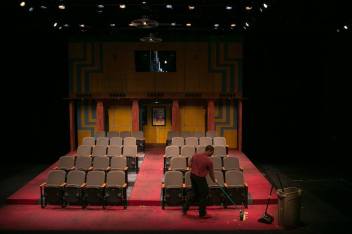
In 2UA Little Rock Flick014, Annie Baker’s The Flick won the Pulitzer Prize for Drama. The play mixes dialogue with long moments of no spoken words as the characters perform tasks on stage.

It is set in a run-down Massachusetts movie theatre and focuses on three millennials as they endure modern-day situations of race, class, and economy, all while working as underpaid employees.  The three actors are tasked with performing the cleaning of the set, just as the characters would be doing in between showings.  The original production received mixed reviews and sharply divided the audiences who saw it.  Feelings that were expressed ranged from brilliant to boring.

In February 2017, UA Little Rock’s Theatre and Dance Department presented the play.  It may have been the first production of it in Arkansas, it was certainly the first in Little Rock.  Giving the students the chance to work on such a new and challenging play is an example of the value of educational theatre.

2018 marks the 100th anniversary of the first Pulitzer Prize for Drama being given. To pay tribute to 100 years of the Pulitzer for Drama, each day this month a different Little Rock production of a Pulitzer Prize winning play will be highlighted.  Many of these titles have been produced numerous times.  This look will veer from high school to national tours in an attempt to give a glimpse into Little Rock’s breadth and depth of theatrical history.