One week remains to be WICKED in Little Rock

There is still one week to see Glinda and Elphaba before they fly away as the Tony winning musical Wicked continues at Robinson Center Performance Hall until January 19.

Based on the best-selling 1995 novel by Gregory Maguire, Wicked, has won a Grammy and three Tony Awards.  Wicked features songs by Stephen Schwartz (Godspell, Pippin, and Working) and a book by Winnie Holzman (“My So Called Life,” “Once And Again” and “thirtysomething”).  It tales the untold story of the witches of Oz.  The musical is directed by multiple Tony Award-winner Joe Mantello (Take Me Out; Assassins; The Receptionist).

Two other girls meet in the Land of Oz.  One – born with emerald-green skin – is smart, fiery and misunderstood.  The other is beautiful, ambitious and very popular.  “Wicked” tells the story of their remarkable odyssey, and how these two unlikely friends grow to become the Wicked Witch of the West and Glinda the Good.

Presented by Celebrity Attractions, the production takes center stage at Robinson Center Music Hall for a limited three-week engagement.

80 years ago today – Basketball came to Robinson Auditorium

Coach Earl Quigley in the 1940s

While Joseph Taylor Robinson Memorial Auditorium is known today as a performance and meeting venue, in its early days it was also the home to sports. Eighty years ago tonight the first basketball game was played at Robinson.

With the renovation dropping the orchestra level down many feet, one of the basketball goals would have been approximately where the cast of Wicked is currently performing.

One of the first regular activities which took place in the lower level exhibition hall was a series of boxing and wrestling matches.  Building on the success of this, basketball came to the convention hall in January 1940.

A series of games featuring Little Rock High School and North Little Rock High School were announced by Tiger Coach Earl Quigley to take place from January 11 through February 16, the official opening day for the facility.

At that time, neither high school had a gymnasium; therefore both schools played their basketball games on their school auditorium stages with fans seated in the audience. The convention hall offered a regulation size floor (made of pecan block parquet) with seating for over 1,300 people along the sidelines and in the balcony.  The first men’s basketball game in Robinson Auditorium took place between the Little Rock High School Tigers and the North Little Rock High School Wildcats on January 11, 1940.

The Tigers lost the game before a crowd estimated to be 1,300.  Earlier in the evening there had been an exhibition between two women’s basketball teams.  The cost for admission to the games was 35 cents for the reserved seating and 25 cents for general admission.

Elvis at 85

Photo by Wayne Cranford

Eighty-five years ago today, Elvis Presley was born in Tupelo, Mississippi. He would, of course, grow up to become a cultural phenomenon.

Elvis performed in Little Rock throughout his career. In April 1972, he played at Barton Coliseum (with tickets on the arena floor going for a whopping $10!). In the 1950s, he played three at Robinson Auditorium. His first appearance was as his career was just starting to take off. The final appearance on that stage, a mere 15 months later, was when he had become a national icon.

His first appearance at Robinson was on February 20, 1955. Billed as the “WSM Grand Ole Opry” show, Elvis Presley was third on the bill behind the Duke of Paducah and Mother Maybelle and the Carter Sisters as he began week long tour of Arkansas and Louisiana. On this date there were a pair of shows, at 3:00 and 8:15 p.m., at Robinson Auditorium. Tickets were 75-cents in advance, $1.00 at the box office and 50-cents for kids. It is believed that Gladys and Vernon Presley attended this performance, invited by Elvis who wanted to introduce them to the Colonel. Gladys was a big fan of the Duke of Paducah. Elvis Presley, Scotty Moore, and Bill Black receive $350 for these two shows instead of their usual $200 per day. In August 1955, he returned and played Robinson as part of the All-Star Jamboree.

His third and final appearance at Robinson Auditorium was on May 16, 1956. This time, the Auditorium was packed. The tickets were $1.50 in advance at Walgreens and $2.00 at the box office. The ads featured 8 great acts in “his” variety show which consisted of the Jordonaires; Rick and Emil Flaim and their orchestra; vocalists Frankie Conners and Jackie Little and comedian-magician Phil Maraquin. A second show was added to accommodate the ticket demand.

About 30 minutes late, due to a missed flight, Elvis appeared on stage in a purple blazer and started singing “Heartbreak Hotel.” The crowd rushed the stage. Little Rock police officers were able to control them eventually and get the teenagers back to their seats. While the crowd was impressed, the police officers were less so. One of the patrolmen told the Arkansas Gazette reporter: “I wouldn’t know him if I saw him. And I wouldn’t be here unless I was being paid.”

The “Popular” WICKED returns to Robinson Center for 3 week run

Oz has returned to the Rock as the Tony winning musical Wicked returns to Robinson Center Performance Hall from January 1 to January 19 for a three week run.

Based on the best-selling 1995 novel by Gregory Maguire, Wicked, has won a Grammy and three Tony Awards.  Wicked features songs by Stephen Schwartz (Godspell, Pippin, and Working) and a book by Winnie Holzman (“My So Called Life,” “Once And Again” and “thirtysomething”).  It tales the untold story of the witches of Oz.  The musical is directed by multiple Tony Award-winner Joe Mantello (Take Me Out; Assassins; The Receptionist).

Two other girls meet in the Land of Oz.  One – born with emerald-green skin – is smart, fiery and misunderstood.  The other is beautiful, ambitious and very popular.  “Wicked” tells the story of their remarkable odyssey, and how these two unlikely friends grow to become the Wicked Witch of the West and Glinda the Good.

On Tuesday, January 7th at 7:30 pm, treat the kids to a night of fun and theatre at KIDS’ NIGHT ON BROADWAY. Fun and pre-show festivities begin at 6pm. Save 50% on tickets when you buy now in person at the Robinson Center Box Office, by phone at 501.244.8800 or online at Ticketmaster.com. Special offer limited to the first 500 tickets sold.

Presented by Celebrity Attractions, the production takes center stage at Robinson Center Music Hall for a limited three-week engagement.

More Boxing Day looks at the sport of Boxing in LR. This time at Robinson Auditorium.

Boxer Al Globe lays in the ring after being knocked down by Bob Sikes in this GAZETTE staff photo

Boxer Al Globe lays in the ring after being knocked down by Bob Sikes in this GAZETTE staff photo

Though the origins of the name Boxing Day have nothing to do with pugilism, today’s entry looks at early boxing matches at Robinson Auditorium.

Though the building did not open until February 1940, there were a few preview events in the lower level exhibition hall beginning in October 1939.  (The construction upstairs would not be completed until January 1940.)

Wrestling was a more common sport on the lower level. But from time to time there was boxing.  It appears that the first boxing matches took place on November 9, 1939.

Pine Bluff’s heavyweight Bob Sikes was the star attraction on the main card as he faced off against Chicago’s Al Globe.  The two were fairly evenly matched through the first three rounds. In the fourth round, Globe sent Sikes to the mat, before the latter arose on the seventh count. (He was a bit groggy and could not name the city in which he was boxing.)  Ninety seconds into the fifth round, however, Sikes delivered a knockout punch to Globe.

The warm-up bout featured Carolinian Maxie Doyle against Jimmy Merritt of Oklahoma. After the ref called the match on a TKO in favor of Doyle, the two continued to fight in the ring. It took their seconds to leave the corner and help the ref break it up.  The boxers were threatened with suspension if they continued it any further.

Prior to the Doyle-Merritt bout, Bauxite’s Woody Bell edged out Young Leonard in six rounds. Charley Regan and Bobbie Lee came to a draw after their six.  The first match of the evening featured two African American boxers: Little Rock’s Bill Walker, who earned a decision over North Little Rock’s Herbert Taylor.

Since the heating system was not yet operational at Robinson Auditorium, promoters for the early wrestling and boxing matches touted the fact that a temporary heating system was in place as temperatures started to drop.

Sikes was back at Robinson in another marquee match on February 9, 1940, one week before the official opening of the upstairs Music Hall.  By this time permanent heating and lighting had been connected.

Boxer Bob Sikes, GAZETTE staffer Lou MacDuff and boxer Joe Regan in a GAZETTE staff photo

Boxer Bob Sikes, GAZETTE staffer Lou MacDuff and boxer Joe Regan in a GAZETTE staff photo

The headline bout was Sikes against Joe Regan of Ames, Iowa.  They were scheduled for ten rounds.

Earlier fights on the card were the six-round middleweight match of Gould Nix of Willow meeting Buck Buchanan of Rogers; welterweight Doyle Venable of Dierks vs. Little Rock’s Freddie Richardson; Johnny Allen of Saint Louis meeting Woody Bell of Bauxite; and, in the first match, Kid Tobey of Hot Springs vs. Bill Walker of Little Rock. The latter was a four round bout featuring two African American boxers.

The marquee fight did not go anywhere near as long as ten rounds.  Fifty-four seconds into the second round, Sikes pummeled Regan with a right to the chin, a right to the cheek and a left hook to the head. After that Regan was down for the count. Though at the eight count he did manage to turn over from his back to his stomach and remained in that position until being helped to his corner following the bell.

Earlier in the evening, Nix, Venable, and Bell all won their bouts by decisions of the judges. Walker won the curtain raiser by a knock out in the second round.

It was a capacity crowd for the boxing event at Robinson Auditorium.  Tickets, which were available for purchase at Rube & Scott, Inc. men’s clothing store, ranged from 55 cents for general admission, to $1.10 for reserved seating and ringside seats of $1.65 or @2.20.

Moscow Ballet’s GREAT RUSSIAN NUTCRACKER at Robinson Center for two performances today

This Christmas season give your family the gift of Moscow Ballet’s Great Russian Nutcracker!
Step into a simpler time filled with sweet dreams and Christmas magic. With world-class artists, over 200 dazzling costumes, stunning sets, towering puppets and soaring birds, don’t miss your chance to ring in the holidays with this acclaimed Christmas extravaganza.

The New York Times, “Hot Ticket!” Celebrate this cherished holiday tradition and relive the dream with Tchaikovsky’s timeless score. Get tickets for the whole family now!

MOSCOW BALLET’S GREAT RUSSIAN NUTCRACKER will perform at 3:00 p.m. and 7 p.m. on Thursday, December 26, 2019.  Platinum tickets include Premium Nutcracker Ornament, a Moscow Ballet Book, and a pre-show Meet and Greet.  Gold Circle tickets receive a Premium Nutcracker Ornament and the official Moscow Ballet Book.  VIP ornaments and books can be purchased at the merchandise table.  Meet and Greet will begin 45 minutes prior to the showtime and will meet at the merchandise table.

New York Times, Chief Dance Critic, “Knockout… Brimful with feeling…Expansive… Kids…were wide-eyed with delight”

An early Christmas present in 1937, Robinson Auditorium groundbreaking on Christmas Eve

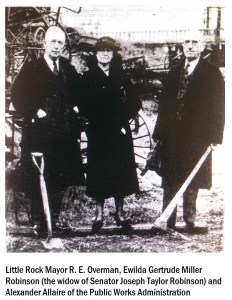
On December 24, 1937, at 11:30 a.m., Little Rock Mayor R. E. Overman, Ewilda Gertrude Miller Robinson (the widow of Senator Joseph Taylor Robinson) and  Alexander Allaire of the PWA turned dirt to participate in the brief groundbreaking ceremony for Little Rock’s municipal auditorium.

That morning, the Arkansas Gazette ran a brief story on the upcoming groundbreaking.  The story mentioned that the building would be named in memory of the late beloved Arkansas politician.  This appears to be the first public pronouncement of the Robinson name for this civic structure.

Among others in attendance at the groundbreaking were Mrs. Charles Miller (sister-in-law of Mrs. Robinson), Mr. and Mrs. Grady Miller (brother and sister-in-law of Mrs. Robinson), the mayor’s wife, the three architects (George Wittenberg, Lawson Delony and Eugene John Stern), and D. H. Daugherty and Will Terry of the City’s Board of Public Affairs.

Construction had to start by January 1, 1938, in order to receive PWA funds.  By breaking ground on December 24, there was over a week to spare.  The site had been selected in late October 1937, and the purchase had not been finalized.  But the PWA did give permission for the City to let a contract for excavation, demolition and filling on the site.

The groundbreaking took place at the corner of Garland and Spring Streets which was on the northeast corner of the block set aside for the auditorium.  Today, Spring Street does not extend north of Markham; the street was closed to make way for the parking structure and what is now the Doubletree Hotel.  That section of Garland Street is basically an alley that runs parallel to Markham north of City Hall, Robinson Auditorium and the Doubletree Hotel.