
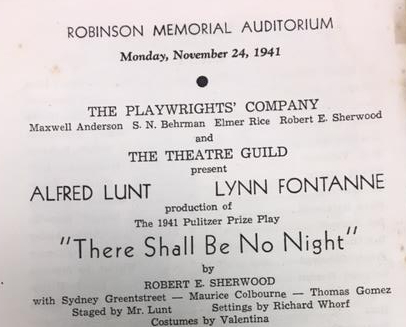
Pulitzers Play in Little Rock: Lunt and Fontanne in THERE SHALL BE NO NIGHT

ThereShallBeOn the eve of the US entry into World War II, Alfred Lunt and Lynn Fontanne returned to Little Rock in the national tour of Robert E. Sherwood’s Pulitzer Prize winning There Shall Be No Night.  It played at Robinson Memorial Auditorium on Monday, November 24, 1941.

Set in Finland in the time leading up to and during the start of the Russian invasion, it looked at the impact of impending war on a family.  Between the time it premiered in March 1940 and the tour in 1941, so many European countries experienced the horrors of war as countries were overtaken and troops were either killed or pressed into service by the enemy.  A program note in the playbill outlined much of this and noted how the script had not been updated to reflect the changes in world events.  (When Robinson opened in February 1940, the Russian invasion of Finland was a top international story.)

Joining Alfred Lunt and Lynn Fontanne were many members of the original Broadway cast including Sydney Greenstreet, Thomas Gomez, Elisabeth Fraser, and Maurice Colbourne.  Also from the original cast was a young actor who played the Lunts’ son, Montgomery Clift.

The play was directed by Mr. Lunt.  The sets were by first time Broadway designer Richard Whorf.  He would go on to have an illustrious career as a theatrical designer.  He had been an actor on Broadway and was a member of the unofficial Lunt-Fontanne repertory company of actors.  The costumes were by Valentina, who often designed costumes for Miss Fontanne.

2018 marks the 100th anniversary of the first Pulitzer Prize for Drama being given. To pay tribute to 100 years of the Pulitzer for Drama, each day this month a different Little Rock production of a Pulitzer Prize winning play will be highlighted.  Many of these titles have been produced numerous times.  This look will veer from high school to national tours in an attempt to give a glimpse into Little Rock’s breadth and depth of theatrical history.

Pulitzers Play Little Rock: FIORELLO!

IMG_3737Winner of the 1960 Pulitzer Prize for Drama, Fiorello! has been described as the best musical you’ve never heard of.

Based on the life of New York politician Fiorello H. LaGuardia, it was a surprise winner of the Pulitzer.  Produced by Robert Griffith and Harold Prince, it featured a book by Jerome Weidman and George Abbott (who also directed) and a score by Jerry Bock and Sheldon Harnick.

In 1961, the national tour played in Little Rock at Robinson Auditorium.   The production used the original Broadway direction and choreography (by Peter Gennaro) and design (sets, costumes and lighting by the duo of William and Jean Eckert).

The cast was led by Bob Carroll as LaGuardia (taking on a role created by Tom Bosley).  Others in the cast were Rudy Bond, Charlotte Fairchild, Paul Lipson, Jen Nelson, Zeme North and Clint Young.

It does not appear to have been produced in Little Rock since then.

90 years of Maya Angelou

Though she left this earth physically in 2014, Maya Angelou’s work and legacy continue on in the lives she touched and her writings.   Ninety years ago today, she was born in St. Louis.

On February 23, 1998, Maya Angelou appeared with the Arkansas Symphony Orchestra in a concert at Robinson Center.  The evening featured Dr. Angelou narrating Joseph Schwantner’s tribute to Dr. Martin Luther King Jr., “New Morning for the World.”

Dr. Angelou, a former resident of Stamps, Arkansas, was not a stranger to Little Rock. She had appeared before at Wildwood Park and would later appear at the Clinton Presidential Center.

A former Poet Laureate of the United States and Tony nominated actor, she won a Grammy Award for her reading of “On the Pulse of the Morning” which had been written for the first inauguration of Bill Clinton as President of the United States.

A poet, author, educator, dancer, singer, actor, and activist, she wrote seven autobiographies. The most notable was arguably I Know Why the Caged Bird Sings.  Born in St. Louis, she spent part of her childhood in Arkansas before moving to California.  She led a peripatetic life both geographically and career-wise ending as a professor at Wake Forest and residing in North Carolina.  It was there that she died in May 2014.

One of the ways her work continues is through the Celebrate Maya project which is led by Janis Kearney.

Little Rock Look Back: LR Voters approve additional funds for Robinson Center in 1940

Though Joseph Taylor Robinson Memorial Auditorium opened in February 1940, there was still money that needed to be raised to finish the construction and the building’s furnishing.  Ten days after the auditorium opening, the City Council approved an ordinance to call a special election on April 2, 1940, for the purposes of approving bonds for three separate projects.  One of these was for $30,000 for the completion of the auditorium; the bonds would not require any additional tax levy.
At the same meeting, a letter was read from the Young Men’s Business Association expressing support for the auditorium in the election, which was to be held in conjunction with the annual municipal general election. The Auditorium Commission had previously asked the City Council to consider issuing the bonds to pay for additional equipment for the building.  In their request to the aldermen, the members stressed that due to the current bond structure, these new bonds would not necessitate any tax increase.

The campaign for the new bonds used a similar structure and message as the 1937 election to build the auditorium.  There were newspaper ads by the steering committee (this time simply called the Citizen’s Committee and led by Omar Throgmorton) and support from civic organizations.  One thing very different from the 1937 campaign was the presence of an actual building.  On Sunday, March 31, just two days before the election, there was an open house for the public to explore the edifice.  From 1:00 p.m. to 9:00 p.m., members of various Little Rock Boy Scout troops led 4,000 visitors on tours of the auditorium.  Visitors were shown all over the building; one scout calculated that the walking tour equated to two miles.  Though most people were from Little Rock, the guest registry indicated visitors from California and Pennsylvania.

On April 2, 1940, Little Rock voters approved the new bonds 1,413 to 423.  Every precinct in every ward of the city voted in favor of the new bonds.  Shortly after the election, the bonds were issued.  The auditorium construction which had first been broached in 1904 was now completed in 1940.

Pulitzers play Little Rock – OF THEE I SING

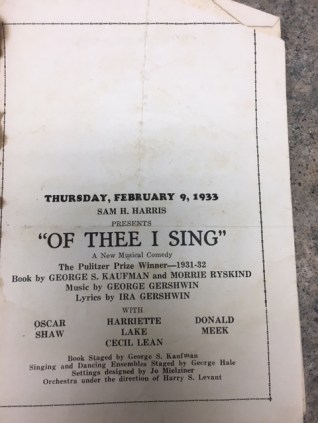
OfTheeISingBefore Robinson Auditorium opened, the stage of Little Rock High School (now Central High) was the prime performance location in Little Rock.  In 1933, it welcomed the national tour of the Pulitzer Prize winning musical Of Thee I Sing.

This was the first musical to win the Pulitzer Prize for Drama.  In fact, because no musical had won the award before, the jury appeared to not know how to handle a composer in a writing category.  Librettists Morris Ryskind and George S. Kaufman and lyricist Ira Gershwin were named as recipients. But composer George Gershwin did not receive the Pulitzer.  (In 1998, he received a posthumous Special Pulitzer.)

The musical, a satire of politics and popular culture, was directed by Mr. Kaufman.  The tour came to Little Rock for one performance on February 9, 1933. The Broadway production had closed less than a month earlier after 441 performances (a very long run at the time).

The tour starred Oscar Shaw (who had played the male lead in the original production of the Gershwins’ Oh Kay!) and Harriette Lake.  She would later change her name to Ann Sothern.  Other main roles were played by Donald Meek and Cecil Lean.   A few months after Little Rock, the tour played a month on Broadway.  Miss Lake continued in her role, but the men were replaced by their original Broadway counterparts.

2018 marks the 100th anniversary of the first Pulitzer Prize for Drama being given. To pay tribute to 100 years of the Pulitzer for Drama, each day this month a different Little Rock production of a Pulitzer Prize winning play will be highlighted.  Many of these titles have been produced numerous times.  This look will veer from high school to national tours in an attempt to give a glimpse into Little Rock’s breadth and depth of theatrical history.

Little Rock Look Back: SPRINGTIME FOR HENRY plays Robinson

On Monday, April 1, 1940, Edward Everett Horton came to Little Rock in the comedy SPRINGTIME FOR HENRY.  This was a play in which he had appeared regularly on tours and in summer stock. He would create productions of it in between film roles from the 1930s to the 1950s.

The play concerned a industrial heir whose dalliances put his family’s business in jeopardy.  It was a boulevard comedy (or a sex comedy—without the sex).  Originally performed on Broadway in 1931, it was written by Benn W. Levy.  He would later serve as a member of Parliament.

By the time Horton arrived in Little Rock, he was an accomplished stage and screen actor.  He was a staple of many Astaire-Rogers films.

The performance at Robinson did not go off without a hitch.  Because Spring had arrived in Little Rock, it was warmer outside.  This necessitated the air conditioner being turned on.   The fans rumbling through the vents made such a noise that it was difficult for the audience to hear the actors.  The air cooler was turned off for the remainder of the performance.  In the days after the performance, the Auditorium staff put buffering in the vents in the muffle the noise.

Pulitzers play Little Rock – HARVEY

harveybrown3

Joe E. Brown in HARVEY

2018 marks the 100th anniversary of the first Pulitzer Prize for Drama being given. It went to Jesse Lynch Williams’ Why Marry?  To pay tribute to 100 years of the Pulitzer for Drama, each day this month a different Little Rock production of a Pulitzer Prize winning play.  Many of these titles have been produced numerous times.  This look will veer from high school to national tours in an attempt to give a glimpse into Little Rock’s breadth and depth of theatrical history.

First up – an appropriate on Easter Sunday, a look at Mary Chase’s HARVEY.  Though not the Easter bunny, it does revolve around a rabbit—or does it?

The winner of the 1945 Pulitzer came to Little Rock in 1948 on its national tour.  Comedian Joe E. Brown was playing the leading role when the show came to Robinson Auditorium.  That same year, Brown received a special Tony Award for starring in the Harvey tour.