RobinsoNovember: Aretha Franklin with the ASO for the Clinton Library opening

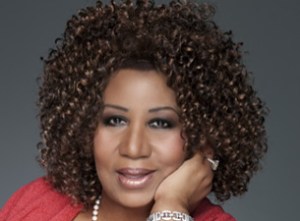
wjc-arethaTwelve years ago today, the William J. Clinton Presidential Center officially opened.  While that day was cold and wet, two days earlier, inside Robinson Center Music Hall, patrons were warmed by the musical talents of Aretha Franklin.

She shared the Robinson stage with the Arkansas Symphony Orchestra.  The ASO brough Miss Franklin to town as part of the festivities surrounding the opening of the presidential library.  Long a favorite of the Clintons, Miss Franklin sang at his 1993 inaugural festivities the night before he took the oath of office.

Resplendent in a series of white dresses, Miss Franklin was in top form feeding off the love from the audience.  While backstage she may have been dealing with back and knee issues (which the Culture Vulture saw first hand), when she stepped on to the stage she was giving her all as she rolled through hit after hit from her starry career.  She sang, she played the piano, she entertained!

It was a sold out house and her voice and energy reached the last row of the balcony.

Prior to her appearance, the ASO played a few selections including variations on “Hail to the Chief” and “America.”


RobinsoNovember: Florence Price

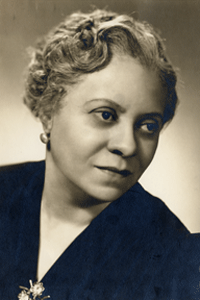
Florence-PriceOutside the William Grant Still Ballroom at Robinson Center is an atrium named for Florence Price.  It is fitting that these two childhood friends should be memorialized in adjoining spaces.

Florence Price was the first African-American female composer to have a symphonic composition performed by a major American symphony orchestra. She was born in Little Rock on April 9, 1887, to James H. Smith and Florence Gulliver Smith. Her father was a dentist in Little Rock, while her mother taught piano and worked as a schoolteacher and a businesswoman.

As a child, Smith received musical instruction from her mother, and she published musical pieces while in high school. She attended Capitol Hill School in Little Rock, graduating as valedictorian in 1903. Smith then studied at the New England Conservatory of Music in Boston, Massachusetts, In 1907, she received degrees as an organist and as a piano teacher.

After graduation, Smith returned to Arkansas to teach music. After stints in Cotton Plant, North Little Rock and Atlanta, GA, Smith returned to Little Rock in 1912 to marry attorney Thomas Jewell Price on September 25, 1912. Her husband worked with Scipio Jones.

While in Little Rock, Price established a music studio, taught piano lessons, and wrote short pieces for piano. Despite her credentials, she was denied membership into the Arkansas State Music Teachers Association because of her race.

The Prices moved to Chicago, Illinois, in 1927. There, Price seemed to have more professional opportunity for growth despite the breakdown and eventual dissolution of her marriage. She pursued further musical studies at the American Conservatory of Music and Chicago Musical College and established herself in the Chicago area as a teacher, pianist, and organist. In 1928, G. Schirmer, a major publishing firm, accepted for publication Price’s “At the Cotton Gin.” In 1932, Price won multiple awards in competitions sponsored by the Rodman Wanamaker Foundation for her Piano Sonata in E Minor, a large-scale work in four movements, and her more important work, Symphony in E Minor.

The latter work premiered with the Chicago Symphony Orchestra on June 15, 1933, and the orchestras of Detroit, Michigan; Pittsburgh, Pennsylvania; and Brooklyn, New York, performed subsequent symphonic works by Price. This was the first time a black woman had presented her work on such a stage. In this regard,

Price’s art songs and spiritual arrangements were frequently performed by well-known artists of the day. For example, contralto Marian Anderson featured Price’s spiritual arrangement “My Soul’s Been Anchored in the Lord” in her famous performance on the steps of the Lincoln Memorial in Washington DC on Easter Sunday, April 9, 1939. European orchestras later played Price’s works.

This national and international recognition made her more popular back home, and in 1935, the Alumni Association of Philander Smith College in Little Rock sponsored Price’s return to Arkansas, billing her as “noted musician of Chicago” and presenting her in a concert of her own compositions at Dunbar High School.

In her lifetime, Price composed more than 300 works, ranging from small teaching pieces for piano to large-scale compositions such as symphonies and concertos, as well as instrumental chamber music, vocal compositions, and music for radio. Price died in Chicago on June 3, 1953, while planning a trip to Europe.

RobinsoNovember: Auditorium Commission Abolished

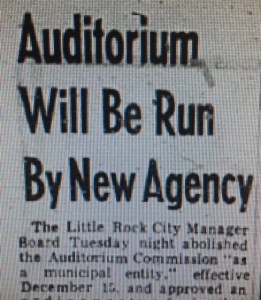
aud-com-abolOn November 16, 1971, the City of Little Rock Board of Directors abolished the Auditorium Commission which oversaw Robinson and transferred duties to the Advertising and Promotion Commission. This was done with the full support of both commissions.  The transfer took place immediately, with all assets and loose ends to be wrapped up by December 15, 1971.
With the adoption of a hospitality sales tax, by state statute, Little Rock had to have an A&P Commission.  By 1971 plans were afoot to use the A&P tax to build a conference center using some of the existing space in Robinson and adding space.  It did not make sense to have two separate commissions overseeing the same building.

For the Auditorium Commission members, it was possibly a relief.  For years, overseeing the building had been a quiet duty.  But with the social changes of the 1960s, they had been confronted ending the policy of segregation as well as changes in content and subject matter of acts booked at Robinson.  Being agents of social change was doubtful what any of them had envisioned when they joined the commission.  Emily Miller had been a member of the body since January 1940 and others had been on it for many years.

Transferring Robinson to the A&P Commission ushered in a new era for the building. It saw increased booking of meetings which led to a better revenue stream.  The use of the A&P tax would mean the opportunity to give the building an upgrade from 1972 to 1974.

Robinson would eventually prove to be inadequate for all of Little Rock’s needs, which led to the creation and subsequent expansion of Statehouse Convention Center.  But the action 45 years ago today set the stage for the transformation Robinson has undergone as it reopened last week.

RobinsoNovember: Carol Channing brings HELLO, DOLLY! to Little Rock

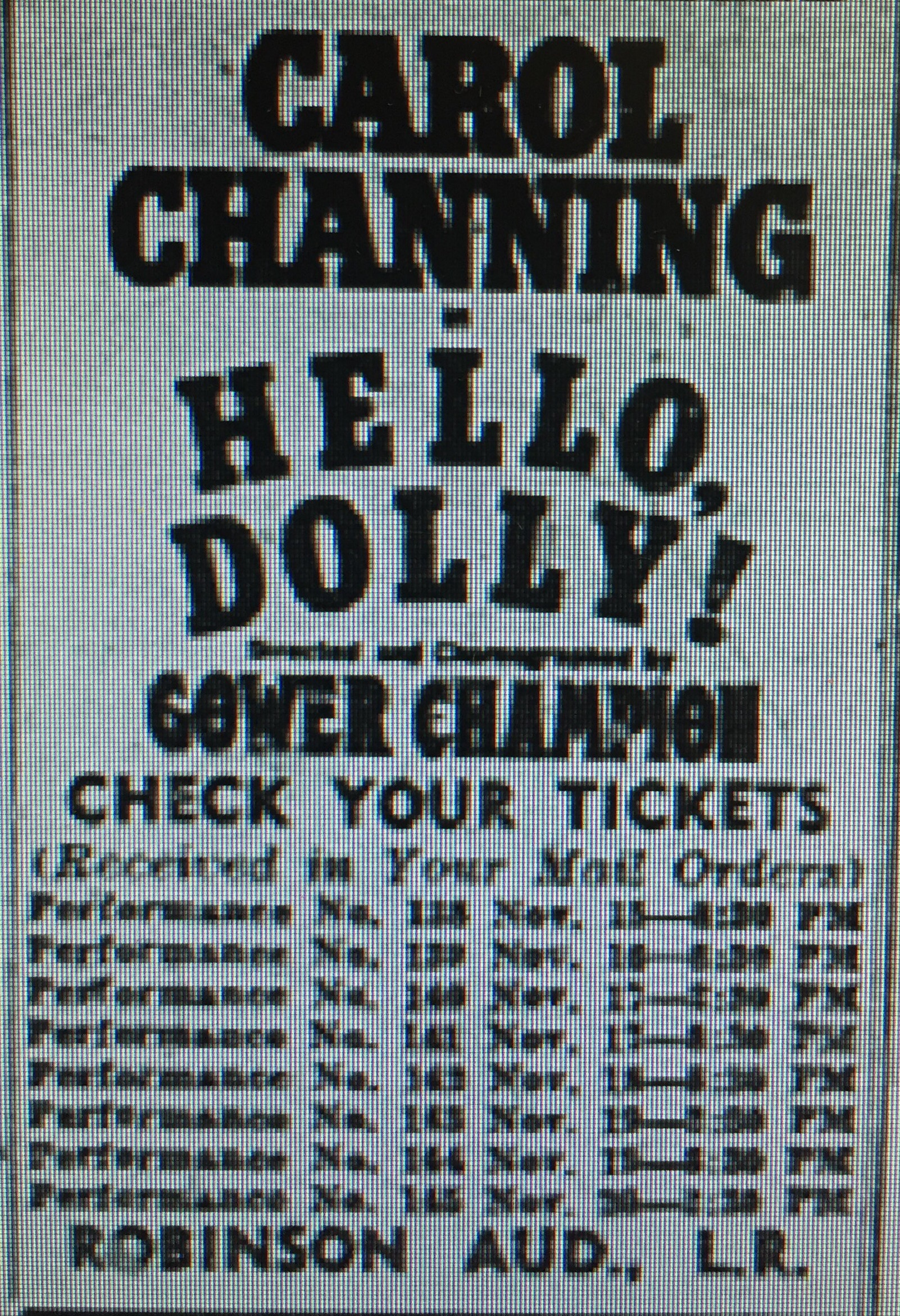
50 years ago tonight, on November 15, 1966, Carol Channing opened a six day stint in HELLO, DOLLY! at Robinson Auditorium.  She would play 8 sold out shows over those six days.

Channing, who had won the 1964 Tony Award for Best Actress in a Musical for her role in this show, had recently returned to the national tour.  She had just wrapped filming THOROUGHLY MODERN MILLIE (for which she would receive an Oscar nomination). She had specifically requested that Little Rock be added to the tour.

Her breakout role was in 1949’s GENTLEMEN PREFER BLONDS. In that show she introduced the song “Little Girl from Little Rock.”  Since it had helped make her a star, she had long felt an affinity for the Arkansas capital.  Therefore when she rejoined the tour, she required that LR be one of her stops before she left the tour.

While in Little Rock, Channing was entertained at the Arkansas Governor’s Mansion and feted at parties.  She was made an honorary citizen of Little Rock, as well.

But she was here to perform. And perform she did. She was rarely known to miss a performance and always gave her utmost.  Bill Lewis, in his review in the ARKANSAS GAZETTE, stated “To hear Channing sing ‘Hello, Dolly!’ Is one of the great experiences of all musical theater to date…”

In assessing the show’s run in Little Rock (which would be seen by more than 20,000 people), Lewis summed up what many felt at the time — and to hear the reminiscences from a half century later, it still is a heartfelt sentiment — “A week’s too little.”

Explore Robinson Center with SHARP- Arkansas Symphony’s Young Professionals

Robinson IntermissionThis Wednesday at 5:30pm (November 16), the Arkansas Symphony Orchestra’s young professionals (also known as SHARP) will be exploring the ASO’s new performance space when they tour Robinson Center.
This sneak-peek party will include a tour, as well as live entertainment, hors d’oeuvres, a cash bar, and the opportunity to sit-in as the orchestra rehearses for their first concert in Robinson in over two years. Tickets are $10 and can be purchased at the door

SHARP is a group of young professionals enjoying contemporary social experiences that provide networking opportunities, enlightening programs, and community connection while promoting audience growth and sustainability for the Arkansas Symphony Orchestra. SHARP membership includes a free ticket (upon request) to all ASO subscription concerts along with special social events,  and volunteer opportunities.

RobinsoNovember: Lawrence Hamilton

LawrenceHamiltonAnother notable former Little Rock performing artist who is memorialized at Robinson Center is Lawrence Hamilton.

The son of the Dr. Oscar and Mae Dell Hamilton, he was born in the small southwest Arkansas town of Foreman With an interest in music stemming from childhood, Hamilton earned a music scholarship to attend Henderson State University in Arkadelphia where he studied piano and voice He graduated in 1976 with a bachelor’s degree in music education.

From Arkansas, Hamilton traveled to Florida to work as a performer at Walt Disney World in Orlando, Florida where he would meet talent manager, Tommy Molinaro. This fateful meeting would prove to be a life-changing encounter, as Molinaro would invite Hamilton to come to New York to audition for the famed actor/director Geoffrey Holder. This marked the beginning of Hamilton’s bold and creative career in the performing arts, leading to performances on Broadway and on tours in Sophisticated Ladies, The Wiz,Uptown – Its Hot, Porgy and Bess, Big River, Play On!, and Jelly’s Last Jam among others. Perhaps his crowning achievement was starring in Ragtime.

Hamilton has been a member of the Southern Ballet Theater, Brooklyn Dance Theater, Ballet Tap USA, and the Arkansas Opera Theater He has performed in concert with the legendary Lena Horne at the White House for President and Mrs. Ronald Reagan, and at the Vatican for Pope John Paul II. Hamilton’s career also led to a stint as musical director for the renowned opera legend Jessye Norman, as well as vocal coach/arranger for the pop group New Kids on the Block

Upon his return to Arkansas, Hamilton served for several years as director of choral music at Philander Smith College. He also appeared in several plays at the Arkansas Repertory Theatre.  In addition, he performed at countless concerts, benefits and galas throughout Arkansas.  In 2003, he was inducted into the Arkansas Black Hall of Fame.  In 2008, he was appointed to the Little Rock Mayor’s Task Force on Tourism.

Hamilton died in New York in April 2014 due to complications from surgery.  Just weeks prior to the surgery, he had appeared in August Wilson’s The Piano Lesson in Cape Fear, North Carolina.  He had also starred in that play at Arkansas Rep a few years earlier.

RobinsoNovember: President Harry S. Truman

HST in LR2

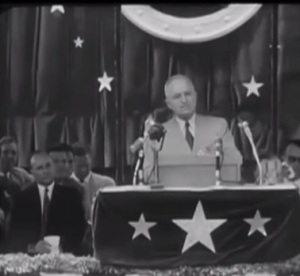
President Truman in War Memorial Park. A photo of him at Robinson does not seem to exist.

Today is Veterans’ Day, a chance to pause and remember those — both living and deceased — who have served in the Armed Forces of the US.  November 11 was chosen since it was on November 11 in 1918, at 11:11 (Paris time), the Armistice was signed to end the Great War, as World War I was then known.  In 1954, the holiday was renamed Veterans Day since the US had been in two military conflicts since the Great War.

A World War I infantry reunion brought President Harry S. Truman to Little Rock in June 1949, a few months after he won his own term in the Presidency. During his time here, he spoke twice at Robinson Auditorium.

Upon arriving, he made some informal remarks:

I am most happy to be here. I am only here in my capacity as a member of the 35th Division. Tomorrow I will address you as President of the United States, and I am afraid you will have to listen, whether you like it or not.

I hope to have a pleasant time in Little Rock, as I always have when I come here. I have been here a dozen times–one of the most hospitable cities in the United States. They know how to treat you, they know how to make you like it, and want you to come back.

I will see more of you later on in the day.

I appreciate the welcome that everybody has given us here this afternoon.

Thank you very much.


Later that night, he spoke at a Ball at Robinson.  It followed a banquet that had taken place at the Hotel Marion.

Governor McMath, the Mayor of Little Rock, and distinguished guests:

I can’t tell you how very much I appreciate the cordial reception which I have received in Little Rock. It has been like coming back home to come down here. It’s a habit of mine and has been for 25 years. I have been here in town many a time, and attracted no attention at all. But my friends were just as cordial to me then as they are now.

And I want to thank Eberts Post No. r for its cooperation with the 35th Division in putting on this ball and entertainment.

My education, so far as taking part on the floor is concerned, was sadly neglected as I grew up. I am a Baptist–not a light-foot one–so I didn’t learn how to dance. But I did learn a lot of other things in life, maybe, that I shouldn’t have learned.

I hope that the 35th Reunion this year will be the usual success that 35th Reunions are. I have missed only one, I think, in 25 years or more. I didn’t want to miss this one. The fact that you had it on a weekend gave me and the congressional delegation of the great State of Arkansas an opportunity to be present and attend the meeting. Otherwise, we would have had to stay in Washington and work.

It doesn’t make any difference, though, where the President goes, his work follows him up. I told the congregation this afternoon–you see, I am talking as a Baptist talks–that it didn’t make any difference where I went, I have to sign my name some 600 times a day to keep the country running. And it has, up to date, and I think it will continue, at least for 3 1/2 years more.

I am looking forward to a most pleasant time. I am talking to you now as a member of the 35th Division only, but if you want to hear the President of the United States you had better come out to the stadium tomorrow, and I will tell you something that will be good for your souls.

Thank you very much.

The following day he gave a national address on foreign affairs at the dedication of War Memorial Park.  It was carried on coast-to-coast radio.  There was no radio coverage of his remarks at Robinson, but a large press corps of national correspondents captured his words.

The Little Rock Mayor to whom he referred was Sam Wassell.  Mayor Wassell’s wife had christened the USS Little Rock during World War II.  A first cousin, Dr. Corydon Wassell, was a war hero who had been played by Gary Cooper in a movie.