
Black History Month Spotlight – Taborian Hall and Dreamland Ballroom

The new Arkansas Civil Rights History Audio Tour was launched in November 2015. Produced by the City of Little Rock and the University of Arkansas at Little Rock allows the many places and stories of the City’s Civil Rights history to come to life an interactive tour.  This month, during Black History Month, the Culture Vulture looks at some of the stops on this tour which focus on African American history.

Completed in 1918, Taborian Hall stands as one of the last reminders of the once-prosperous West Ninth Street African-American business and cultural district. West Ninth Street buildings included offices for black professionals, businesses, hotels, and entertainment venues. In 1916, the Knights and Daughters of Tabor, a fraternal insurance organization, hired local black contractor Simeon Johnson to enlarge an existing building to accommodate their activities, other offices and a ballroom.

During World War I, black soldiers from Camp Pike came to the Negro Soldiers Service Center here. In World War II, Taborian Hall was home to the Ninth Street USO, catering to black soldiers from Camp Robinson. By 1936, Dreamland Ballroom hosted basketball games, boxing matches, concerts and dances.

A regular stop for popular black entertainers on the “Chitlin’ Circuit,” Dreamland hosted Cab Callaway, Count Basie, Duke Ellington, Ella Fitzgerald, Louis Armstrong, B.B. King, Earl “Fatha” Hines and Ray Charles. Arkansas’s own Louis Jordan also performed here. Between the 1960s and 1980s, West Ninth Street declined, and many buildings were demolished. In 1991, Taborian Hall was renovated to house Arkansas Flag and Banner. Once again, Dreamland Ballroom hosts concerts and social events.

The app, funded by a generous grant from the Arkansas Humanities Council, was a collaboration among UALR’s Institute on Race and Ethnicity, the City of Little Rock, the Mayor’s Tourism Commission, and KUAR, UALR’s public radio station, with assistance from the Little Rock Convention and Visitors Bureau.

Black History Month Spotlight – First Missionary Baptist Church

The new Arkansas Civil Rights History Audio Tour was launched in November 2015. Produced by the City of Little Rock and the University of Arkansas at Little Rock allows the many places and stories of the City’s Civil Rights history to come to life an interactive tour.  This month, during Black History Month, the Culture Vulture looks at some of the stops on this tour which focus on African American history.

Established in 1845, First Missionary Baptist Church is one of the oldest black congregations in Arkansas. The first church building was completed by 1847, with the current Gothic Revival building constructed in 1882.

In 1891, more than 600 blacks gathered here to protest the state’s recently enacted Separate Coach Law that required racial separation in passenger cars and separate waiting rooms in train stations. They marched from the church to the then state capitol, now the Old State House., to dispute laws that denied black people their constitutional rights. Historians cite that black boycotts in Little Rock, Pine Bluff, and Hot Springs on May 27, 1903, the first day of the streetcar law, caused a 90 percent drop in black patrons on Little Rock streetcars.

In May 1958, Dr. Martin Luther King, Jr., traveled to Little Rock here to attend the graduation ceremony of Ernest Green, the first African American to graduate from Central High School. In 1963, four months before the famous “I Have a Dream” speech, Dr. King visited Little Rock to provide the First Missionary Baptist Church’s 118th anniversary sermon.

The app, funded by a generous grant from the Arkansas Humanities Council, was a collaboration among UALR’s Institute on Race and Ethnicity, the City of Little Rock, the Mayor’s Tourism Commission, and KUAR, UALR’s public radio station, with assistance from the Little Rock Convention and Visitors Bureau.

Black History Month Spotlight – Mosaic Templars Cultural Center

The new Arkansas Civil Rights History Audio Tour was launched in November 2015. Produced by the City of Little Rock and the University of Arkansas at Little Rock allows the many places and stories of the City’s Civil Rights history to come to life an interactive tour.  This month, during Black History Month, the Culture Vulture looks at some of the stops on this tour which focus on African American history.

The Mosaic Templars Cultural Center and Museum collects, preserves, interprets and celebrates Arkansas’s unique African American political, economic, and social achievement from 1865 to 1950. The Center resides in the footprint of the original Mosaic Templars of America National Headquarters and Annex Buildings.

The permanent museum exhibits depict historic West Ninth Street as a thriving commercial and social hub, focusing on the black entrepreneurship, Templars organization, and the legacy of black legislators. Between 1868 and 1893, eighty-five African Americans served in the Arkansas General Assembly. The majority served in the House, with nine in the Senate. Election laws passed in 1891, together with a poll tax in 1832, ended the election of African Americans to the legislature. No black person served again until the General Assembly in 1973.

In addition to community educational programs, the Center offers a genealogy research room, an art collection created by local talent, and a well-stocked store. The Center’s third floor features a replica of the original Headquarters Building auditorium and the Arkansas Black Hall of Fame galleries.

The Center is a museum of the Department of Arkansas Heritage and admission is free.

The app, funded by a generous grant from the Arkansas Humanities Council, was a collaboration among UALR’s Institute on Race and Ethnicity, the City of Little Rock, the Mayor’s Tourism Commission, and KUAR, UALR’s public radio station, with assistance from the Little Rock Convention and Visitors Bureau.

Black History Month Spotlight – Mosaic Templars of America

The new Arkansas Civil Rights History Audio Tour was launched in November 2015. Produced by the City of Little Rock and the University of Arkansas at Little Rock allows the many places and stories of the City’s Civil Rights history to come to life an interactive tour.  This month, during Black History Month, the Culture Vulture looks at some of the stops on this tour which focus on African American history.
The Mosaic Templars of America was formed as a business in the late 1870s by Arkansas freedmen John E. Bush and Chester W. Keatts to provide insurance and other services to black people, and was incorporated as a fraternal organization in 1882. The Mosaic Templars name was derived from the biblical Moses who led his people out of bondage and relates to black America’s journey out of slavery.

By the 1920s the Templars’ organization extended to 26 states and six Caribbean nations. At the time, as one of the largest black-owned business enterprises in the world, Templars’ holdings included the original insurance company, a building and loan association, a publishing company, a business college, a nursing school and a hospital. For more than 40 years, the Templars Headquarters Building and the adjoining Annex and State Temple buildings on Broadway anchored the city’s black business district on West Ninth Street. Like many businesses, black and white, the Templars did not survive the era of the Great Depression.

Though the original Headquarters building burned in 2005, the Mosaic Templars Cultural Center is modeled on the original design. Exhibits highlight black business and self-achievement from Reconstruction to the 1950s in Arkansas and the nation.

The app, funded by a generous grant from the Arkansas Humanities Council, was a collaboration among UALR’s Institute on Race and Ethnicity, the City of Little Rock, the Mayor’s Tourism Commission, and KUAR, UALR’s public radio station, with assistance from the Little Rock Convention and Visitors Bureau.


National Park Service Director, Local Leaders to Speak at Black History Month Town Hall Meeting

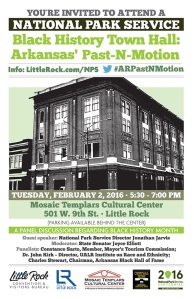
Feb 2 NPS eventLittle Rock Central High School National Historic Site in partnership with Little Rock Convention & Visitors Bureau, Mosaic Templars Cultural Center and the City of Little Rock, invite the public to join them for a Black History Month Town Hall Meeting entitled Arkansas’s Past-N-Motion to be held at Mosaic Templars Cultural Center at 5:30pm on February 2, 2016.

National Park Service Agency Director Jonathan Jarvis will serve as the guest speaker, and will discuss the National Parks Centennial Celebration, his tour to several of our nation’s civil rights-related historic sites and parks, and the importance of the National Park Service’s role in preserving and sharing our country’s history for future generations.  After his remarks, a panel discussion with local individuals will discuss several local institutions, and their roles and recent initiatives in preserving and sharing our city’s African American history, and its unique place in our nation’s civil rights movement.  This discussion will feature State Senator Joyce Elliott as moderator, and feature local panelists: Constance Sarto, Member, Mayor’s Tourism Commission; Dr. John Kirk – Director, UALR Institute on Race and Ethnicity; and Charles Stewart, Chairman, Arkansas Black Hall of Fame.

This Town Hall Meeting will highlight the resources of Civil Right institutions both from a national and local perspective, and the role of the National Park Service as the nation’s storyteller as it prepares to embark upon its Centennial 100th Birthday celebration on August 25, 2016.

During Director Jarvis’ time in Arkansas, he plans to visit Little Rock Central High School National Historic Site, engage Youth Leadership Academy members from Central High School as well as elementary students around the new White House youth initiative to get all 4th graders and their families to experience the places that are home to our country’s natural treasures, rich history, and vibrant culture FREE OF CHARGE! His visit to Arkansas will mark the start of Director Jarvis’ month-long endeavor to promote Civil Rights Sites during Black History Month.

They have also created the hashtag #ARPastNMotion to encourage local community groups to share information regarding any upcoming events relating to Black History Month.

For more information, please contact Enimini Ekong at (501) 396-3006 or Enimini_Ekong@nps.gov, or visit www.LittleRock.com/NPS.

Little Rock Central High School National Historic Site is located at 2120 Daisy L. Gatson Bates Drive, diagonally across the street from Central High School. The visitor center is open from 9:00 a.m. – 4:30 p.m. Monday through Sunday.  Admission is free. For more information call (501) 374-1957 or email chsc_visitor_center@nps.gov.

Black History Month Spotlight – West Ninth Street

BHM16 W9thThe new Arkansas Civil Rights History Audio Tour was launched in November 2015. Produced by the City of Little Rock and the University of Arkansas at Little Rock allows the many places and stories of the City’s Civil Rights history to come to life an interactive tour.  This month, during Black History Month, the Culture Vulture looks at some of the stops on this tour which focus on African American history.

As early as the 1840s and reaching 1880, the businesses of both black and white races existed in what is now known as Downtown Little Rock. In the last years of the 1800s, a prolific business broker and social center for African Americans dominated West Ninth Street.

In 1898, D. B. Gaines, a local black doctor who also served as pastor of the Mt. Pleasant Baptist Church, wrote a book called Racial Possibilities as Indicated by the Negroes of Arkansas. The last chapter, “Colored Business Directory of Little Rock,” documents the existence of a vibrant commercial center with almost twenty churches and hundreds of dealers of black people.

The black district was home to doctors, dentists, lawyers and entrepreneurs such as restaurant owners, newspaper editors, pharmacists, barbers, tailors, and merchants.

This city within a city, met the needs of the black community since the early 1880 to the 1950s. West Ninth Street saw its peak between 1870 and 1950. Since the 1960s, a number of factors including desegregation, urbanization, urban renewal and the construction of I-630 caused its decline.

The app, funded by a generous grant from the Arkansas Humanities Council, was a collaboration among UALR’s Institute on Race and Ethnicity, the City of Little Rock, the Mayor’s Tourism Commission, and KUAR, UALR’s public radio station, with assistance from the Little Rock Convention and Visitors Bureau.

Fourteen new names added to 2015 Arkansas Civil Rights Heritage Trail

2015 ACRHTLast month, the University of Arkansas at Little Rock Institute on Race and Ethnicity unveiled the 2015 Arkansas Civil Rights Heritage Trail markers. This year’s theme is “Politics and Law” to commemorate the 50th anniversary of the passage of the Voting Rights Act of 1965.

The fourteen new markers are installed at Scott and Markham Streets near the Statehouse Convention Center.

Established in the summer of 2011, the Arkansas Civil Rights Heritage Trail honors those who made significant contributions to civil rights in Arkansas. The trail raises public awareness of the long and rich legacy of Arkansas’s civil rights history.

A 12-inch bronze marker is placed in the sidewalk for each honoree. The trail begins in front of the Old State House Convention Center on Markham Street and will eventually extend to the William J. Clinton Presidential Center and Park and other points throughout the downtown corridor.

This year’s 14 honorees are:

  • Annie Mae Bankhead, who was a community activist in Pulaski County’s black College Station neighborhood
  • Wiley Branton, Sr., who was head of the Southern Regional Council’s Voter Education Project in the 1960s
  • Charles Bussey, who was leader of the Veterans Good Government Association and became Little Rock’s first black mayor in 1980
  • William Harold Flowers, who laid the foundations for the Arkansas State Conference of National Association for the Advancement of Colored People branches
  • Jeffrey Hawkins, who was for decades the unofficial mayor of Little Rock’s black East End neighborhood
  • Irma Hunter Brown, who was the first black woman elected to the Arkansas General Assembly
  • Scipio Africanus Jones, a leading black Republican who defended 12 prisoners for their role in the 1919 Elaine Race Riot
  • Mahlon Martin, who was the first black city manager of Little Rock
  • I.S. McClinton, who was head of the Arkansas Democratic Voters Association, a forerunner of today’s Black Democratic Caucus
  • Richard L. Mays and Henry Wilkins III, who were among the first blacks elected to the Arkansas General Assembly in the 20th century in 1972
  • Olly Neal, who was the first black district prosecuting attorney in Arkansas and later served on the Arkansas Court of Appeals
  • Lottie Shackelford, who was the first black woman mayor of Little Rock
  • John Walker, who for more than five decades has been involved in civil rights activism in the courts, most notably in school desegregation cases

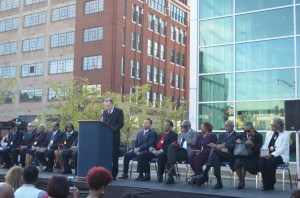
Dr. John Kirk is the director of the Institute.  At the November ceremony, he spoke along with UALR Chancellor Joel Anderson. At a reception following the ceremony, Senator Joyce Elliott gave a toast in honor of the 14 and several of the honorees or their descendants spoke.