BRAIN AWARENESS DAY at Museum of Discovery

20120814-171022.jpgMuseum of Discovery will host Brain Awareness Day Saturday, March 16, in conjunction with National Brain Awareness Week.   The event will be held from 10 a.m. to 3 p.m. and will include demonstrations and exhibits presented by the Arkansas Chapter of the Society for Neuroscience. The first 725 visitors will receive $2 off their admission.

Representatives from the Center for Toxicological Research (NCTR), the University of Arkansas for Medical Sciences (UAMS), Hendrix College and University of Central Arkansas (UCA) will offer hands-on exhibits and demonstrations on the brain for visitors of all ages.

“Scientific outreach activities such as Brain Awareness events are very important to help kindle interest in science and encourage scientific achievement in young students who participate,” said Dr. Jeff Padberg, assistant professor of neuroscience at UCA. “Engaging the youth of Arkansas in scientific exploration of the world around them, as well as increasing scientific literacy of students at an early age, are the goals of this event.”


Brain Awareness Day demonstrations include:

  • “Your Brain on Jell-O” is an interactive exhibit that will allow children to touch artificial brains made of Jell-O and powdered milk.   The activity will show the fragility of the human brain as well as demonstrate its overall size, shape and form. Children 5 and older will use cake frosting to place artificial arteries on the Jell-O brains. Children 4 and younger will use a “brain mold” to make a moon sand brain.
  • “Behavioral Tasks” will show how an Operant Test Battery assesses the intelligence of a monkey
  • “Your Brain and You!” is a hands-on exhibit that will offer many activities describing the shape of the brain. Visitors can color and create their own brain headband and sculpt brains out of clay. Adults will receive information on magnetic resonance imaging (MRI) research being conducted at the Brain Imaging Research Center at UAMS while children will learn how MRIs work from a display using magnets and iron filings.
  • “What Can We Learn from Animal Brains?” will show why some animals can give clues as to how the human brain works. Stained sections of armadillo and rat brains will be presented on a microscope along with a rat atlas.
  • “Visual Illusions: Fooling the Brain!” will provide a variety of visual illusions and explain how the mechanisms employed by the eyes and brain that support visual perception can also be deceiving.

“Hosting Brain Awareness Day is in lockstep with our mission at the Museum of Discovery,” said Kelley Bass, museum CEO. “We strive to ignite a passion for science, technology and math in a dynamic, interactive environment – and that’s all about engaging the brains of our visitors. So many of our programs and exhibits are about helping visitors understand how things work, as are so many of the exhibits and demonstrations that will be featured during Brain Awareness Day. It’s a perfect fit.”

For more information on Brain Awareness Day at Museum of Discovery, contact 501-396-7050.

Little Rock Look Back: Mayor J. J. McAlmont

McAlmontJohnJ_fFuture Little Rock Mayor John Josephus McAlmont was born on this date in 1821 in New York state. (Various reports give his birthdate as December 22 — but the family reports December 19 as the date.)

After studying medicine in Pennsylvania and Ohio, he arrived in Little Rock in March 1850 with his family.  After practicing medicine in nearby Benton, he returned to Little Rock in 1852.  In addition to being a physician, he was a pharamacist.

During the Civil War, he relocated his family out of Little Rock (to a spot where the present day community of McAlmont bears his name).  Following the war, he moved them back to the City.  In 1866 he was elected Mayor of Little Rock, the first elected Mayor since local government resumed following the Civil War.

In October 1879, he and seven other physicians founded the Arkansas Industrial University Medical Department in Little Rock. This institution has grown into the University of Arkansas for Medical Sciences.  He served on the faculty of the medical school for several years.

Dr. McAlmont died in September 1896.  He is buried at Mt. Holly Cemetery.  In addition to the McAlmont community bearing his name, there is a McAlmont street in downtown Little Rock which was named in his memory.

Free Concert This Afternoon Featuring ASO Musicians

The Ruth Allen UAMS Series takes place from time to time at UAMS and is free.  This afternoon at 4:30pm the concert will feature ASO co-concertmaster Andrew Irvin, violist Ryan Mooney and pianist Julie Cheek.

The program will feature Mr. Irvin and Mr. Mooney performing Mozart’s Duo No. 1 in G for Violin and Viola, K. 423 and Mr. Irvin and Ms. Cheek performing Beethoven’s Sonata No. 1, Op. 12 for Violin and Piano.

Here are the directions for the concert:

From Markham, turn south onto Hooper St.
Follow signs to Parking Lot 1.
Enter the lot, which goes underground.
Take the elevator to the “top” of the parking Lot 1, which immediately adjoins the back side of the lobby.
The Music Room is at the west end of the lobby, behind the grand piano.

Sculpture Vulture: Mount Holly Cameos

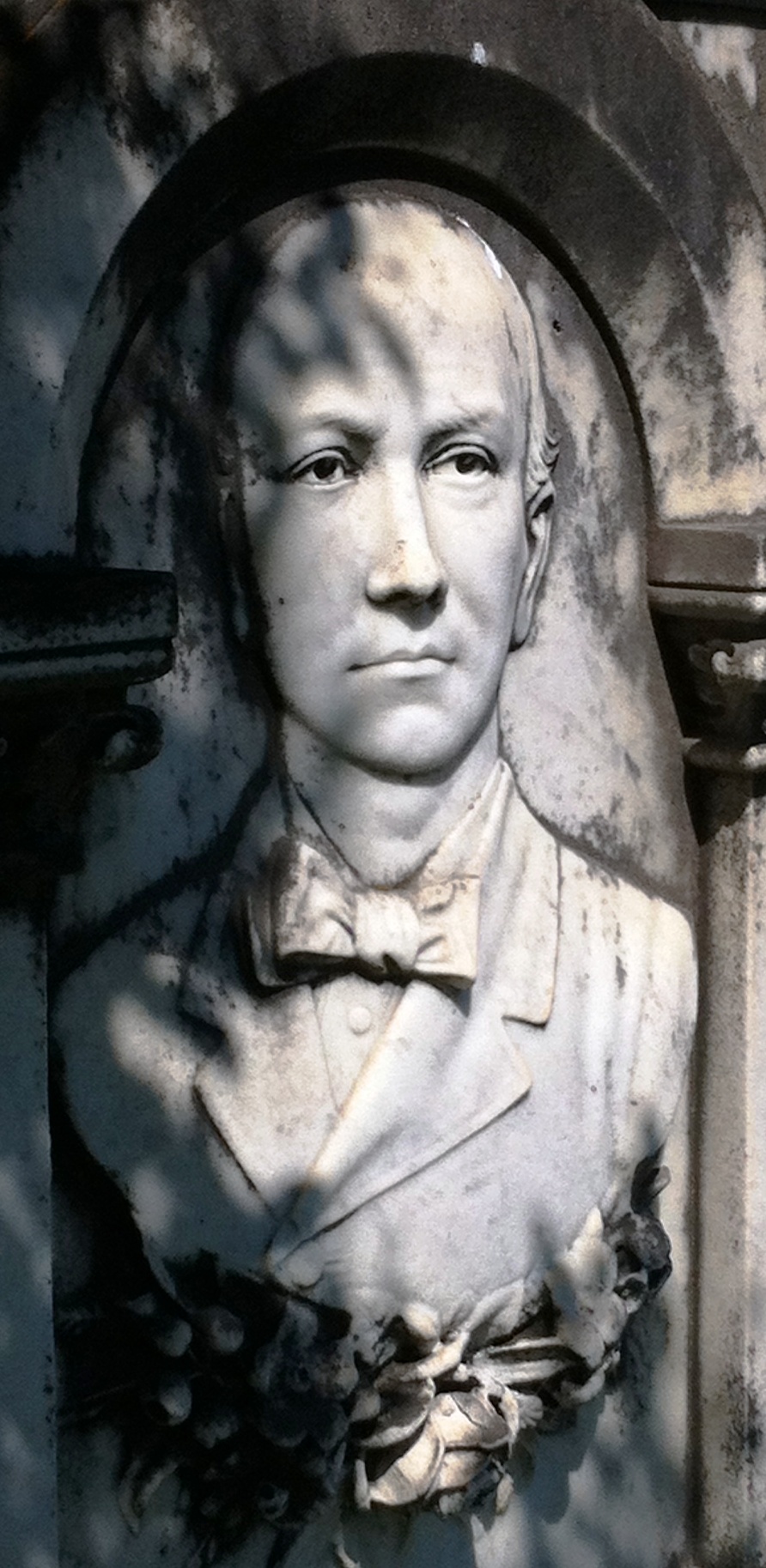
Today’s Sculpture Vulture returns to Mt. Holly Cemetery.  There are quite a few sculptures of angels and religious figures throughout the cemetery.   There are a few very unique sculptural ornamentations in the cemetery. These are carvings to represent the faces of the deceased which are mounted on grave markers.  Though this does not purport to be an exhaustive list of the carvings, it does showcase the ones the Culture Vulture noticed on a recent visit to Mt. Holly.

Hornibrook

James H. Hornibrook was born on July 8, 1840 and died on May 24, 1890.  He came to Little Rock from Toronto following the Civil War and ran a very successful saloon business.  He died of an “apoplectic stroke” just shy of his 50th birthday.  His house is now the Empress of Little Rock Bed & Breakfast located near the Governor’s Mansion.   He had feared his death and had commissioned a death mask to be made.

Johnson

Sydney J. Johnson was born February 12, 1866 and died on March 17, 1899.  He was a banker, Little Rock City Treasurer, and Pulaski County Deputy Circuit Clerk. He died from complications of a broken leg, an injury sustained while sledding.

Fones

Daniel Gilbert Fones was born on August 19, 1837 and died on May 28, 1912.  He was a hardware merchant who served as president of the German National Bank, the Arkansas Building & Loan Association, and the Equitable Building & Loan Association.  He served on the Little Rock School Board from 1883 to 1893.  Together with his brother James, he founded the Fones Brothers Hardware Company.  The final location of their warehouse, 100 Rock Street, opened in 1921. In 1997, after extensive renovation and repurposing the building reopened as the main branch of the Central Arkansas Library System.

LeFevre

Leon LeFevre was a farmer who owned a great deal of land north of the Arkansas River. He was born on April 19, 1808 and died on February 26, 1892. The house that he built in 1842 existed in what later became North Little Rock until 1966.  He was born on his family’s property prior to the establishment of Little Rock over a decade later. As Little Rock became formalized and grew to include both sides of the Arkansas River, he became a civic leader.

Peyton

Dr. Craven Peyton was born on November 30, 1823 and died on November 7, 1872.  He was a physician in Little Rock.  During the Civil War, he held the rank of Colonel and was commander of the 13th Regiment, Arkansas Militia.  He was Kentucky native who moved to Little Rock after graduating from Medical School. During the Mexican War he was commissioned as a surgeon in the Arkansas Regiment of Volunteers. He was one of the founders of Arkansas’s Medical School.