Dr. Cal Ledbetter Collection opens at UALR Center for Arkansas History and Culture

The UALR Center for Arkansas History and Culture revealed its newest collection, donated by educator, scholar, and legislator Calvin R. Ledbetter Jr., at a reception held at the Arkansas Studies Institute Tuesday evening, April 30.

Calvin R. Ledbetter Jr.The 12-linear-foot collection covers Ledbetter’s life between 1964 and 1988. The papers document Ledbetter’s political career including the state’s legislative sessions from 1967 to 1977. A portion of the papers references his academic career at the University of Arkansas at Little Rock.

Ledbetter, 84, led an accomplished political and educational career.

In addition to the collection housed at ASI, there is an online exhibit at ualrexhibits.org/ledbetter. The digitized collection includes photographs, video clips, and a selected bibliography on articles and books written by Ledbetter.

In 1960, Ledbetter joined the faculty at Little Rock University, now the University of Arkansas at Little Rock. He has served as chair of the Department of Political Science and dean of the College of Liberal Arts, now the College of Arts, Humanities, and Social Sciences. After retiring in 1997, Ledbetter was named professor emeritus of political science.

The gift of Dr. Ledbetter is not just his collection, ever the visionary, he has an eye on the future. In addition to donating his papers for research, Ledbetter has established the Cal Ledbetter Arkansas Legislative Institute Endowment to promote a better understanding of Arkansas through the scholarly study of legislators and legislative process.

Ledbetter served for five terms in the Arkansas House of Representatives between 1967 and 1977. In the course of his political career, he served three Arkansas’ governors, Winthrop Rockefeller, Dale Bumpers, and David Pryor. CAHC holds the collections of both Rockefeller and Bumpers.

The UALR Center for Arkansas History and Culture is housed in the Arkansas Studies Institute, a partnership between UALR and the Central Arkansas Library System. For more information, go to ualr.edu/cahc.

In recognition of his contributions, the Arkansas House of Representatives passed HR1045 this session. It was sponsored by Rep. Ann V. Clemmer, a member of the UALR Political Science faculty.

Double Bill Opera at UALR Tonight and Sunday

The UALR Opera Theatre will present a double-bill performance of “The Telephone” and “The Medium,” both by Gian Carlo Menotti, at 7:30 p.m., Friday, May 3, and again at 3 p.m., Sunday, May 5, in the Stella Boyle Smith Concert Hall in the UALR Fine Arts Building.

Opeara at UALRBoth performances will feature the talents of students in the vocal arts program and will be performed in English, the language in which they were written.  These operas premiered on Broadway in the 1940s as a double-bill and have been presented together and separately by opera  Carcompanies and theatre troupes since then.

UALR students can receive one free ticket; all other student tickets are $5. These tickets may be reserved by calling 501.569-3295.

For general admission, tickets are $15 and can be purchased through the music box office at 501.569.8993.

“The Telephone”
“The Telephone” is a romantic comic opera in one act about a suitor on a mission.

According to Don Bernardini, professor of music and director of the vocal program, “Ben, bearing a gift, comes to visit Lucy at her apartment. He wants to propose to her before he leaves on a trip. Despite his attempts to get her attention for sufficient time to ask his question, Lucy is occupied with interminable conversations on the telephone, but Ben will not be deterred!”


“The Medium”
“The Medium” is a two-act dramatic opera. Would-be psychic, Baba, with her daughter, Monica, pose as ghosts from the beyond during séances.

They take in a person who is deaf and doesn’t speak as a lodger but become distrustful of him. During one session, Baba feels a mysterious cold hand around her throat which panics her into revealing to her clients that she is a fake. When they refuse to believe her, Baba’s terror leads to tragedy.

May 2 Architeaser

IMG_5151In keeping with this week’s focus on Arkansas Arts Center entrances, today’s Architeaser focuses on the front portico of the Pike-Fletcher-Terry House. The iconic ionic columns are constructed of brick. They date from the early days of this often-modified house.

The original construction of this edifice started in 1840 by Albert Pike.  After uses as a residence and a women’s college, former Mayor John G. Fletcher took ownership of the property in 1889.  From 1889 to 1977 it was in the Fletcher family, first Mayor Fletcher and then his three children – Pulitzer Prize winning poet John Gould Fletcher, Mary Fletcher Drennan and Adolphine Fletcher Terry.

Mrs. Terry and her husband Congressman David D. Terry raised their five children in the house.  The house was also a base for Mrs. Terry’s community interests.  Most notably, the Women’s Emergency Committee was founded in the house.  This group of Little Rock area women focused on reopening the Little Rock public schools after they had been shut in response to the desegregation of Little Rock Central High.  The list of members of this group was kept secret for 40 years.  In 1997, the list was made public and the names were etched in the glass of the conservatory on the east facade of the building.

In 1963, the two remaining heirs of Mayor Fletcher – Mrs. Terry and Mrs. Drennan – announced that they were deeding the house to the City of Little Rock for use by the new Arkansas Arts Center. This transfer would go into effect upon the death of both sisters.  Following Mrs. Terry’s death, Mrs. Drennan (who lived out of state) went ahead and transferred the property in 1977.

From 1985 to 2003, the building was known as the Arkansas Arts Center Decorative Art Museum and housed the AAC’s decorative art and contemporary craft collection.  Because of expansion of the main campus in MacArthur Park, that collection was moved to the main building.  Since 2004, the building has been home to a variety of community art exhibits in conjunction with the Arts Center.

Since 1977, the building has long been a favorite site for special events and weddings. That tradition continues today. Tomorrow night, Our House will host its annual Dinner on the Grounds at the Arkansas Arts Center’s Pike-Fletcher-Terry House.


Arkansas Arts Center Looks Back and Forward with TABRIZ

tabriz-logoThis year, the Arkansas Arts Center’s biennial Tabriz marks 50 years.  What started out as a blacktie dinner and dance as the Beaux Arts Bal (sic) in 1963 transformed by 1971 into Tabriz – an auction event.  Over the years, the one evening has grown into three different events.

Thursday, May 2, 6 p.m., Alice Pratt Brown Atrium
Tabriz: Moroccan Market Silent Auction

The Thursday, May 2, event will be a casual party featuring a silent auction with over 350 unique items for every interest. Beginning at 6 p.m., attendees will enjoy entertainment, specialty drinks and light fare with a Moroccan twist. Tickets are $50 per person. Guests are invited to bid online with bidpal.net/tabrizwww.Tabriz2013.org


Saturday, May 4, 6 p.m.,Alice Pratt Brown Atrium
Tabriz Gala Dinner: A 50th Anniversary Ball

A Moroccan market-themed black-tie gala will be held Saturday, May 4, at 6 p.m. There will be silent and live auctions featuring items such as premiere destination vacations, elegant jewelry, marvelous parties and various other art and cultural experiences available for bidding, premium cocktails and an elegant dinner. Tickets are $750 per person and include admission to the Studio Party 50th Anniversary Celebration Ball immediately following the gala at 9 p.m.


Saturday, May 4, 9 p.m.,Alice Pratt Brown Atrium
Tabriz Studio Party

Following the Gala Dinner, guests will enjoy exciting entertainment with The Jump Street Band, hors d’oeuvres and cocktails. Tickets to attend the Studio Party 50th Anniversary only are $100 per person.www.Tabriz2013.org

May is Arkansas Heritage Month

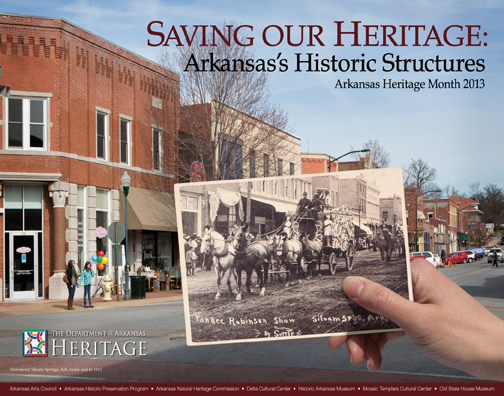
HM 2013This year’s theme is: Saving our Heritage: Arkansas’s Historic Structures.

Arkansas is fortunate to have preserved so many historic structures. Homes, businesses, churches, bridges, courthouses, banks, log cabins and even entire historic districts have been preserved and protected. But there may be structures in your town that need attention and resources so they can be saved.

A wealth of assistance is available through the Arkansas Historic Preservation Program to help save important places in Arkansas, including educational materials, federal tax credit program information, and technical resources to name just a few.

From local museums and historical societies to private homes and businesses, preserving our past is something Arkansas does well.

For more information, visit the Department of Arkansas Heritage at www.arkansasheritage.com.