Little Rock Look Back: Miss America in Little Rock

Tonight a new Miss America will be crowned.  Arkansas’ own Savvy Shields will conclude her whirlwind year as the third Miss America to come from the Natural State.

Earlier this year, two of Arkansas’ three Miss Americas were in Little Rock for the Miss Arkansas pageant.  So as Savvy wraps up her reign, it seems a good time to remember when Donna Axum first brought the Miss America title to Arkansas.

A native of El Dorado and a student at the University of Arkansas, during her reign as Miss America Miss Axum (or simply Donna as the newspaper headlines referred to her) made four public visits to Little Rock.  As the first Miss Arkansas to become Miss America, the state’s Capitol City was very interested in giving her a warm welcome.

After being crowned on September 7, 1963, Axum’s first official visit to Arkansas was November 1 through 3.  In addition to stops in Hot Springs and El Dorado, she appeared in Little Rock to attend events including an Arkansas Razorback football game at War Memorial Stadium.  Her entourage included the top four runners up from the Miss America pageant.

In February 1964, she made a brief appearance in Little Rock which included a press conference.

Donna Axum spent nearly two weeks in Arkansas in May 1964 attending several pageants as well as spending time with family.  During that visit she appeared in Little Rock twice.  The second time she headlined a concert with the Arkansas Symphony (not related to the current Arkansas Symphony Orchestra) and the Arkansas Choral Society. It took place at Robinson Auditorium.

Little Rock Look Back: Labor Day Bombings of 1959

Labor Day Bomb

ARKANSAS GAZETTE photos showing the exterior and interior of the LRSD building after the bomb blast.

On September 7, 1959, a peaceful Labor Day in Little Rock was shattered by the explosions of three dynamite bombs.

The locations were Fire Chief Gene Nalley’s driveway on Baseline Road at 10:20pm, Baldwin Company offices at Fourth and Gaines at 10:53pm (where Little Rock Mayor Werner Knoop was a partner–the company is now known as Baldwin Shell), and the School District offices at 10:58pm (then located at Eighth and Louisiana streets).

Given the three targets, it was fairly quickly assumed that there was a connection between the bombings and the lingering effects of the 1957 integration crisis. In light of that, police officers were stationed at the homes of all Little Rock City Directors and School Board members.

The investigation into the bombings turned up a purported fourth location for a bomb. That was the office of Letcher Langford. (Culture Vulture Editorializing Note:  This could have been a ploy to throw investigators off the scent. Langford was the only City Director who had been backed by segregationist candidates and had been openly hostile to the Women’s Emergency Committee — to the point of threatening them with legal action for not disclosing their membership rolls.)

Investigators determined that the bombing had been planned in late August by members of the Ku Klux Klan.  Five individuals were arrested.  They were J. D. Sims, Jesse Raymond Perry, John Taylor Coggins, Samuel Graydon Beavers, and E. A. Lauderdale.  The latter had twice been an unsuccessful candidate for the City Board of Directors.

Sims pleaded guilty and started serving a prison term later in September 1959.  Perry, Coggins and Beavers all went to trial in October and November.  Each was found guilty. Their terms ranged from three to five years.  Lauderdale was convicted, but appealed his decision. Though the Arkansas Supreme Court upheld the verdict against him, he did not start serving his sentence until the court decision in February 1961.

Governor Faubus commuted the sentences of Perry, Coggins and Beavers.  All three served less than six months.  Lauderdale’s sentence was reduced by Faubus so that he, too, was eligible for release after six months.  Sims, who was first to plead, served the longest: nearly two years.

Sadly, this would not be the last bombing in Little Rock tied to 1957. In February 1960, Carlotta Walls’ house was bombed.

Little Rock Look Back: Arkansas Arts Center established

Architectural model of the original Arkansas Arts Center which would open in 1963.

On Tuesday, September 6, 1960, the City of Little Rock Board of Directors adopted ordinance 11,111 which formally established the Arkansas Arts Center.

In July 1957, the City Council of Little Rock granted the Museum of Fine Arts the authority to solicit and receive funds for expanding that museum’s physical plant.  During that process, it had been decided that the museum needed an expanded mission and a new name.  By the summer of 1960, the museum supporters had raised sufficient funds to proceed with constructing the new facility.  Therefor the new ordinance was prepared and submitted to the City Board.  (In November 1957, the City Council had been replaced by a City Board.)

Ordinance 11,111 set forth that the Museum of Fine Arts would be known as the Arkansas Arts Center and that the previous museum’s board would serve as the board for the new museum.  The Board of the Arkansas Arts Center was given the authority to have the new building constructed in MacArthur Park and the existing building modified.  As a part of the planning for the new museum, the City committed $75,000 for the capital campaign.

The groundbreaking for the new museum would take place in August 1961.  Mayor Werner Knoop, who signed Ordinance 11,111, took part in the groundbreaking.

Media attending the September 6, 1960, City Board meeting were more interested in discussion about a potential leash law for dogs within the City limits.

Little Rock Look Back: Duke Ellington refuses to play in segregated Robinson

Newspaper ad for the concert that was not to be

In August 1961, it was announced that Duke Ellington would perform in concert at Robinson Center.  He had previously played there in the 1940s and early 1950s.  His concert was set to be at 8:30 pm on Tuesday, September 5.

Due to the changes of times, the NAACP had a relatively new rule that they would boycott performers who played at segregated venues.  When it became apparent that Robinson would remain segregated (African Americans restricted to the balcony), the NAACP announced they would boycott any future Ellington performances if he went ahead and played Robinson.

The music promoters in Little Rock (who were white) petitioned the Robinson Auditorium Commission asking them to desegregate Robinson – even if for only that concert.  The Commission refused to do so.  Though the auditorium was finding it harder to book acts into a segregated house, they felt that if it were integrated, fewer tickets would be sold.

On September 1, 1961, Ellington cancelled the concert.

Robinson remained segregated until a 1963 judge’s decision which integrated all public City of Little Rock facilities (except for swimming pools).

LR Look Back: A Photo Seen Around the World

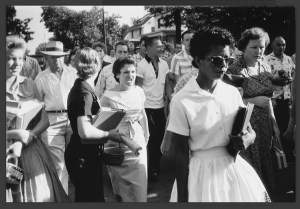
Will Counts (American, Little Rock, 1931 – 2001, Evansville, Illinois), It was not the plan for Elizabeth Eckford to walk along toward Central High, 1957 (printed 1997), gelatin silver print, 25 x 32 inches, Arkansas Arts Center Foundation Collection: Gift of the artist, Bloomington, Indiana. 1997.039.007

On September 4, 1957, the students known as the Little Rock Nine made their first attempt to enter all-white Little Rock Central High School.  This was the second day of the 1957-58 school year in Little Rock.  Over the preceding Labor Day weekend, it had been decided that the African American students would wait until the second day of school to officially start at Central.

As is now well known, NAACP leader Daisy Bates was not able to notify one of the students about meeting as a group of the Bates house.  That one student, Elizabeth Eckford, approached the school by herself and quickly realized the National Guard members surrounding the school were not their to protect her, but to ban her and the others.

Arkansas Democrat photographer Will Counts captured Eckford’s quiet determination in the face of the guards and the taunting crowds.  His photo of a white student screaming at Eckford was picked up by media outlets worldwide. It became not only a symbol for the Central High integration crisis, but for the Civil Rights movement.  Counts’ photo was the jury’s choice for the Pulitzer Prize in Photography in 1958. But the jury was overruled by the Pulitzer board, with no explanation given.

A copy of this photo is now on display at the Arkansas Arts Center.  In 1997, Counts gave the Arts Center several prints from his collection that were taken during the time period of August 1957 through September 1959.  The exhibit is on display through October 22.


Little Rock Look Back: LR Likes Ike in 1952

Detail from UPI photo of General Eisenhower following his address.

If Ike, Little Rock and September are considered, it is usually in reference to his role in the desegregation of Little Rock Central High in September 1957.  But five years earlier, he appeared in Little Rock on September 3, 1952.

General Eisenhower’s speech to 14,000 in MacArthur Park was the final leg in his swing through the South on his campaign for the White House.  He became the third presidential candidate to visit MacArthur Park in 1952 following General MacArthur (in his ill-fated attempt to gain traction as a GOP candidate during the delegate selection process) and Democratic nominee Adlai Stevenson.

He visited every southern state except Mississippi on this campaign jaunt.  In comments that neither he nor his audience could have foreseen as prescient, Eisenhower declared that he deplored the government meddling in areas in which it did not belong.  This remark was made in reference to race relations.  His stance was that some rights of minorities should be protected, but it was not necessarily the role of the federal government.

Ike proffered that if white southerners did not protect the rights of African Americans they were in danger of losing their own rights, too.  In the era of the Cold War when people were worried about the imminent loss of rights, this message seems to have crafted to appeal to those concerns.  While Eisenhower did not shy away from addressing civil rights, his Democratic opponent Adlai Stevenson was silent on the issue.  But with Alabama segregationist Senator John Sparkman as his running mate, it put Stevenson in a difficult position to try to bring it up.

In the end, Ike lost most of the South.  He did carry Maryland, Virginia, Tennessee and Florida. The only states Stevenson won were in the South.  Eisenhower’s 43.74% of the Arkansas popular vote was the highest any Republican had garnered since General Grant carried the state in 1868 and 1872.