
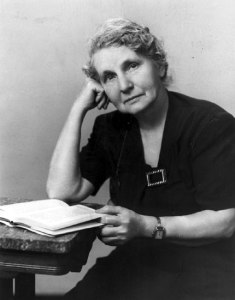
Women’s History Month – Bernie Babcock

Julia Burnelle “Bernie” Smade Babcock was an author and museum founder.  When her husband died, leaving her with five children, she starting writing for money. She published several temperance novels and later wrote for the Arkansas Democrat.  She also published a magazine, wrote plays which were performed in New York, and authored a poetry anthology.  She later became recognized as an expert on Abraham Lincoln and wrote several books about him, as well as other historical figures.  For her writing skills, she became the first Arkansas woman to be included in Who’s Who in America.

In 1927, after professional curmudgeon H. L. Mencken wrote derisively of Arkansas, she decided to start a museum. The Museum of Natural History and Antiquities was first located in a Main Street storefront.  In 1929, she “gave the City of Little Rock a Christmas present” by giving the museum to the city.  It was relocated to the unfinished third floor of City Hall, with her as its employee. After being closed during part of the Great Depression, she relocated the museum to the Arsenal Building and reopened it as the Museum of Natural History.  She was involved in the efforts to rename City Park in honor of Douglas MacArthur (who had been born there) and welcomed him when he came to Little Rock in 1952.

Following her retirement in 1953, she moved to Petit Jean Mountain where she wrote and painted.

After more name changes and a relocation, her museum is now known as the Museum of Discovery and is an anchor in the River Market district.

Women’s History Month – Raye Montague

Last month, Raye J. Montague, RPE was recognized on “Good Morning America” for her work as a pioneering scientist. She was not only the first woman to design a U.S. Naval ship using a computer, or the first African American to do so, she was the first PERSON to do so.
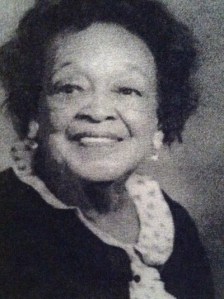
She began a career in Washington, DC with the United States Navy in 1956 and retired in 1990 after serving in numerous leadership roles during her tenure of thirty-three and one-half years. Her work designing the FFG-7 Class in the early 1970s revolutionized naval ship design.  She also served as the first female Program Manager of Ships in the US Navy and was the first female professional engineer to receive the Society of Manufacturing Engineers Achievement Award.

Throughout her career she received many honors, and was often the first woman of any race to achieve statuses in the engineering profession.

In 2006, she returned to Arkansas.  She is involved with numerous civic activities including mentoring students in the sciences at UALR and also eStem Public Charter School.  She was inducted into the Arkansas Black Hall of Fame in 2013.

Women’s History Month – Sue Cowan Williams

Sue Cowan Williams was an educator who fought for fair treatment.

After being educated in Alabama and Illinois, she returned to Arkansas, and began her teaching career in 1935 at Dunbar High School in Little Rock.  In 1942, Williams became the plaintiff in a lawsuit aimed at equalizing the salaries of black and white teachers in the Little Rock School District. The NAACP’s Legal Defense Fund, including its director-counsel Thurgood Marshall, assisted in the case. The trial ended after a week with a verdict against Williams, and her teaching contract was not renewed for the 1942-43 school year. Other black educators left the school as a result of their involvement in the lawsuit.

In 1945, Williams successfully appealed the verdict to the Eighth Circuit Court of Appeal in St. Louis, which ordered equal pay for black and white teachers in Little Rock. Dr. Christophe, the new principal of Dunbar High School, demanded Williams’s reinstatement in the fall of the same year, but it was not granted until 1952. In the intervening years, she taught classes at what is now UAPB and Arkansas Baptist College as well as at the Ordnance Plant in Jacksonville.  Upon returning to the LRSD, Williams taught at Dunbar until 1974, when she retired. She died in 1994.

The Central Arkansas Library Branch located in the Dunbar neighborhood was named for her when it opened in 1997.  She is honored with inclusion in the Arkansas Civil Rights Heritage Trail.

Women’s History Month – Charlie May Simon

Charlie May Simon is known today for being the eponym of a children’s literature award. But during her lifetime she was a prolific author for children and for adults.

Born in South Arkansas, she was raised in Memphis and then resided in Chicago and Paris. With her then-husband (who would serve as illustrator for her books even after they divorced) she moved to Perry County in the 1930s. She returned to writing, with Robin on the Mountain being published in 1934.  In 1936, she married longtime friend and Arkansas poet John Gould Fletcher. The couple resided in Little Rock.

Following his 1950 death, Simon continued to live in Little Rock, though she traveled all over the world. Her books for children and adults covered a variety of topics and themes.

In 1971, the Arkansas Department of Education named its annual Children’s Literature Award the Charlie May Simon Award.

After her death in 1977, she was buried next to her husband in Mount Holly Cemetery.

Women’s History Month – Charlotte Stephens

Charlotte Andrews Stephens was the first African American teacher in the Little Rock School District.  Between 1910 and 1912, when an elementary school for African Americans was named after her, she became the first woman to have a public building in Little Rock named after her.  For nearly fifty years, Stephens Elementary (which is now in its third building) would be the only LRSD building named after a woman.
Born into slavery, Charlotte Stephens was educated first by her father who ran a private school in what is now Wesley Chapel UMC.  At the age of 15, she started teaching at the Union School to finish out the term of a white teacher who had become ill.  She taught for 70 years, retiring at age 85 in 1939.

From 1870 to 1873, she attended college at Oberlin College, though not always every semester. (It is possible she was the first African American woman from Arkansas to attend college, but that cannot be verified.)  During her career with the LRSD, she taught students in all grades. She was twice principal of Capitol Hill School, and later headed the high school Latin Department.  At the time of her retirement, she was librarian of Dunbar High School.

The land on which Stephens Elementary now sits was once owned by Charlotte Stephens.  She donated the land and attended the 1950 dedication of the second Stephens Elementary.  That building was torn down in 1994 to make way for the current Stephens Elementary.  Some of her grandchildren attended the dedication of the new and current Stephens Elementary.


Little Rock Look Back: President Clinton performs with Arkansas Symphony

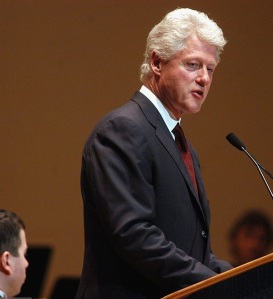
Former U.S. President Bill Clinton addresses the audience after reciting Martin Luther King’s famous speech, ‘I Have A Dream’, to the music of Alexander L. Miller at Robinson Auditorium March 25, 2003 in Little Rock. (Photo by Karen E. Segrave/Getty Images)

On March 25, 2003, former President Bill Clinton took the stage of Robinson Center Music Hall to perform with the Arkansas Symphony Orchestra. Entitled “Let Freedom Ring – A Patriotic Celebration,” the evening was a joint fundraiser for the Symphony and the Clinton Foundation.

Before a packed house, Clinton narrated Aaron Copland’s A Lincoln Portrait which weaves excerpts from Lincoln speeches with Copland’s own unique classical take on American heartland music.  Clinton also narrated Let Freedom Ring, a symphonic setting by Alexander Miller of Martin Luther King’s “I Have A Dream” speech.

The evening also consisted of Broadway veteran and Little Rock favorite Lawrence Hamilton singing “Wheels of a Dream” from the musical Ragtime.  On Broadway and on national tour, Hamilton had previously sung the song.

The Arkansas Symphony Orchestra also performed An American in Paris by George Gershwin and “Jupiter” from The Planets by Gustav Holst.  This final selection was a tribute to the seven astronauts who had died in the crash of the space shuttle Columbia on February 1, 2003.

David Itkin, who was then the musical director of the ASO, conducted the concert.

Women’s History Month – Dr. Joycelyn Elders

Being the second female and first African American female to serve as Surgeon General, was just another milestone in the career of Dr. Joycelyn Elders.

In 1960, she graduated from the University of Arkansas for Medical Sciences. Though not the first African American female to do so, she was very much in a minority for both her race and her gender.  In 1967, she would return to UAMS as a faculty member.

After two decades of service as a physician and educator, Governor Bill Clinton appointed her to lead the Arkansas Department of Health in 1987.  She was the first African American woman to lead that department.  She led that department until 1992.  At that point in time, President Bill Clinton tapped her to be Surgeon General.

Upon leaving the post of Surgeon General, she returned to UAMS as a professor. She is now a professor emeritus.  Dr. Elders is also in demand as a lecturer and panelist.

She has been inducted into the Arkansas Black Hall of Fame, Arkansas Women’s Hall of Fame, and the Arkansas Civil Rights Heritage Trail.