Sculpture Vulture: Kathleen Caricof’s INFINITY dedicated in 2011

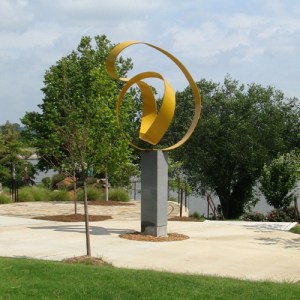
CARICOF05bOn April 14, 2011, Kathleen Caricof’s Infinity sculpture was dedicated in Riverfront Park. It became the signature sculpture for the Vogel Schwartz Sculpture Garden.
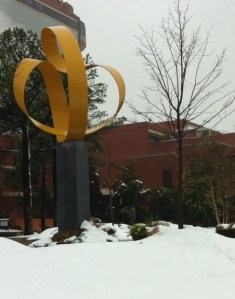
Standing over 10 feet tall, it consists of one inch thick steel which loops around to form a continuous abstract shape. It sits atop a column of grey granite.

Caricof suggested the warm golden yellow hue represented “the warmth of the people of Little Rock.”

Funding for the project came, in part, from the Vogel Schwartz Foundation.

IMG_3980

INFINITY amidst snow in 2012

Caricof is a member of the National Sculptors Guild.  Her interest in sculpture developed from a background in designing for space. Much of her past work incorporates the theme of community through abstract form. She places a great deal of importance in ‘the gathering’ for mutual support and as a collective celebration of life. Caricof focuses her creative energies on public art because of its shared impact on a wide range of diverse viewers, fueling community involvement and enriching the surrounding environment.

Pulitzers Play Little Rock: RABBIT HOLE at Weekend Theater

RabbitHoleTWTThe announcement that the 2007 Pulitzer Prize for Drama went to David Lindsay-Abaire for Rabbit Hole was a bit of surprise.  The play had actually opened on Broadway the prior season.  (While now the Pulitzer year equals the calendar year, at that time, the Pulitzer calendar went from Autumn to Autumn.)
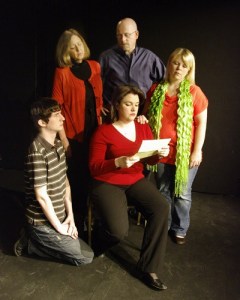
Lindsay-Abaire’s play tells the tale of a family coming to grips with the accidental death of a four year old son.  The Weekend Theatre brought the play to life on a Little Rock stage in 2009.  Andy Hall directed the production (duties he has performed for the current Weekend Theatre production of Assassins).

Patti Airoldi took on the central role of the aggrieved mother.  Duane Jackson played her husband, Patti German played her mother, and Regi Ott was her somewhat unconventional sister.  William Moon rounded out the cast.

Though the play veers to the edge of maudlin, it never gets there.  The script presents how different people cope with grief and guilt without becoming a “Very Special Episode” of After School Special.

2018 marks the 100th anniversary of the first Pulitzer Prize for Drama being given. To pay tribute to 100 years of the Pulitzer for Drama, each day this month a different Little Rock production of a Pulitzer Prize winning play will be highlighted.  Many of these titles have been produced numerous times.  This look will veer from high school to national tours in an attempt to give a glimpse into Little Rock’s breadth and depth of theatrical history.

Pulitzers Play Little Rock: Talley’s Folly

TalleyLanford Wilson’s two person play Talley’s Folly has one of the smallest casts of a Pulitzer Prize winning play.  It is a prequel to Wilson’s Fifth of July giving a backstory that is only touched upon the earlier play.

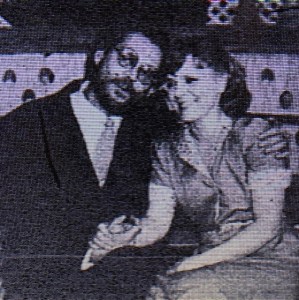
In January 1985, the Arkansas Rep staged this seemingly simple play in Little Rock.  A quiet, romantic story, it reveals much in the layered story and nuanced characters.  Directed by Rep favorite Terry Sneed, the two-hander starred Ronald J. Aulgur and Cathey Crowell Sawyer.  The former was a frequent actor in Rep productions.  The latter was making her Rep acting debut, though she was on the Rep staff as Associate Director.

In his Arkansas Gazette review, Bill Lewis singled out Mike Nichols for his set (Nichols is still designing and building sets for the Rep in 2018) and James Hunter for his lighting.

2018 marks the 100th anniversary of the first Pulitzer Prize for Drama being given. To pay tribute to 100 years of the Pulitzer for Drama, each day this month a different Little Rock production of a Pulitzer Prize winning play will be highlighted.  Many of these titles have been produced numerous times.  This look will veer from high school to national tours in an attempt to give a glimpse into Little Rock’s breadth and depth of theatrical history.

Pulitzers Play Little Rock: FIORELLO!

IMG_3737Winner of the 1960 Pulitzer Prize for Drama, Fiorello! has been described as the best musical you’ve never heard of.

Based on the life of New York politician Fiorello H. LaGuardia, it was a surprise winner of the Pulitzer.  Produced by Robert Griffith and Harold Prince, it featured a book by Jerome Weidman and George Abbott (who also directed) and a score by Jerry Bock and Sheldon Harnick.

In 1961, the national tour played in Little Rock at Robinson Auditorium.   The production used the original Broadway direction and choreography (by Peter Gennaro) and design (sets, costumes and lighting by the duo of William and Jean Eckert).

The cast was led by Bob Carroll as LaGuardia (taking on a role created by Tom Bosley).  Others in the cast were Rudy Bond, Charlotte Fairchild, Paul Lipson, Jen Nelson, Zeme North and Clint Young.

It does not appear to have been produced in Little Rock since then.

Pulitzer plays Little Rock: GLENGARRY GLEN ROSS

GGR PrecipiceDavid Mamet’s scalding comedy Glengarry Glen Ross focuses on small-time, cutthroat real estate salesmen trying to grind out a living by pushing plots of land on reluctant buyers, in a never-ending scramble for their share of the American dream.

With cutting language and well-developed characters, Glengarry Glen Ross has been popular among theatres since it debuted.  In January 2018, Precipice Theatre brought this play back to the Little Rock stage.

Directed by Heather Norris, the cast included Ricco Ardemagni, Larry Lapaglia, James Norris, Paul Seminara, Neil Gillespie, Scott Minor, Terry D. Norris, and Anthony Nguyen.

2018 marks the 100th anniversary of the first Pulitzer Prize for Drama being given. To pay tribute to 100 years of the Pulitzer for Drama, each day this month a different Little Rock production of a Pulitzer Prize winning play will be highlighted.  Many of these titles have been produced numerous times.  This look will veer from high school to national tours in an attempt to give a glimpse into Little Rock’s breadth and depth of theatrical history.

Pulitzers Play Little Rock: AUGUST: OSAGE COUNTY

August Osage CastoTracy Letts won the Pulitzer for his sprawling family tale August: Osage County.  It was brought to life in Little Rock on the Arkansas Repertory Theatre stage.

Rep founder Cliff Baker, who starred in the Rep’s first production of The Threepenny Opera returned to the stage as an actor to portray the mysterious patriarch of the Weston clan.  Joining him were Susanne Marley as matriarch Violet and LeeAnne Hutchison, Kathy McCafferty and Brenny Rabine as their three daughters.  Marc Carver, Michael McKenzie,  and Mary Katelin Ward are family members of the three daughters.  Natalie Canerday, Richard Waddingham and Michael Patrick Kane played another branch of the family. Grant Neale and Cassandra Seidenfeld were two other residents of Osage County who are drawn into the family drama.

The design team includes Mike Nichols (set), Marianne Custer (costumes), Yael Lubetzky (lighting), Allan Branson (sound) and Lynda J. Kwallek (props).  Other members of the creative team include fight director D. C. Wright (and there is plenty of physical sparring in addition to the verbal sparring) and dialect coach Stacy Pendergraft.

2018 marks the 100th anniversary of the first Pulitzer Prize for Drama being given. To pay tribute to 100 years of the Pulitzer for Drama, each day this month a different Little Rock production of a Pulitzer Prize winning play will be highlighted.  Many of these titles have been produced numerous times.  This look will veer from high school to national tours in an attempt to give a glimpse into Little Rock’s breadth and depth of theatrical history.

Little Rock Look Back: La Harpe and La Petite Roche

On April 9, 1722, French explorer Jean-Baptiste Bénard de La Harpe rounded the bend of the Arkansas River and saw La Petite Roche and Le Rocher Français.  He had entered the mouth of the Arkansas River on February 27 after traveling up the Mississippi River from New Orleans.

Though La Harpe and his expedition are the first Europeans documented to have seen La Petite Roche, the outcropping of rocks was well-known to the Quapaw Indians in the area.  The outcropping jutted out in the Arkansas River and created a natural harbor which provided a perfect place for boats to land.

The rock outcropping is the first one visible along the banks of the Arkansas River.  It marks the place where the Mississippi Delta meets the Ouachita Mountains.  Geologists now believe that the Little Rock is not the same type of rock as the Ouachita Mountains and more closely matches the composition and age of mountains in the western US.

In 1813, William Lewis became the first European settler to live near La Petite Roche but only stayed a few months.  Speculators and trappers continued to visit the area throughout the 1810s. During that time, the outcropping became known informally as the Little Rock.

La Petite Roche had become a well-known crossing when the Arkansas Territory was established in 1819. The permanent settlement of ‘The Rock’ began in the spring of 1820, and the first building has been described as a cabin, or shanty, and was built on the bank of the river near the ‘Rock.’ In March 1820, a Post Office was established at the ‘Rock’ with the name “Little Rock.”

Over the years, La Petite Roche was altered.  In 1872, Congress authorized the building of a railroad bridge. A pier for the bridge was built at the location of the La Petite Roche which caused the removal of several tons of rock.  The bridge was never built.  When the Junction Bridge was built in 1899, even more rock was removed in the process of erecting part of the bridge on top of the rock.  It was not viewed as being disrespectful of the City’s namesake at the time.  Indeed, it was viewed as a testament to the sturdiness of the rock.

In 2010, La Petite Roche plaza opened in Riverfront Park.  It celebrates the history of La Petite Roche and explores its importance to various aspects of Little Rock’s history and geography.