
Little Rock Look Back: US Supreme Court hands down BROWN v BOARD decision

On May 17, 1954, the U.S. Supreme Court issued its ruling in Brown vs. Board of Education of Topeka.  

This landmark United States Supreme Court case declared state laws establishing separate public schools for black and white students to be unconstitutional. The decision overturned 1896’s Plessy v. Ferguson decision, which allowed state-sponsored segregation in public education. In a unanimous 9-0 decision, the Warren Court stated “separate educational facilities are inherently unequal.”  The results of this decision would be tested on the streets of Little Rock in 1957.

The Court’s fourteen page decision did not spell out any sort of method for ending racial segregation in schools, and the Court’s second decision in Brown II, muddied the waters even further by only ordering states to desegregate with the oxymoronic “all deliberate speed.”

Brown v. Board grew out of a class action suit filed in Topeka, Kansas, by thirteen African American parents on behalf of their children.  Mr. Oliver Brown was the only male. He was chosen to be the lead plaintiff, because it was felt that the court would look more favorably on a male plaintiff.  The District Court ruled in favor of the Board of Education, citing Plessy v. Ferguson.  The court did note that segregation had a detrimental effect on African American students, but that since the Topeka schools were substantially equal, there was no relief to be granted.

When it was appealed to the Supreme Court, Brown v. Board was combined with four other cases from other jurisdictions.  All were NAACP sponsored cases.  Thurgood Marshall was the lead attorney for the plaintiffs.  In December 1952, the Justice Department filed a “friend of the court” brief and argued, in part, that racial segregation had a detrimental effect on US foreign policy. Communist countries were using racial separation in anti-US propaganda.

In the spring of 1953, the Supreme Court held the case.  Unable to decide the issue, they reheard it in the fall of 1953.  They then put special emphasis on the Fourteenth Amendment’s Equal Protection Clause.

During deliberations, Chief Justice Earl Warren insisted on a unanimous ruling to avoid massive Southern resistance.

Since the Topeka schools were found to be substantially equal, the Court’s ruling was important in noting that the harm came from the separation.  While there was no doubt that many (if not most) African American public schools were inferior in infrastructure and supplies to white schools – that in and of itself was not the issue.

School leaders in Little Rock started perusing the Brown decision and considering how the Little Rock School District would comply.

Groundbreaking today for Elizabeth Eckford commemorative bench project

Little Rock Central High School National Historic Site is collaborating with the Central High Memory Project students and additional partners for the groundbreaking ceremony of the Elizabeth Eckford Commemorative Bench on May 17, 2018.  It will take place at 4:30 this afternoon at the corner of Park and 16th Streets.

The date for this groundbreaking was chosen to be on the 64th anniversary of the US Supreme Court’s Brown v. Board decision.  It was that decision which paved the way for Little Rock Central High School to be a pivotal location in the Civil Rights struggle.

September 4, 1957, was supposed to be the first day of school for the African American students who were selected to integrate Little Rock Central High School.  Due to the mobs gathered outside of the school and interference from Governor Orval Faubus, the students would not get in the school that day.

The most famous images from that day are the photos of Elizabeth Eckford walking in front of the school, only to be rebuffed by soldiers and tormented by the crowds. Elizabeth’s decision to walk through the mob of protesting segregationists to enter school, only to be turned away became world news. The story of the desegregation of Central High School was thrust into a defining role within the Civil Rights Movement. Elizabeth’s efforts to overcome the fear and uncertainty that she faced that morning resulted in her seeking refuge at a lonely bus stop bench.

In order to highlight this aspect of the story and create more personal connections with this turning point in history for students and visitors, the National Park Service and the Central High Memory Project Student Team will work with community partners in a new public history project.  The Bench Project includes building a replica of the bus stop bench, creating a mobile app for the students’ audio walking tour of eyewitness accounts of that first day of desegregation, and developing a storycorps recording booth for interviews and student podcasts.

The partnership includes: Bullock Temple C.M.E., Central High School and their EAST LAB, the Little Rock School District, the City of Little Rock, Central Arkansas Library System’s Butler Center for Arkansas Studies, Good Earth Garden Center, Friends of Central High Museum Inc., Home Depot, Little Rock Club 99 and other Rotary International Clubs,  Pam Brown Courtney and Willis Courtney M. D., the Clinton School of Public Service, Unity in the Community, and others.

The groundbreaking ceremony will be held at the corner of Park and 16th Street starting at 4:30 p.m. The program will include remarks by the NPS Superintendent and the directors of some of the partnering organizations regarding the projects that will be completed in connection with this effort. The Central High Memory Project Student Team will be on hand to meet the public and share details about their work.

Little Rock Look Back: Members Preview of Arkansas Arts Center on May 16, 1963

Mrs. Rockefeller

Two days before the Grand Opening of the Arkansas Arts Center, the institution’s members were given a sneak preview. On May 16, 1963, at 8:00pm, members were given a preview of the opening exhibition: Five Centuries of European Painting.

Members were greeted with remarks by Jeannette Rockefeller, the Board of Trustees president. Following her were comments by Alan R. Symonds, who was the Arts Center’s executive director.  James Rorimer, the director of the Metropolitan Museum of Art, which had created the opening exhibition, also spoke.

The exhibition featured works by Titian, El Greco, van Dyck, Murillo, Gainsborough, Monet, Courbet, Renoir, Degas, Pissarro, and Gauguin.  Another artist featured was Paul Signac.  Today the Arts Center has one of the largest collections or works by Signac due to the generosity of collector James T. Dyke.

Mr. Symonds had been hired by the Rockefellers to lead the planned automobile museum on Petit Jean. He was loaned to the Arts Center to get the museum open.  A year after the AAC grand opening, he returned to the assignment on Petit Jean.

Little Rock Look Back: CROSS formed to Stop STOP

On May 16, 1959, a new organization emerged in an effort to keep Little Rock schools segregated.
The Committee to Retain Our Segregated Schools (CROSS) was launched by Rev. M. L. Moser, Jr., the pastor of Central Baptist Church.  The three leading segregationist organizations in Little Rock disavowed any connection to it.  Representatives from the Capitol Citizens Council, Central High Mother’s League and States Rights Council noted that he was not affiliated with them.

Approximately 300 people attended the CROSS kick off event at the Hotel Marion.   Joining Rev. Moser as a speaker at the rally was LRSD School Board President Ed McKinley.  It was announced that the CROSS office would be at 108 Scott Street.  Robert D. Lee was the campaign treasurer.

With STOP advocating for the removal of McKinley, Ben Rowland and Robert Laster from the school board, CROSS was now out to recall Everett Tucker, Ted Lamb and Russell Matson.

With the election on May 25, the final nine days were going to be intense.


Elvis Has Left the Building (Robinson Center, that is) – May 16, 1956

Photo by Wayne Cranford

After two visits in 1955 where he was down on the bill, Elvis Presley made his third and final appearance at Robinson Auditorium on May 16, 1956.  This time he was the star and Robinson was packed. The tickets were $1.50 in advance at Walgreens and $2.00 at the box office.

The ads featured 8 great acts in “his” variety show which consisted of the Jordonaires; Rick and Emil Flaim and their orchestra; vocalists Frankie Conners and Jackie Little and comedian-magician Phil Maraquin. A second show was added at 9:30 p.m. to accommodate the ticket demand.

About 30 minutes late, due to a missed flight, Elvis appeared on stage in a purple blazer and started singing “Heartbreak Hotel.”  The crowd rushed the stage. Little Rock police officers were able to control them eventually and get the teenagers back to their seats.  While the crowd was impressed, the police officers were less so.  One of the patrolmen told the Arkansas Gazettereporter: “I wouldn’t know him if I saw him. And I wouldn’t be here unless I was being paid.”

Disc jockey Ray Green recorded the concert that night.  Copies of the concert on CD (which also includes an interview with Presley) are prized possessions of Presley collectors.

The Arkansas Democrat-Gazette has a special section on its website containing quotes from some of the concert attendees.

Little Rock Look Back: Date set for 1959 Recall Election

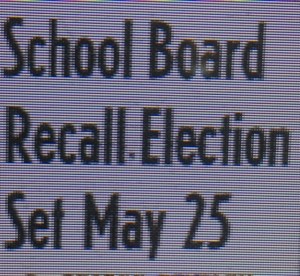
On May 15, 1959, the Pulaski County Election Commission met to discuss the competing efforts to recall members of the Little Rock School Board.

The day prior, the Pulaski County Clerk had certified that petitions had enough valid signatures to have an election about recalling School Board members Ed McKinley, Robert Laster and Ben Rowland. There were also enough valid signatures to put before voters the recall of Ted Lamb, Everett Tucker and Russell Matson.

Because all of the school board members were to be on the ballot, the Election body decided to list them each alphabetically.  For each person there would be the question as to whether he should be recalled and voters would indicate “yes” or “no.”

The date of May 25, 1959, was set for the election.

It would be open to anyone with a valid 1958 poll tax receipt.  Voters must also live within the Little Rock School District boundaries (which were not coterminous with the city limits). They must have been residents of Arkansas for a year by election day, residents of Pulaski County for six months, and resided within their precinct for 30 days.

Meanwhile supporters of both trios were hard at work.  STOP had been in existence for a week to promote the efforts to recall the segregationist faction of the school board.  While the Central High Mothers League and Capitol Citizens Council had been working to recall the other three members of the school board, rumors were swirling about the emergence of a new organization which sought to fight for segregation.

Remembering the 23 LRPD Officers killed in the line of duty

May 15 each year is set aside as Peace Officers Memorial Day during Police Week.  Last Friday, the City of Little Rock paid tribute to the 23 men who were Little Rock Police Officers killed in the line of duty since the department was founded in 1866.

These were veterans and newcomers. They were white and African American.  They held the rank of Patrolman, Detective, Sergeant and Lieutenant.  Some had been on the force just a few years while one had over thirty years service in the LRPD uniform.

The details of each incident are tragic in their own way. But regardless of the circumstances which led to their death, it is important to remember that each of them gave their life in service to the citizens of Little Rock.

Patrolman William L. Copeland
December 30, 1885
Killed after being assaulted

Patrolman W. T. Phillips
August 1, 1908
Shot and killed while attempting an arrest

Patrolman John O. Miller
April 23, 1911
Shot and killed while attempting an arrest

Sergeant William I. Campbell
April 18, 1912
Shot and killed while investigating a disturbance

Detective Sam Morgan
October 30, 1915
Killed in a shootout while attempting an arrest

Patrolman Joe Erber
June 30, 1920
Shot and killed while responding to a disturbance

Patrolman Thomas D. Hudson
August 19, 1920
Shot and killed while attempting an arrest

Detective Sergeant John W. Cabiness
August 12, 1922
Accidentally shot and killed by a law enforcement official from another agency

Detective Sergeant George W. Moore
July 24, 1923
Shot and killed instantly while on an investigation with Detective Sergeant Luther Hay

Detective Sergeant Luther C. Hay
July 26, 1923
Died from injuries after being shot while on an investigation with Detective Sergeant George Moore

Patrolman Charles B. Faulkner
July 13, 1924
Died from injuries in a motorcycle accident while responding to a call

Patrolman Harvey L. Biggs
July 27, 1924
Shot and killed while investigating a burglary

Patrolman Frank E. Swilling Sr.
December 11, 1926
Died due to injuries received after being struck by a car while serving a summons

Patrolman Robert A. Johnson
March 23, 1930
Killed when his police motorcycle was struck by a car

Detective Samuel Neal McDermott
September 3, 1930
Died from injuries after being shot while attempting an arrest

Detective Oscar F. Deubler
January 1, 1947
Killed by an officer under investigation who mistakenly thought Lt. Deubler had testified against him. After killing Lt. Deubler, the officer killed himself.

Patrolman Lloyd W. Worthy
September 2, 1967
Shot and killed while investigating suspicious activity

Patrolman Alvin Joseph Free
September 27, 1970
Killed in an automobile accident while responding to backup an officer

Detective Noel Don McGuire
May 14, 1980
Shot in the back and killed while working a vice detail

Patrolman David Barnett
February 13, 1991
Shot and killed while trying to stop an armed robbery

Patrolman Henry L. Callanen
May 15, 1993
Shot and killed while making a bank deposit in an off-duty job

Detective Joseph Tucker Fisher
February 7, 1995
Shot and killed while serving a narcotics search warrant

Patrolman Jack David Cooper
February 2, 2002
Died from a gunshot wound received the previous day when respondeding to a disturbance