Little Rock Look Back: First six Little Rock Police officers are hired

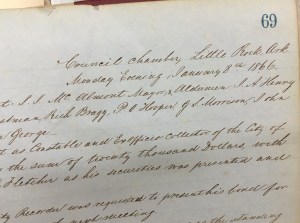
On January 9, 1866, the new Little Rock City Council held its second meeting after the post-Civil War resumption of municipal government.  At that meeting, a special committee was created to meet with Gen. Williams who was the military commander for Arkansas.  Mayor J. J. McAlmont, Alderman I. A. Henry, and Alderman Henry Ashley were authorized to discuss the creation of a permanent police force in Little Rock.

At the same meeting, the City Council hired the first Little Rock police officers. These six men were hired on a temporary basis until a department could be created. Their pay was $3.00 a day (that would be the equivalent of $47.55 a day in 2019). The first six officers were John O’Brien, Thomas Doyle, James Anderson, John Henry, Fred Kurtz, and Joseph Chears.

Prior to the Civil War, Little Rock had a Constable and volunteers, but no police force.  As the City had continued to grow, even during the Civil War, as the government was reorganizing, it was felt it was time for a permanent police force.

The Little Rock Police Department was officially created on January 15, 1866 by Ordinance 2 of 1866. Two days later, the salary was set at $2.00 a day.  No reason was given as to the reduction from the temporary pay base.

Learn more about ways to get involved with Arkansas Rep

Interested in becoming more involved with The Rep? They are back in action and ready for a great 2019 season, but they cannot do it without community support!

On January 22 from 5:30pm to 7:00pm, the Arkansas Repertory Theatre will host an information session about volunteer and involvement opportunities.

Join them to learn about the ways you can volunteer at The Rep and impact the community.

Light refreshments will be provided.

The session will be at the Rep’s main building.

The 2019 Intimate Neighborhood Concerts announced by Arkansas Symphony

Songs from the HeartThe Arkansas Symphony Orchestra, Philip Mann, Music Director and Conductor, presents the 2018-2019 Intimate Neighborhood Concerts (INC) Series. The series opens with Songs from the Heart, featuring ASO principal musicians Michael Underwood (trombone), Susan Bell León (bassoon), and Blake Taylor (percussion) as soloists at Trinity Episcopal Cathedral on Mar. 28, 2019, and closes with Beethoven’s Triple Concerto on May 23, 2019 at Calvary Baptist Church in Little Rock.

Subscriptions and single tickets to the two-concert series are on-sale now; general admission single tickets are $29 per concert, and new subscribers get both concerts at half-price if they subscribe by January 25th. Patrons interested in the subscription discount should visit www.ArkansasSymphony.org/inc2019. Active duty military and student tickets are $10.

Tickets can be purchased online at www.ArkansasSymphony.org; at the concert venues beginning 60 minutes prior to a concert; or by phone at 501-666-1761, ext. 1.

The ASO Intimate Neighborhood Concerts series is an opportunity for audiences to enjoy fantastic music in acoustically unique venues around Little Rock.  The concerts offer intimate performances where patrons can get up-close and personal with musicians in chamber orchestra ensembles. In addition to hearing these beautiful works, concertgoers are invited to mingle with the musicians after the concerts.

Series Performances:

Songs from the Heart | March 28, 2019 at 7 pm
Trinity Episcopal Cathedral (310 W 17th St, Little Rock, AR 72206)
Philip Mann, conductor
Michael Underwood, trombone
Susan Bell León, bassoon
Blake Taylor, vibraphone

ALBRECHTSBERGER–Trombone Concerto in B-flat Major
LARSEN–Elegy for Bassoon and Strings
SÉJOURNÉ–Concerto for Vibraphone and Strings


Beethoven’s Triple Concerto | May 23, 2019 at 7 pm
Calvary Baptist Church (5700 Cantrell Rd, Little Rock, AR 72207)
Philip Mann, conductor
soloists TBA

KARLOWICZ— Serenade for Strings, Op. 2
MOSZKOWSKI–Prelude and Fugue, Op. 85
BEETHOVEN–Concerto for Violin, Cello, and Piano in C Major, Op. 56


The Arkansas Symphony Orchestra celebrates its 53rd full season in 2018-2019, under the leadership of Music Director Philip Mann. ASO performs more than sixty concerts each year for more than 165,000 people through its Stella Boyle Smith Masterworks Series, ACXIOM Pops LIVE! Series, River Rhapsodies Chamber Music Series, Intimate Neighborhood Concerts and numerous concerts performed around the state of Arkansas, in addition to serving central Arkansas through numerous community outreach programs and bringing live symphonic music education to over 26,000 school children and over 200 schools. ASO is a member of the League of American Orchestras.

For more information about the Arkansas Symphony Orchestra call 501-666-1761 or visit www.ArkansasSymphony.org

Little Rock Look Back: Post-Civil War government resumes for Little Rock

One hundred and fifty three years ago today (on January 8, 1866), Little Rock City Hall resumed functioning after the Civil War.  The City government had disbanded in September 1863 after the Battle of Little Rock.  From September 1863 through the end of the war (on on through part of Reconstruction), Little Rock was under control of Union forces.
Following the April 1865 conclusion of the Civil War, plans were made to restart local government in Little Rock.  Even though Arkansas would not have Congressional representation in Washington until June 1868 (becoming the second Confederate state after Tennessee), the establishment of local government took place in January 1866.  (It was supposed to have started earlier, but the local elections set for November 1865 were cancelled on the day they were originally set to take place.)

The first City Council meeting took place on Monday, January 8, 1866. The council met again on Tuesday, January 9 and Monday, January 15 as they were trying to establish committees and rules for the new government.

The first post-Civil War mayor was Dr. J. J. McAlmont, who was a physician and pharmacist. Following his service as the city’s chief executive, he would later be a co-founder of what is now UAMS.  The initial aldermen were I.A. Henry (who had been on the City Council when it ceased in 1863), Henry Ashley, M. H. Eastman, Rick Bragg, Dr. P. O. Hooper, G. S. Morrison, John Collins and Alexander George.

Their first action was to approve the bond of Thomas C. Scott as Constable and City Collector.  Vouching for him were S. H. Tucker and future LR mayor John Gould Fletcher.  The Recorder was asked to present his bond and the next meeting.

The Mayor then established several committees of the City Council and named his appointments. Among the committees were Finances, Streets, Ordinances, Mount Holly Cemetery, Fire Department and Police.

That meeting and the following two meetings, the City continued to approve motions, resolutions and ordinances to set up the duties and responsibilities of a government.

Ordinance Number 1 established the rates of Licenses for 1866.  Among those were:

  • $100 for the privilege of selling goods at auction
  • $20 for a one-horse wagon, paid quarterly
  • $35 for a two-horse wagon, paid quarterly
  • $50 for a four-horse wagon, paid quarterly
  • $25 to run a cab or bus (which would have been in some horse drawn conveyance), paid quarterly
  • $40 a month to sell liquor, wine, ale, beer, etc., by the glass or bottle to be consumed in a store, tavern, shop or store
  • $25 each quarter for each billiard table
  • $50 each quarter for each ten pin alley

Little Rock Look Back: First documented theatrical performance in Little Rock

On January 8, 1835, the Little Rock Town Council passed an ordinance granting the Society of Thalians a one year franchise to conduct performances in Little Rock.

That same day, the Thalians performed She Stoops to Conquer, Oliver Goldsmith’s 1773 comedy.

The following week, on January 17, they performed the comedy Ways and Means (by George Colman, Jr.) and David Garrick’s farce The Lying Valet.

The cost of the license to perform was $10 for the year. That would be the equivalent of $287 today. The ordinance also instructed the Town Constable to attend, by himself or a deputy, all theatrical performances to keep and preserve order.

There may well have been theatrical troupes come through Little Rock prior to January 1835, but records do not exist to any performances they may have given.  The performances by the Thalians are the first documented theatrical productions in Little Rock.

Mid-Century Modern work of Frank Doughty topic of architecture lecture

Tonight (January 8), the Architecture and Design Network (ADN) continues its 2018/2019 June Freeman lecture series by taking a look at the Mid-Century Modern work of architect Frank Doughty (1930-present), a lecture by Mason Toms, architectural historian and preservation designer at the Arkansas Historic Preservation Program.  The program is entitled “The Unexpected Modernism of Frank Doughty.”

There is a reception starting at 5:30pm followed by the lecture at 6pm. It is in the lecture hall of the Arkansas Arts Center.

Frank L. Doughty was born and raised near Tunica, Mississippi at the dawn of the 1930s. After high school and military service during the Korean Conflict, Doughty attended the University of Arkansas architecture program. After graduating from the program, he went to work for internationally renowned architect and Arkansas native, Edward Durell Stone, in his New York office. This was followed by work in the Fayetteville office of equally renowned architect, E. Fay Jones. Eventually he moved to Boca Rotan, Florida, where he operated his own practice before returning to Arkansas to teach at the University of Arkansas School of Architecture.

Though primarily remembered for his 23 years as an architecture professor at the University of Arkansas, Doughty also created a small but meaningful body of work that injected Modernist architecture into the most unlikely of places in a profound and elegant way. Located mainly in the Arkansas Delta region, Doughty’s work drew inspiration from the work of Frank Lloyd Wright and Edward Durell Stone as well as the surrounding rural landscape. He uniquely designed his buildings in such a way that they simultaneously stood out and blended into their individual settings.  The excellence of construction and high level of architectural skill present in each of the structures has made them hidden gems of Modernist design in predominantly traditional areas.

Mason Toms is an architectural historian and preservation designer at the Arkansas Historic Preservation Program. In college, Mason developed a passion for Mid-Century Modern architecture, but was disappointed to learn that there was little research being done on Mid-Century Modern architects in Arkansas. This led him to work closely with the National Register and Survey staff to find, research, and document Mid-Century Modern architecture around the state.

In an effort to raise awareness of the many remarkable Modernist structures in Arkansas, Mason created and continues to administer the Facebook group Mid-Century Modern Arkansas. The group page features a different Modernist building in the state almost every Friday. Additionally, Mason collaborates with local preservation organizations to create tours and present lectures that center on the significance of Mid-Century Modern architecture in general and the unique examples found here in Arkansas.

Architecture and Design Network lectures are free and open to the public. No reservations are required. Supporters of ADN include the Fay Jones School of Architecture and Design, the Central Section of the Arkansas Chapter of the American Institute of Architects and friends in the community.

Elvis at 84

Elvis backstage at Robinson–photo by Wayne Cranford

Eighty-four years ago today, Elvis Presley was born in Tupelo, Mississippi. He would, of course, grow up to become a cultural phenomenon.

Elvis performed in Little Rock throughout his career. In April 1972, he played at Barton Coliseum (with tickets on the arena floor going for a whopping $10!). In the 1950s, he played three at Robinson Auditorium. His first appearance was as his career was just starting to take off. The final appearance on that stage, a mere 15 months later, was when he had become a national icon.

His first appearance at Robinson was on February 20, 1955. Billed as the “WSM Grand Ole Opry” show, Elvis Presley was third on the bill behind the Duke of Paducah and Mother Maybelle and the Carter Sisters as he began week long tour of Arkansas and Louisiana. On this date there were a pair of shows, at 3:00 and 8:15 p.m., at Robinson Auditorium. Tickets were 75-cents in advance, $1.00 at the box office and 50-cents for kids. It is believed that Gladys and Vernon Presley attended this performance, invited by Elvis who wanted to introduce them to the Colonel. Gladys was a big fan of the Duke of Paducah. Elvis Presley, Scotty Moore, and Bill Black receive $350 for these two shows instead of their usual $200 per day. In August 1955, he returned and played Robinson as part of the All-Star Jamboree.

His third and final appearance at Robinson Auditorium was on May 16, 1956. This time, the Auditorium was packed. The tickets were $1.50 in advance at Walgreens and $2.00 at the box office. The ads featured 8 great acts in “his” variety show which consisted of the Jordonaires; Rick and Emil Flaim and their orchestra; vocalists Frankie Conners and Jackie Little and comedian-magician Phil Maraquin. A second show was added to accommodate the ticket demand.

About 30 minutes late, due to a missed flight, Elvis appeared on stage in a purple blazer and started singing “Heartbreak Hotel.” The crowd rushed the stage. Little Rock police officers were able to control them eventually and get the teenagers back to their seats. While the crowd was impressed, the police officers were less so. One of the patrolmen told the Arkansas Gazette reporter: “I wouldn’t know him if I saw him. And I wouldn’t be here unless I was being paid.”