
15 Highlights of 2015 – Robinson Center Renovation Tops Out

LRCV 1The Little Rock Convention & Visitors Bureau (LRCVB), members of the Little Rock Advertising and Promotion Commission (LRA&P), local officials, and members of the design and construction teams hosted a topping out ceremony July 1, 2015 at 10:00 AM for the Robinson Center’s new conference facility, signifying a one–‐year milestone in the 28–‐month, $70 million renovation and expansion project.

Following a press conference and ceremonial beam signing held on the western side of the Robinson Center, local media and special guests were given tours of the magnificent ballroom platform and conference center located on Robinson’s north side. This new addition not only provides some of the most dramatic enhancements of the project, but will also provide groups with spectacular views of the Arkansas River and the city’s illuminated bridges.

Along with additional meeting and pre–‐function space situated above its ballroom, the new conference center will also provide a new connection to the DoubleTree Hotel, with an adjoining lobby and additional pre–‐function space.

Robinson Center will reopen in November 2016.  The Arkansas Symphony Orchestra will return its Masterworks and Pops series to Robinson. Ballet Arkansas will perform The Nutcracker there in December 2016.  Celebrity Attractions will bring Broadway back to Robinson (on Broadway, no less) next season as well.  They have already announced The Phantom of the Opera for March 2017.

LRCV 5For more information on the Robinson Center Second Act renovation and expansion project, visit http://www.RobinsonCenterSecondAct.com.

Robinson Construction Facts to Date:

  • Nearly 10,000 tons of material have been recycled, representing 91% of the waste material diverted 1,216 tons of steel has been erected
  • 2,300 cubic yards of concrete has been placed
  • 470 individuals have gone through CDI/Hunt Safety Orientation
  • 73% of the project subcontractors are local
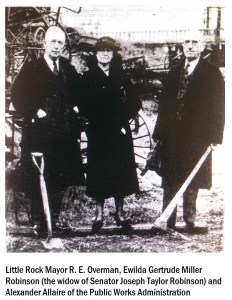
Little Rock Look Back: Groundbreaking for Robinson Auditorium

122437 GroundbreakOn December 24, 1937, at 11:30 a.m., Little Rock Mayor R. E. Overman, Ewilda Gertrude Miller Robinson (the widow of Senator Joseph Taylor Robinson) and  Alexander Allaire of the PWA turned dirt to participate in the brief groundbreaking ceremony for Little Rock’s municipal auditorium.  That morning, the Arkansas Gazette ran a brief story on the upcoming groundbreaking.  The story mentioned that the building would be named in memory of the late beloved Arkansas politician.  This appears to be the first public pronouncement of the Robinson name for this civic structure.

Among others in attendance at the groundbreaking were Mrs. Charles Miller (sister-in-law of Mrs. Robinson), Mr. and Mrs. Grady Miller (brother and sister-in-law of Mrs. Robinson), the mayor’s wife, the three architects (George Wittenberg, Lawson Delony and Eugene John Stern), and D. H. Daugherty and Will Terry of the City’s Board of Public Affairs.

Construction had to start by January 1, 1938, in order to receive PWA funds.  By breaking ground on December 24, there was over a week to spare.  The site had been selected in late October 1937, and the purchase had not been finalized.  But the PWA did give permission for the City to let a contract for excavation, demolition and filling on the site.

The groundbreaking took place at the corner of Garland and Spring Streets which was on the northeast corner of the block set aside for the auditorium.  Today, Spring Street does not extend north of Markham; the street was closed to make way for the parking structure and what is now the Doubletree Hotel.  Garland Street is basically an alley that runs parallel to Markham north of City Hall, Robinson Auditorium and the Doubletree Hotel.

15 Highlights of 2015 – New Visual Arts Building Announced for UALR thanks to gift from Windgate Foundation

Entry DriveFor the final fifteen days of 2015, a look back at some of the cultural highlights of 2015.

Up next–

In May, UALR announced plans for a new Visual Arts Building.  With a target date to open in fall 2017, the University of Arkansas at Little Rock’s newest building will be among the finest higher education facilities in the country for visual arts education.

UALR unveiled the design concept for the 71,636 square-foot building during a news conference in the Stella Boyle Smith Concert Hall. The visual arts building will be funded by a $20.3 million grant award approved by the Trustees of the Windgate Charitable Foundation, headquartered in Siloam Springs. The grant, designated for building construction and equipment, is the second largest gift in UALR’s history.

UALR serves about 1,000 students each year who are enrolled in visual arts classes. This semester, 180 students have designated visual arts as their major, and there are 16 full-time faculty devoted to visual arts programs.

The new facility, to be located on the UALR campus at 28th Street and East Campus Drive, will bring together under one roof the applied design program currently located at University Plaza and the art history and studio arts programs currently in the Fine Arts Building, a structure built in 1977 to house the departments of art and music.

The new building will integrate UALR’s Applied Design, Art History and Studio Arts classes into a facility that promotes collaboration and creativity between students, faculty and guests under one roof. Drawing/Painting/Printmaking/Art History and 2D Design and Illustration classrooms will be located on the north side of the building to make use of the large expanse of glass along 28th Street.

Faculty and administrative offices will be oriented on the south side to take advantage of the campus and natural plaza views. Photography and Graphic Design spaces will complete the programs that are housed within the visual arts track.

Students and visitors have the opportunity to experience two generous art galleries within the building showcasing both permanent and transitional exhibits or attend a guest lecturer speaking in the 80-seat lecture hall and reception venue on the ground floor.

The Applied Design spaces will be organized within a single story industrial high bay section of the building to take advantage of the expansive volumes of space necessary for Sculpture/Metalsmithing/Furniture Design /3D Craft & Fibers/Ceramics. Each of these spaces has access to an outdoor studio space that allows work on large pieces with natural ventilation and sunlight.

The building will be designed to achieve a LEED Silver rating with the USGBC LEED (Leadership in Energy and Environmental Design) rating system.

The Bachelor of Fine Arts (BFA) in Art/Applied Design track, a unique program in Arkansas, primarily serves students interested in the study of traditional arts and crafts representative of the South Central region of the U.S., with particular emphasis upon craft practices within Arkansas.

“The vision of the Department of Art is to be a destination center for students intent on pursuing lifelong careers in the visual arts,” said department chair Tom Clifton. “This new facility will enable the department to embrace traditional, contemporary, and technological approaches to the visual arts in central Arkansas and provide opportunities for students throughout the southern region of the United States.

The Windgate Charitable Foundation has provided consistent and visionary support of the UALR Department of Art through scholarships, program support, visiting artists, workshops and gallery exhibitions.

15 Highlights of 2015 – Polk Stanley Wilcox wins AIA/ALA Library Building Award for CALS Children’s Library

Childrens Library 2For the final fifteen days of 2015, a look back at some of the cultural highlights of 2015.

Up first –

Polk Stanley Wilcox Architects and the Central Arkansas Library System were honored with Library Architecture’s highest and most prestigious achievement: A 2015 AIA/ALA Library Building Award. 

Of all libraries submitted, the 2015 AIA/ALA Library Building Awards honor only six separate projects. The Hillary Rodham Clinton Children’s Library and Learning Center joins prestigious projects from as far away as Vancouver, Washington, Dartmouth, Mass., Norfolk, Virginia, San Antonio, Texas, and Des Moines, Iowa. The projects was honored at the National ALA Conference in San Francisco on June 25-30th.

To encourage excellence in the architectural design and planning of libraries, the National American Institute of Architects (AIA) in Washington DC and the American Library Association (ALA) created this award to distinguish accomplishments in library architecture. Biennially, representatives of each organization celebrate the finest examples of library design from around the world designed by American Architects.

READThe new Children’s Library and Learning Center is based on experiential learning, where children are educated through hands on activities that teach life skills needed to become responsible adults. Referred to as a “community-embedded, supportive learning center,” this library offers not only books, but also a performance space, a teaching kitchen, a greenhouse and vegetable garden, and an arboretum.

The award is given every two years.  It is the second time that Polk Stanley Wilcox has received the award for a CALS project.  In 2011 the firm won it for the Arkansas Studies Institute building.  Not only is it rare for a firm to receive this award, it is even more rare for the same firm to receive it twice for working with the same client.  These honors are a testament to the leadership at both Polk Stanley Wilcox and the Central Arkansas Library System.

Little Rock Look Back: Little Rock votes to Restore Robinson

On Tuesday, Dec. 10, 2013, voters of Little Rock overwhelmingly chose to renovate the historic Joseph Taylor Robinson Memorial Auditorium.

By a vote of 5,183 For and 1,800 Against, Little Rock citizens approved a plan to use a portion of the city’s existing 2 percent restaurant and hotel tax to repay bonds for a renovation of Robinson Center.  The campaign was chaired by businessman Charles Stewart, restaurateur Capi Peck and former LR Mayor Jim Dailey.

Robinson has long been a landmark in central Arkansas. Construction of the Joseph T. Robinson Memorial Auditorium began in 1938 (after a December 1937 groundbreaking under a deadline) and officially opened February 1940. The structure was a PWA (Public Works Administration) project, and is an excellent example of the Art Deco style architecture of the time. The building was added to the National Register of Historic Places in 2007.

The facility is owned by the City of Little Rock and managed by the Little Rock Convention & Visitors Bureau.

The 1940 structure suffered from a wide array of deficiencies, including stage loading and unloading, stage size, acoustical insufficiency, dressing room access and inadequate wing space within the performance hall. Also, structural, mechanical and electrical issues, public circulation and outdated conference center spaces existed within the facility.

Knowing the center is in need of major upgrades if the facility is to continue to serve central Arkansas into the future, the Little Rock Advertising and Promotion Commission (LRA&P) empanelled a Robinson Center Concept Team in October 2011. The group was tasked with evaluating all aspects of the existing facility, researching user needs, proposing conceptual solutions and estimating the cost and construction schedule of the proposed additions and renovations. The concept team was led by Mike Steelman of SCM Architects, PLLC, and included representatives from WD&D Architects, Shuler Shook Theatre Planners, Jaffe-Holden Acoustical Consultants, TME Inc. Mechanical and Electrical Engineers, ECI Inc. Structural Engineers, McClelland Consulting Engineers Inc. Civil Engineers, East Harding Construction, HVS Consulting and Hunt Construction Group.

Additionally, stakeholder and tenant organizations representing the Arkansas Symphony Orchestra, Celebrity Attractions of Tulsa, Oklahoma and the Double Tree Hotel participated in the planning. The concept team findings were presented publicly on June 5, 2012.

On January 17, 2013 the LRA&P announced the selection of Polk Stanley Wilcox Architects, partnered with Ennead Architects, as the architectural and design team for the future renovations. On March 28, 2013 CDI Contractors LLC, partnered with Hunt Construction Group, were selected by LRA&P as the general contractors and construction managers.

On September 23, 2013 the final schematic renderings and cost estimates were presented publicly. The schematic plans depict major interior upgrades within the performance hall including additional volume to create a two-balcony setup, increased lobby space, acoustical improvements, theatrical upgrades, loading dock expansion, a larger stage area, and new dressing room facilities. Additionally, an enhanced modern ballroom and small conference center was unveiled. New technology, mechanical systems, and outdoor plaza spaces were included in the presentation.

Construction would begin on July 1, 2014, with a completion scheduled for November 2016.


Elysse Newman discusses “NEW (OLD) DIRECTIONS IN ARCHITECTURE” tonight at the ADN Lecture

AN_WENewman_ArchHeadElysse Newman, recently installed as Professor and Head of the Department of Architecture at the Fay Jones School of Architecture and Design (FJSAD), will be the final 2015 first speaker for the Architecture and Design Network’s lecture series. Her remarks are entitled “NEW (OLD) DIRECTIONS IN ARCHITECTURE.”

Newman will speak tonight at 6pm at the Arkansas Arts Center. A reception at 5:30 will precede the remarks.

She has been tasked with developing a “curriculum for the 21st Century”, one that will prepare students for new, unexpected and increasingly complex challenges likely to be encountered in the practice of architecture. Building on the “old” while incorporating the “new”, much of it research based, is what she and her staff will be doing. FJSAD dean, Peter MacKeith, calls Newman “one of a new generation of architectural educators.”

The focus of Newman’s academic research has been and will continue to be multidisciplinary studies involving the fields of perception, psychology and neuroscience, disciplines whose relationship to architecture is of increasing interest to the profession.

Newman received a Bachelor of Architecture and a Bachelor of Science in history, with psychology and anthropology minors, all from the University of Texas at Austin. She also received a Master of Architecture, a Master of Philosophy in history of technology and science, and a Doctorate of Philosophy in architecture, urban design, planning and landscape architecture, all from Harvard University. She has taught at Florida International University since 2011. She previously was a visiting professor at Washington University in St. Louis and the University of Tennessee, and a teaching fellow at Harvard University. Newman was a Fellow at the Max Planck Institute for the History of Science in Berlin.

Architecture and Design Network lectures are free and open to the public. For additional information contact ardenetwork@icloud.com.
Supporters of the non-profit Architecture and Design  Network (ADN) include the Arkansas Arts Center, the Fay Jones School of Architecture, the Central Section of the Arkansas Chapter of the American Institute of Architects and friends in the community.

Little Rock Look Back: Robinson Auditorium Construction Hits Milestone in 1939

jtrma-bw.jpgMany months behind schedule, it was 76 years ago today that the construction of the Joseph Taylor Robinson Memorial Auditorium was declared “substantially finished.”

On December 8, 1939, the work of the general contractor was complete.  The building’s utilities were all fully connected as the steam line and electric transformer were hooked up.  While the work of the general contractor was through, there was still much work to be done.

Though there were still unfinished portions of the structure, the exterior was complete and finished surfaces had been installed on the interior.  Until the building was officially turned over to the City, the federal Public Works Administration still had to give approval for any uses of the building.

Mayor J. V. Satterfield, Jr. told the press that he wasn’t sure when the City would formally accept the building. The connection of the utilities had used up the remaining funds, so there was uncertainty as to when the final tasks would be completed.

When it was built, Robinson Auditorium was the first municipal auditorium in the south central United States to be air conditioned.  However, the air conditioning unit was not sufficient to cool both the music hall and the convention hall at the same time.  In warm weather months concurrent events would not be able to take place on the two levels.