
Skip to primary content
Skip to secondary content

Little Rock Culture Vulture

Cultural events, places and people in the Little Rock area

Little Rock Culture Vulture

Main menu

  • Home
  • About the Little Rock Culture Vulture
  • Little Rock Cultural Institutions and Organizations (alphabetical)
  • LR Cultural Sites by Discipline
  • Pulitzer Prize
  • Shows Seen
  • Theatre Reviews
    • Lucky 13
    • NPHS Fall of the House of Usher, ushers in fall
    • PIPPIN’s Magic Just for You
    • The Lullaby of a Golden Tent Season
    • Thoroughly Enjoyable Millie(s)
  • Tony Awards
    • 2014 Tony Award Predictions
    • 2015 Tony Awards
      • 2015 Tony Award Nomination Predictions
      • Tony Award Nomination Analysis
    • 2016 Tony Awards
      • 2016 Tony nomination predictions

Category Archives: Civic Engagement

Post navigation

← Older posts
Newer posts →

LR Likes Ike. In September 1952.

Posted on September 3, 2019 by Scott

Detail from UPI photo of General Eisenhower following his address.

If Ike, Little Rock and September are considered, it is usually in reference to his role in the desegregation of Little Rock Central High in September 1957.  But five years earlier, he appeared in Little Rock on September 3, 1952.

General Eisenhower’s speech to 14,000 in MacArthur Park was the final leg in his swing through the South on his campaign for the White House.  He became the third presidential candidate to visit MacArthur Park in 1952 following General MacArthur (in his ill-fated attempt to gain traction as a GOP candidate during the delegate selection process) and Democratic nominee Adlai Stevenson.

He visited every southern state except Mississippi on this campaign jaunt.  In comments that neither he nor his audience could have foreseen as prescient, Eisenhower declared that he deplored the government meddling in areas in which it did not belong.  This remark was made in reference to race relations.  His stance was that some rights of minorities should be protected, but it was not necessarily the role of the federal government.

Ike proffered that if white southerners did not protect the rights of African Americans they were in danger of losing their own rights, too.  In the era of the Cold War when people were worried about the imminent loss of rights, this message seems to have crafted to appeal to those concerns.  While Eisenhower did not shy away from addressing civil rights, his Democratic opponent Adlai Stevenson was silent on the issue.  But with Alabama segregationist Senator John Sparkman as his running mate, it put Stevenson in a difficult position to try to bring it up.

In the end, Ike lost most of the South.  He did carry Maryland, Virginia, Tennessee and Florida. The only states Stevenson won were in the South.  Eisenhower’s 43.74% of the Arkansas popular vote was the highest any Republican had garnered since General Grant carried the state in 1868 and 1872.

The number of votes Ike received in 1952 prompted Adlai Stevenson to come to Little Rock in 1956 – the first time a Democratic nominee had come to solidly Democratic Little Rock since the 1920s.

Share this:

  • Share on Facebook (Opens in new window) Facebook
  • Email a link to a friend (Opens in new window) Email
  • Share on X (Opens in new window) X
  • Share on LinkedIn (Opens in new window) LinkedIn
  • Share on Tumblr (Opens in new window) Tumblr
  • More
  • Share on Reddit (Opens in new window) Reddit
Like Loading...
Posted in Civic Engagement, Government, History, LR Look Back | Tagged Adlai Stevenson, civil rights, Douglas MacArthur, Dwight Eisenhower, Foster Bandshell, John Sparkman, Little Rock, MacArthur Park, Ulysses S. Grant, United Press

It is RBG Day!

Posted on September 3, 2019 by Scott
Image may contain: 1 person, eyeglasses and closeup
After selling out in less than 45 minutes (proving she really is a rock star!) and switching venues (which still left a waiting list of several thousand long), tonight is the night that the Honorable Ruth Bader Ginsburg, Associate Justice of the U.S. Supreme Court makes her appearance here.
In July, the Clinton Foundation and Clinton School of Public Service announced the next Frank and Kula Kumpuris Distinguished Lecture would feature Justice Ginsburg.  She will be introduced by the man who nominated her to the Supreme Court, President Bill Clinton.

Though the event is sold out, it will be available to watch via live stream.


Those attending the Kumpuris Lecture with the Honorable Ruth Bader Ginsburg, please read this important information on entry, seating, security, accessibility, and more:

Event Information
• The event is scheduled to begin at 6:30 p.m. and doors open at 5 p.m.
• Please arrive early and expect traffic delays and long lines.

Entry and Seating
• You must have a printed or digital Eventbrite ticket to gain admission to the event. This event is at full capacity and we cannot admit anyone who does not have a ticket.
• Your tickets can be accessed through the Eventbrite app or through your Eventbrite account online at https://eventbrite.com. Your tickets are also attached to this email.
• Seating for the event is general admission with open seating. Again, the event is at full capacity, so we encourage everyone to move to the middle of the row as you arrive to make seating go more smoothly.
• If you plan to sit together during the event, please arrive together. We cannot accommodate saving groups of seats because we need to fill in the rows as guests arrive.

Parking Information
• There will not be reserved parking for this event.
• There are paid and public parking areas around Verizon Arena. Directions and parking information can be found at this link.
• As a reminder, the METRO Streetcar rides are currently free and the Blue Line has a stop located two blocks from Verizon Arena.

Bag and Security Policy
• We will be following Verizon Arena’s Security Policies. A full list of those policies can be found at this link.
• All guests entering Verizon Arena will be subject to inspection by walk-through metal detector and all bags will be inspected.
• Any bags larger than 14” x 14” x 6 will not be allowed in Verizon Arena.

Accessible Information
• Verizon Arena strives to meet all public facility structure and service requirements set by the Americans with Disabilities Act. ADA parking is available by the Washington Street/Box Office Tunnel.
• All ADA areas can be accessed from the Box Office Tunnel Entrance.
• ADA seating is available on a first come, first served basis, and each ADA seat comes with one (1) companion seat.
• There will be an interpreter during the event. American Sign Language designated seating will be at the front of Section 106.
• ASL seating is available on a first come, first served basis, and each ASL seat comes with one (1) companion seat.
• Wheelchairs and hearing impaired devices are available at Verizon Arena Guest Services, located in front of sections 113-144 on the Main Concourse.
• More ADA information can be found at this link.


Ruth Bader Ginsburg, Associate Justice of the Supreme Court of the United States, was born in Brooklyn, New York, March 15, 1933. She married Martin D. Ginsburg in 1954, and has a daughter, Jane, and a son, James. She received her B.A. from Cornell University, attended Harvard Law School, and received her LL.B. from Columbia Law School.
She served as a law clerk to the Honorable Edmund L. Palmieri, Judge of the United States District Court for the Southern District of New York, from 1959–1961. From 1961–1963, she was a research associate and then associate director of the Columbia Law School Project on International Procedure. She was a Professor of Law at Rutgers University School of Law from 1963–1972, and Columbia Law School from 1972–1980, and a fellow at the Center for Advanced Study in the Behavioral Sciences in Stanford, California from 1977–1978. In 1971, she co-founded the Women’s Rights Project of the American Civil Liberties Union, and served as the ACLU’s General Counsel from 1973–1980, and on the National Board of Directors from 1974–1980. She served on the Board and Executive Committee of the American Bar Foundation from 1979-1989, on the Board of Editors of the American Bar Association Journal from 1972-1978, and on the Council of the American Law Institute from 1978-1993.
She was appointed a Judge of the United States Court of Appeals for the District of Columbia Circuit in 1980. President Bill Clinton nominated her as an Associate Justice of the Supreme Court. After receiving unanimous confirmation from the United States Senate, she took her seat August 10, 1993.

Share this:

  • Share on Facebook (Opens in new window) Facebook
  • Email a link to a friend (Opens in new window) Email
  • Share on X (Opens in new window) X
  • Share on LinkedIn (Opens in new window) LinkedIn
  • Share on Tumblr (Opens in new window) Tumblr
  • More
  • Share on Reddit (Opens in new window) Reddit
Like Loading...
Posted in Civic Engagement, Government, Lecture | Tagged Bill Clinton, Clinton Foundation, Clinton School of Public Service, Clinton School Speaker Series, Frank and Kula Kumpuris Distinguished Lecture Series, Ruth Bader Ginsburg, Skip Rutherford, Stephanie S. Streett

Writing contest by CALS in honor of 2019 Banned Books Week

Posted on September 2, 2019 by Scott

Image result for fight club bookThe Central Arkansas Library System has announced the title for its annual Banned Book Writing Contest and Crazy Free Books giveaway.
The 2019 Banned Books Writing Contest is inspired by Chuck Palahniuk’s Fight Club, which has been challenged in the U.S. due to some readers’ perception of the “violent and explicit” nature of some of the book’s content.

The writing contest has one $300 grand prize and one $100 honorable mention prize. Winning entries will be selected based on creativity, flow, style, and originality. CALS will give away 30 free copies of Fight Club as part of Crazy Free Books starting September 4.

Entries will be accepted beginning September 1 and must be received by September 20. Entries can be mailed to CALS Banned Books Writing Contest, 100 Rock Street, Little Rock, AR 72201 or sent to sixbridgesbookfestival@cals.org. The writing contest winner will be announced at a special event on Thursday, September 26, at CALS Ron Robinson Theater, 100 River Market Avenue.

For more contest rules and information about the Six Bridges Book Festival and Banned Books Week, call 501-918-3000 or visit cals.org.

Share this:

  • Share on Facebook (Opens in new window) Facebook
  • Email a link to a friend (Opens in new window) Email
  • Share on X (Opens in new window) X
  • Share on LinkedIn (Opens in new window) LinkedIn
  • Share on Tumblr (Opens in new window) Tumblr
  • More
  • Share on Reddit (Opens in new window) Reddit
Like Loading...
Posted in Civic Engagement, Government, Literature | Tagged CALS, Central Arkansas Library System, Chuck Palahniuk, Fight Club, Six Bridges Book Festival

Thurgood Marshall and Little Rock

Posted on August 30, 2019 by Scott

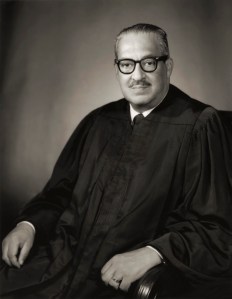
On August 30, 1967, Thurgood Marshall was confirmed as the first African American to serve on the Supreme Court of the United States.
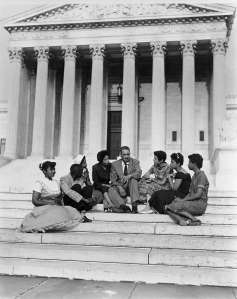
Ten years earlier, Marshall had been spending much time in Little Rock as he fought for the Little Rock Nine to be allowed to integrate Little Rock Central High School.

While he was in town, he would stay at the home of L. C. and Daisy Bates.  One  can tour the home today and see the bedroom in which he, Dr. Martin Luther King Jr., Ossie Davis & Ruby Dee, and other Civil Rights leaders stayed while visiting Little Rock.

Thurgood Marshall, of the NAACP, sits on the steps of the Supreme Court Building after he filed an appeal in the integration case of Little Rock’s Central High School. The students are, from left: Melba Pattillo, Jefferson Thomas, Gloria Ray, escort Daisy Bates, Marshall, Carlotta Walls, Minnijean Brown, and Elizabeth Eckford. (AP Photo, file)

His involvement with the Little Rock Nine came about from his role with the NAACP. In had been in that capacity that he was lead attorney for the Brown v. Board of Education decision which paved the way for the Little Rock schools to be integrated.  He worked with local attorneys such as Wiley Branton Sr. and Chris Mercer on the Little Rock efforts.

In May 1961, President John F. Kennedy named Marshall to a seat on the US Court of Appeals. Unsurprisingly, a group of segregationist senators tried to hold up the appointment.  In 1965, he was named to the position of Solicitor General by President Lyndon B. Johnson.

Regrettably there is another Arkansas connection to Thurgood Marshall’s appointment to the Supreme Court.  As he had with the 1961 appointment to the Court of Appeals, Arkansas Senator John L. McClellan vigorously opposed the nomination of Marshall.  As a member of the Judiciary Committee he tried to hold it up.  In the end, McClellan did not vote on Marshall’s appointment when it came before the full Senate.

The final vote was 69 for and 11 against with 20 not voting. Of the 11 former states of the Confederacy, Arkansas’ J. William Fulbright, Tennessee’s Howard Baker & Al Gore Sr., Texas’ John Tower & Ralph Yarborough, and Virginia’s William Spong were the only six votes for yes.  There were six who did not vote, and 10 Nay votes.

The remaining Nay vote came from West Virginia’s Robert Byrd. Among those outside the South who did not vote were future Democratic presidential candidates Eugene McCarthy,  Edmund Muskie and George McGovern as well as Republican former actor George Murphy.  Montana was the only state with neither senator casting a vote one way or the other.

Marshall served on the US Supreme Court until October 1991, when he retired due to failing health. He died in January 1993, just four days after Bill Clinton became president.

Share this:

  • Share on Facebook (Opens in new window) Facebook
  • Email a link to a friend (Opens in new window) Email
  • Share on X (Opens in new window) X
  • Share on LinkedIn (Opens in new window) LinkedIn
  • Share on Tumblr (Opens in new window) Tumblr
  • More
  • Share on Reddit (Opens in new window) Reddit
Like Loading...
Posted in Civic Engagement, Government, History, LR Look Back | Tagged Bill Clinton, Brown v. Board of Education of Topeka, Daisy Bates, J. William Fulbright, John F. Kennedy, John L. McClellan, L. C. Bates, Lyndon Baines Johnson, Martin Luther King Jr., Ossie Davis, Ruby Dee, Supreme Court, Thurgood Marshall, Wiley Branton Sr.

Joe T. Robinson born on August 26 1827

Posted on August 26, 2019 by Scott

Future Senator Joseph Taylor Robinson was born in Lonoke in August 26, 1872.  In 1894 Robinson was elected to the Arkansas General Assembly for one term.  From 1903 until 1913, he served in the US House of Representatives as a Congressman from Arkansas’ then-Sixth District.
He chose not to seek another term in Congress and ran for Governor in 1912.  On January 3, 1913, sitting US Senator Jeff Davis died in office.  Robinson was sworn in as Governor on January 16, 1913. Twelve days later he was chosen by the Arkansas General Assembly to become the next US Senator. He became the final US Senator to be selected by a legislator instead of popular vote.  At the time, Senate terms started in March, so Robinson served as governor until March 8, 1913.

He rose through the ranks of the Senate and eventually became the first person to hold the title of Senate Majority Leader.  In 1928, he was the Vice Presidential nominee for the Democratic Party.  Four years later, he rode with Franklin and Eleanor Roosevelt to the inauguration ceremonies before FDR took the oath.  He would be President Roosevelt’s go-to man on legislative issues.

Senator Robinson died in Washington D.C. on July 14, 1937.  His wife was in Little Rock making preparations for a trip the couple was to take. Following his demise, Mrs. Robinson went to Washington to accompany her husband’s body back to Arkansas.

It was not until December 1937, that Senator Robinson’s name became attached to the municipal auditorium which Little Rock voters had approved in January 1937.  Mrs. Robinson participated in the December 24, 1937, groundbreaking for the auditorium.

Naming the auditorium after him was not Little Rock’s first attempt at honoring Senator Robinson.  In 1930, portions of Lincoln, Q, and Cantrell streets were renamed Robinson Drive in his honor. This was part of an effort to give Highway 10 (which had four different names as it wended through the City) a single name in Little Rock.  A few months later the Senator requested that the original names be returned.  Cantrell had been named in honor of a developer who was continuing to work in the area surrounding that street.  The Senator felt it should be named after Mr. Cantrell.  As part of that, the name Cantrell was extended to most of Highway 10 within the Little Rock city limits.

In 1935, on Senator Robinson’s ante-penultimate birthday, the Little Rock City Council coincidentally approved the plans for a municipal auditorium which would then be submitted to the Public Works Administration.  It was this project which would become Robinson Auditorium.

Share this:

  • Share on Facebook (Opens in new window) Facebook
  • Email a link to a friend (Opens in new window) Email
  • Share on X (Opens in new window) X
  • Share on LinkedIn (Opens in new window) LinkedIn
  • Share on Tumblr (Opens in new window) Tumblr
  • More
  • Share on Reddit (Opens in new window) Reddit
Like Loading...
Posted in Civic Engagement, Government, History | Tagged Arkansas State Capitol, City of Little Rock, Ewilda Robinson, Franklin Delano Roosevelt, Gov. Jeff Davis, Joseph Taylor Robinson, Public Works Administration, Robinson Center Performance Hall, U. S. Senate

Movie Monday: THE WAR ROOM

Posted on August 19, 2019 by Scott

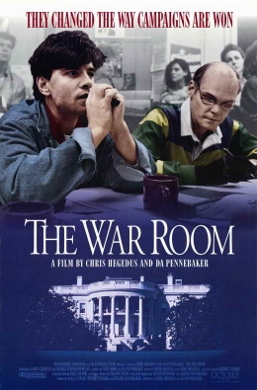
Later this week, Little Rock will be the site of the Arkansas Cinema Society’s FILMLAND 2019.  In anticipation of that (and in honor of today being Bill Clinton’s birthday), today we feature a film which showcased Little Rock’s role in the national political scene:  THE WAR ROOM.
This Oscar-nominated 1993 American documentary film follows Bill Clinton’s campaign for President of the United States, during the 1992 presidential election.  At the start of the 1992 Democratic primaries, husband and wife filmmakers D.A. Pennebaker and Chris Hegedus requested permission from the Campaign to film its progression.

The Clinton Campaign agreed, and Pennebaker and Hegedus were allowed to film Communications Director George Stephanopoulos as well as Lead Strategist James Carville; they were given limited access to Bill Clinton.  At the start of filming, the film team was embedded with the Clinton Campaign in New Hampshire for that state’s Democratic primary. During the onset of the campaign, the film crew traveled around the state with the Clinton campaign.

After the surprise Clinton second place finish in the New Hampshire primary, the crew filmed mostly in Little Rock, home to the Clinton campaign’s national headquarters. As the film focused in on Carville and Stephanopoulos, the film crew saw no need to travel outside of Little Rock as both were present in the city for much if not all of the primary and general election campaigns.

Because of the time spent in Little Rock, numerous buildings and backgrounds familiar to the capital city residents appear throughout the film. Jason D. Williams’ song “Get Back to Little Rock” is featured in the film’s soundtrack.

Though Stephanopoulos and Carville were the film’s main figures, many other prominent figures in the campaign were featured, including Paul Begala, Dee Dee Myers, Mandy Grunwald, Bob Boorstin, Stan Greenberg, Mickey Kantor, Harold Ickes, and Bush deputy campaign manager Mary Matalin, who later married Carville.  Also featured in footage are rivals George H. W. Bush, Ross Perot and Jerry Brown.

Though the film did not win the Oscar for Feature Documentary, Pennebaker would receive an Honorary Oscar in 2013.

Share this:

  • Share on Facebook (Opens in new window) Facebook
  • Email a link to a friend (Opens in new window) Email
  • Share on X (Opens in new window) X
  • Share on LinkedIn (Opens in new window) LinkedIn
  • Share on Tumblr (Opens in new window) Tumblr
  • More
  • Share on Reddit (Opens in new window) Reddit
Like Loading...
Posted in Civic Engagement, Film, Government, History | Tagged Academy Awards, Arkansas Cinema Society, Bill Clinton, Bob Boorstin, Chris Hegedus, D. A. Pennebaker, David Wilhelm, Dee Dee Myers, Filmland, George H W Bush, George Stephanopoulos, Harold Ickes, James Carville, Jason D. Williams, Jerry Brown, Mandy Grunwald, Mary Matalin, Mickey Kantor, Oscars, Paul Begala, Ross Perot, Stan Greenberg, The War Room b

On Bill Clinton’s 73rd Birthday, a look back to his performance with the Arkansas Symphony Orchestra

Posted on August 19, 2019 by Scott

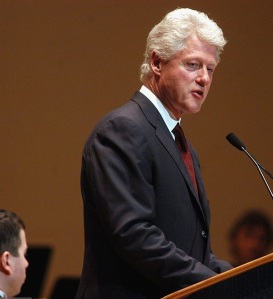
Former U.S. President Bill Clinton addresses the audience after reciting Martin Luther King’s famous speech, ‘I Have A Dream’, to the music of Alexander L. Miller at Robinson Auditorium March 25, 2003 in Little Rock, Arkansas. Clinton was the honored guest for a performance by the Arkansas Symphony Orchestra to benefit the William Jefferson Clinton Presidential Foundation. (Photo by Karen E. Segrave/Getty Images)

Bill Clinton turns 73 today.  In honor of his birthday, today we look back at his 2003 appearance with the Arkansas Symphony Orchestra.

Though he was known for his saxophone playing during the 1992 campaign and his days in the White House, his ASO appearance (much like the album for which he won a Grammy Award) did not involve him playing. Instead he provided narration to a symphonic work.

On March 25, 2003, former President Bill Clinton took the stage of Robinson Center Music Hall to perform with the Arkansas Symphony Orchestra. Entitled “Let Freedom Ring – A Patriotic Celebration,” the evening was a joint fundraiser for the Symphony and the Clinton Foundation.

Before a packed house, Clinton narrated Aaron Copland’s A Lincoln Portrait which weaves excerpts from Lincoln speeches with Copland’s own unique classical take on American heartland music.  Clinton also narrated Let Freedom Ring, a symphonic setting by Alexander Miller of Martin Luther King’s “I Have A Dream” speech.

The evening also consisted of Broadway veteran and Little Rock favorite Lawrence Hamilton singing “Wheels of a Dream” from the musical Ragtime.  On Broadway and on national tour, Hamilton had previously sung the song.

The Arkansas Symphony Orchestra also performed An American in Paris by George Gershwin and “Jupiter” from The Planets by Gustav Holst.  This final selection was a tribute to the seven astronauts who had died in the crash of the space shuttle Columbia on February 1, 2003.

David Itkin, who was then the musical director of the ASO, conducted the concert.

Share this:

  • Share on Facebook (Opens in new window) Facebook
  • Email a link to a friend (Opens in new window) Email
  • Share on X (Opens in new window) X
  • Share on LinkedIn (Opens in new window) LinkedIn
  • Share on Tumblr (Opens in new window) Tumblr
  • More
  • Share on Reddit (Opens in new window) Reddit
Like Loading...
Posted in Civic Engagement, Government, History, Music | Tagged A Lincoln Portrait, Aaron Copland, Abraham Lincoln, Alexander Miller, An American in Paris, Arkansas Symphony Orchestra, Bill Clinton, Clinton Foundation, David Itkin, George Gershwin, Grammy Awards, Gustav Holst, Jupiter, Lawrence Hamilton, Martin Luther King Jr., Ragtime, Robinson Center Performance Hall, The Planets

Post navigation

← Older posts
Newer posts →

Search the Site

Archives

  • January 2020
  • December 2019
  • November 2019
  • October 2019
  • September 2019
  • August 2019
  • July 2019
  • June 2019
  • May 2019
  • April 2019
  • March 2019
  • February 2019
  • January 2019
  • December 2018
  • November 2018
  • October 2018
  • September 2018
  • August 2018
  • July 2018
  • June 2018
  • May 2018
  • April 2018
  • March 2018
  • February 2018
  • January 2018
  • December 2017
  • November 2017
  • October 2017
  • September 2017
  • August 2017
  • July 2017
  • June 2017
  • May 2017
  • April 2017
  • March 2017
  • February 2017
  • January 2017
  • December 2016
  • November 2016
  • October 2016
  • September 2016
  • August 2016
  • July 2016
  • June 2016
  • May 2016
  • April 2016
  • March 2016
  • February 2016
  • January 2016
  • December 2015
  • November 2015
  • October 2015
  • September 2015
  • August 2015
  • July 2015
  • June 2015
  • May 2015
  • April 2015
  • March 2015
  • February 2015
  • January 2015
  • December 2014
  • November 2014
  • October 2014
  • September 2014
  • August 2014
  • July 2014
  • June 2014
  • May 2014
  • April 2014
  • March 2014
  • February 2014
  • January 2014
  • December 2013
  • November 2013
  • October 2013
  • September 2013
  • August 2013
  • July 2013
  • June 2013
  • May 2013
  • April 2013
  • March 2013
  • February 2013
  • January 2013
  • December 2012
  • November 2012
  • October 2012
  • September 2012
  • August 2012
  • July 2012
  • June 2012
  • May 2012
  • April 2012
  • March 2012
  • February 2012
  • January 2012
  • December 2011
  • November 2011
  • October 2011
Blog at WordPress.com.
Little Rock Culture Vulture
Blog at WordPress.com.
Privacy & Cookies: This site uses cookies. By continuing to use this website, you agree to their use.
To find out more, including how to control cookies, see here: Cookie Policy
  • Subscribe Subscribed
    • Little Rock Culture Vulture
    • Join 668 other subscribers
    • Already have a WordPress.com account? Log in now.
    • Little Rock Culture Vulture
    • Subscribe Subscribed
    • Sign up
    • Log in
    • Report this content
    • View site in Reader
    • Manage subscriptions
    • Collapse this bar
 

Loading Comments...
 

    %d