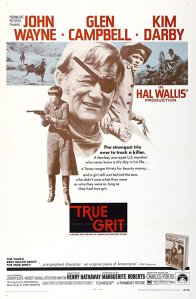
 Fifty years ago, former Arkansas Gazette reporter Charles Portis wrote a novel entitled True Grit. It is more than a work of literature, it is a work of art. In April 2018, the Oxford American will be celebrating the 50th anniversary of the publication of the novel with a series of events.
In 1969, the movie was made into a movie starring John Wayne and Arkansan Glen Campbell. Kim Darby, Robert Duvall, Dennis Hopper, Jeff Corey and Strother Martin are also in the cast. The movie was directed by Henry Hathaway, produced by Hal B. Wallis, and written by Marguerite Roberts. Wilford Brimley and Jay Silverheels are uncredited actors in the movie.
Though set in Arkansas and Oklahoma, the movie was filmed in Colorado. Elvis Presley was the first choice for the part Campbell would play. But when his manager demanded top billing (over Wayne), he was bypassed and the part went to Campbell.
The movie was nominated for two Oscars: Wayne for Best Actor and composer Elmer Bernstein and lyricist Don Black for the song “True Grit.” The latter had been sung by Campbell in the movie.
Wayne won the Oscar that night, his only win. He would reprise the character of Rooster Cogburn in the eponymously named sequel in 1975. This film, in which he co-starred with Katharine Hepburn, was his penultimate film.
In 1970, Campbell teamed up with Kim Darby again in a film written by Roberts based on a Portis book. This time it was Norwood. It also starred Joe Namath, Carol Lynley, Meredith MacRae, and Dom DeLuise. It did not repeat the success of the earlier Portis based movie.

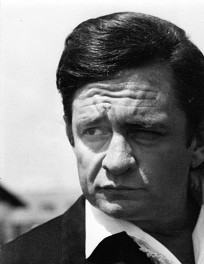 Cleveland County, Arkansas, native Johnny Cash was the subject of the Oscar winning film Walk the Line. Although he never lived in Little Rock, he was a frequent visitor throughout his career.
 Born in Little Rock, Robinson moved to Los Angeles at the age of four with her mother and two younger sisters. Ultimately, however, Robinson’s love for dance would become the catalyst for dreams even bigger than she ever dared to dream.
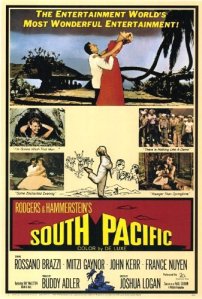 Written for the stage by Oscar winners Richard Rodgers and Oscar Hammerstein II, along with Oscar nominee Joshua Logan, in 1958 South Pacific was the fourth Rodgers and Hammerstein stage musical to make it to the Silver Screen. With the female leading character, Nellie Forbush, hailing from Little Rock, there are references to Arkansas and its capital city throughout the film.
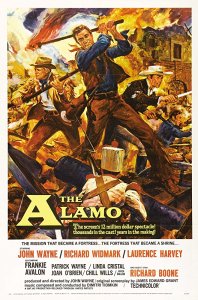 One of the early settlers in Little Rock was a man from Tennessee named Davy Crockett. He did not stay in Little Rock very long. He and several others ventured to the Republic of Texas. His final days are depicted (with more liberties than the original Texans had under Mexican control), in the film The Alamo. (While Stephen F. Austin does not appear in the movie, he was actually one of Little Rock’s founding fathers before becoming a founder of Texas.)
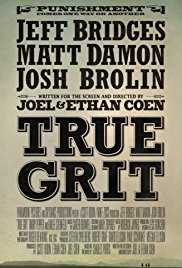 In 2010, the Coen Brothers released a new version of Charles Portis’ True Grit. (As a reminder, Portis had roots in Central Arkansas and was once a writer for the Arkansas Gazette.)
 Little Rock Culture Vulture