Little Rock Look Back: Final Saturday in May 1959 Recall Election Campaign

May 23, 1959, was a Saturday. It was also two days before the School Board recall election.  With it being a Saturday, it was the last full day for door knocking as supporters for all sides were busy trying to get out the vote.
Both sides were confident of victory.  Before a crowd of 1,000 in MacArthur Park, segregationists Rep. Dale Alford and Mississippi congressman John Bell Williams berated Harry Ashmore and the Arkansas Gazette.

STOP chair Dr. Drew Agar and campaign chair William Mitchell predicted it would be the largest turnout in Little Rock school election history.  They also stated that Gov. Faubus’ TV appearance criticizing STOP had actually pushed people over to their side.

Echoing Agar and Mitchell, the Pulaski County Election Commission predicted 30,000 of the district’s 42,000 registered voters would cast ballots.  The previous record of 27,000 had been cast in September 1958 when voters decided to keep the high schools closed.  By contrast, 14,300 voted in the December 1958 election which had selected the six school board members now on the ballot for recall.  On May 22, the final day of absentee ballot voting, 205 absentee votes had been cast bringing it to a total of 455 absentee ballots.

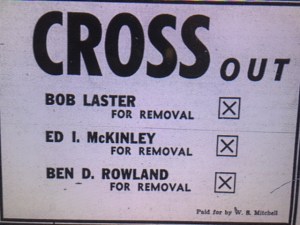
William S. Mitchell, who in addition to being a renowned attorney, apparently had a wicked sense of humor.  He used CROSS’s name against them in ads (placed throughout the newspaper) which urged voters to “Cross” out the names of the three candidates being backed by CROSS.

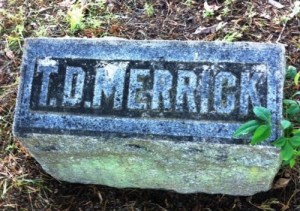
Little Rock Mayor T. D. Merrick born on May 23, 1814

_Thomas D. Merrick was born on May 23, 1814, in Hampden County, Massachusetts. He later moved to Indianapolis and Louisville before ending up in Little Rock.

On January 17, 1841, he married Anna M. Adams of Kentucky at Christ Episcopal Church in Little Rock. They had seven children: George, Annie, Ellie, Mollie, Lillian, Dwight, and Thomas.

Merrick became a prominent member of the Little Rock business community, as a merchant and cotton broker. He was involved in Freemasonry, holding the position of Grand Secretary of the Grand Lodge of Arkansas in 1845.

In 1855 Merrick entered into a business partnership with future LR Mayor John Wassell. Merrick was also involved in city politics, serving on the city council and also as mayor from January 1854 to January 1855.

He saw active service during the Civil War. On February 6, 1861, Merrick delivered an ultimatum to Captain James Totten of the United States Arsenal at Little Rock, demanding the surrender of the federal troops.  This was more than two months before Fort Sumter was attacked.

Captain Totten ignored the ultimatum. Merrick, however, did not lead an attack on the Arsenal, which would have certainly been viewed as aggression against the federal government.

Merrick also raised a regiment of Confederate Arkansas Militia, holding the rank of Colonel of Infantry at Camp Conway, near Springfield, Arkansas.  Following the Battle of Shiloh (April 1862), Merrick resigned his commission and returned to Little Rock.

Merrick died in his home in Little Rock on March 18, 1866.  He is buried in Mount Holly Cemetery.

JAWS on the big screen tonight at CALS Ron Robinson Theater

Jaws

duunnn dunnn… duuuunnnn duun… duuunnnnnnnn dun dun dun dun dun dun dun dun dun dun dunnnnnnnnnnn dunnnn

The terrifying motion picture from the terrifying No. 1 best seller – Steven Spielberg’s breakout movie Jaws will be shown at the CALS Ron Robinson Theater tonight as part of their “Movies Meant for the Big Screen” series.

Based on Peter Benchley’s bestselling book, the film starts Roy Scheider, Robert Shaw and Richard Dreyfuss.  It is, in many ways, the ultimate Summer movie — beach, action, special effects, and a hearkening back to simpler times.

The cast also includes Lorraine Gray and Murray Hamilton as well as Bruce the Shark. Spielberg’s dog at the time also made an appearance.  It also features the iconic score by John Williams. Nominated for four Academy Awards, it won three: Score, Sound and Film Editing. The only Oscar it lost was Best Picture.

Originally slated for Christmas 1974 release, the movie was so far behind schedule the release did not happen until June 20, 1975. At the time, summer was the dumping ground for movies. But based on the success of Jaws, the concept of the Summer Blockbuster was born.

Tonight’s screening starts at 7pm.  Admission is $5.

Little Rock Look Back: Plans for Arkansas Arts Center unveiled on May 22, 1961

In a dinner at the Hotel Sam Peck, plans for the new Arkansas Arts Center were unveiled on Monday, May 22, 1961.
It was estimated the project would cost $600,000. A total of $646,000 (the equivalent of $5.5 million in 2019) had been raised by the Junior League of Little Rock, Fine Arts Club, and the Board of the Museum of Fine Arts.

At the time the project was getting underway, it was one of the first types of multidisciplinary arts facilities in the United States.

Ground was broken in August 1961 and the building would open officially in May 1963 (though parts of it were already in use by December 1962).

The firm of Ginocchio, Cromwell, Carter & Neyland did the architectural design.  Pickens-Bond Construction Company was the general contractor.

The May 1961 plans featured a slight expansion of existing gallery space (which was the 1937 Museum of Fine Arts building). It included the addition of a theatre, classrooms, administrative offices, a library, and more gallery space.  While the original entrance would be kept, the main focus of the building would be shifted from 9th Street into MacArthur Park with a new south entrance.

Over the years, the building underwent several additions.  These were tacked on to the existing edifice without truly linking it into one building.  On July 1, 2019, the facility will be closed to begin the work on the re-imaging and renovation. That process will unite the existing and new spaces into one seamless structure.

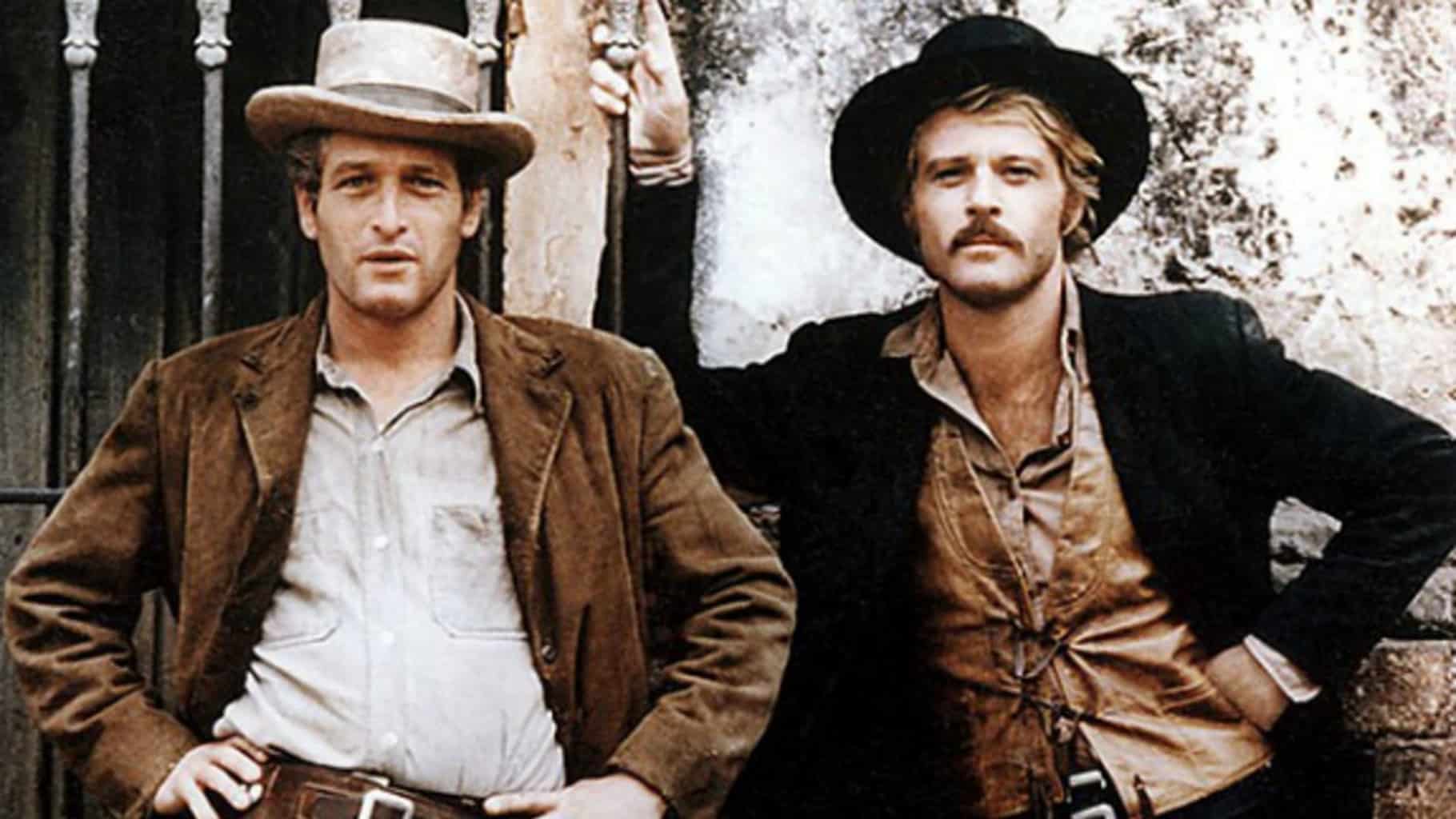
Redford, Newman and Ross light up CALS Ron Robinson Theater screen tonight with BUTCH CASSIDY AND THE SUNDANCE KID

Butch Cassidy & the Sundance Kid

As part of the CALS Ron Robinson Theater’s series of films that turn 50 in 2019, tonight (May 21) they are showing Butch Cassidy and the Sundance Kid.

Nominated for seven Oscars (and winner of four), this is the true story of fast-draws and wild rides, battles with posses, train and bank robberies, a torrid love affair and a new lease on outlaw life in far away Bolivia. It is also a character study of a remarkable friendship between Butch – possibly the most likable outlaw in frontier history – and his closest associate, the fabled, ever-dangerous Sundance Kid.

Directed by George Roy Hill, it paired Paul Newman and Robert Redford as the title characters.  Katharine Ross also starred in a cast that included Strother Martin, Henry Jones, Cloris Leachman, George Furth, Jeff Corey, and Kenneth Mars.  The screenplay was written by William Goldman.

The four Academy Awards were for Goldman’s Screenplay, Cinematography by Conrad L. Hall, Musical Score by Burt Bacharach, and Best Song by Bacharach and Hal David. The song was “Raindrops Keep Fallin’ on My Head.”

The movie starts tonight at the CALS Ron Robinson Theater at 7pm.  Admission is $5.

(In 1969, the cost to see it was probably $1.50. With inflation, that would be close to $10 today. So a $5 movie ticket is like seeing it for half price in 1969.)

176 years of Mount Holly Cemetery

Mount Holly Cemetery in January 2013.

2019 marks the 176th year of Mount Holly Cemetery in Little Rock.

The land was donated by Roswell Beebe and Chester Ashley in February 1843.  From March through October 1843, the Little Rock City Council would pass a variety of ordinances and resolutions governing the cemetery and making other provisions for it.

Though the opening day sale of lots and picnic would not take place until May 1843, the first burial appears to have been on April 8, 1843.  William Cummins was buried will full Masonic orders on that day.  The service was conducted by Little Rock’s second mayor, Rev. W. W. Stevenson.

On May 1, 1843, it became illegal to bury persons in Little Rock any location other than Mount Holly.  This ordinance had been adopted on March 7, 1843.

The prior cemetery had been at Capitol and Gaines Streets (on which a portion of the Federal Courthouse now stands). Skeletal remains have also been found at Seventh and Rock Streets, in what was probably a family burial plot.  Other small plots were in existence until action in 1834 by the Little Rock Town Council which prohibited private cemeteries.

During the Civil War and years following it, the City would establish other cemeteries and allow additional cemeteries to be created.  But the creation of Mount Holly marked another step in Little Rock’s development as a city.

From 1843 until 1877, Mount Holly was governed by a City Council Committee.  Upset by the lack of attention given to the cemetery, a group of civic leaders asked the City Council to create a separate Commission to govern the cemetery. This was done on March 20, 1877.  It was possibly the first City Board or Commission composed of non-elected officials.

By 1914, the cemetery was once again being neglected.  This time a group of Little Rock’s leading women decided it was time to band together to address it.  In June 1915, the Little Rock City Council disbanded the Cemetery Commission for Mount Holly and designated the Mount Holly Cemetery Association as the governing body.  103 years later, the ladies of the Mount Holly Cemetery Association continue this outstanding work.